Treasury looks after the company's money itself: which bank accounts it has, how much cash is on them today, how much will come in and go out in the next weeks, where surplus cash is invested, how loans are raised and how currency and interest rate risks are hedged. In SAP S/4HANA this is covered by Cash Management (bank accounts, cash position, liquidity forecast and planning) and Treasury and Risk Management (TRM) (financial transactions, hedging, risk analysis), plus payment and bank connectivity services around them. This page gives the landscape, the organization units and the integration map. Master data and tables: page 02; processes and customizing: page 03. House banks, the payment run and bank statements are taught in FICO ABAP › 03 and 05 – here they are only linked.
Part 1 – What treasury does and the key terms
A corporate treasury has three daily questions: Do we have enough cash? (cash and liquidity management), What do we do with surplus or shortage? (investments, borrowings, intercompany funding) and Which risks do we accept? (FX, interest rate, commodity, counterparty risk). The SAP answer to each question is a different component, all working on the same data in one S/4HANA system.
Term | Meaning |
|---|---|
Cash position | Today's and the next few days' balances per bank account: bank statement balances plus expected short-term flows (payments released, memo records) |
Liquidity forecast | Medium-term expected cash in- and outflows from operations: open receivables and payables, sales and purchase orders, treasury deals, forecasts |
Liquidity planning | The treasury's plan of cash flows per liquidity item for months or years, compared with actuals (plan / actual analysis) |
Liquidity item | Category of a cash flow by economic reason, e.g. receipts from customers, payments to suppliers, interest, taxes – the rows of a cash flow statement |
Financial transaction (deal) | One treasury contract with a counterparty: fixed-term deposit, loan, FX spot / forward / swap, interest rate swap, option, security purchase |
Counterparty | The bank or company on the other side of the deal – a business partner (page 02) |
Exposure | A future cash flow in foreign currency (or depending on an interest rate or commodity price) that creates a risk, e.g. a USD sales forecast of a EUR company |
Hedge / hedging relationship | A derivative (e.g. FX forward) bought to offset the risk of an exposure; for hedge accounting the link between hedged item and hedging instrument is documented |
Valuation | Revaluing positions at market prices on a key date (month-end) for the balance sheet |
Front / middle / back office | Trading (deal entry), risk control (limits, analysis, confirmations), settlement and accounting – separated for segregation of duties |
Part 2 – The S/4HANA treasury landscape
SAP groups its treasury portfolio into cash management, treasury and risk management, payments and connectivity. In SAP's cloud naming the three core blocks are SAP S/4HANA Cloud for Cash Management, SAP S/4HANA Cloud for Treasury and Risk Management and SAP S/4HANA Cloud for Advanced Payment; on-premise and in the private cloud the same functions are part of S/4HANA Finance. Around them sit services on SAP BTP or own platforms: SAP Multi-Bank Connectivity, SAP Trading Platform Integration, SAP Market Rates Management, SAP Cash Application, SAP Digital Payments and SAP Taulia (working capital: supplier and receivables financing, dynamic discounting).
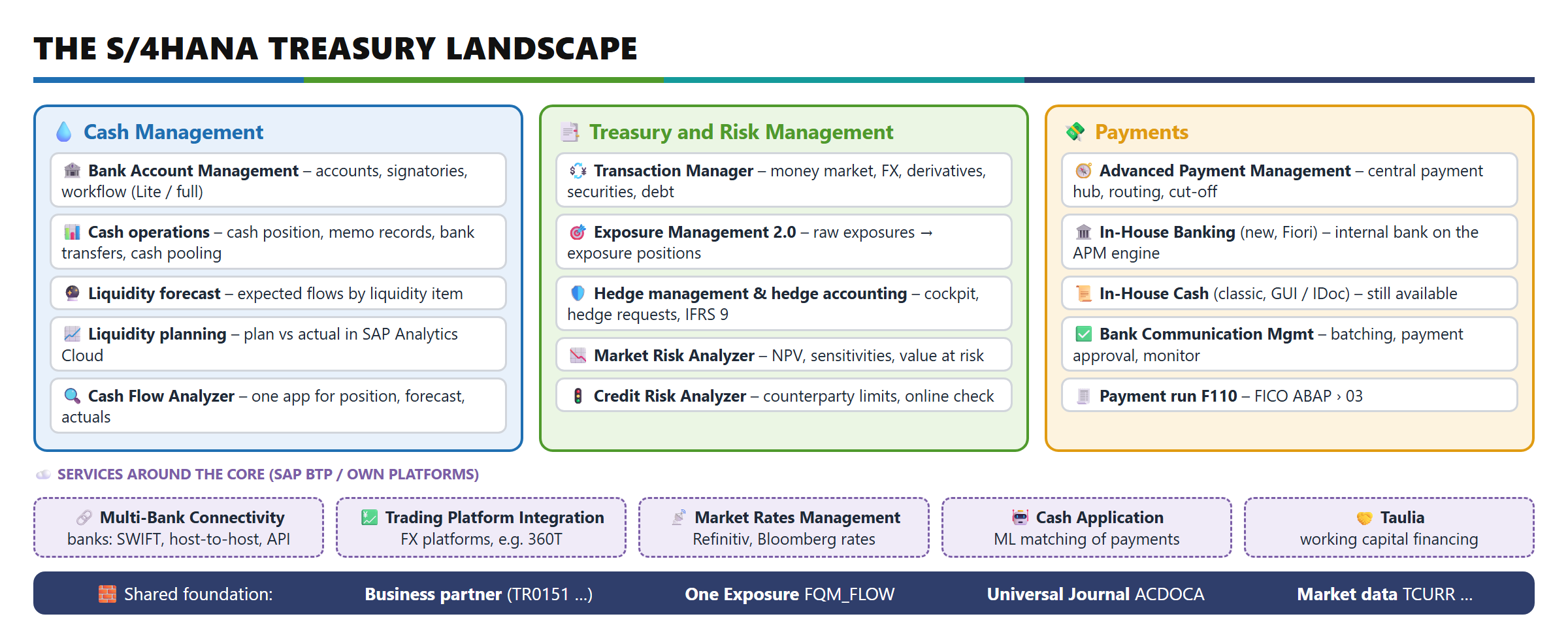
Block | Main components | Taught in detail |
|---|---|---|
Cash Management | Bank Account Management (BAM), cash operations (cash position, bank transfers, cash pooling), liquidity forecast, liquidity planning (with SAP Analytics Cloud), One Exposure from Operations | Part 3; data page 02; processes page 03 |
Treasury and Risk Management | Transaction Manager (money market, FX, securities, derivatives, debt and investment), exposure management, hedge management and hedge accounting, Market Risk Analyzer, Credit Risk Analyzer | Part 4; processes page 03 |
Payments | Advanced Payment Management (payment hub), In-House Banking / In-House Cash, Bank Communication Management (approval, monitor), payment run F110 | Part 5; F110 in FICO ABAP › 03 |
Connectivity | SAP Multi-Bank Connectivity (banks), SAP Trading Platform Integration (FX trading platforms), SAP Market Rates Management (market data) | Part 5 and page 04 |
- All blocks share the business partner, the Universal Journal (ACDOCA) for postings and the One Exposure from Operations table FQM_FLOW for cash flows (page 02).
- Licensing matters for architects: the basic cash management scope is delivered with S/4HANA; the full scope (SAP S/4HANA Finance for cash management, business function FIN_FSCM_CLM: BAM workflow, signatories, cash pools, liquidity plans) and TRM are licensed separately, so the licence scope is the first input to a solution design.
Part 3 – Cash Management
Cash Management in S/4HANA (often called new Cash Management; it replaced the classic cash position FF7A and liquidity forecast FF7B, which are legacy) answers "how much cash do we have, where, and what will happen next". It reads all flows from One Exposure in real time instead of the old totals tables.
Area | What it does | Typical apps |
|---|---|---|
Bank relationship / Bank Account Management (BAM) | Bank account master data with life cycle (open, change, close) and approval workflow, signatories and payment approval rules, overdraft limits, bank hierarchy, account review | Manage Bank Accounts, bank hierarchy |
Cash operations | Daily cash position per bank account, memo records for expected flows, bank transfers, cash pooling and cash concentration, bank statement monitoring | Cash Flow Analyzer, Cash Position, Make Bank Transfers, Manage Memo Records, Manage Cash Pools, Bank Statement Monitor |
Liquidity management | Liquidity forecast from operational data, actual cash flows by liquidity item, liquidity planning and plan / actual comparison | Liquidity Forecast, Cash Flow Analyzer, SAP Analytics Cloud planning |
3.1 Bank Account Management – basic vs full scope
Feature | Basic scope (delivered with S/4HANA) | Full scope (SAP S/4HANA Finance for cash management, FIN_FSCM_CLM) |
|---|---|---|
Bank account master data, import / export | Yes | Yes |
Approval workflow for opening, changing, closing accounts (change requests) | No | Yes |
Signatories and signatory-based payment approval | No | Yes |
Bank hierarchy and account groups, overdraft limits, periodic account review | No | Yes |
- In S/4HANA every house bank account is linked to a BAM bank account; FI12 only displays (ECC: house banks and house bank accounts T012 / T012K maintained in FI12). Details of the tables on page 02; house bank set-up in FICO ABAP › 03.
3.2 Liquidity planning and the Cash Flow Analyzer
- Cash Flow Analyzer – the central analysis app: cash position, liquidity forecast and actual cash flows by company code, bank account, liquidity item and other dimensions, read from FQM_FLOW.
- Liquidity planning – SAP's direction is planning in SAP Analytics Cloud (SAC) integrated with S/4HANA: actuals and forecasts flow from S/4HANA to SAC, the plan is built there per liquidity item and compared with actuals. The core cash management alone does not provide full planning, so an architecture that needs liquidity planning includes SAC (planning models in depth: SAP Analytics Cloud section).
- Predictive forecasting – cloud versions add machine-learning based cash forecasts on top of the same data.
Part 4 – Treasury and Risk Management
TRM manages financial instruments from deal entry to accounting and analyses their risks. Its heart is the Transaction Manager; exposure management, hedge management and the analyzers build on the same deals and market data.
Component | Scope | Example instruments / functions |
|---|---|---|
Transaction Manager – Money Market | Short-term investments and borrowings, intercompany loans | Fixed-term deposit (product type 51A), deposit at notice, commercial paper, cash flow transaction |
Transaction Manager – Foreign Exchange | Currency trades | FX spot / forward (60A), swap, non-deliverable forward (60B), OTC currency options |
Transaction Manager – Derivatives | OTC and listed derivatives | Interest rate swap (62A), cross-currency swap, FRA, caps / floors, futures, options |
Transaction Manager – Securities | Investments in stocks, bonds, funds held in security accounts | Bond purchase, coupon, redemption, corporate actions |
Debt and investment management | Long-term financing | Facilities (bilateral / syndicated), loans, bond issues |
Exposure management (Exposure Management 2.0) | Records FX and commodity exposures as raw exposures and aggregates them into exposure positions | Input for hedge management and hedge accounting |
Hedge management and hedge accounting | Plans hedges for open exposures and documents hedging relationships for IFRS 9 / US GAAP | Hedge Management Cockpit, hedge requests, designation, effectiveness, OCI postings |
Market Risk Analyzer | Measures market risk of positions | NPV, sensitivities, value at risk, scenarios and stress tests |
Credit Risk Analyzer | Controls counterparty and issuer risk | Limits per counterparty and product group, online limit check at deal entry, utilization |
- Classic TRM in ECC already used the same Transaction Manager (t-codes FTR_CREATE / FTR_EDIT). In S/4HANA it is still there, with Fiori apps, the Universal Journal and new functions (Exposure Management 2.0, Hedge Management Cockpit, trading platform integration). Page 06 lists the simplification items.
- Commodity risk (commodity derivatives, commodity exposures) is supported on the same framework; this section focuses on FX and interest rate treasury.
Part 5 – Payments, in-house banking and bank connectivity
Component | Purpose | Status |
|---|---|---|
Payment run F110 / Payment Medium Workbench | Creates outgoing payments and files (pain.001) | Core FI – FICO ABAP › 03 |
SAP Bank Communication Management (BCM) | Batching of payments, payment approval (e.g. Approve Bank Payments), bank statement monitor | On-premise / private cloud, part of S/4HANA |
Advanced Payment Management (APM) | Central payment hub / payment factory: collects payment orders from many systems and company codes, routes them, applies cut-off times and approvals, sends them to the banks | S/4HANA (separate licence); in the cloud: SAP S/4HANA Cloud for Advanced Payment |
In-House Banking (IHB) | Internal bank of the group: in-house accounts for subsidiaries, payments on behalf of, internal interest and statements; Fiori based, uses the APM payment engine | S/4HANA, released 2022, included in the APM licence; on-premise and cloud |
In-House Cash (IHC) | The older internal bank, SAP GUI and IDoc based | Still available on-premise (own licence), no new development – IHB is the strategic successor |
SAP Multi-Bank Connectivity (MBC) | Managed bank channel on SAP BTP: payment files, status messages and statements via SWIFT, host-to-host or bank APIs | Cloud service – page 04 |
- Do not repeat the F110 and bank statement mechanics in a treasury interview answer – mention them, then focus on what treasury adds: centralised payments (APM / IHB), approval with BAM signatories and visibility of the flows in the cash position.
Part 6 – Organization structure
Treasury has few organization units of its own; most come from FI. The important extra concept is the valuation area, which lets the same deal be valued under several accounting principles.
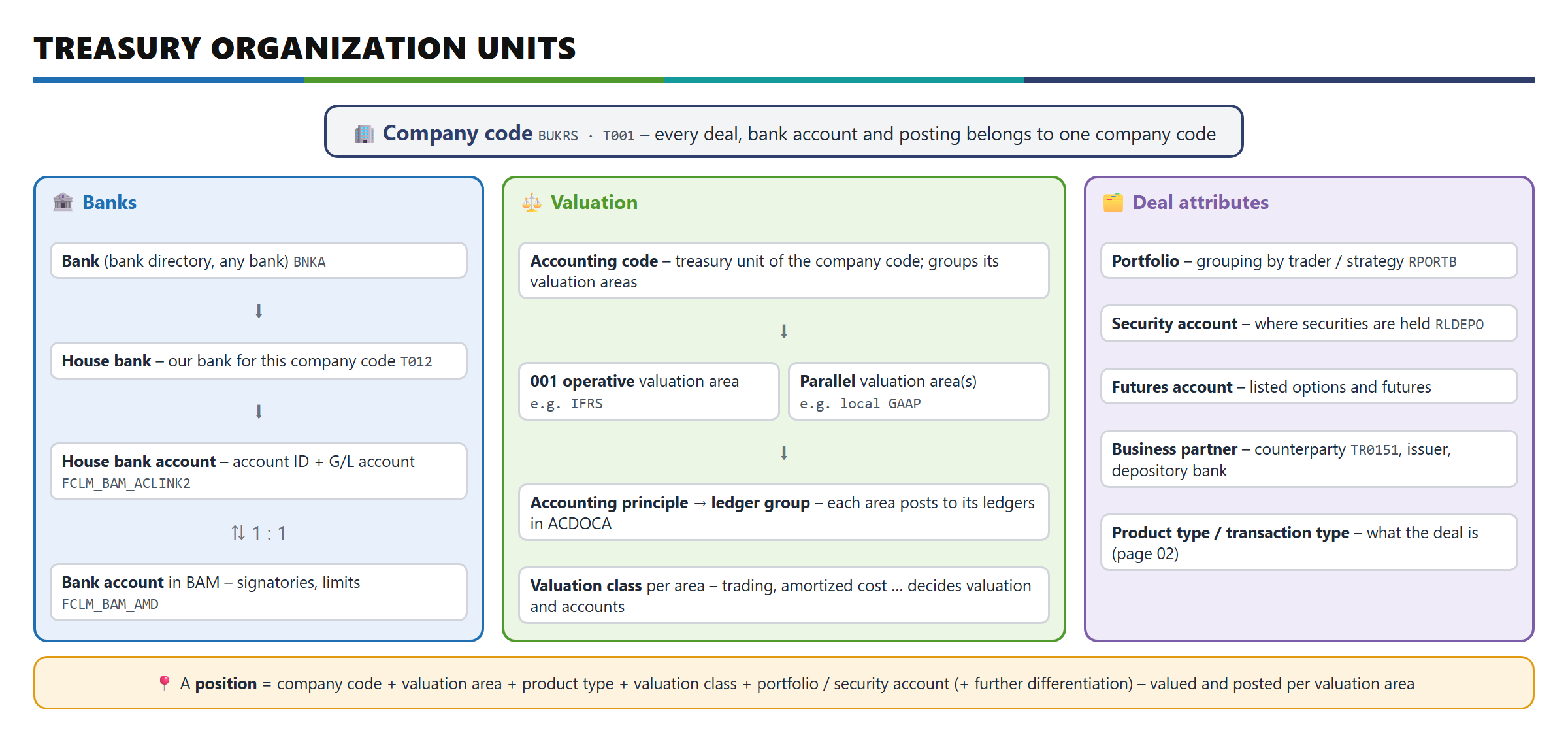
Unit / object | Meaning | Relevance |
|---|---|---|
Company code | Legal entity; every financial transaction belongs to one company code (VTBFHA-BUKRS) | Postings, cash position, BAM bank accounts |
Valuation area | One valuation per accounting principle. 001 is the operative valuation area (active by default); further valuation areas are parallel (e.g. IFRS vs local GAAP) | Valuation, accruals and postings per area; each area is assigned to an accounting principle and so to a ledger group |
Accounting code | Treasury unit assigned to a company code; groups the valuation areas used for that company code | Parallel valuation areas must be assigned to the accounting code |
Valuation class | Classifies a position per valuation area (e.g. held for trading, held to maturity / amortized cost) | Decides valuation rules and G/L accounts |
Portfolio | Organizational grouping of deals (e.g. by trader or strategy), field RPORTB | Reporting, authorizations, position differentiation |
Security account / futures account | Where securities or listed derivatives are held | Position level for securities |
Business partner | Counterparty, issuer, depository bank, payment bank – roles such as TR0151 Counterparty | Required in every deal (page 02) |
House bank / house bank account | Our bank and the account used for settlement of treasury flows | Payment details of each flow; linked to BAM |
- Bank vs house bank vs bank account: the bank is any bank in the bank directory (BNKA); a house bank is a bank where our company code has accounts (T012); the bank account is the real account managed in BAM, and the house bank account (account ID) is its link into FI with the G/L account. One BAM bank account is linked to one house bank account.
- Position management: deals and securities are kept as positions per valuation area. A position is identified by company code, valuation area, product type, valuation class, portfolio or security account and other differentiation terms (page 02).
Part 7 – Integration map and deployment options
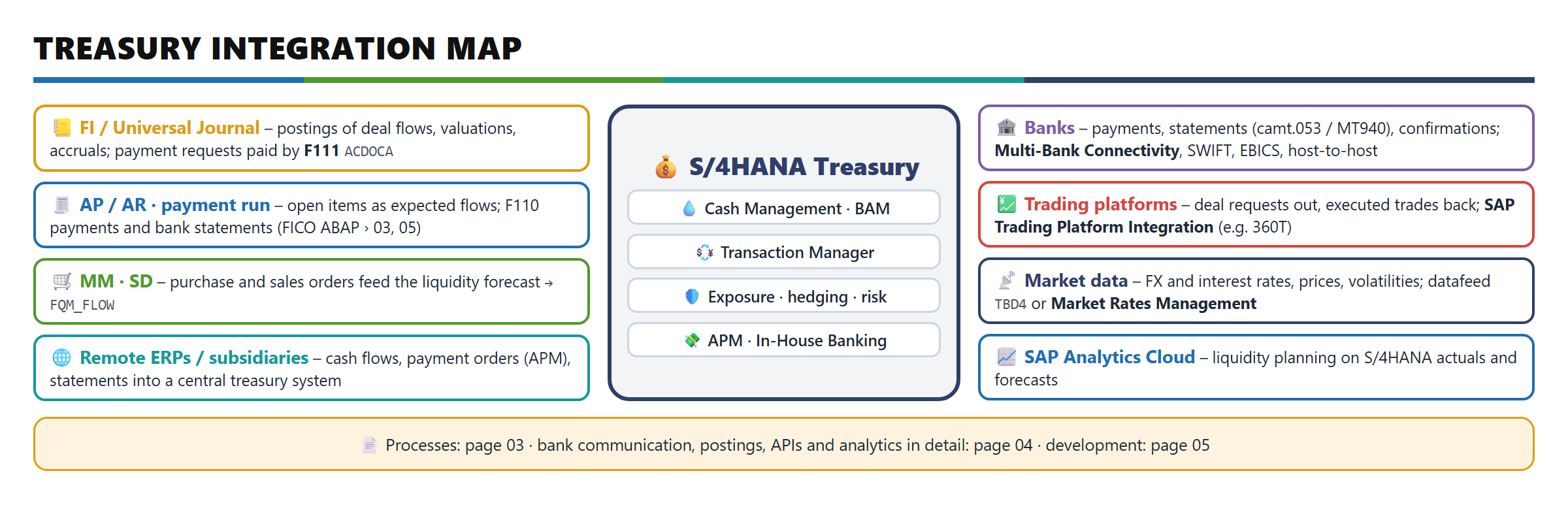
Partner | Direction | What flows |
|---|---|---|
FI / Universal Journal | TRM → FI | Postings of deal flows, valuations, accruals; payment requests paid by F111 (page 03) |
AP, AR, MM, SD | → Cash Management | Open items, purchase / sales orders as expected cash flows in One Exposure (liquidity forecast) |
Banks | ↔ | Payments and statements (camt.053 / MT940), FX and money market confirmations; channel MBC, EBICS, SWIFT, host-to-host (page 04) |
Trading platforms (e.g. 360T) | ↔ | Deal requests out, executed trades back as financial transactions – SAP Trading Platform Integration |
Market data providers (e.g. Refinitiv, Bloomberg) | → TRM | Exchange rates, interest rates, security prices, volatilities via datafeed (TBD4) or SAP Market Rates Management |
SAP Analytics Cloud | ↔ | Actuals and forecasts for liquidity planning, plan back for comparison |
Remote / subsidiary systems | → | Cash flows from other ERPs into One Exposure; payment orders into APM; bank statements into the central system |
7.1 Deployment options
Option | How it looks | When chosen |
|---|---|---|
Embedded (one S/4HANA) | Cash management and TRM in the same S/4HANA as FI, MM, SD | Most greenfield projects; real-time operational data in the cash position |
Central treasury system (treasury workstation / side-car) | A separate S/4HANA for treasury, connected to several ERPs (also ECC) of the subsidiaries | Many ERPs, treasury moves to S/4HANA before the full ERP migration, central treasury organization |
S/4HANA Cloud, public edition | SAP S/4HANA Cloud for Cash Management / for Treasury and Risk Management / for Advanced Payment with released scope | Standardised processes, clean core |
S/4HANA Cloud, private edition / on-premise | Full scope including classic transactions and custom extensions | Complex instruments, existing TRM, heavy extensions |
- Architect checklist: one or many treasury systems, which bank channel (MBC vs own SWIFT / EBICS), where payments run (local ERPs vs APM payment hub), which accounting principles (valuation areas), SAC for planning, market data source. Editions and design decisions in depth: page 06.
Part 8 – Interview questions
Q1. What are the main components of treasury in SAP S/4HANA?
Cash Management (Bank Account Management, cash operations, liquidity forecast and planning), Treasury and Risk Management (Transaction Manager, exposure and hedge management, hedge accounting, Market and Credit Risk Analyzer) and payments (Advanced Payment Management, In-House Banking, BCM), plus BTP services such as Multi-Bank Connectivity, Trading Platform Integration and Market Rates Management.
Q2. What is the difference between cash position and liquidity forecast?
The cash position shows short-term balances per bank account (statements, released payments, memo records). The liquidity forecast shows medium-term expected flows from operations (open items, orders, treasury deals) by liquidity item. Both read FQM_FLOW and are analysed in the Cash Flow Analyzer.
Q3. What is Bank Account Management and how does the basic scope differ from full BAM?
BAM keeps the bank accounts as master data with life cycle. The basic scope (delivered with S/4HANA) has the master data and import / export; full BAM adds change-request workflow, signatories and signatory-based payment approval, bank hierarchy, overdraft limits and account review.
Q4. What does the Transaction Manager cover?
The life cycle of financial transactions – money market, foreign exchange, derivatives, securities and debt / investment – from trading (FTR_CREATE) through back-office settlement to accounting (posting, valuation, accruals) and maturity.
Q5. What is a valuation area?
A treasury unit that values positions for one accounting principle. Area 001 is the operative valuation area; parallel areas (e.g. local GAAP) value the same deals differently and post to their ledger group. Valuation areas are grouped per company code by the accounting code.
Q6. What is the difference between a house bank and a bank account in BAM?
The house bank (T012) is our bank for a company code; the bank account is the real account in BAM (FCLM_BAM_AMD) with signatories and limits; the house bank account (account ID, G/L account) links it to FI. One BAM account is linked to one house bank account.
Q7. What is In-House Banking and how is it related to In-House Cash and APM?
In-House Banking (2022) is the Fiori-based internal bank: in-house accounts for subsidiaries, payments on behalf of, internal interest. It runs on the Advanced Payment Management engine and licence. In-House Cash is the older SAP GUI / IDoc solution, still available but not developed further.
Q8. How does liquidity planning work in S/4HANA?
Actuals and forecasts per liquidity item come from S/4HANA (One Exposure) and are planned in SAP Analytics Cloud, where plan and actual are compared. Core cash management alone gives forecast and actuals but not full planning.
Q9. Which systems does treasury integrate with?
FI (postings, payments), MM / SD / AP / AR (expected cash flows), banks (MBC, EBICS, SWIFT), trading platforms (Trading Platform Integration), market data providers (datafeed, Market Rates Management), SAC (planning) and remote subsidiary systems.
Q10. Embedded treasury or a central treasury system – how do you decide?
Embedded when one S/4HANA holds the operational data and the treasury is part of that company. A central treasury system (side-car / treasury workstation) when many ERPs feed one treasury, when treasury must move to S/4HANA before the ERPs, or when the treasury is a separate organization.
Q11. Why is the business partner important in treasury?
Every financial transaction needs a counterparty (role TR0151) with authorizations and standing instructions such as payment details; issuers, depository banks and payment banks are partners too. Credit Risk Analyzer limits are also set per business partner.
Q12. Which old cash management reports are legacy in S/4HANA?
The classic cash position FF7A, liquidity forecast FF7B and the Liquidity Planner. They are replaced by the new Cash Management apps reading One Exposure (FQM_FLOW); the classic totals tables are no longer used.
🏠 Start Here · 02 · Master Data ▶ · Sections: CORE ABAP | OOPS ABAP | ABAP on HANA | Clean Core | RAP | ABAP Points | SAP Fiori | SAPUI5 | Mobile Development (MDK) | BTP Foundations | BTP Development | CAP | SAP Build | ABAP on BTP | Integration Suite | SAP Business AI | SAP BASIS | Security | SAP SDLC
Functional: FICO ABAP | TRM ABAP | VIM | SAP BIS | SD ABAP | MM ABAP | PP ABAP | QM ABAP | PM ABAP | PS ABAP | EWM | TM ABAP | GTM ABAP | EHS ABAP | HR ABAP | BW | SAP Datasphere | SAP Business Data Cloud | SAP MDG | SAP Analytics Cloud | SAP Ariba | SAP CX | SAP IBP