The database tables an ABAP developer reads every day, grouped by area: repository and system tables, then SD, MM, FI/CO, business partner and HR. Each entry says what one row holds. Items marked S/4HANA are new or changed in S/4HANA; legacy items still exist in ECC (and often as a compatibility view in S/4HANA), with their successor named. Rule of thumb in S/4HANA: in classic ABAP you may still SELECT from these tables, but in ABAP Cloud you read the released CDS views instead (see ABAP on HANA › 05 CDS Views; clean core: Clean Core › 01 Clean Core).
Part 1 – Finding tables and naming patterns
1.1 How to find the table behind a screen field
- F1 → Technical Information (wrench icon) on the field: shows table/structure and field name. If it shows a screen structure (e.g. RV45A), keep looking with the next methods.
- ST05 SQL trace: switch on, run the transaction, switch off – the trace lists every table read or written.
- SE11 / SE84 where-used on the data element of the field: lists all tables that use it.
- SE16N / SE16H to browse contents; SE11 → Display for fields, keys, foreign keys and the text table.
- In S/4HANA also look for the CDS view (ADT: search
I_*views, or the Fiori app *View Browser*).
1.2 Naming patterns
Prefix | Area | Examples |
|---|---|---|
KN | Customer master | KNA1, KNB1, KNVV, KNVP |
LF | Vendor (supplier) master | LFA1, LFB1, LFM1, LFBK |
MA / MB / MV / MC | Material master | MARA, MAKT, MARC, MARD, MARM, MBEW, MVKE, MCHA |
VB | Sales and billing documents | VBAK, VBAP, VBEP, VBKD, VBPA, VBFA, VBRK, VBRP |
LI | Deliveries | LIKP, LIPS |
VT | Shipments | VTTK (header), VTTP (items) |
EK / EB | Purchasing | EKKO, EKPO, EKET, EKBE, EKKN, EBAN |
MK / MS | Material documents (legacy) | MKPF, MSEG → MATDOC in S/4HANA |
BK / BS | Accounting documents | BKPF, BSEG, BSIS, BSID, BSIK |
T… | Customizing and settings | T001, T001W, T001L, TVAK, T156 |
DD… | ABAP Dictionary (metadata) | DD02L, DD03L, DD04L, DD07L |
E07… | Transport requests | E070, E071, E07T |
AGR_ / USR | Roles and users | AGR_USERS, AGR_1251, USR02 |
CD… | Change documents | CDHDR, CDPOS |
ED… | IDocs and partner profiles | EDIDC, EDID4, EDIDS, EDP13, EDP21 |
BUT | Business partner | BUT000, BUT020, BUT050, BUT100 |
PA / HRP / PCL | HR infotypes, OM objects, clusters | PA0001, HRP1000, PCL2 |
A + number | Pricing condition tables | A004, A305 (key combinations of condition records) |
Z / Y | Customer tables | ZSALES_LOG (customer namespace) |
- Suffix T usually means text table (language-dependent texts): MAKT, TSTCT, DD02T, SKAT, CSKT.
- A1 usually means general data (KNA1, LFA1, SKA1), B1 company-code data (KNB1, LFB1, SKB1).
Part 2 – ABAP repository and system tables
2.1 Repository objects
Table | One row holds |
|---|---|
TADIR | Directory of repository objects: object type + name → package (DEVCLASS), author, original system |
TDEVC | Packages (development classes) |
TRDIR | Program attributes: type (1 report, M module pool, F function group, I include …), author, dates |
TRDIRT | Program titles |
REPOSRC | Program source code (compressed) – read with |
TFDIR | Function modules: name → function group program, include number, RFC flag |
TFTIT | Function module short texts |
ENLFDIR | Function module → function group |
TSTC | Transaction codes: t-code → program, screen (or class/method) |
TSTCT | Transaction code texts |
TSTCP | Parameters of parameter / variant transactions |
SEOCLASS | Global classes and interfaces (SE24) |
SEOCLASSTX | Class / interface short texts |
SEOCOMPO | Class components: attributes, methods, events |
SEOMETAREL | Class relations: superclass, implemented interfaces |
DDDDLSRC | S/4HANA / 7.40+: CDS DDL source code |
DDLDEPENDENCY | S/4HANA / 7.40+: CDS DDL source → generated objects (entity, SQL view) |
D010TAB | Which tables a program uses (where-used index) |
2.2 ABAP Dictionary (DDIC metadata)
Table | One row holds |
|---|---|
DD01L / DD01T | Domains / domain texts |
DD02L / DD02T | Tables and structures (class TRANSP, INTTAB, VIEW …) / their short texts |
DD03L | Table and structure fields (position, data element, key flag) |
DD04L / DD04T | Data elements / their texts and field labels |
DD07L / DD07T | Domain fixed values / their texts |
DD08L | Foreign key relationships |
DD09L | Technical settings (data class, size category, buffering) |
DD12L | Secondary indexes |
DD40L | Table types |
2.3 Transports
Table | One row holds |
|---|---|
E070 | Header of a request or task: TRKORR, type, status (D modifiable, R released), owner; STRKORR = parent request of a task |
E071 | Object entries of a request/task: PGMID, object type, object name |
E071K | Table key entries (customizing contents in a request) |
E07T | Request / task short texts |
2.4 Messages, variants, numbers, jobs, logs
Table | One row holds |
|---|---|
T100 | Message texts: language, message class, number, text |
T100A | Message classes |
TVARVC | Selection variables for variants (STVARV) – client-specific |
VARID / VARIT | Report variants (directory) / variant texts |
TPARA | SET/GET parameter IDs |
NRIV | Number range intervals with the current number level |
TNRO | Number range objects (SNRO) |
TBTCO | Background job header and status (SM37) |
TBTCP | Background job steps: program, variant |
APQI | Batch input sessions (SM35) |
BALHDR / BALDAT | Application log header / data (SLG1) |
SNAP | Short dumps (ST22) |
TSP01 | Spool requests (SP01) |
RFCDES | RFC destinations (SM59) |
2.5 Change documents, texts, output, IDocs, workflow
Table | One row holds |
|---|---|
CDHDR | Change document header: object class, object key, change number, user, date, t-code |
CDPOS | Change document items: table, field, old value, new value |
STXH | Long text header (SAPscript texts): object, name, ID, language |
STXL | Long text lines (compressed) – read with READ_TEXT, never with SELECT |
NAST | Output (message control) records: application, object key, output type, status |
TNAPR | Processing program, form routine and form per output type (NACE) |
APOC_D_OR_ROOT | S/4HANA output management: output requests |
EDIDC | IDoc control record: number, message type, IDoc type, partner, direction, status |
EDID4 | IDoc data records (segments) |
EDIDS | IDoc status records (history) |
EDP13 / EDP21 | Partner profiles: outbound / inbound parameters (WE20) |
SWWWIHEAD | Workflow work item header |
SWWUSERWI | Work items per user (current agents) |
2.6 Users, roles, clients and global settings
Table | One row holds |
|---|---|
USR02 | User logon data: user type, lock status, validity, last logon |
USR05 | User parameters (SET/GET parameter values per user) |
USR21 | User → person and address number (name in ADRP, e-mail in ADR6) |
AGR_DEFINE | Role definitions (PFCG) |
AGR_USERS | Role → user assignments with validity |
AGR_1251 | Authorization values in roles: object, field, low/high |
AGR_TCODES | Transactions in roles |
AGR_AGRS | Composite role → single roles |
TOBJ | Authorization objects (SU21) |
T000 | Clients (SCC4) |
T002 | Languages |
T005 | Countries |
T006 | Units of measure |
TCURC / TCURR | Currency codes / exchange rates |
Part 3 – SD: sales, delivery, billing
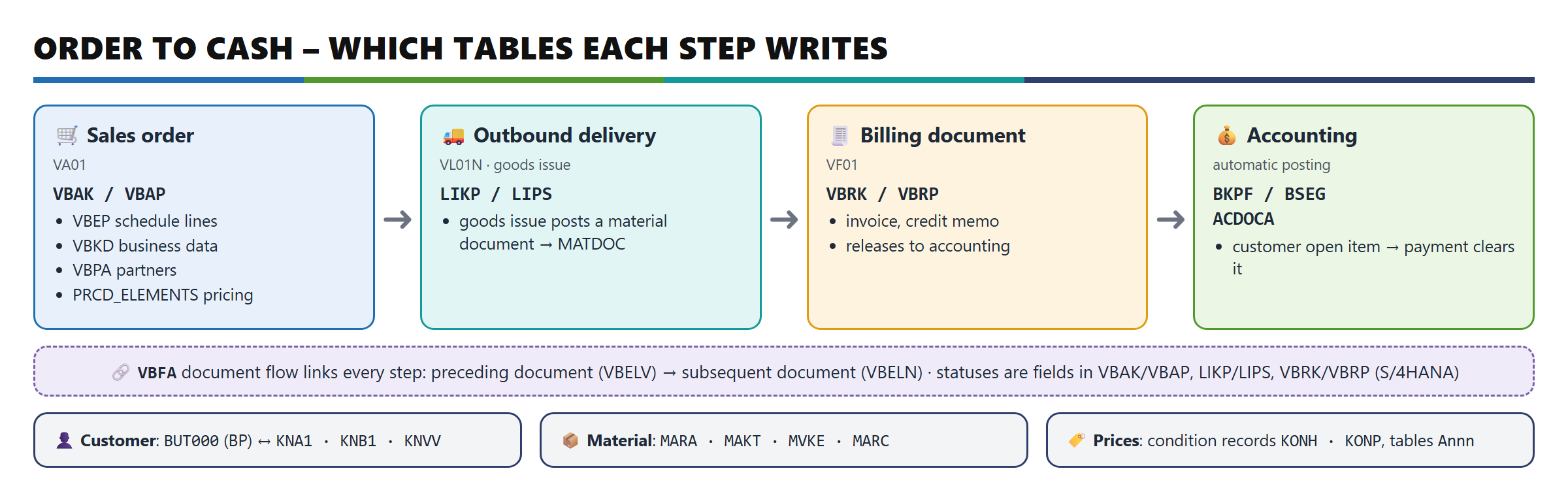
Table | One row holds | S/4HANA note |
|---|---|---|
KNA1 | Customer general data | Customer is a business partner (Part 6); KNA1 kept via CVI |
KNB1 | Customer company code data (reconciliation account, payment terms) | |
KNVV | Customer sales area data (sales org, channel, division) | |
KNVP | Customer partner functions (sold-to, ship-to, bill-to, payer) | |
VBAK | Sales document header (order, quotation, contract) | Now also holds header status |
VBAP | Sales document item | Now also holds item status |
VBEP | Schedule lines (quantities and dates) | |
VBKD | Business data (pricing date, payment terms, Incoterms, customer PO) | |
VBPA | Partners of a sales, delivery or billing document | |
VBFA | Document flow: preceding → subsequent document | Simplified |
VBUK / VBUP | Header / item status (legacy) | Removed – status fields in VBAK/VBAP, LIKP/LIPS, VBRK |
LIKP / LIPS | Delivery header / item | |
VTTK / VTTP | Shipment header / items | |
VBRK / VBRP | Billing document header / item | |
KONV | Pricing conditions of documents (legacy) | Replaced by PRCD_ELEMENTS |
KONH / KONP | Condition records header / item (prices, discounts) | |
Annn (A004 …) | Condition tables: key combination → condition record number | |
TVAK | Sales document types | |
TVKO | Sales organizations |
- Read the document flow with VBFA: VBELV/POSNV = preceding document and item, VBELN/POSNN = subsequent, VBTYP_N = category of the subsequent document (J delivery, M invoice …).
Part 4 – MM: material, purchasing, inventory
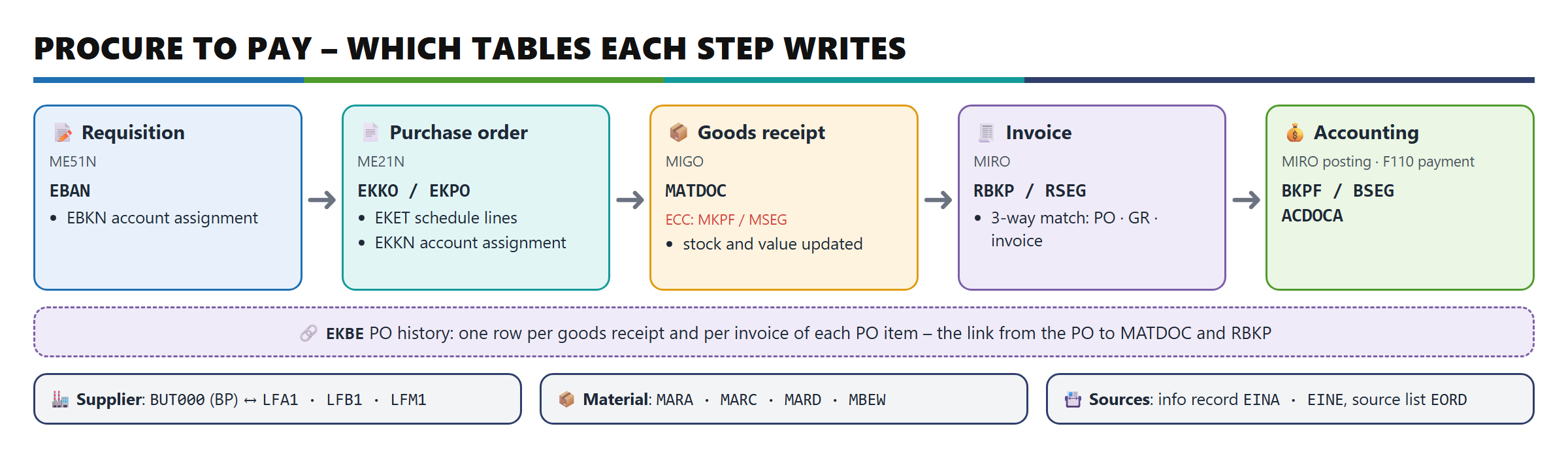
Table | One row holds | S/4HANA note |
|---|---|---|
MARA | Material general data | Called *product*; MATNR is 40 characters |
MAKT | Material descriptions (per language) | |
MARC | Material plant data (MRP, procurement) | |
MARD | Material storage location data and stock | Stock is calculated from MATDOC |
MARM | Units of measure of a material | |
MVKE | Material sales data (sales org, channel) | |
MBEW | Material valuation (price control, price, stock value) | Material Ledger is mandatory |
MCHA / MCHB | Batches / batch stock | |
T134 | Material types | |
LFA1 | Vendor general data | Supplier is a business partner; LFA1 kept via CVI |
LFB1 | Vendor company code data | |
LFM1 | Vendor purchasing organization data | |
EINA / EINE | Purchasing info record general / org data | |
EORD | Source list | |
EBAN | Purchase requisition items | |
EKKO | Purchasing document header (PO, contract, scheduling agreement) | |
EKPO | Purchasing document item | |
EKET | PO schedule lines (delivery dates) | |
EKKN | PO account assignment (cost center, WBS …) | |
EKBE | PO history: goods receipts and invoices per item | |
MKPF / MSEG | Material document header / item (legacy) | Replaced by MATDOC |
MATDOC | S/4HANA: material document header + item in one table | New |
RBKP / RSEG | Supplier invoice header / item (MIRO) | |
T001W | Plants | |
T001L | Storage locations | |
T024 / T024E | Purchasing groups / purchasing organizations | |
T156 | Movement types |
- Old aggregate stock tables (MARD, MCHB stock fields …) are read through compatibility CDS views in S/4HANA, so a SELECT still returns stock – but it is computed from MATDOC, so avoid it in loops.
Part 5 – FI/CO: accounting and controlling
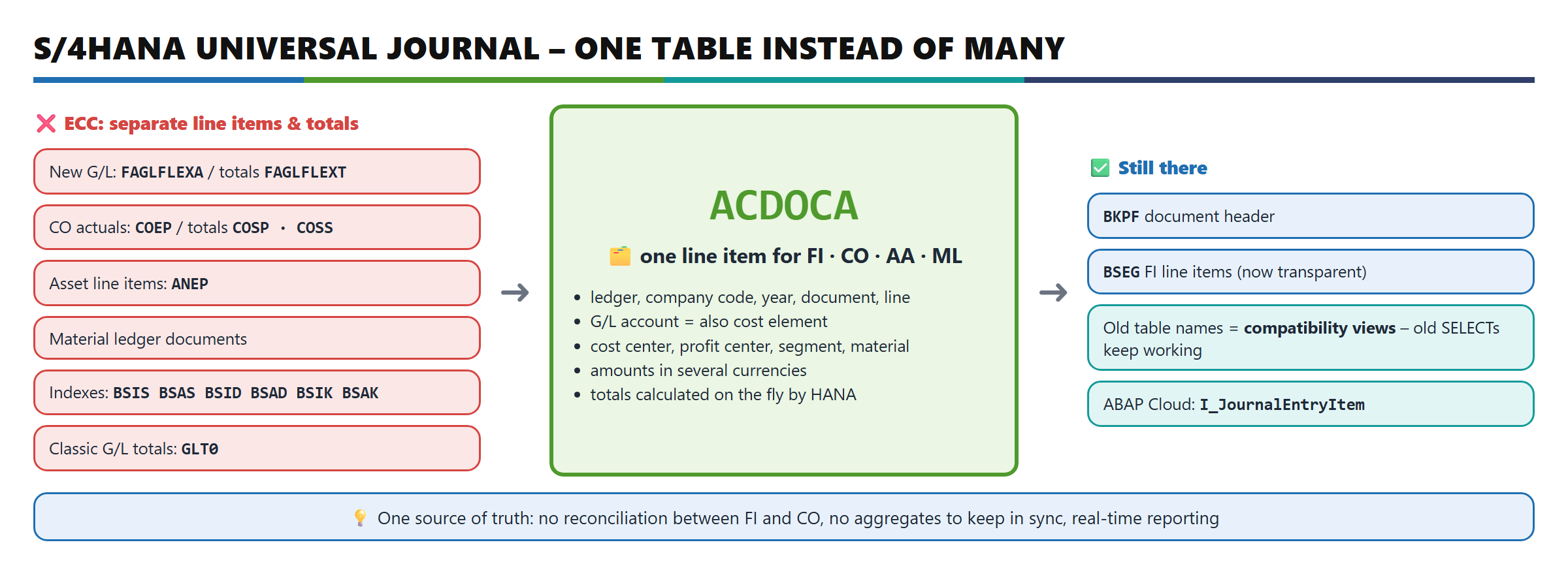
Table | One row holds | S/4HANA note |
|---|---|---|
T001 | Company codes | |
T004 | Charts of accounts | |
SKA1 / SKAT | G/L account (chart of accounts level) / texts | Also cost elements now |
SKB1 | G/L account company code data | |
T003 | Accounting document types | |
BKPF | Accounting document header | Kept |
BSEG | Accounting document line items (FI view) | Kept; transparent (was a cluster table) |
ACDOCA | S/4HANA: universal journal – one line item for FI, CO, AA, ML | New, the single source of truth |
BSIS / BSAS | G/L open / cleared items index (legacy) | Compatibility views |
BSID / BSAD | Customer open / cleared items index (legacy) | Compatibility views |
BSIK / BSAK | Vendor open / cleared items index (legacy) | Compatibility views |
FAGLFLEXA / FAGLFLEXT | New G/L line items / totals (legacy) | → ACDOCA / compatibility views |
COEP | CO line items (legacy for actuals) | Actuals → ACDOCA |
TKA01 | Controlling areas | |
CSKS / CSKT | Cost center master / texts | |
CSKA / CSKB | Cost elements (legacy) | Cost elements are G/L accounts (SKA1/SKB1) |
CEPC / CEPCT | Profit center master / texts | |
AUFK | Order master (internal orders, production orders) | |
PROJ / PRPS | Project definitions / WBS elements | |
ANLA | Asset master | |
ANEP | Asset line items (legacy) | → ACDOCA |
BNKA | Bank master | |
T012 | House banks | |
T030 | Automatic account determination |
- ACDOCA key fields: RLDNR (ledger), RBUKRS (company code), GJAHR (fiscal year), BELNR (document), DOCLN (line). It carries account, cost center, profit center, segment, material, amounts in several currencies.
Part 6 – Business partner and addresses
In S/4HANA every customer and supplier is created as a business partner (transaction BP). CVI (Customer/Vendor Integration) keeps the classic KNA1/LFA1 records in sync.
Table | One row holds |
|---|---|
BUT000 | Business partner general data (number, category person/organization/group, name) |
BUT020 | Business partner → address numbers |
BUT050 | Business partner relationships (e.g. contact person of) |
BUT100 | Business partner roles (e.g. FLCU01 customer, FLVN01 supplier) |
BUT0ID | Identification numbers (tax and other IDs) |
BUT0BK | Bank details |
ADRC | Addresses (central address management) – used by BP, customer, vendor, plant … |
ADR2 / ADR6 | Telephone numbers / e-mail addresses |
CVI_CUST_LINK | Business partner GUID → customer number |
CVI_VEND_LINK | Business partner GUID → vendor number |
Part 7 – HR (short)
Table | One row holds |
|---|---|
PA0000 | Infotype 0000 Actions |
PA0001 | Infotype 0001 Organizational assignment |
PA0002 | Infotype 0002 Personal data |
PA0008 | Infotype 0008 Basic pay |
HRP1000 / HRP1001 | OM objects / relationships |
PCL1 / PCL2 | HR clusters (PCL2 holds payroll results) |
T512T | Wage type texts |
- Details: HR ABAP › 02 Infotypes & Personnel Administration and 05 Payroll & Time Data – Clusters.
Part 8 – What changed in S/4HANA
S/4HANA removed redundant tables (aggregates, indexes, status tables) because SAP HANA can calculate them on the fly. Most removed tables survive as compatibility CDS views with the same name, so old SELECTs still work – but new code should use the new table or, better, a released CDS view.
ECC | S/4HANA | Released CDS view (ABAP Cloud) |
|---|---|---|
MKPF / MSEG | MATDOC | I_MaterialDocumentHeader_2 / I_MaterialDocumentItem_2 |
FAGLFLEXA, COEP (actuals), ANEP … | ACDOCA (universal journal) | I_JournalEntryItem |
GLT0, FAGLFLEXT, COSP, COSS (totals) | Calculated from ACDOCA (compatibility views) | I_JournalEntryItem |
BSIS/BSAS, BSID/BSAD, BSIK/BSAK | Compatibility views on BSEG / ACDOCA | I_OperationalAcctgDocItem |
BSEG (cluster table) | BSEG transparent, still filled | I_JournalEntryItem |
KONV | PRCD_ELEMENTS | – |
VBUK / VBUP | Status fields in VBAK/VBAP, LIKP/LIPS, VBRK | I_SalesOrder / I_SalesOrderItem |
Index tables VAKPA, VAPMA … | Removed – read VBAK/VBAP | I_SalesOrderItem |
KNA1 / LFA1 maintained directly | Business partner BUT000 + CVI | I_BusinessPartner, I_Customer, I_Supplier |
CSKA / CSKB cost elements | G/L accounts (SKA1/SKB1) with a type | I_GLAccountInCompanyCode |
MATNR 18 characters | MATNR 40 characters | I_Product |
NAST output control | Output management (APOC_D_OR_ROOT); NAST still possible | – |
KNKK credit limits | SAP Credit Management (UKMBP_CMS_SGM) | – |
- Interview line: "In S/4HANA the data model is simplified: one universal journal ACDOCA for finance, one MATDOC for inventory, no status, index or aggregate tables – HANA calculates them on the fly."
- Custom code: SELECTs on removed tables are flagged by the ATC S/4HANA readiness checks (see ABAP on HANA › 02 Migration to S/4HANA).
Part 9 – Interview questions
Which tables hold sales order, delivery and billing data?
Sales order VBAK/VBAP (+ VBEP schedule lines, VBKD business data, VBPA partners), delivery LIKP/LIPS, billing VBRK/VBRP. VBFA links them as document flow.
What is ACDOCA and which tables did it replace?
The universal journal of S/4HANA: one line-item table for FI, CO, asset accounting and the material ledger. It replaced FAGLFLEXA, actual COEP, ANEP, the totals tables and the BSIS/BSID/BSIK index tables (those remain as compatibility views). BKPF and BSEG still exist.
What replaced MKPF and MSEG?
MATDOC – one table for material document header and items. Stock quantities are calculated from MATDOC; the old aggregate tables are compatibility views.
Where are VBUK/VBUP and KONV in S/4HANA?
VBUK/VBUP are gone: the status fields moved into the header and item tables (VBAK/VBAP, LIKP/LIPS, VBRK). KONV was replaced by PRCD_ELEMENTS.
How do you find all objects in a transport request?
E070 gives the request and its tasks (task rows point to the request through STRKORR), E071 the objects in each request/task, E071K the table keys, E07T the description.
How do you find the table of a field on a screen?
F1 → Technical Information; if it shows a screen structure, run an ST05 SQL trace or use the where-used list of the data element in SE11.
How are customers and vendors stored in S/4HANA?
As business partners (BUT000, BUT020 addresses, BUT100 roles). CVI keeps KNA1/KNB1/KNVV and LFA1/LFB1/LFM1 in sync; CVI_CUST_LINK and CVI_VEND_LINK map BP to customer/vendor numbers.
How do you read long texts and change history?
Long texts: STXH/STXL, but read them with READ_TEXT (STXL is compressed). Change history: CDHDR (header) and CDPOS (old and new field values).
Why should ABAP Cloud code not SELECT from VBAK or ACDOCA?
SAP tables are not released APIs and may change. ABAP Cloud allows only released objects, so you read the released CDS views (I_SalesOrder, I_JournalEntryItem …), which stay stable across upgrades.
🏠 T-Codes · FMs, Classes & Programs ▶ · Sections: CORE ABAP | OOPS ABAP | ABAP on HANA | Clean Core | RAP | ABAP Points | SAP Fiori | SAPUI5 | Mobile Development (MDK) | BTP Foundations | BTP Development | CAP | SAP Build | ABAP on BTP | Integration Suite | SAP Business AI | SAP BASIS | Security | SAP SDLC
Functional: FICO ABAP | TRM ABAP | VIM | SAP BIS | SD ABAP | MM ABAP | PP ABAP | QM ABAP | PM ABAP | PS ABAP | EWM | TM ABAP | GTM ABAP | EHS ABAP | HR ABAP | BW | SAP Datasphere | SAP Business Data Cloud | SAP MDG | SAP Analytics Cloud | SAP Ariba | SAP CX | SAP IBP