EHS (Environment, Health and Safety) in SAP S/4HANA protects the people, assets and environment of a company and keeps its products legal. It is really two product families in one system: SAP S/4HANA for EHS (incidents, risk assessment, environmental compliance, management of change) and SAP S/4HANA for product compliance (product marketability, safety data sheets, dangerous goods, substance volume tracking). This page explains the scope, how the S/4HANA architecture differs from classic EHS on ECC, how the organization is modelled with locations, how EHS integrates and which editions offer what. Master data and tables: page 02; processes and customizing: page 03; integration and analytics: page 04; development: page 05; architect view: page 06.
Part 1 – What EHS covers in SAP S/4HANA
EHS belongs to the supply chain / manufacturing line of business. Its users are safety managers, incident managers, industrial hygienists, environmental managers and product stewards – but every employee can report an incident from the Fiori launchpad or a mobile device.
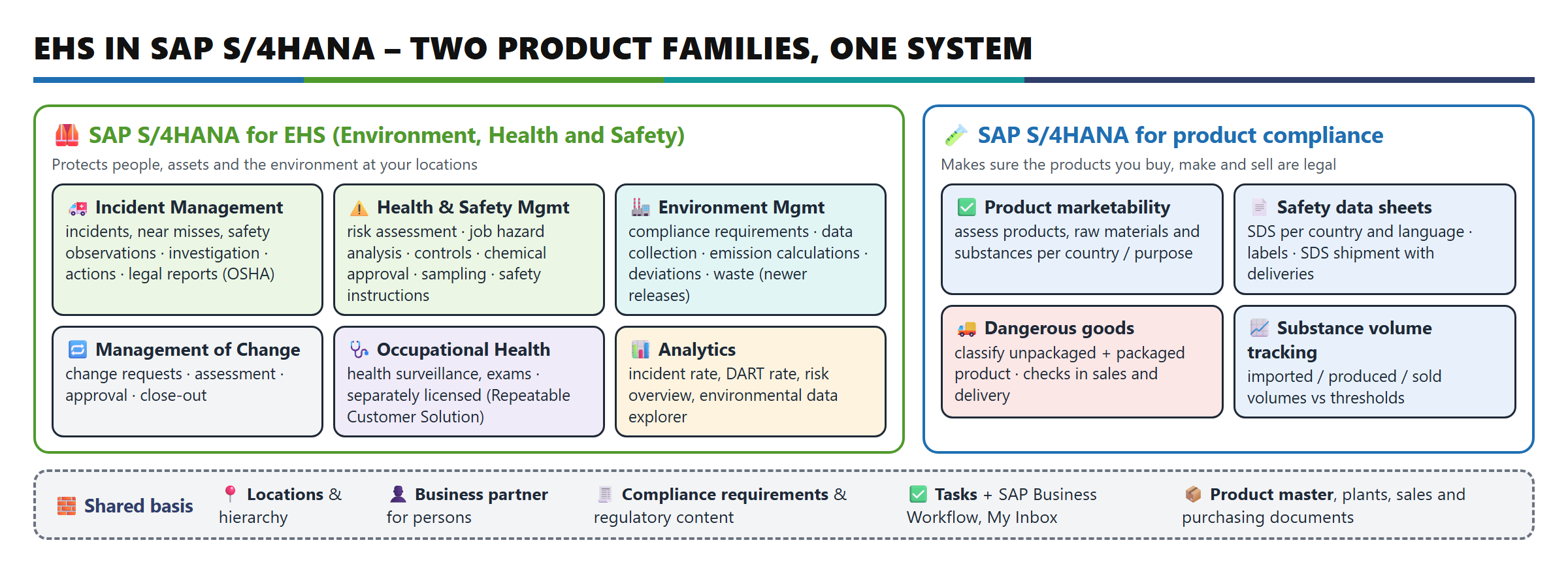
1.1 SAP S/4HANA for EHS
Area | What it does | Main business objects |
|---|---|---|
Incident Management | Records incidents, near misses and safety observations; investigation with root causes; corrective and preventive actions; financial tracking; legal reports to authorities and insurers (e.g. OSHA forms); incident KPIs | Incident, investigation, task, injury/illness log entry, hours worked |
Health and Safety Management | Operational risk assessment (hazards, risks, controls), job hazard analysis, exposure assessment against occupational exposure limits, chemical approval, industrial hygiene sampling campaigns, safety instructions | Risk assessment, risk, control, chemical, agent, job, sampling campaign |
Environment Management | Compliance requirements (regulations, permits, policies), environmental data collection and sampling, emission calculations (incl. GHG), aggregation, deviations, task calendar; waste management in newer releases | Compliance requirement, compliance scenario, deviation, task |
Management of Change (MoC) | Controls operational changes: change request, evaluation, risk assessment, approval, implementation, close-out | Change request, change activity |
Occupational Health | Health history, surveillance protocols, examinations, work restrictions. Component EHS-SUS-OH, documented in S/4HANA 2025 and Cloud Public Edition 2608 | Person, examination |
Analytics | Incident rate, DART rate, risk overview, environmental data explorer, SAP Analytics Cloud content | CDS views, analysis paths |
1.2 SAP S/4HANA for product compliance
Solution area | What it does | Example scope items |
|---|---|---|
Compliance data foundation | Compliance requirements and purposes, link of company substances to legally listed substances, basic compliance data (composition, properties) of products and raw materials | – |
Product marketability | Assesses whether a product, raw material or substance may be produced or sold in a country for a purpose; checks in sales and delivery; approval of purchased materials and suppliers | 31H assess marketability · 31J chemical compliance in the value chain · 31G approval for purchased material and supplier |
Safety data sheet management | Country- and language-specific SDS per product, labels, SDS authoring, automatic SDS shipment with deliveries | 3VR manage SDS · 3VQ SDS in the value chain · 6MT label management · 6AV authoring |
Dangerous goods management | Classifies the unpackaged product (UN number, packing group) and the packaged product; checks and documents in sales and logistics | 3FC assess dangerous goods · 3G8 dangerous goods in the value chain |
Substance volume tracking | Calculates imported, produced and exported substance volumes per country / region from logistics documents and compares them with thresholds (e.g. REACH) | 4OL |
- Scope item numbers are from the public cloud best practices; the same functions exist on-premise.
- Regulatory content (listed substances, dangerous goods lists, SDS languages per country) is delivered as embedded content by a content partner, so customers do not type in legal lists themselves.
Part 2 – Classic EHS (ECC) vs EHS in S/4HANA
Classic EHS on ECC (component EHS) was built around the specification database and SAP GUI transactions. S/4HANA EHS is a new architecture: it started as the SAP EHS Management add-on on ECC (BOPF business objects, Web Dynpro / Fiori UIs) and is now part of the S/4HANA core. Product compliance was rebuilt again on its own new data model.
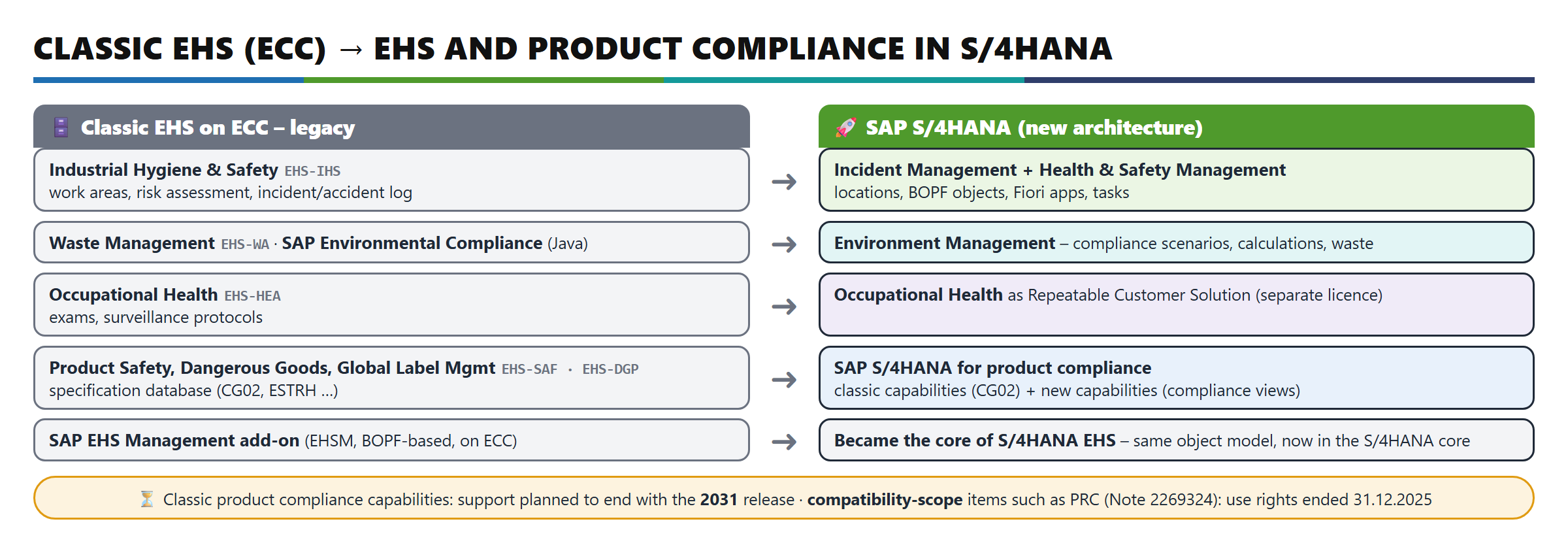
Classic component (legacy) | What it did | Successor in S/4HANA |
|---|---|---|
EHS-BD Basic data and tools | Specification database (CG02; tables ESTRH header, ESTRI identifiers …), phrases, report management | Chemicals and compliance views of the new data models; chemical data can be transferred from the specification database |
EHS-SAF Product safety, global label management | SDS (report) generation and shipping, labels | SAP S/4HANA for product compliance – SDS management, label management |
EHS-DGP Dangerous goods management | Dangerous goods master, checks, documents | Product compliance – dangerous goods management |
EHS-IHS Industrial hygiene and safety | Work areas, risk assessment, incident/accident log (table CCIHT_IAL) | Incident Management and Health and Safety Management |
EHS-HEA Occupational health | Medical service, examinations | Occupational Health (EHS-SUS-OH) |
EHS-WA Waste management | Waste disposal, manifests | ECC EHS-WA is not available in S/4HANA (Note 2267783); new Waste Management EHS-SUS-WA in Environment Management since S/4HANA 2023 |
SAP Environmental Compliance (separate product) | Emissions, permits | Environment Management |
SAP EHS Management: Product and REACH Compliance (EHS-MGM-PRC; compatibility scope on S/4HANA, KBA 2950167) – the add-on SPRC is not supported (Note 2267423) | Substance volume tracking, REACH | Product compliance – marketability and substance volume tracking |
- What survived in S/4HANA: classic product safety, basic data, dangerous goods and global label management continue as the classic capabilities of product compliance (on-premise and private cloud only, support planned to end with the 2031 release – page 06). Classic industrial hygiene and safety and waste management are replaced by the new applications; classic occupational health (ECC EHS-HEA) is succeeded by Occupational Health (EHS-SUS-OH).
- Compatibility scope: some classic items, e.g. SAP Product and REACH Compliance, ran on S/4HANA only as compatibility-scope items (SAP Note 2269324). Their on-premise use rights ended at the end of May 2026; under a cloud subscription they run until the end of 2030.
- Key difference for developers: classic EHS = specification tables, function modules and SAP GUI; S/4HANA EHS = BOPF business objects (
EHFND…foundation,EHHSS…health and safety), Fiori apps, tasks on SAP Business Workflow and released APIs (page 05).
Part 3 – System architecture
EHS is embedded in S/4HANA – there is no separate EHS system to integrate. It reads plants, materials, business partners and HR data directly and creates maintenance notifications, absences or internal orders in the same database.
Layer | S/4HANA EHS | Developer view |
|---|---|---|
UI | Fiori apps on the launchpad (Report Incident, Manage Incidents, Manage Locations …); some detail screens are Web Dynpro Floorplan Manager (FPM) apps; mobile Report Incident app with offline entry | OData services (SEGW / RAP), FPM configuration |
Business objects | Locations, incidents, risk assessments, risks, chemicals, compliance scenarios – implemented with BOPF (Business Object Processing Framework) | Transaction BOBX shows nodes, actions, validations; e.g. BO EHHSS_INCIDENT |
Foundation for EHS | Shared objects and services: locations, agents, chemicals, compliance requirements, task management, forms, Process Foundation for workflows | Package / component prefix EHFND, application component EHS-SUS-FND (ERP EHS Management: EHS-MGM-FND) |
Process layer | Tasks (definition → instances), SAP Business Workflow, My Inbox, task calendar | Workflow templates, BAdI: Create and Initialize PCBOs (page 05) |
Output | Adobe print and interactive forms: legal reports, summary reports, questionnaires | Adobe Forms (CORE ABAP › 11 Forms) |
Analytics | CDS-based analytical apps, Analysis Path Framework, Smart Business, SAP Analytics Cloud | CDS views (page 04) |
Application components you see in notes and dumps
- S/4HANA: EHS-SUS-FND foundation, EHS-SUS-IM incident management, EHS-SUS-HS health and safety, EHS-SUS-EM environment management, EHS-SUS-OH occupational health · ERP EHS Management (and older notes): EHS-MGM-… names.
- The new product compliance capabilities have their own components and data model (compliance views, assessments); they do not use the classic specification database transactions.
Roles
- Master role SAP_EHSM_MASTER contains the full EHS content – copy it and remove what you do not need.
- Business roles such as Incident Reporter, Incident Manager, Safety Manager, Industrial Hygienist, Hazardous Substance Manager, Environmental Manager, Safety Data Sheet Clerk; product compliance has roles such as Product Stewardship Specialist and Master Data Specialist – Product Compliance.
Part 4 – Organization structure: locations
EHS does not introduce a new organization unit in the Enterprise Structure customizing. Its central organizational object is the location: a physical or virtual place where incidents happen, risks exist or emissions are released – a site, building, plant area, work area, piece of equipment or an emission source. Locations are master data (page 02), not customizing.
Concept | Meaning | Link to S/4HANA org units |
|---|---|---|
Location | Place in the company relevant for EHS; has a type, address, responsible persons and a status (new, active, inactive, historic) | Plant, company code, business area, controlling area, cost center, HR organizational unit |
Location hierarchy | Parent-child structure (site → building → floor → work area). Data is aggregated along it (incident KPIs, emissions) | Two views: location structure and organizational structure |
Location type | Classifies locations (e.g. site, building, equipment); used for filtering, reporting and field control. Customer types start with Z or Y | – |
Technical object link | Locations can be imported from PM technical objects (functional locations, equipment) or created locally | Functional location, equipment |
Persons responsible | Persons with roles on the location (the roles determine e.g. the chemical approval team); they receive tasks and notifications | Business partner (natural person), HR person |
My Location | Personal start node of a user; many apps show data only below it | – |
Authorization group | Restricts who can see or change data of a location | Authorization objects on location level |
- Plant and company code come from the location: when an incident is reported for a location, address and plant default from it, and HR / accounting follow-on documents use its org data.
- Product compliance is organized differently: by country / region (where a product is sold or produced), purpose (e.g. sales, production) and the product master's plants and distribution chains (sales org + distribution channel).
- Persons are business partners: the BP is the leading object for natural persons in EHS (employees come from HR, contractors and visitors as BPs).
Part 5 – Integration map
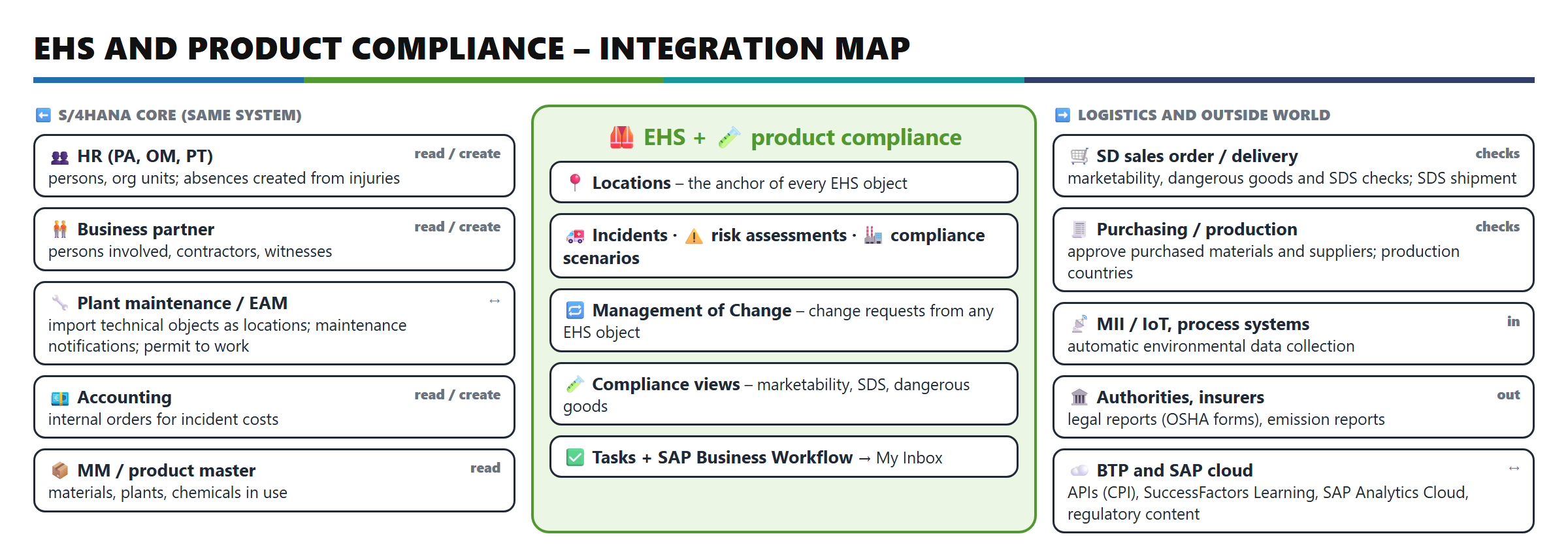
Partner | Direction | What flows |
|---|---|---|
HR – PA, OM, PT | Read / create | Employee data, positions and org units; Incident Management creates absences for injured persons |
Business partner | Read / create | Persons and organizations involved in incidents (created from Incident Management) |
PM / EAM | Read / create | Technical objects imported as locations; maintenance notifications created from incidents or risks; EHS data on maintenance orders; permit to work (page 03) |
Accounting | Read / create | Internal orders to collect incident costs |
MM / product master | Read | Materials, plants; the product master's compliance-relevant indicator triggers product compliance work |
SD, purchasing, production | Checks | Marketability, dangerous goods and SDS checks block or allow sales orders, deliveries, stock transfers and purchases |
Management of Change | Create | Change requests from any EHS object |
SAP MII, IoT, process systems | Inbound | Automatic collection of environmental data |
SAP SuccessFactors Learning | ↔ | Safety training of employees (integration offered for EHS workplace safety) |
Authorities, insurers | Outbound | Legal reports (OSHA 300 / 301 type forms), emission reports |
Regulatory content providers | Inbound | Listed substances, compliance requirements |
Details of each integration, the APIs and the analytics are on page 04.
Part 6 – Editions, licensing and deployment
Edition | EHS | Product compliance |
|---|---|---|
On-premise and private cloud (RISE) | Full scope: incident, health and safety, environment, MoC; occupational health (EHS-SUS-OH); customizing in SPRO; full ABAP extensibility | New capabilities plus the classic capabilities (specification database) until their planned end of support (page 06) |
Public cloud | Marketed as EHS workplace safety (incident management, health and safety) and EHS environment management; Cloud 2608 also documents occupational health, waste, management of change, audit and inspection; configuration via business configuration (SSCUI); released APIs and key-user / developer extensibility only | New capabilities only: scope items for marketability, SDS, dangerous goods, substance volume tracking (Part 1) |
- Licensing: EHS and product compliance are separately licensed products – a standard S/4HANA user licence does not include them. Occupational Health (EHS-SUS-OH) is part of the documented EHS scope (S/4HANA 2025, Cloud 2608).
- Product names on sap.com: SAP S/4HANA for EHS workplace safety, SAP S/4HANA for EHS environment management, SAP S/4HANA for product compliance (public cloud variants carry "Cloud" in the name).
- Direction: SAP describes EHS as moving from a monolithic system of record to a modular suite with AI features (e.g. AI-assisted safety instructions and permit management). The architect view is on page 06.
Part 7 – Interview questions
Q1. What does EHS cover in SAP S/4HANA?
Two families: SAP S/4HANA for EHS (incident management, health and safety management with risk assessment, environment management, management of change, occupational health) and SAP S/4HANA for product compliance (product marketability, safety data sheets, dangerous goods, substance volume tracking).
Q2. How is S/4HANA EHS different from classic EHS on ECC?
Classic EHS was built on the specification database (CG02, ESTRH) and SAP GUI. S/4HANA EHS comes from the EHS Management add-on: BOPF business objects, locations as the central object, Fiori apps, task management on SAP Business Workflow. The new product compliance capabilities use a new data model of compliance views and do not use CG02.
Q3. What happened to classic EHS components in S/4HANA?
Industrial hygiene and safety moved to incident and health and safety management, waste to environment management, occupational health to Occupational Health (EHS-SUS-OH). Product safety, basic data, dangerous goods and GLM continue as the classic capabilities of product compliance (on-premise / private cloud, support planned to end with the 2031 release) next to the new capabilities. Items that ran only in the compatibility scope (Note 2269324, e.g. PRC) lost their on-premise use rights at the end of May 2026 (under a cloud subscription: end of 2030) – same dates as Part 2.
Q4. What is a location in EHS?
The central master data object: a physical or virtual place (site, building, equipment, emission source) arranged in a hierarchy. It carries plant, company code, cost center and org unit, persons responsible and an authorization group; incidents, risks and compliance scenarios all refer to it.
Q5. Does EHS have its own organization units in Enterprise Structure?
No. It reuses plant, company code, cost center and HR org units and links them through the location hierarchy. Product compliance works per country / region, purpose, plant and distribution chain.
Q6. Is EHS a separate system?
No, it is embedded in S/4HANA. It reads and creates HR absences, business partners, maintenance notifications and internal orders in the same system; only external parties (authorities, content providers, IoT) are integrated through interfaces.
Q7. Which framework implements the EHS business objects?
BOPF. You inspect them in BOBX, e.g. EHHSS_INCIDENT with its root table EHHSSD_INC_ROOT. Foundation objects carry the prefix EHFND, health and safety objects EHHSS.
Q8. How do tasks work in EHS?
A task definition is attached to a host object (incident, investigation step, risk assessment, compliance scenario); saving it creates task instances that go to the assignee's My Inbox through SAP Business Workflow, optionally with an approver and recurrence.
Q9. What is the difference between an incident, a near miss and a safety observation?
An incident caused injury or damage; a near miss could have caused harm but did not; a safety observation records unsafe behaviour or a hazardous condition before anything happens. They are the three incident categories.
Q10. Which EHS scope is available in the public cloud?
EHS workplace safety (incident management, health and safety), EHS environment management and the product compliance scope items. Configuration is done in business configuration, extensions only with released objects.
Q11. How does product compliance get involved in a sales order?
For products flagged as compliance-relevant in the product master, the sales order and delivery run marketability, dangerous goods and SDS checks against the assessment results and can block the document; missing assessments create requests to the product stewardship team.
🏠 Start Here · 02 · Master Data ▶ · Sections: CORE ABAP | OOPS ABAP | ABAP on HANA | Clean Core | RAP | ABAP Points | SAP Fiori | SAPUI5 | Mobile Development (MDK) | BTP Foundations | BTP Development | CAP | SAP Build | ABAP on BTP | Integration Suite | SAP Business AI | SAP BASIS | Security | SAP SDLC
Functional: FICO ABAP | TRM ABAP | VIM | SAP BIS | SD ABAP | MM ABAP | PP ABAP | QM ABAP | PM ABAP | PS ABAP | EWM | TM ABAP | GTM ABAP | EHS ABAP | HR ABAP | BW | SAP Datasphere | SAP Business Data Cloud | SAP MDG | SAP Analytics Cloud | SAP Ariba | SAP CX | SAP IBP