The architect's view of EHS: what replaced classic EHS on ECC, the two generations of product compliance, what each edition offers, how data is migrated, which design decisions shape an EHS project and how to keep the core clean. The component overview and the classic-to-S/4HANA mapping table are on page 01 Part 2 – this page goes deeper into the consequences for projects and code.
Part 1 – From classic EHS to S/4HANA EHS
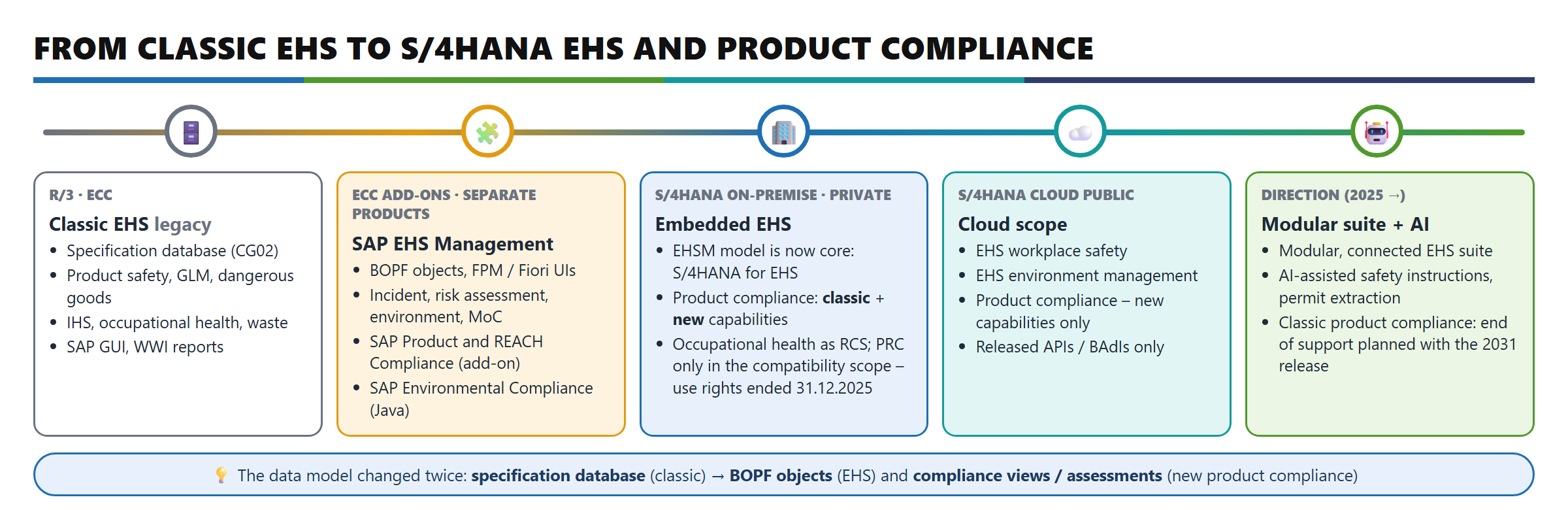
Area | Classic EHS on ECC (legacy) | S/4HANA |
|---|---|---|
Incidents | Incident/accident log (CBIH82, table CCIHT_IAL) | Incident Management: Report Incident, Manage Incidents; BO EHHSS_INCIDENT; legal reports, e-submission |
Risk | Work areas and risk assessment in industrial hygiene and safety | Health and Safety Management: operational risk assessment, controls, job hazard analysis, sampling |
Occupational health | EHS-HEA medical service | Occupational Health (EHS-SUS-OH) |
Environment / waste | EHS-WA, SAP Environmental Compliance | Environment Management incl. emissions, data collection and Waste Management EHS-SUS-WA since S/4HANA 2023 (ECC EHS-WA not available – Note 2267783) |
Safety data sheets | Specification workbench CG02, WWI report templates, report shipping (CVD1) | Product compliance SDS management, Adobe LiveCycle layouts, SDS shipment with the delivery |
Dangerous goods | DG master and checks on specifications | DG assessments for unpackaged and packaged products, checks in logistics |
REACH / volumes | SAP EHS Management: Product and REACH Compliance (EHS-MGM-PRC; add-on SPRC not supported, Note 2267423) | Marketability and substance volume tracking |
Technology | Specification tables (ESTRH …), function modules, BAPIs, SAP GUI | BOPF (EHS), RAP (newer product compliance), Fiori, released APIs and BAdIs |
- Compatibility scope: items such as SAP Product and REACH Compliance ran on S/4HANA only in the compatibility scope (SAP Note 2269324, page 01 Part 2). Their on-premise use rights ended at the end of May 2026 (under a cloud subscription: end of 2030); support ends with the use right, so a system still using them needs a migration plan and a licence clarification with SAP.
- Custom code impact: Z programs on the specification database or CCIHT_IAL do not work on the new objects – they are rewritten on BOPF tables, CDS views or APIs. Run the ATC S/4HANA readiness checks (ABAP on HANA › 02 Migration to S/4HANA) and list every classic EHS object you use.
- Mindset change: classic EHS was specification-centric (one database for all properties); S/4HANA EHS is location- and process-centric (incidents, risks, compliance scenarios at locations), and product compliance is assessment-centric (results per country and purpose).
Part 2 – Product compliance: classic and new capabilities
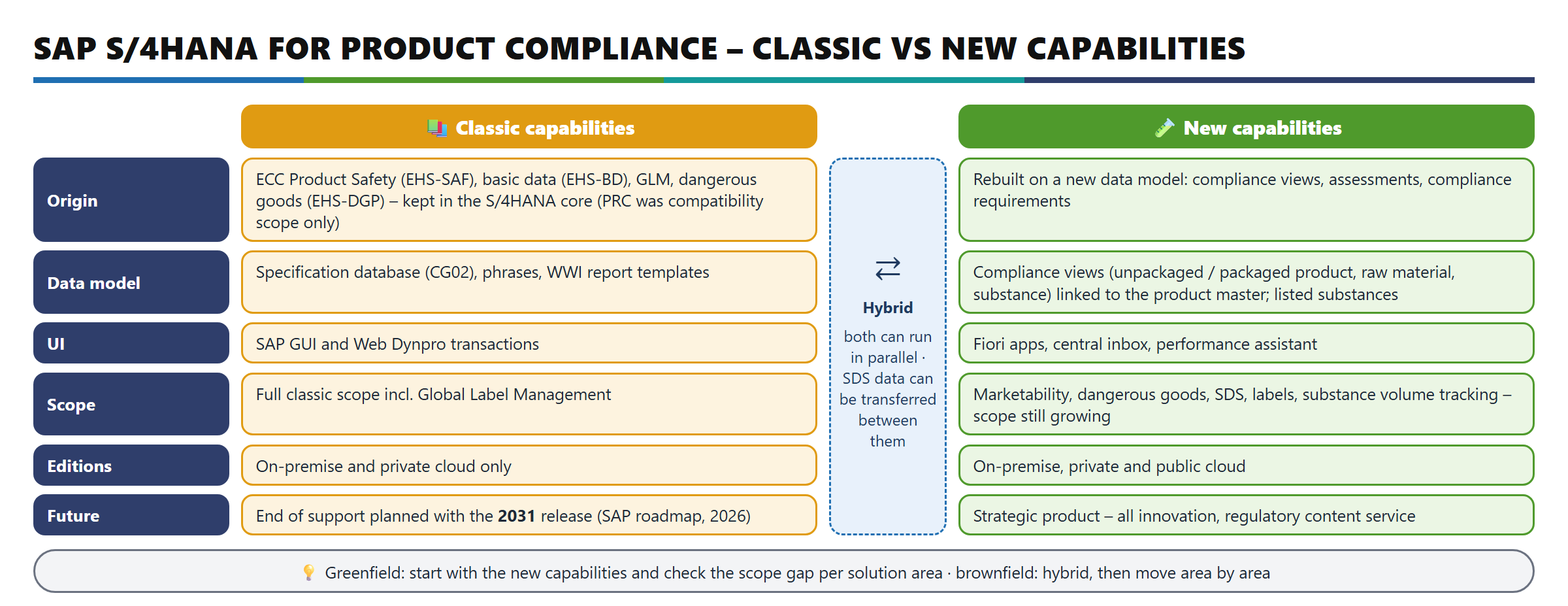
SAP S/4HANA for product compliance contains two generations under one product name:
- Classic capabilities – the ECC functions (Product Safety EHS-SAF, basic data and tools EHS-BD, Global Label Management, Dangerous Goods EHS-DGP) running on the specification database with SAP GUI and Web Dynpro. Available only on-premise and in private cloud. SAP's roadmap (2026) plans the 2031 release as the first without them (2029 is the last release with classic support): the new capabilities reach full scope, followed by a 3–4 year transition.
- SAP Product and REACH Compliance (PRC) was not carried over as a classic capability – on S/4HANA it ran only in the compatibility scope; its REACH and volume functions live on in marketability and substance volume tracking.
- New capabilities – product marketability and compliance, dangerous goods, safety data sheets, labels and substance volume tracking on the new data model (compliance views, assessments), Fiori, the SAP Regulatory Content Service; on-premise, private and public cloud.
- Hybrid: both can run in parallel in one system; SDS data can be transferred between them. Typical for brownfield customers who move area by area.
- Licensing: product compliance is licensed separately from the S/4HANA user licences (also true for EHS).
Situation | Recommendation |
|---|---|
Greenfield, scope covered by the new capabilities | New capabilities only; no specification database |
Brownfield with classic Product Safety / GLM | Hybrid: keep classic where the new scope has gaps, migrate per solution area (e.g. DG first, SDS later), plan the end before 2031 |
Public cloud | New capabilities only – classic is not available |
Heavy WWI / GLM customizing | Inventory every template and label; redesign in Adobe LiveCycle / label management instead of 1:1 conversion |
Part 3 – Editions: what is available where
Capability | On-premise | Private cloud | Public cloud |
|---|---|---|---|
Incident management | ✓ | ✓ | ✓ (EHS workplace safety) |
Health and safety (risk assessment, chemicals, sampling) | ✓ | ✓ | ✓ (EHS workplace safety) |
Environment management | ✓ | ✓ | ✓ (EHS environment management, incl. AI-assisted permit management) |
Management of change | ✓ | ✓ | ✓ |
Occupational health | ✓ (EHS-SUS-OH) | ✓ (EHS-SUS-OH) | ✓ (EHS-SUS-OH, Cloud 2608) |
Permit to work | WCM incl. classic transactions + PTW apps | Same as on-premise | Permit to Work apps (scope item 7Z4); no classic WCM |
Product compliance – new | ✓ | ✓ | ✓ |
Product compliance – classic | ✓ (until planned end) | ✓ (until planned end) | – |
Compatibility-scope items (e.g. PRC) | Use rights ended end of May 2026 | Cloud subscription: until end of 2030 | – |
Configuration | SPRO | SPRO | Central Business Configuration + Manage Your Solution |
Extensibility | Classic + clean core | Classic + clean core | Released objects only |
- Public cloud product names: SAP S/4HANA Cloud Public Edition, EHS workplace safety and EHS environment management (separately licensed); on-premise: SAP S/4HANA for EHS workplace safety, for EHS environment management, for product compliance.
- Public cloud integration with EAM, product compliance and SuccessFactors Learning is offered as standard integration options; environment management can feed SAP Sustainability Control Tower.
Part 4 – Migration to S/4HANA EHS
Data | Tool / object | Note |
|---|---|---|
Locations and hierarchy | Migration cockpit: EHS – Location, EHS – Location hierarchy (Excel templates) | First object to load; design the hierarchy before (Part 5) |
Tasks | Migration cockpit: EHS – Task | Task definitions for incidents and compliance requirements / scenarios |
Persons | Business partners / HR | Load or replicate before incidents |
Compliance requirements | Import Compliance Requirement app, content provider | Regulations, permits, limits, emission factors |
Open incidents / history | Public cloud: migration object EHS – Incident; otherwise (no cockpit object in the release list) – re-enter open cases, API-based load, keep history in a read-only archive or BW | Decide with legal retention rules (e.g. 5-year OSHA log) |
Product compliance | Migration cockpit, templates in XML or CSV – 11 objects | Product compliance info, raw material compliance info, substance, properties, DG assessments (unpackaged, packaged), DG technical names, marketability (simple, supplier information), SDS assessment, SDS shipment history |
Classic specification data | Hybrid transfer of SDS data; chemical data transfer from the specification database | Only where classic and new run in parallel |
Typical load sequence
- 1. Foundation configuration (location types, number ranges, roles, workflow check).
- 2. Locations and hierarchy → persons / business partners → chemicals and agents.
- 3. Compliance requirements → compliance scenarios and tasks (environment).
- 4. Product compliance: substances → raw materials → unpackaged products → packaged products → assessments → SDS shipment history.
- 5. Open incidents and actions last, after cut-over of the reporting process.
- Migration objects need the matching EHS roles (e.g. an environment management business role) to be visible in the Migrate Your Data app; the object lists of on-premise and cloud differ per release.
- Brownfield from the SAP EHS Management add-on: that add-on is the origin of the S/4HANA EHS object model, so its incidents and risk assessments are much closer to S/4HANA than classic EHS data; the simplification item check and custom code analysis still apply.
Part 5 – Architect decisions
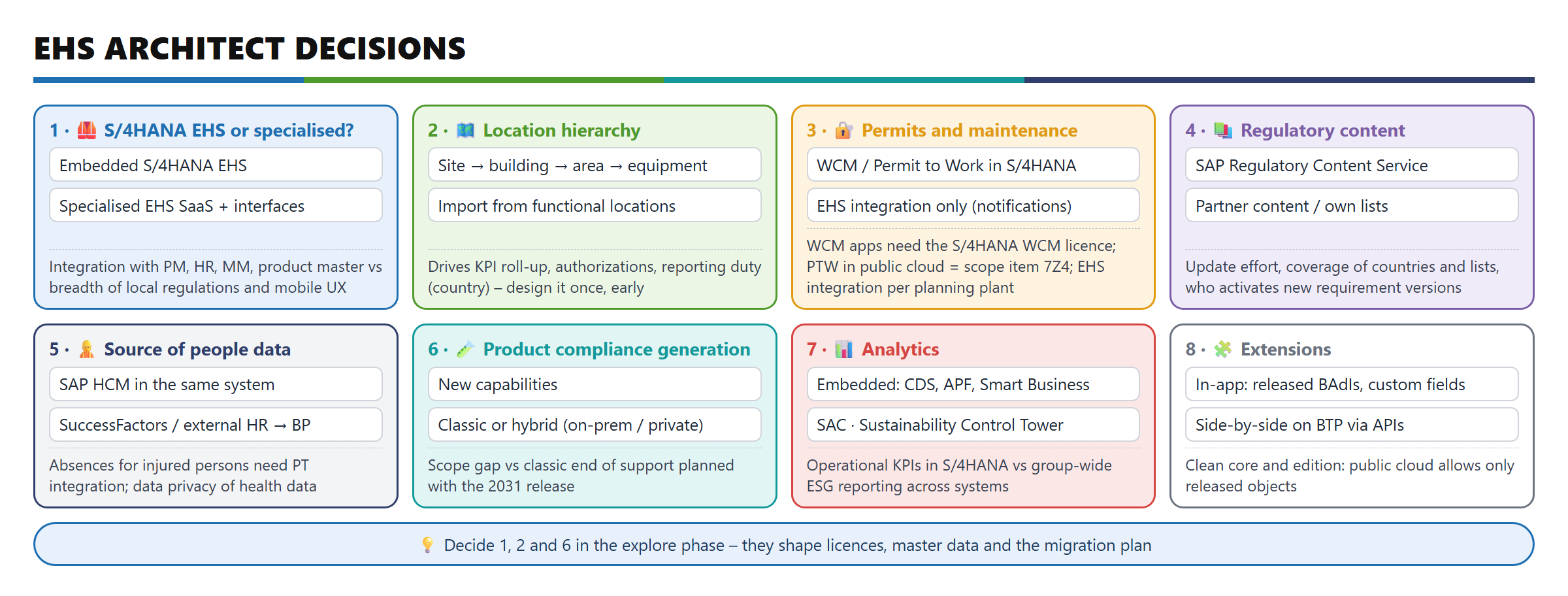
Decision | Options | Criteria / recommendation |
|---|---|---|
EHS in S/4HANA or a specialised EHS system | Embedded S/4HANA EHS; specialised SaaS with interfaces | Choose S/4HANA when PM, HR, MM and product compliance integration matters (notifications, absences, logistics checks); a specialised system may win on country-specific regulations or mobile UX – then budget the interfaces |
Location hierarchy | Site → building → area → equipment; imported from functional locations; separate organizational view | Drives KPI roll-up, reporting duty (country), authorizations and responsible persons. Model the level where incidents and emissions are recorded; avoid 1:1 copies of deep PM hierarchies |
Permits and PM | WCM / Permit to Work in S/4HANA; EHS integration only; external permit system | Licence (WCM), edition (public cloud: PTW apps, no classic WCM), need for lockout/tagout; activate the PM integration in the EHS IMG and the PM worker-safety planning plants |
Regulatory content | SAP Regulatory Content Service; partner content; own lists | Coverage of countries and lists, update effort, responsibility for activating new requirement versions |
People data | SAP HCM in the same system; SuccessFactors or other HR replicated as BPs | PT absences and occupational health need HR time data; health data privacy and blocking |
Product compliance generation | New, classic, hybrid | Scope gap vs classic end of support (planned 2031); public cloud = new only |
Analytics | Embedded CDS / APF / Smart Business; SAC; Sustainability Control Tower | Operational KPIs embedded; group ESG reporting and multi-system data in SAC / Control Tower |
Extensions | In-app (released BAdIs, custom fields); side-by-side on BTP | Clean core; public cloud allows only released objects; mobile and portal apps side-by-side |
Part 6 – Clean core in EHS
Rule | EHS-specific consequence |
|---|---|
Use released objects | Released EHS objects are mostly product compliance (SDS, DG, foundation) and environment; incident and health and safety have few released objects – integrate them through the released APIs |
No modifications of BOPF objects | BOPF enhancements (BOPF_EWB) and FPM configuration enhancements are classic extensions: on-premise only, documented, retested at upgrades |
Key user first | Custom Fields (e.g. task definitions), UI adaptation, Custom Logic in released BAdIs |
Developer extensibility | Implement released BAdIs (task field control, data import, SDS generation) in ADT; RAP / EML only on released RAP BOs such as the product compliance logistics document |
Side-by-side | Contractor portals, mobile safety walks, AI services on BTP calling API_EHS_REPORT_INCIDENT_SRV and the product compliance APIs; processes in SAP Build Process Automation |
Governance | ATC with cloud readiness checks on Z code; SAP's released-object list (also used by ATC) shows what is allowed |
General clean-core principles and tools: Clean Core › 01 Clean Core.
Part 7 – Roadmap and direction
- July 2025 strategy update: SAP moves EHS "from a monolithic system of record into a modular and connected suite" – from reactive to proactive, later predictive EHS.
- Workplace safety: safety performance management, operational risk management and incident management combined; integrated risk assessments link hazards to controls; AI-assisted safety instructions; real-time safety performance analytics.
- Environment: waste, emissions, water and wastewater; AI-assisted permit management that extracts regulatory obligations from permit documents (PDF); planned proactive regulatory intelligence.
- Joule: SAP publishes configuration guides for EHS Joule agents (e.g. an incident location finder agent) – AI features arrive as BTP / Joule services around the core.
- Product compliance: new capabilities growing towards full scope; classic capabilities end of support planned with the 2031 release.
- Occupational health: component EHS-SUS-OH, documented in S/4HANA 2025 and Cloud Public Edition 2608.
- Sustainability: EHS environment data feeds SAP Sustainability Control Tower and SAP Sustainability Footprint Management – EHS becomes one data source of the ESG landscape.
Part 8 – Interview questions
Q1. What replaced classic EHS in S/4HANA?
The SAP EHS Management object model became S/4HANA for EHS (incident, health and safety, environment, MoC, occupational health). Product safety, dangerous goods and GLM became SAP S/4HANA for product compliance – first as classic capabilities on the specification database, now as new capabilities. PRC ran only in the compatibility scope, whose use rights ended on-premise at the end of May 2026 (under a cloud subscription: end of 2030).
Q2. What are the classic and new capabilities of product compliance?
Classic = the ECC functions on the specification database (EHS-SAF, EHS-BD, GLM, EHS-DGP), on-premise / private only, end of support planned with the 2031 release. New = marketability, DG, SDS, labels, substance volume tracking on a new data model with Fiori, in all editions. Both can run in parallel (hybrid).
Q3. A customer uses CG02, WWI and GLM heavily. How do you plan the move?
Inventory specifications, WWI templates and labels; check the new-capability scope per area; run hybrid on-premise or in private cloud, migrate area by area (migration cockpit objects, SDS data transfer), redesign layouts in Adobe LiveCycle / label management, finish before the classic end of support.
Q4. Which EHS scope is in the public cloud?
EHS workplace safety (incident and health and safety management), EHS environment management (incl. AI-assisted permit management), management of change, Permit to Work apps (7Z4) and the new product compliance capabilities. No classic product compliance, no compatibility scope, released extensions only.
Q5. How do you migrate locations and product compliance data?
Migration cockpit objects EHS – Location and EHS – Location hierarchy (and EHS – Task); for product compliance 11 objects with XML / CSV templates, loaded in dependency order: substances, raw materials, unpackaged and packaged products, assessments, SDS shipment history.
Q6. How do you handle historical incidents?
In the public cloud the migration object EHS – Incident exists; otherwise check the object list of the release. Re-enter or API-load open cases, keep closed history in an archive or BW for the legal retention period (e.g. OSHA logs), and make sure summary reports for the current year are complete.
Q7. When would you recommend a specialised EHS system instead of S/4HANA EHS?
When country-specific regulations, mobile UX or industry content outweigh integration – but then PM notifications, HR absences and logistics checks need interfaces. Product compliance checks in sales and delivery strongly favour S/4HANA product compliance in the same system.
Q8. How do you design the location hierarchy?
At the level where incidents, risks and emissions are recorded: site → building → area, equipment only where needed. It drives KPI roll-up, reporting duty per country, authorizations and responsible persons. Import from functional locations selectively instead of copying the PM hierarchy.
Q9. What is clean core in EHS?
Released APIs, BAdIs and RAP objects only; key user extensibility first; BOPF / FPM enhancements just on-premise as documented classic extensions; new functions side-by-side on BTP calling the incident and product compliance APIs.
Q10. Which permit to work option fits the public cloud?
The Permit to Work apps of Asset Management (scope item 7Z4, customizing under Work Clearance Management → Permit to Work); classic WCM transactions are on-premise / private only, and the EHS integration is activated in the EHS IMG (Activate and Configure PM Integration).
Q11. What is SAP's direction for EHS?
A modular, connected suite (July 2025): workplace safety combining safety performance, operational risk and incidents; AI-assisted safety instructions and permit extraction; Joule agents; environment data flowing into the sustainability products; new product compliance replacing the classic capabilities.
Q12. Which licences must an EHS architect check?
EHS (workplace safety, environment management) and product compliance are separate from the S/4HANA user licences; occupational health is part of the EHS scope (EHS-SUS-OH); the WCM-based permit apps need the WCM licence; compatibility-scope use rights ended on-premise in May 2026 (cloud subscription: end of 2030).
🏠 Start Here · ◀ 05 · Development · 07 · Interview Questions ▶ · Sections: CORE ABAP | OOPS ABAP | ABAP on HANA | Clean Core | RAP | ABAP Points | SAP Fiori | SAPUI5 | Mobile Development (MDK) | BTP Foundations | BTP Development | CAP | SAP Build | ABAP on BTP | Integration Suite | SAP Business AI | SAP BASIS | Security | SAP SDLC
Functional: FICO ABAP | TRM ABAP | VIM | SAP BIS | SD ABAP | MM ABAP | PP ABAP | QM ABAP | PM ABAP | PS ABAP | EWM | TM ABAP | GTM ABAP | EHS ABAP | HR ABAP | BW | SAP Datasphere | SAP Business Data Cloud | SAP MDG | SAP Analytics Cloud | SAP Ariba | SAP CX | SAP IBP