Warehouse management is one of the areas where S/4HANA forces a decision: classic LE-WM is no longer the future, so every conversion and every greenfield project chooses between embedded EWM (basic or advanced), decentralized EWM and Stock Room Management. This page gives the status of each option, what the cloud editions offer, how warehouse data is migrated, the decisions an architect makes and the clean-core rules for EWM. History and deployment basics: page 01 Parts 1 – 3; extension techniques: page 05.
Part 1 – Status of the warehouse options in S/4HANA
Option | Status | What it means for a project |
|---|---|---|
LE-WM in SAP ECC | Part of SAP ERP 6.0 – mainstream maintenance until end of 2027, optional extended maintenance until end of 2030 | Runs until the ERP is replaced; no new investment |
LE-WM in S/4HANA (legacy) | Compatibility scope (simplification item S4TWL Warehouse Management, note 2270211). Usage rights ended 31 Dec 2025; SAP granted a final transition to the end of May 2026 for on-premise. Cloud subscription contracts (RISE) have a longer, restricted period – details in note 2269324 | On-premise LE-WM in S/4HANA is now out of usage rights: replace it with EWM or Stock Room Management |
Stock Room Management (S/4HANA, since 1909) | Part of S/4HANA, reuses LE-WM code with a reduced scope; may be used beyond 2025 (FAQ note 2881166) | Small stock rooms that only need bins, transfer orders and simple moves; SAP's innovation goes into EWM |
Embedded EWM (S/4HANA) | Strategic; basic included in S/4HANA, advanced with EWM licence | Default target for most warehouses |
Decentralized EWM on S/4HANA | Strategic (since S/4HANA 1809); always advanced licence | High-volume, automated or multi-ERP warehouses |
SCM EWM 9.5 (legacy) | Last release on the SCM platform, Business Suite 7 maintenance – mainstream to end of 2027, extended to end of 2030 | Migrate to EWM on S/4HANA (new installation + data migration, not an upgrade) |
- Stock Room Management is not a long-term platform for a real warehouse: it inherits LE-WM's limits and SAP's warehouse innovation goes into EWM. Choose it only when EWM would be oversized.
- Release and restriction notes per S/4HANA release exist for both EWM options (e.g. 3376453 embedded, 3376455 decentralized for 2023) – read them before committing to a feature.
Part 2 – Embedded EWM: basic vs advanced as a decision
The feature split is on page 01 Part 3. For the architect the question is commercial and functional: which warehouses need advanced features, and does the business case pay for the EWM licence?
Question | Points to basic | Points to advanced |
|---|---|---|
Automation | Manual or forklift warehouse, maybe a vendor WCS via IDoc | EWM should drive conveyors / AS/RS directly (MFS) |
Labour | Productivity measured outside SAP | Labour management with engineered standards |
Outbound volume | Delivery-by-delivery picking | Waves, cartonization, complex consolidation |
Yard and dock | Trucks handled informally | Yard management, dock appointment scheduling |
Value-adding work | None | VAS, kitting, cross-docking, slotting |
- The licence level is set per warehouse number – a plant can run a basic spare-parts store next to an advanced distribution centre in the same system.
- Starting with basic and moving to advanced later needs no migration – same code and data, only the licence and the Customizing of the new features.
- The feature scope description of the target release is the reference for the exact split; it changes between releases.
Part 3 – Decentralized EWM on S/4HANA
- A separate S/4HANA system in which only EWM is used, connected by qRFC and ALE / DRF (page 04 Part 1). It can serve SAP ERP 6.0 (EhP3 or higher) or S/4HANA, and several ERP systems at once.
- Why: warehouse runs 24/7 even during ERP downtime and upgrades; performance isolation for very high volumes or MFS; one warehouse system for several company ERPs or a 3PL; own release cycle.
- Cost: a second system to run and upgrade, master data replication, queue monitoring, stock reconciliation, and some functions only in embedded (e.g. synchronous goods receipt from production without a delivery, QM without the QIE, Advanced Shipping and Receiving at its start).
- Conversion path: a company still on ECC can implement decentralized EWM on S/4HANA first and connect it to ECC – the warehouse moves to the target platform before the ERP conversion and stays when ECC is replaced.
Part 4 – Editions: on-premise, private cloud, public cloud
On-premise / private cloud | Public cloud (S/4HANA Cloud Public Edition) | |
|---|---|---|
Product | Embedded EWM (in-stack) basic or advanced, decentralized EWM (extra-stack) | Warehouse Management based on EWM, embedded only, smaller scope |
Releases | S/4HANA releases with feature packs; customer decides when to upgrade | Two releases a year (e.g. 2602, 2608) applied by SAP |
UI | Fiori, SAP GUI, RF (ITSmobile, SAP GUI for HTML) | Fiori apps; mobile RF via SAP GUI for HTML with SAP Screen Personas |
Extensibility | Classic BAdIs, RF framework, /SCWM/ code access plus ABAP Cloud | Only key-user and developer extensibility with released APIs, views and BAdIs |
Integration | IDocs, MFS, qRFC, OData, CPI | Released APIs (e.g. warehouse order / task, A2A send to external system from 2602), CPI |
- Public cloud apps evolve quickly – e.g. with 2608 the Run Outbound Process apps are replaced by Manage Outbound Delivery Orders; the What's New Viewer lists such changes per release.
- A public cloud customer with advanced warehouse needs typically keeps a decentralized EWM (private cloud or on-premise) next to the public cloud ERP – a two-tier design that must be integrated through APIs.
Part 5 – Data migration to EWM
5.1 From LE-WM (ECC or S/4HANA compatibility scope) to EWM
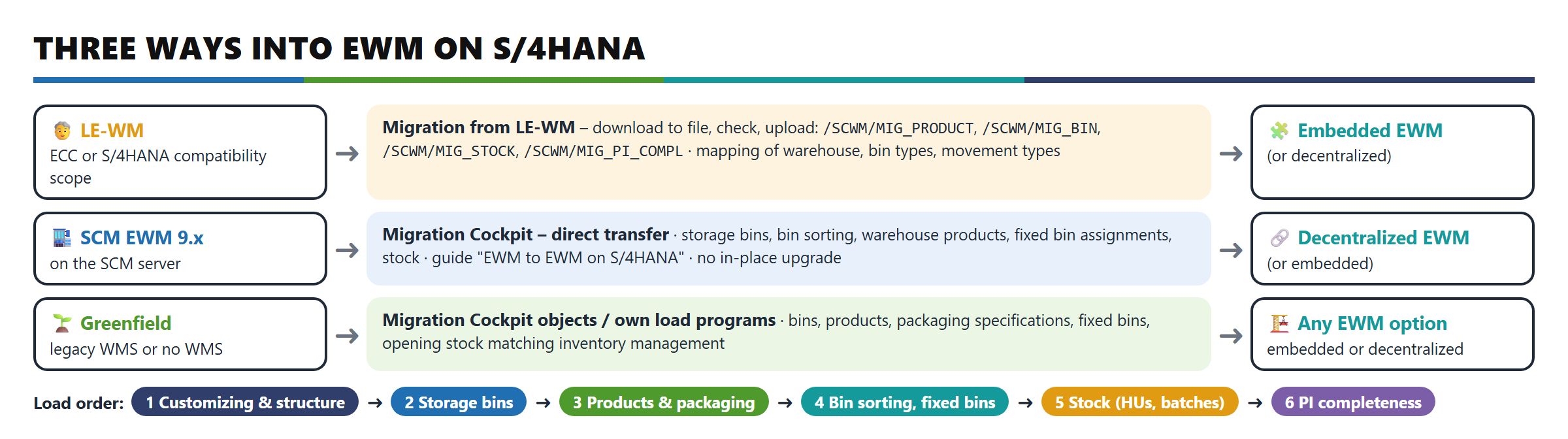
There is no automatic conversion – LE-WM tables are not converted into EWM tables during the system conversion. SAP delivers migration tools under Logistics → SCM Extended Warehouse Management → Extended Warehouse Management → Interfaces → Migration from LE-WM: each one downloads data from the LE-WM warehouse to a file, the business checks it, and the file is uploaded into EWM.
Transaction | Migrates |
|---|---|
/SCWM/MIG_PRODUCT | Warehouse-specific product data incl. fixed bin assignments and palletization |
/SCWM/MIG_BIN | Storage bins and bin sorting |
/SCWM/MIG_STOCK | Stock (quants) – the riskiest step, test with HUs and batches |
/SCWM/MIG_PI_COMPL | Physical inventory completeness – which bins count as inventoried |
Report /SCWM/IPU | Packaging and unit of measure data from a text file |
- Prerequisites: EWM warehouse structure configured, LE-WM warehouse mapped to the EWM warehouse, mapping rules for bin types and movement types → warehouse process types; for physical inventory the PI area must be defined and mapped to activity areas.
- Cutover: no open transfer orders or deliveries in the old warehouse, stock frozen, migrated by warehouse – plan the go-live per warehouse, not per system.
5.2 From SCM EWM 9.x to EWM on S/4HANA
- SCM EWM is not upgraded: EWM on S/4HANA is a new system (or the embedded EWM in the converted S/4HANA) and the data is migrated with the S/4HANA Migration Cockpit (direct transfer) – SAP's migration guide "EWM to EWM on S/4HANA" describes the process.
- Migration objects: warehouse storage bin, warehouse storage bin sorting, warehouse product, warehouse fixed bin assignments, warehouse stock – bin sorting, fixed bins and stock need the bins first.
5.3 Greenfield
- Load bins, products, packaging specifications, fixed bins and opening stock as part of the normal S/4HANA migration; the stock load must match the inventory management stock of the EWM storage locations. Object availability differs between editions and approaches (file / staging); the Migration Cockpit object list of the release is the reference.
Part 6 – Architect decisions
Decision | Options | Key criteria |
|---|---|---|
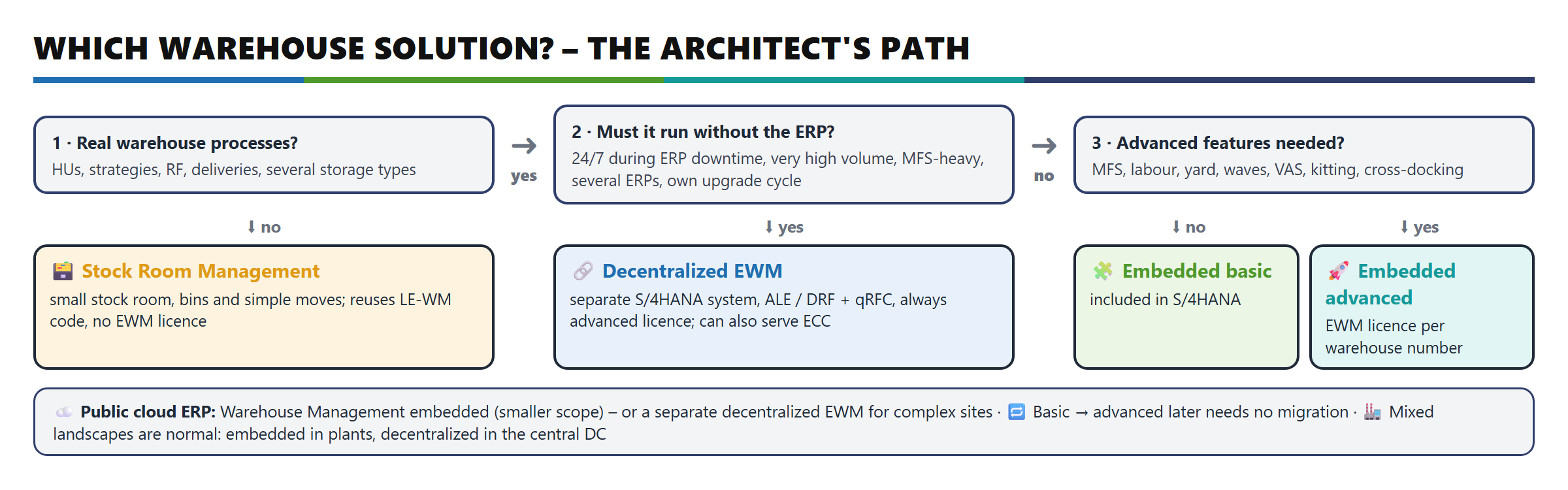
Deployment | Embedded / decentralized | 24/7 and ERP downtime tolerance, volume and automation (performance isolation), number of ERP systems, upgrade independence, TCO, integration effort |
Licence level | Basic / advanced (per warehouse) | Need for MFS, labour, yard, VAS, kitting, waves – business case per warehouse |
Light option | Stock Room Management / EWM | Size and future growth of the stock room; innovation goes into EWM |
Automation | MFS / vendor WCS via IDoc / BTP | Who controls the PLCs, vendor support, real-time requirements, skills in the team |
Transport integration | TU-based / ASR | Embedded TM available, need for decentralized EWM, process maturity |
User interface | RF (ITSmobile, SAP GUI for HTML) / Fiori / voice | Device types, scan-heavy vs screen-heavy work, ruggedized devices, edition |
Number of warehouse numbers | One per site / several per site | Separate processes or organisations need separate warehouse numbers; shared resources need one |
- Rule of thumb: embedded is the default; decentralized must be justified by availability, volume, automation or a multi-ERP landscape. Many companies mix: embedded for plant warehouses, decentralized for the central automated DC.
- Performance: HANA removed many old reasons for decentralization, but a highly automated DC with MFS and thousands of tasks per hour still benefits from its own system and its own maintenance window.
- Organisation: the warehouse number design (page 01) and the storage location mapping are hard to change later – decide them early with the logistics and finance teams.
Part 7 – Clean core for EWM
Level | Meaning | EWM examples |
|---|---|---|
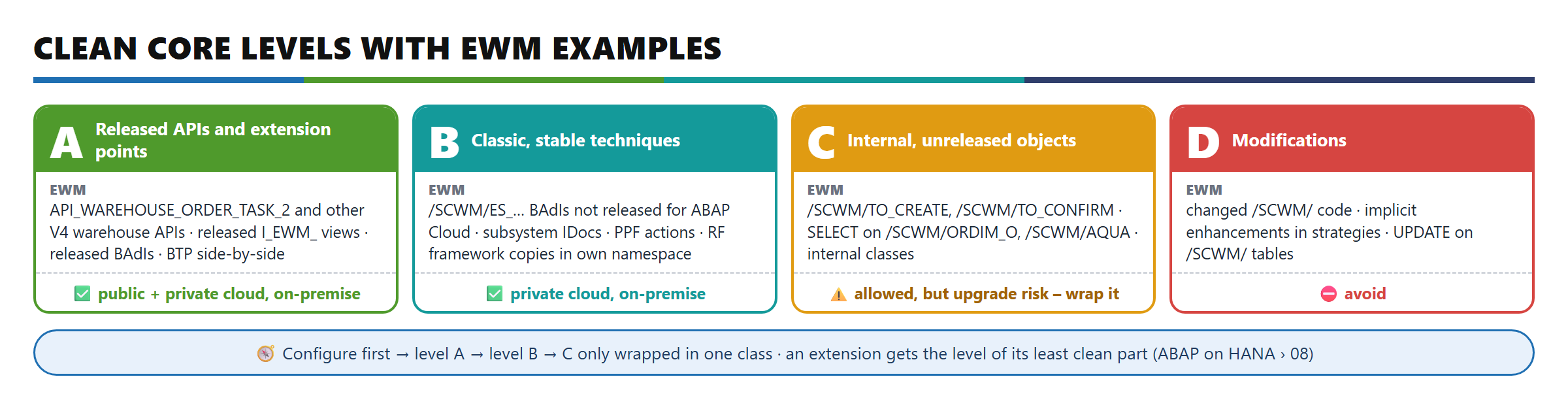
A | Released APIs and extension points (ABAP Cloud, key user) | API_WAREHOUSE_ORDER_TASK_2, released I_EWM_ views, released BAdIs, side-by-side apps on BTP |
B | Classic but stable APIs and techniques | /SCWM/ES_… BAdIs not released for ABAP Cloud, subsystem IDocs, PPF actions, RF framework copies in own namespace |
C | Use of internal, unreleased objects | Calls to /SCWM/TO_CREATE or /SCWM/TO_CONFIRM, direct SELECTs on /SCWM/ tables |
D | Modifications, implicit enhancements, writes to SAP tables | Changed /SCWM/ code, implicit enhancements in the strategies, UPDATE on /SCWM/ tables – avoid |
- SAP introduced the A – D levels in 2025; an extension gets the level of its least clean part. Details: Clean Core › 01 Clean Core.
- Practical EWM rule: configure first, then released objects, then the unreleased /SCWM/ BAdIs; wrap any unavoidable level-C call in one class so it can be replaced when SAP releases an API.
- Public cloud allows only level A; private cloud and on-premise allow B and C, but every C object is upgrade risk and is found by ATC in each release upgrade.
Part 8 – Interview questions
Q1. What happens to LE-WM in S/4HANA?
It is in the compatibility scope (S4TWL Warehouse Management). Usage rights ended at the end of 2025, with a final on-premise transition to the end of May 2026; cloud subscription contracts have a longer restricted period (note 2269324). Successors: embedded or decentralized EWM, or Stock Room Management for simple stock rooms.
Q2. What is Stock Room Management and when would you use it?
A part of S/4HANA since 1909 that reuses LE-WM code with a reduced scope and may be used beyond 2025. It suits small stock rooms with bins and simple moves; SAP invests in EWM, so real warehouses go to EWM.
Q3. Embedded or decentralized EWM – how do you decide?
Embedded is the default: one system, no replication, real-time accounting, lower TCO. Decentralized when the warehouse must run during ERP downtime, needs performance isolation for high volume or MFS, serves several ERPs, or needs its own upgrade cycle.
Q4. A plant needs only basic putaway and picking now, conveyors in three years. What do you propose?
Embedded EWM basic for the warehouse number now; switch that warehouse to advanced when the conveyors come (MFS is advanced). No migration is needed – same code, licence and Customizing change.
Q5. What is available for warehousing in S/4HANA Cloud Public Edition?
EWM-based Warehouse Management, embedded only, with a smaller scope delivered in scope items, two releases a year, Fiori and SAP GUI for HTML for mobile, and only released extensibility. Decentralized EWM is not part of the public cloud; complex warehouses run a separate EWM integrated by APIs.
Q6. How do you migrate an LE-WM warehouse to EWM?
With the Migration from LE-WM tools: /SCWM/MIG_PRODUCT, /SCWM/MIG_BIN, /SCWM/MIG_STOCK and /SCWM/MIG_PI_COMPL – download from LE-WM, check, upload to EWM – after mapping the warehouse, bin types and movement types. Cutover per warehouse with no open transfer orders.
Q7. Can SCM EWM 9.5 be upgraded to S/4HANA?
No – EWM on S/4HANA is a new system; data is migrated with the Migration Cockpit direct transfer (storage bins, bin sorting, warehouse products, fixed bins, stock) following SAP's EWM-to-EWM migration guide.
Q8. A customer on ECC wants to modernise the warehouse before the S/4HANA conversion. Options?
Decentralized EWM on S/4HANA connected to ECC (ERP 6.0 EhP3 or higher). The warehouse runs on the target platform and stays connected when ECC is converted or replaced.
Q9. Which integration model would you choose between EWM and TM?
With embedded TM and EWM in S/4HANA 2020 FPS01 or later: Advanced Shipping and Receiving, based on the freight order without TUs. For decentralized EWM or existing processes: the TU-based shipping and receiving integration.
Q10. MFS or an external warehouse control system?
MFS when EWM should talk to the PLCs directly – one system, no WCS licence, but advanced licence and MFS skills needed. A vendor WCS via subsystem IDocs when the automation vendor supplies and supports its control layer or the equipment is very specialised.
Q11. What does clean core mean for EWM developments?
Configuration first, then level A objects (released APIs, views, BAdIs, BTP side-by-side), then the unreleased /SCWM/ BAdIs and IDocs (level B). Unreleased /SCWM/ function modules and table access are level C – wrapped and documented; modifications (level D) are avoided.
Q12. What must be decided early in an EWM project because it is hard to change later?
Deployment (embedded vs decentralized), the warehouse number design and its mapping to plants and storage locations, the licence level per warehouse, the HU strategy, and the automation concept (MFS or WCS).
🏠 Start Here · ◀ 05 · Development · 07 · Interview Questions ▶ · Sections: CORE ABAP | OOPS ABAP | ABAP on HANA | Clean Core | RAP | ABAP Points | SAP Fiori | SAPUI5 | Mobile Development (MDK) | BTP Foundations | BTP Development | CAP | SAP Build | ABAP on BTP | Integration Suite | SAP Business AI | SAP BASIS | Security | SAP SDLC
Functional: FICO ABAP | TRM ABAP | VIM | SAP BIS | SD ABAP | MM ABAP | PP ABAP | QM ABAP | PM ABAP | PS ABAP | EWM | TM ABAP | EHS ABAP | HR ABAP | BW | SAP MDG | SAP Analytics Cloud | SAP Ariba | SAP CX | SAP IBP