FICO is the common name for the two finance modules of SAP: FI (Financial Accounting) records every business transaction for the legal books – balance sheet, profit and loss, tax – and CO (Controlling) uses the same postings to steer the company from inside – costs per cost center, product, project and market segment. Every other module ends in FICO: a goods receipt, an invoice, a payroll run or a settlement becomes a journal entry. This page explains the scope, the organization units that appear as key fields in every finance table, the currencies, the integration map and the deployment options. The General Ledger and the Universal Journal follow on page 02, AP / AR / Asset Accounting on page 03, Controlling on page 04.
Part 1 – What FI and CO do
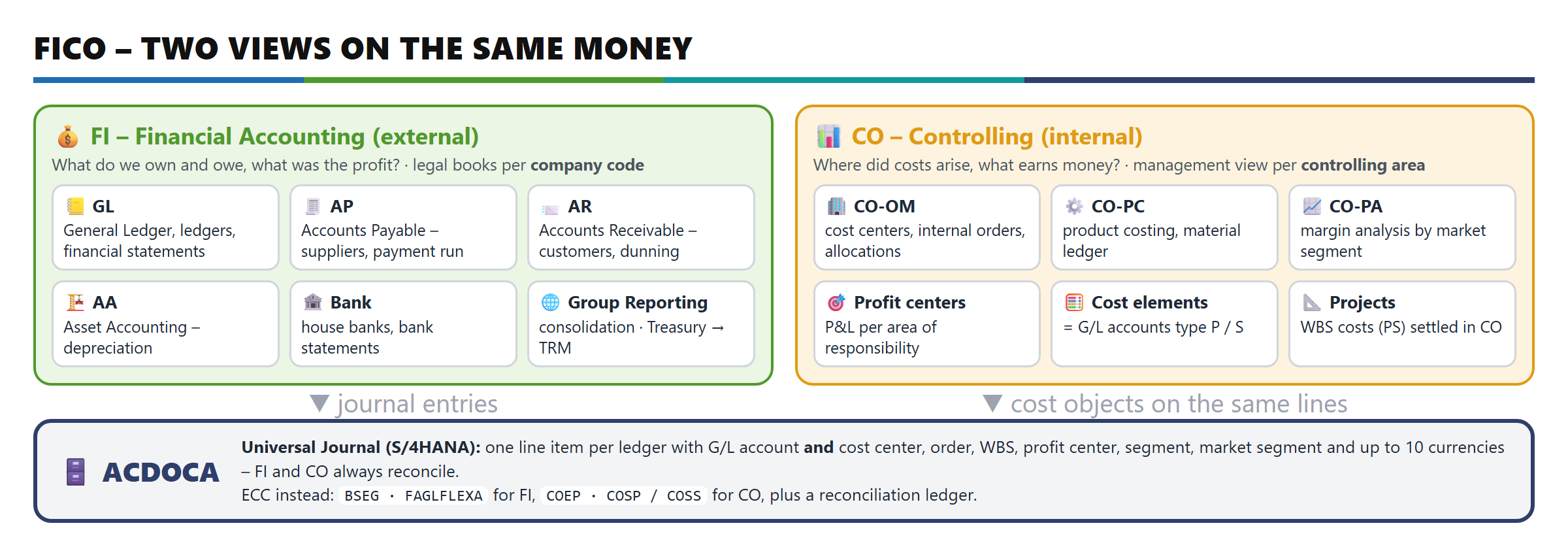
FI and CO look at the same money from two angles. FI answers "what does the company own and owe, and what was its profit?" for auditors, tax authorities and investors. CO answers "where did the costs arise, and which product, customer or business line earns money?" for managers.
FI – Financial Accounting | CO – Controlling | |
|---|---|---|
Also called | External accounting | Internal accounting, management accounting |
Audience | Auditors, tax office, shareholders, banks | Managers, cost center owners, controllers |
Rules | Legal: IFRS, US GAAP, local GAAP, tax law | Company's own rules (allocations, overhead rates, margins) |
Main org unit | Company code (legal entity) | Controlling area (can span several company codes) |
Main objects | G/L accounts, customers, suppliers, assets, banks | Cost centers, internal orders, WBS elements, products, profit centers, market segments |
Main outputs | Balance sheet, P&L, tax returns, trial balance | Cost center reports, product costs, contribution margins, profitability |
One journal for both – the S/4HANA architecture
- ECC: FI wrote BKPF / BSEG and the new G/L tables (FAGLFLEXA / FAGLFLEXT), CO wrote its own line items (COEP) and totals (COSP / COSS), Asset Accounting and the material ledger had their own tables again. FI and CO had to be reconciled (reconciliation ledger, real-time integration CO → FI).
- S/4HANA: FI, CO, Asset Accounting, the material ledger and margin analysis write one line item table, the Universal Journal ACDOCA. A cost center posting is a G/L posting with a cost center filled in, so FI and CO always agree – reconciliation is no longer needed (details on page 02).
- Cost elements are G/L accounts: primary and secondary cost elements are maintained in the G/L account master (FS00) with G/L account type P (primary costs or revenue) or S (secondary costs) – KA01 / KA06 of ECC lead to FS00 (page 02 Part 3).
Part 2 – Sub-components of FICO
Component | What it does | Key objects / tables | Page |
|---|---|---|---|
FI-GL General Ledger | Chart of accounts, journal entries, ledgers, parallel accounting, financial statements | SKA1 / SKB1, BKPF, BSEG, ACDOCA | 02, 05 |
FI-AP Accounts Payable | Supplier invoices, down payments, payment run | Supplier (BP) LFA1 / LFB1, payment run REGUH / REGUP | 03 |
FI-AR Accounts Receivable | Customer invoices, incoming payments, dunning | Customer (BP) KNA1 / KNB1, dunning MHNK / MHND | 03 |
FI-AA Asset Accounting | Fixed assets from acquisition to retirement, depreciation | Asset master ANLA / ANLZ, values in ACDOCA (ECC: ANEP / ANLC) | 03 |
FI-BL Bank Accounting | House banks, bank accounts, electronic bank statements, cheques | House bank T012, accounts T012K, bank statement FEBKO / FEBEP | 03, 05 |
FIN-FSCM Financial Supply Chain Mgmt | SAP Credit Management, Collections, Dispute Management | Credit segment, credit limit per business partner | 03 |
Group Reporting | Consolidation of company codes into group statements (successor of EC-CS) | Consolidation unit, group chart of accounts | 05, 07 |
Treasury and cash | Cash management, liquidity, financial instruments, hedging | – | TRM section |
CO-OM Overhead Management | Cost centers, internal orders, activity types, allocations | CSKS, AUFK, CSLA, values in ACDOCA (ECC: COEP / COSP / COSS) | 04 |
CO-PC Product Cost Controlling | Standard cost estimates, cost object controlling, actual costing with the material ledger | KEKO / KEPH, CKMLHD | 04 |
CO-PA Profitability Analysis | Margins by market segment (customer, product, region …) | Operating concern, margin analysis in ACDOCA | 04 |
Profit center accounting | P&L (and balance sheet items) per profit center; in S/4HANA part of the General Ledger | CEPC, field PRCTR in ACDOCA | 04 |
- Legacy: classic profit center accounting (EC-PCA, ledger 8A, table GLPCA) and the special purpose ledger for profit center reporting are replaced by the profit center field in the Universal Journal.
- Each sub-component has its own area menu in SAP GUI and its own Fiori business role, e.g. General Ledger Accountant, Accounts Payable Accountant, Accounts Receivable Accountant.
Part 3 – Organization units
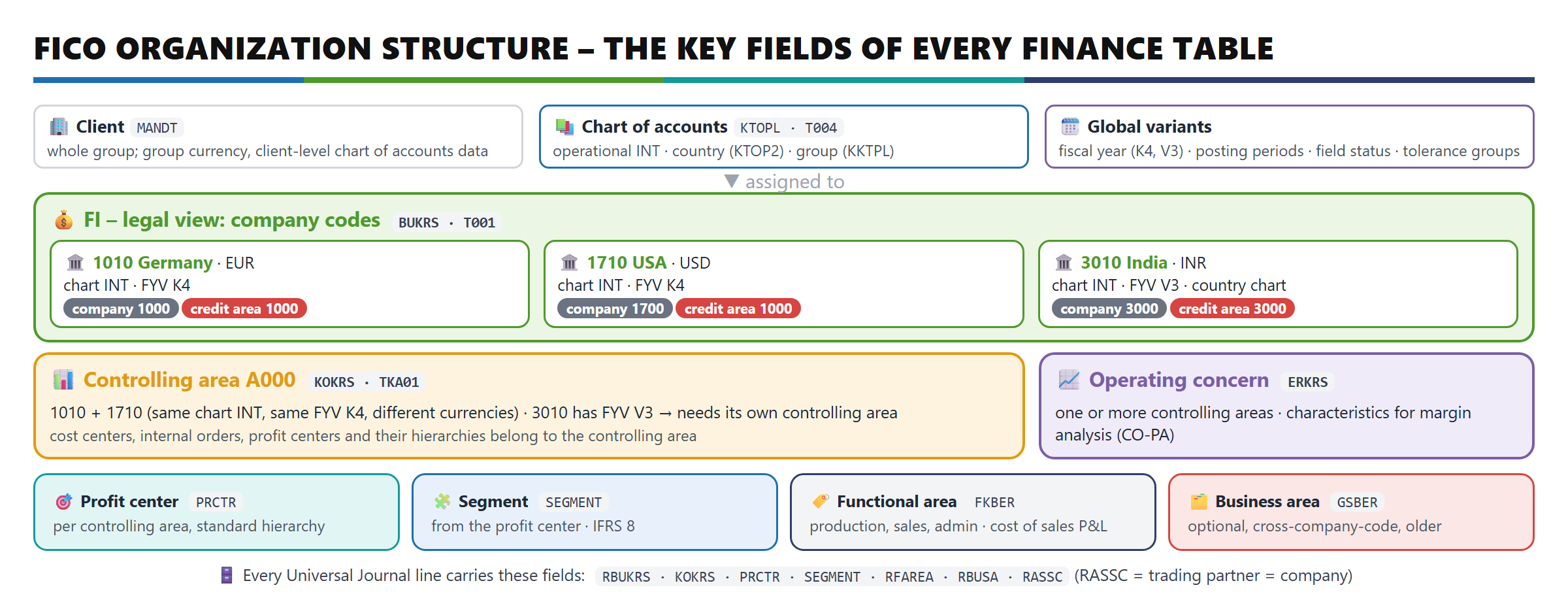
Organization units are defined and assigned once in Customizing (SPRO → Enterprise Structure → Definition / Assignment, plus Financial Accounting → Global Settings). They become key fields of every finance table, so a developer must know what each field means and where its settings live.
3.1 FI organization units
Unit | Meaning | Field | Table | Define |
|---|---|---|---|---|
Client | The whole group in one system; client-level data is shared by all company codes | MANDT | T000 | SCC4 |
Company code | Smallest unit with its own complete balance sheet and P&L – usually one legal entity. Key of almost every FI document and balance. | BUKRS | T001 | OX02 (copy EC01, global data OBY6) |
Company | Legal unit for consolidation; groups one or more company codes. Its ID is used as trading partner (BSEG-VBUND, ACDOCA-RASSC) in intercompany postings. | RCOMP | T880 | OX15 |
Chart of accounts | List of G/L accounts (number, name, type). Operational, country and group charts – see 3.3. | KTOPL | T004 | OB13 |
Business area | Optional cross-company-code unit for internal balance sheets (e.g. by product line). Still available, but segment and profit center are the recommended dimensions. | GSBER | TGSB | OX03 |
Segment | Business segment for segment reporting (IFRS 8, ASC 280); normally derived from the profit center. | SEGMENT | FAGL_SEGM | IMG: Define Segment |
Functional area | Function of a cost – production, sales, administration, R&D – for the cost of sales P&L format. Derived from G/L account, cost center or order. | FKBER | TFKB | OKBD |
Credit control area | Unit in which customer credit limits are managed for the classic SD credit check; S/4HANA uses SAP Credit Management with credit segments (page 03). | KKBER | T014 | OB45 |
3.2 CO organization units
Unit | Meaning | Field | Table | Define |
|---|---|---|---|---|
Controlling area | Unit for cost accounting. One or more company codes; all CO objects (cost centers, orders, profit centers) belong to one controlling area. | KOKRS | TKA01 | OKKP (assign CC: OX19, table TKA02) |
Operating concern | Unit for profitability analysis: defines the characteristics (customer group, region …) and, in costing-based CO-PA, the value fields. One or more controlling areas. | ERKRS | TKEB | KEA0 (assign CO area: KEKK) |
Profit center | Area of responsibility that earns profit (e.g. a business line or plant). Master data of the controlling area with a standard hierarchy; assigned to a segment. | PRCTR | CEPC | KE51 / KE52 / KE53 |
Cost center | Place where costs arise (department). CO master data, not an org unit – page 04. | KOSTL | CSKS | KS01 / KS02 / KS03 |
3.3 The three charts of accounts
Chart | Purpose | Where it is stored |
|---|---|---|
Operational chart of accounts | Used for daily postings in FI and CO. Exactly one per company code; many company codes can share it. | T001-KTOPL; account in SKA1 (chart level) + SKB1 (company code level) |
Country (alternative) chart of accounts | Local statutory account numbers required by a country (e.g. France, Italy). Reporting by the alternative number. | T001-KTOP2; SKB1-ALTKT holds the alternative account number |
Group chart of accounts | Common accounts for the consolidated group statements. | T004-KKTPL; SKA1-BILKT holds the group account number |
- In S/4HANA the G/L account master also holds the consolidation link: Group Reporting maps G/L accounts to the financial statement items of a consolidation chart of accounts (page 05).
- Logistics units hang below the company code too: a plant belongs to one company code (OX18), a sales organization (OVX3) and a purchasing organization (OX01) as well – see SD ABAP and MM ABAP page 01.
Part 4 – Assignments and global variants
4.1 Assignment rules
Assignment | Rule | T-code / table |
|---|---|---|
Company code → chart of accounts | Each company code uses exactly one operational chart; one chart can serve many company codes. | OB62 · T001-KTOPL |
Company code → company | Many company codes can belong to one company. | OX16 · T001-RCOMP |
Company code → controlling area | n : 1. All company codes in one controlling area must use the same operational chart of accounts and the same fiscal year variant (FI and CO share ACDOCA). Currencies may differ. | OX19 · TKA02 |
Controlling area → operating concern | n : 1. Several controlling areas can feed one operating concern. | KEKK · TKA01-ERKRS |
Company code → credit control area | n : 1. A credit control area can cover several company codes. | OB38 · T001-KKBER |
Profit center → segment | Set in the profit center master; the segment is then derived in every posting. | KE52 · CEPC-SEGMENT |
Plant, sales org, purchasing org → company code | Each belongs to exactly one company code. | OX18 · OVX3 · OX01 |
4.2 Global variants of a company code
Variants are defined once and assigned to many company codes, so a group with 50 companies maintains the rules only once.
Variant | What it controls | Define · assign | Example |
|---|---|---|---|
Fiscal year variant | Number of posting periods (max. 16 = 12 normal + 4 special periods) and their start and end dates; calendar or non-calendar year, year-dependent if periods change per year | OB29 · OB37 (T009, T001-PERIV) | K4 calendar year + 4 special periods; V3 April – March + 4 special periods |
Posting period variant | Which periods are open for posting, separately per account type (+ all, A, D, K, M, S, V) and account range, with an authorization group | OBBO · OBBP · open / close OB52 (T001B, T001-OPVAR) | Period 10 open, period 9 open only for G/L (S) for the closing team |
Field status variant | Groups of field status groups: which fields are required, optional or suppressed when posting to an account | OBC4 · OBC5 (T001-FSTVA); group in SKB1-FSTAG | G001 general, G005 bank accounts, G004 cost accounts |
Tolerance groups | Maximum amounts per user and document, payment difference limits | OBA4 · OB57 (users) | Clerk may post up to 100,000 per document |
Document types / number ranges | Document type → number range, allowed account types | OBA7 · FBN1 | Page 02 Part 2 |
- Field status rule: the posting key (OB41) also has a field status. The system combines both: required wins over optional, suppressed wins over optional, and required + suppressed is an error.
- Special periods 13 – 16 are only reached by posting to the last normal period with a special period entered – they hold year-end adjustments and audit corrections.
- S/4HANA: periods are opened and closed in OB52 or the Fiori app Manage Posting Periods; the fiscal year variant is also needed by CO, because FI and CO periods are the same ACDOCA field (FISCYEARPER / POPER).
Example – read the finance settings of a company code
|
Other released views for org units: I_ChartOfAccounts, I_ControllingArea, I_ProfitCenter, I_Segment, I_FunctionalArea, I_BusinessArea, I_Ledger. In cloud code (ABAP Cloud) only released views are allowed – see ABAP on HANA › 05 CDS Views; clean core: Clean Core › 01 Clean Core.
Part 5 – Currencies
Every amount is stored in several currencies at the same time, so that a German company code can report in EUR and the US parent in USD without conversion at reporting time. The currency type says which role a currency plays.
Currency type | Meaning | ACDOCA field |
|---|---|---|
00 Document (transaction) currency | Currency of the business transaction, e.g. invoice in GBP | WSL (currency RWCUR) |
10 Company code currency | Local currency of the company code (T001-WAERS); the legal books | HSL (RHCUR) |
Global currency – usually 30 group currency | Currency type of the controlling area, the same for all company codes of the controlling area; normally the group currency (30), type 10 only if all company codes share one currency | KSL (RKCUR) |
20 Controlling area currency | Classic CO currency type; in S/4HANA the controlling area currency is held as the global currency | KSL |
40 / 50 / 60 | Hard currency, index-based currency, global company currency (countries with high inflation, group companies) | Freely defined amounts |
Freely defined currencies | S/4HANA: up to 8 more currencies per ledger; own currency types start with Y or Z | OSL, VSL, BSL, CSL, DSL, ESL, FSL, GSL |
- ECC: the new G/L had the company code currency plus up to two parallel currencies (OB22). S/4HANA: the Universal Journal stores up to 10 currencies per line: company code currency, global currency and 8 freely defined ones.
- Configuration: FINSC_LEDGER (Financial Accounting Global Settings → Ledgers → Define Settings for Ledgers and Currency Types) – per currency type the exchange rate type (usually M, rates in TCURR, maintained with OB08), the translation date and whether conversion is real-time or done later by the foreign currency valuation.
- Not every component supports all 10: Asset Accounting and the material ledger work with a limited set of the ledger currencies, so the currency design is agreed with those components first.
- Developer rule: an amount field is meaningless without its currency key. In CDS use
@Semantics.amount.currencyCode(or theCURRtype with a reference field) and never add amounts of different currencies.
Part 6 – Integration map: how the other modules post to FI and CO
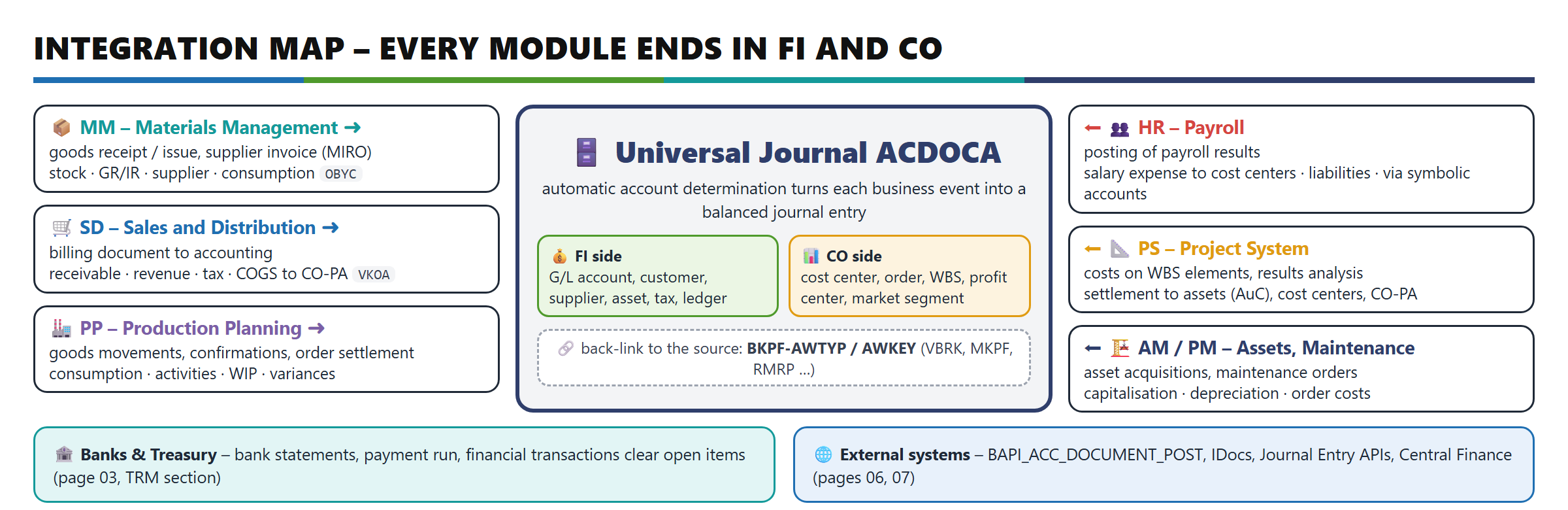
FICO is the end point of almost every business process. The other modules do not post to G/L accounts directly; they hand over a business event and automatic account determination finds the accounts.
From | Business event | Posting in FI / CO | Account determination |
|---|---|---|---|
MM | Goods receipt, goods issue, invoice (MIRO) | Stock ↔ GR/IR ↔ supplier; consumption to cost center / order | OBYC (transaction keys BSX, WRX, GBB, PRD) – MM ABAP page 03 |
SD | Billing document released to accounting | Customer receivable ↔ revenue, tax; revenue and COGS to CO-PA / profit center | VKOA (revenue accounts) – SD ABAP page 03 |
PP | Goods issue / receipt for production order, confirmation, order settlement | Material consumption, activity allocation, WIP, variances | OBYC + CO settlement profile – page 04 |
HR / Payroll | Posting of the payroll results | Salary expense to cost centers, liabilities to employees and authorities | Symbolic accounts – HR ABAP |
PS | Costs on WBS elements, results analysis, settlement | Costs collected on WBS, settled to assets (AuC), cost centers or CO-PA | Settlement rules – page 04 |
AM / PM | Maintenance order costs, asset acquisitions | Costs to maintenance order, capitalisation to assets | Asset classes, account determination in FI-AA – page 03 |
Banks / Treasury | Bank statement, payment run, financial transactions | Bank ↔ clearing ↔ open items | Posting rules of the bank statement – page 03, TRM |
- Every FI document records its origin in BKPF-AWTYP (reference transaction, e.g.
VBRKbilling,MKPFgoods movement,RMRPMIRO invoice) and BKPF-AWKEY (reference key) – the way to jump from an accounting document back to the source document (code on page 05). - Interfaces from outside SAP post through BAPIs, IDocs or the Journal Entry APIs – page 06.
Part 7 – Deployment options
Edition | What it means for FICO |
|---|---|
SAP S/4HANA (on-premise) | Customer runs the system; full IMG, all classic t-codes, classic and modern extensibility. Same data model (ACDOCA) as the cloud editions. |
SAP S/4HANA Cloud Private Edition | Same software as on-premise, operated by SAP (usually through RISE with SAP); customer keeps the full configuration and its own code, clean core recommended. |
SAP S/4HANA Cloud Public Edition | Multi-tenant SaaS with SAP Best Practices content; configuration through SAP Central Business Configuration and self-service configuration UIs instead of SPRO; finance features such as document splitting come preconfigured; only ABAP Cloud development. |
Central Finance | One S/4HANA system that receives the FI/CO postings of many source systems (ECC, S/4HANA, non-SAP) in real time for central reporting and processes – a common first step to S/4HANA (page 07). |
- Which edition, which ledger and currency design and whether to start with Central Finance are architect decisions – page 07.
Part 8 – Interview questions
Q1. What is the difference between FI and CO?
FI is external accounting by company code for the legal books (balance sheet, P&L, tax) under IFRS or local GAAP. CO is internal management accounting by controlling area: costs and revenues per cost center, order, product, profit center and market segment. In S/4HANA both post into the Universal Journal ACDOCA.
Q2. What is a company code and what is a company?
A company code (T001) is the smallest unit with its own complete set of books – usually one legal entity. A company (T880) groups company codes for consolidation; its ID is used as trading partner in intercompany postings.
Q3. What are the three kinds of chart of accounts?
Operational (daily postings, one per company code, T001-KTOPL), country (local statutory numbers, T001-KTOP2 with SKB1-ALTKT) and group (consolidation, T004-KKTPL with SKA1-BILKT).
Q4. Can two company codes with different charts of accounts be in one controlling area?
No. All company codes in a controlling area must use the same operational chart of accounts and, in S/4HANA, the same fiscal year variant, because cost elements are G/L accounts and FI and CO share one table. Their currencies can be different.
Q5. What do the fiscal year variant and the posting period variant control?
The fiscal year variant (OB29, assigned OB37) defines the periods – e.g. K4 calendar year with 4 special periods, V3 April to March. The posting period variant (OBBO / OBBP) decides which periods are open; periods are opened and closed per account type in OB52.
Q6. What is a field status variant?
A set of field status groups (OBC4, assigned with OBC5). The group in the G/L account's company code segment (SKB1-FSTAG) decides which fields are required, optional or suppressed; it is combined with the field status of the posting key.
Q7. What is the difference between a segment, a profit center and a business area?
A profit center is a CO object for profit responsibility; the segment is an IFRS 8 reporting unit derived from the profit center; the business area is an older optional FI unit for internal balance sheets. In S/4HANA profit center and segment are the recommended dimensions, filled in ACDOCA.
Q8. Which currencies does a journal entry carry in S/4HANA?
Document currency (WSL), company code currency (HSL), global currency (KSL) and up to 8 freely defined currencies (OSL … GSL) per ledger – up to 10 in total. ECC's new G/L had only two parallel currencies. Settings in FINSC_LEDGER.
Q9. How does an SD invoice or an MM goods receipt reach FI?
Through automatic account determination: SD uses revenue account determination (VKOA), MM uses OBYC with transaction keys such as BSX and WRX. The FI document stores its origin in BKPF-AWTYP and AWKEY.
Q10. Where do classic profit center accounting and the reconciliation ledger go in S/4HANA?
Both are obsolete. The profit center is a field of every Universal Journal line, so profit center reporting comes from ACDOCA; FI and CO cannot differ any more, so no reconciliation ledger is needed.
Q11. As a developer, how do you read company code settings in a cloud-ready way?
With the released CDS view I_CompanyCode (CompanyCode, Currency, ChartOfAccounts, FiscalYearVariant, ControllingArea) instead of T001 and TKA02, which are not released for ABAP Cloud.
Q12. What is Central Finance?
An S/4HANA system that replicates FI/CO postings from several source systems in real time, giving one central Universal Journal for reporting and shared services while the source systems keep running. Often used as a first step of a finance transformation.
🏠 Start Here · 02 · GL & Universal Journal ▶ · Sections: CORE ABAP | OOPS ABAP | ABAP on HANA | Clean Core | RAP | ABAP Points | SAP Fiori | SAPUI5 | Mobile Development (MDK) | BTP Foundations | BTP Development | CAP | SAP Build | ABAP on BTP | Integration Suite | SAP Business AI | SAP BASIS | Security | SAP SDLC
Functional: FICO ABAP | TRM ABAP | VIM | SAP BIS | SD ABAP | MM ABAP | PP ABAP | QM ABAP | PM ABAP | PS ABAP | EWM | TM ABAP | GTM ABAP | EHS ABAP | HR ABAP | BW | SAP Datasphere | SAP Business Data Cloud | SAP MDG | SAP Analytics Cloud | SAP Ariba | SAP CX | SAP IBP