What happens to Global Trade Management when a company moves to S/4HANA: the trading contract, the Trading Execution Workbench and trading expenses stay, but the data model of several tables changes, some ERP transactions and functions are gone, and the commodity integration is only partly supported. This page lists the simplification items, what each S/4HANA edition offers, how GTM relates to Commodity Management, Agricultural Contract Management and the other LO-GT products, how to migrate, the decisions a solution architect makes and how to keep GTM extensions clean-core. What GTM is and how it differs from SAP GTS: page 01; development techniques: page 05.
Part 1 – GTM in S/4HANA: what stays and what changes
GTM is part of SAP S/4HANA (application component LO-GT) and runs in the same system as SD, MM and FI – exactly as in ERP, where it came with the Global Trade enterprise extension EA-GLTRADE. The business process – trading contract, release, follow-on documents, execution workbench, expenses – is unchanged; the changes are technical and in the surrounding functions.
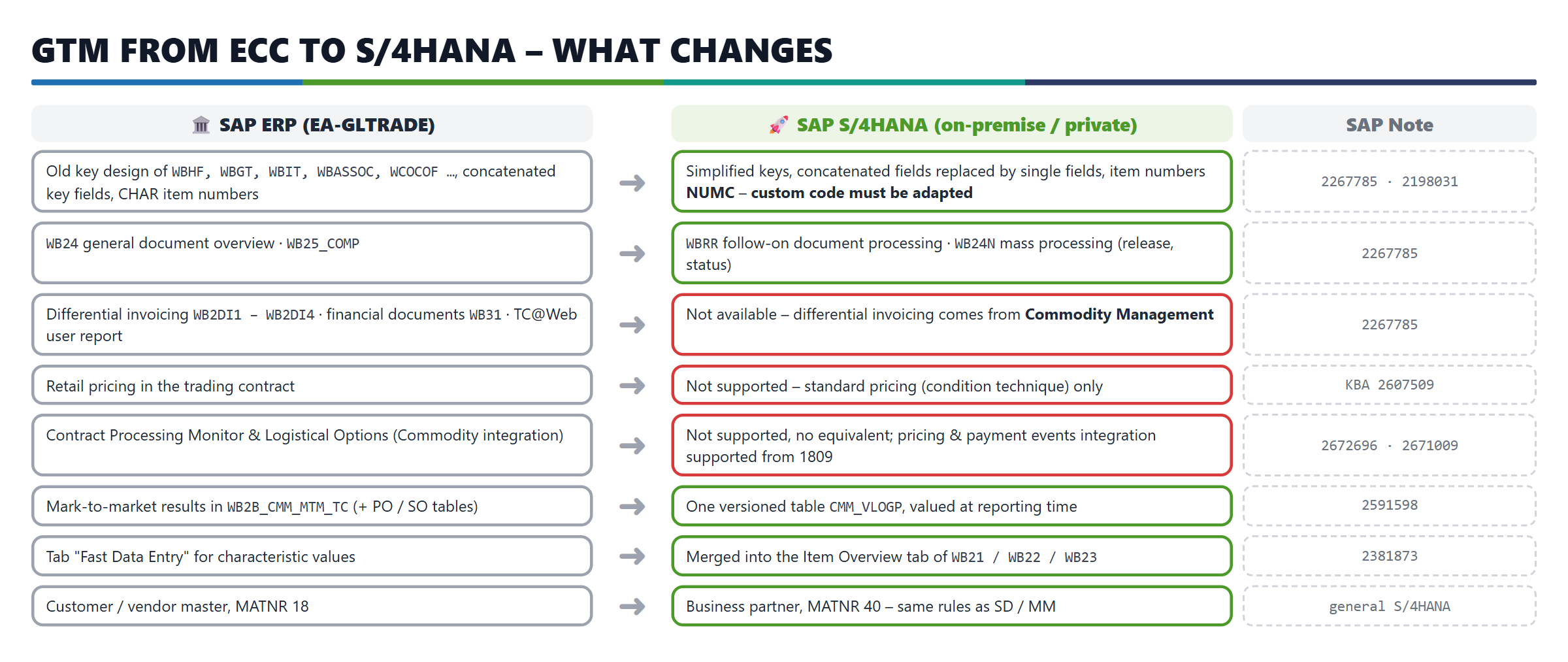
Area | SAP ERP | SAP S/4HANA | Impact for developers |
|---|---|---|---|
Tables | ERP key design of WBHF, WBGT, WBIT, WBASSOC, WCOCOF, WB2_D_BUSVOLBASE, WB2_D_BVB_SETTL | Simplified key fields, concatenated fields replaced by single fields, item-number domains CHAR → NUMC | Adapt every SELECT, JOIN and key build on these tables (Part 3) |
Document overview | WB24 (RWB2B001), WB25_COMP | WBRR (RWB2BREL) release trading contracts, WB24N (RWB2BMAS) status and release | Change batch jobs, menus, authorizations |
Differential invoicing | WB2DI1 – WB2DI4, WB31 financial documents | Not available – differential invoicing of Commodity Management | Rebuild custom logic on the CM solution |
Pricing | Standard or retail pricing per contract type | Standard pricing only (KBA 2607509) | Retail pricing BAdIs become obsolete |
Characteristics | Tab 'Fast Data Entry' | Merged into the Item Overview tab of WB21 – WB23 (from 1610) | Re-enter customizing after conversion (Note 2337868) |
Master data | Customer / vendor, MATNR 18 | Business partner, MATNR 40 | Same rules as SD / MM |
Part 2 – Simplification items for GTM and its neighbours
Source: SAP Simplification List for SAP S/4HANA 2023 FPS03 and Private Edition 2023 (version 1.35, 2025). For a project use the Simplification Item Catalog and the readiness check, which show the items relevant for the actual system.
Item | SAP Note | Content |
|---|---|---|
S4TWL – Global Trade Management (LO-GT) | 2267785; custom code: 2198031 (trading contracts), 2204137 (condition contracts), 2198035 | Table-key simplification, obsolete transactions and reports, differential invoicing removed; pre-check for component LO-GT |
S4TWL – Fast entry of characteristic values in trading contract | 2381873 | Fast Data Entry merged into Item Overview (relevant if business function /SAPMP/GEN_CI_1 is active) |
S4TWL – Contract Processing Monitor & Logistical Options with GTM not supported | 2672696 | GTM – Commodity Management integration only partly supported; CPM and LOP have no equivalent; exemption possible in /SDF/RC_START_CHECK |
S4TWL – Integration of Pricing and Payment Events in GTM with Commodity Management | 2671009 | Supported from S/4HANA 1809 via business function ISR_GLT_CMMINTEG |
S4TWL – Mark-to-Market & P&L for logistics transactions | 2591598 | From 1709 one versioned table CMM_VLOGP instead of CMM_MTM_PO, CMM_MTM_SO and WB2B_CMM_MTM_TC |
S4TWL – ACM items (LO-AGR) | 2468737 and follow-up notes | Approval tab removed – contract status via GTM status management; status group, contract type assignment, XPRA sets WBHK-BTBSTA |
S4TWL – Foreign Trade | see list | ECC SD / MM Foreign Trade · S/4HANA successor: SAP S/4HANA for international trade; LC via Trade Finance; SAP GTS e.g. for preference management; Intrastat inside S/4HANA (page 01) |
- Not a simplification item but documented by SAP: retail pricing is no longer supported for trading contracts in S/4HANA (KBA 2607509).
- ACM release note: business function /ACCGO/BF_FP01 (prepayment integration) is removed with S/4HANA 2025 FPS00 – actions are required before the upgrade (Note 3519685).
Part 3 – Custom code impact of a conversion
- Run the pre-check (readiness check / simplification item check) in the ERP system: it covers component LO-GT and shows the affected items before the project starts.
- Custom code on GTM tables: use ATC with the S/4HANA readiness check variant and the notes 2198031 / 2198035. Typical findings: SELECTs on WBGT or WBHF with the old key layout, string concatenation of document and item numbers, CHAR comparisons on item numbers that are NUMC now.
- Communication structures: SAP moved the replaced fields into the dynamic part of the GTM communication structures to avoid runtime errors – BAdI implementations that read these structures still need a functional test.
- Obsolete transactions in jobs and menus: replace WB24 / WB25_COMP with WBRR / WB24N; remove differential-invoicing jobs (WB2DI*) and TC@Web user creation.
- SD / MM exits on follow-on documents follow the SD and MM simplification items (business partner, MATNR 40, credit management …) – see the SD ABAP and MM ABAP pages 06.
Generic conversion tools (readiness check, SUM, custom code migration): ABAP on HANA › 02 Migration to S/4HANA.
Part 4 – Editions: on-premise, private cloud and public cloud
Edition | GTM scope | Extensibility |
|---|---|---|
S/4HANA on-premise | Full GTM: trading contract, TEW, expenses, position; Commodity Management and ACM options | Everything on page 05: BAdIs, BAPIs, message determination, own CDS views, SD / MM exits |
S/4HANA Cloud Private Edition | Same software as on-premise – the Simplification List covers both editions | Same as on-premise; RISE contract and clean-core guidelines apply |
S/4HANA Cloud Public Edition | No GTM trading contract scope item and no trading contract API found in SAP's published sources | Treat GTM as not available; check the current scope item list before any public-cloud design |
SAP BTP (side-by-side) | Own apps or integrations around GTM | Only via own services that wrap BAPIs or CDS views – no SAP-released GTM API |
- Architect message: a trading business that needs back-to-back trading contracts today plans on-premise or Private Edition. In the public cloud the requirement has to be redesigned (for example separate purchase and sales contracts) or solved side-by-side.
Part 5 – GTM, Commodity Management, ACM and adjacent products
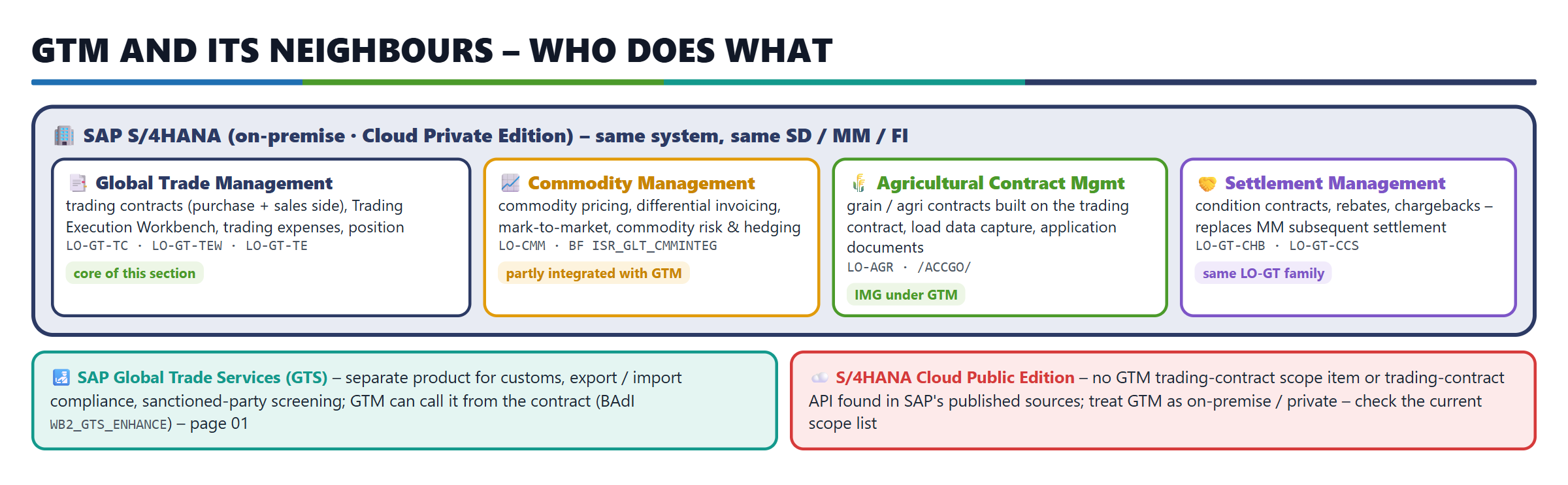
Product | Purpose | Relation to GTM |
|---|---|---|
Global Trade Management (LO-GT-TC / TEW / TE) | Trading contracts with purchase and sales side, execution workbench, trading expenses, position | This section |
Commodity Management (LO-CMM) | Commodity pricing, differential invoicing, mark-to-market, commodity risk and hedging | Partly integrated: pricing and payment events with GTM (ISR_GLT_CMMINTEG); CPM and logistical options not supported. Released APIs exist for commodity hedging (e.g. Commodity Hedge Specification, Commodity Hedge Book) |
Agricultural Contract Management (LO-AGR, namespace /ACCGO/) | Agri commodity contracts, load data capture, application documents, settlement | Built on the GTM trading contract (WBHK status, contract types); IMG under Global Trade Management |
Settlement Management (LO-GT-CHB / LO-GT-CCS) | Condition contracts, rebates, chargebacks | Same LO-GT family; replaces MM subsequent settlement in S/4HANA; Migration Cockpit object 'Condition contract' exists |
SAP Global Trade Services | Customs, export / import compliance, screening | Separate product, called from GTM via BAdI WB2_GTS_ENHANCE (page 01) |
- Typical interview trap: GTM is not GTS. GTM manages the commercial deal (buy and sell), GTS the legal side of crossing borders.
Part 6 – Migration paths and data migration
6.1 System conversion (brownfield)
- GTM converts with the system: contracts, document flow and expenses stay. The work is the pre-check, the custom code adaptation (Part 3), replacing obsolete transactions and deciding what happens with commodity functions that are not supported (CPM, logistical options, differential invoicing).
- Close or settle what depends on removed functions before conversion (for example open differential invoicing steps), and run the XPRAs and follow-up activities named in the notes (ACM: status conversion of approved contracts).
6.2 New implementation (greenfield)
- The migration object lists of the S/4HANA Migration Cockpit that were checked (on-premise 1909 and 2021) contain no trading contract object – only neighbours such as the condition contract.
- Options: a BAPI load program (BAPI_TRADINGCONTRACT_CREATE, then _RELEASE for contracts whose follow-on documents must exist), or an own migration object in the Migration Object Modeler (LTMOM) that calls the same BAPI. Load the open quantities only, with the legacy number in TKONN_EX.
- Order: master data (business partners, materials, conditions) → open purchase / sales documents or contracts → planned expenses → open positions. Reconcile quantities and values per contract after the load.
Migration Cockpit and LTMOM in general: ABAP on HANA › 02 Migration to S/4HANA.
Part 7 – Architect decisions
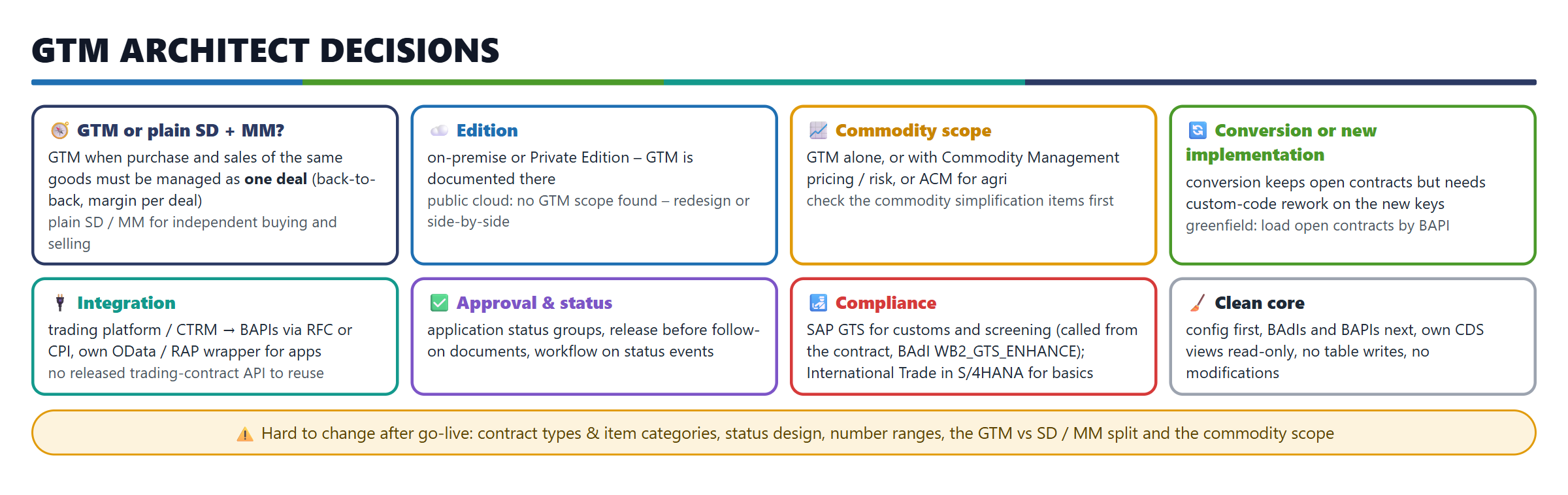
Decision | Options | Choose … when |
|---|---|---|
GTM or plain SD + MM | Trading contract vs separate purchase and sales documents | GTM when buying and selling the same goods is one deal (back-to-back, margin and expenses per deal, position); plain SD / MM for independent procurement and sales |
Edition | On-premise / Private Edition vs Public Edition | GTM requires on-premise or Private Edition today; public cloud only with redesign |
Commodity scope | GTM only, + Commodity Management, + ACM | Commodity Management for formula / market pricing and risk; ACM for agricultural trading – check the not-supported items first |
Conversion vs new implementation | Brownfield vs greenfield | Brownfield keeps history and open contracts but carries custom code; greenfield is cleaner but needs a contract load |
Integration | Direct RFC, CPI, own OData / RAP wrapper | CPI for external platforms and monitoring; own wrapper service for Fiori or BTP apps |
Approval and status | Status groups, workflow (approval app F0587: Business Suite only) | Release only from an approved status when limits or risk checks apply |
Compliance | SAP GTS vs S/4HANA International Trade | GTS for customs and screening on export business; International Trade for Intrastat and basics |
Expenses | Planned in the contract vs posted only at invoice | Plan expenses in the contract when the margin per deal must include freight, insurance and commission |
- Hard to change after go-live: contract types and item categories, status design, number ranges, the split between GTM and plain SD / MM, and the commodity scope. Record each decision with its reasons.
Part 8 – Clean core for GTM
Level | GTM examples | Clean-core rating |
|---|---|---|
Configuration | Contract types, item categories, status groups, copy control, output types | Best – no code |
SAP extension points | GTM BAdIs, BAPI extension parameters (approval app BAdIs: Business Suite only) | Allowed – stable SAP interfaces, keep implementations small |
Own read models | CDS view entities on WBHK / WBHI for reports and interfaces | Acceptable on-premise – tables are not released, so re-test at upgrades |
Side-by-side (SAP BTP) | Apps and integrations through an own wrapper service, CPI | Clean – decoupled, but the wrapper is your responsibility |
Direct table updates, modifications | UPDATE on WBHK, changes in WB2* includes | Avoid |
- Because GTM has no released API, clean core here is about discipline: every custom object goes through a BAdI, a BAPI or a read-only view, and is documented for the next upgrade. Clean core in general: ABAP on HANA › 08 Clean Core.
Part 9 – Roadmap and outlook
Topic | Direction |
|---|---|
GTM in S/4HANA | Available on-premise and in the Private Edition; no separate public roadmap for GTM was found – plan with the standard S/4HANA release and maintenance cycle |
Commodity functions | Innovation goes to Commodity Management (pricing, risk, hedging APIs) and ACM; some older GTM–commodity integrations are not supported in S/4HANA |
ACM | Delivered on S/4HANA with its own release notes; business function /ACCGO/BF_FP01 removed in S/4HANA 2025 |
APIs and RAP | No released trading contract API or RAP object so far – keep wrappers thin so they can be replaced if SAP releases one |
Tools | Simplification Item Catalog and readiness check; re-read the S4TWL items per release (the PDF Simplification List is still published) |
Part 10 – Interview questions
Q1. Does GTM still exist in S/4HANA?
Yes – trading contracts, the Trading Execution Workbench and trading expenses are part of S/4HANA (LO-GT) on-premise and in the Private Edition. The simplification item 'S4TWL – Global Trade Management' (Note 2267785) changes table keys and replaces some transactions.
Q2. What changes technically for GTM in a conversion?
Key fields of WBHF, WBGT, WBIT, WBASSOC, WCOCOF and the business volume tables are simplified, concatenated fields are replaced, item-number fields become NUMC; WB24 / WB25_COMP are replaced by WBRR and WB24N; differential invoicing is gone. Custom code on these tables must be adapted.
Q3. Which GTM functions are no longer available?
Differential invoicing (now in Commodity Management), retail pricing in the trading contract, the Contract Processing Monitor and logistical options of the commodity integration, the old document overview reports and the TC@Web user report.
Q4. Can I use GTM in S/4HANA Cloud Public Edition?
No GTM trading contract scope item or trading contract API is documented for the public cloud. Customers who need trading contracts choose on-premise or the Private Edition, or redesign the process with standard purchase and sales documents or side-by-side apps.
Q5. How do GTM, Commodity Management and ACM relate?
GTM manages trading contracts; Commodity Management adds commodity pricing, differential invoicing, mark-to-market and risk; ACM is the agricultural solution built on the trading contract with its own /ACCGO/ objects. In S/4HANA the GTM–CM integration is partly supported (pricing and payment events yes, CPM and logistical options no).
Q6. How do you migrate open trading contracts in a greenfield project?
There is no standard Migration Cockpit object for trading contracts, so you load them with BAPI_TRADINGCONTRACT_CREATE (and _RELEASE where follow-on documents are needed) in a load program or an own LTMOM object, keep the legacy number in TKONN_EX and reconcile quantities and values.
Q7. How do you find the GTM-relevant simplification items for a customer?
Run the readiness check and the simplification item check in the ERP system, then read the items in the Simplification Item Catalog: LO-GT for GTM, LO-CMM / LO-GT-CMM for commodity integration, LO-AGR for ACM. Use ATC with the S/4HANA checks for custom code.
Q8. When would you recommend GTM instead of plain SD and MM?
When the business buys and sells the same goods as one deal – back-to-back or from stock – and needs the margin, expenses, position and approval per deal. Independent buying and selling does not need GTM and is simpler in plain SD / MM.
Q9. What is the difference between GTM and GTS in an S/4HANA landscape?
GTM is the trading-contract application inside S/4HANA; SAP GTS is a separate product for customs, export / import compliance and screening. GTM can call GTS from the contract (BAdI WB2_GTS_ENHANCE); the successor of ECC SD / MM Foreign Trade is SAP S/4HANA for international trade (GTS e.g. for preference management), Intrastat stays in S/4HANA.
Q10. How do you keep GTM extensions clean-core when there is no released API?
Configuration first, then GTM BAdIs and BAPIs, read-only own CDS views, no table updates or modifications, and side-by-side apps only through an own thin wrapper service. Document each extension and re-test it at every upgrade.
Q11. What happened to the ACM approval tab in S/4HANA?
It was removed; contract approval is modelled with GTM status management – a status group with statuses such as draft and approved, assigned to the contract type. During conversion an XPRA sets WBHK-BTBSTA for contracts that were approved in ERP.
Q12. Which GTM decisions are hardest to change after go-live?
The split between GTM and plain SD / MM, contract types and item categories, status and approval design, number ranges and the commodity scope (CM, ACM) – they shape every document, interface and report.
🏠 Start Here · ◀ 05 · Development · 07 · Interview Questions ▶ · Sections: CORE ABAP | OOPS ABAP | ABAP on HANA | Clean Core | RAP | ABAP Points | SAP Fiori | SAPUI5 | Mobile Development (MDK) | BTP Foundations | BTP Development | CAP | SAP Build | ABAP on BTP | Integration Suite | SAP Business AI | SAP BASIS | Security | SAP SDLC
Functional: FICO ABAP | TRM ABAP | VIM | SAP BIS | SD ABAP | MM ABAP | PP ABAP | QM ABAP | PM ABAP | PS ABAP | EWM | TM ABAP | GTM ABAP | EHS ABAP | HR ABAP | BW | SAP Datasphere | SAP Business Data Cloud | SAP MDG | SAP Analytics Cloud | SAP Ariba | SAP CX | SAP IBP