What an ABAP developer actually builds in MM: checks and defaults in the purchase requisition and purchase order BAdIs, custom fields in ME21N, logic in MIGO and MIRO, programs that create documents with BAPIs, IDoc interfaces with suppliers, purchase order output and custom reports – and how all of this changes in S/4HANA (MATDOC, 40-character material number, released CDS views, APIs and clean-core extensibility). General techniques: CORE ABAP › 10 Enhancements, 07 Interfaces, 11 Forms; the same patterns for SD: SD ABAP › 04. Business background: pages 01 – 03.
Part 1 – Where to enhance MM: choosing the technique
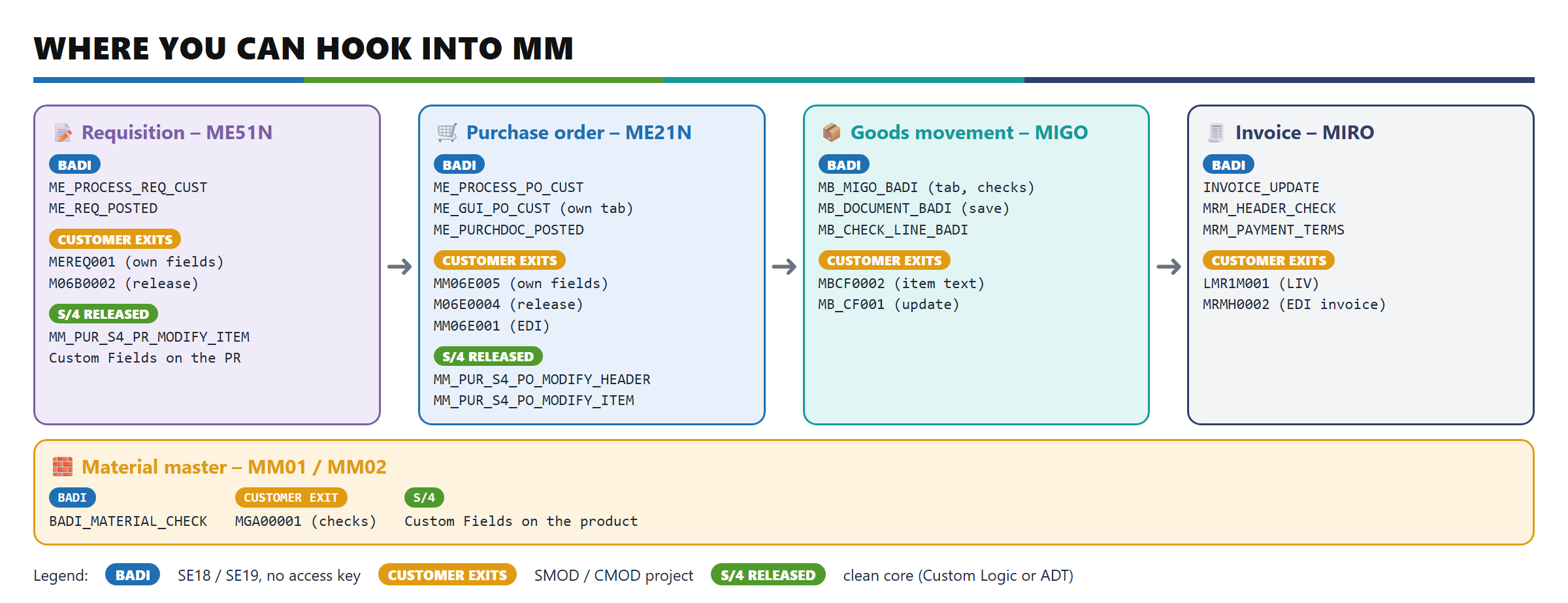
Requirement | Technique | Where |
|---|---|---|
Check or default fields in ME21N / ME22N | BAdI ME_PROCESS_PO_CUST | Part 2 |
Same for purchase requisitions (ME51N) | BAdI ME_PROCESS_REQ_CUST | Part 2 |
Own fields on the PO screen | Append CI_EKKODB / CI_EKPODB + MM06E005 or ME_GUI_PO_CUST | Parts 2.3, 3 |
Influence the release strategy | Exits M06E0004 (PO) / M06B0002 (PR); S/4HANA flexible workflow BAdIs | Part 3, page 02 |
Checks or own tab in MIGO | BAdI MB_MIGO_BADI / MB_CHECK_LINE_BADI | Part 4 |
Update own tables with the material document | BAdI MB_DOCUMENT_BADI | Part 4 |
Change or check the invoice in MIRO | BAdIs INVOICE_UPDATE, MRM_HEADER_CHECK, MRM_PAYMENT_TERMS | Part 4 |
Material master checks | BAdI BADI_MATERIAL_CHECK / exit MGA00001 | Part 4 |
Create documents from a program | BAPIs | Part 5 |
EDI with suppliers | IDocs ORDERS, ORDRSP, DESADV, INVOIC | Part 6 |
S/4HANA, clean core | Custom Fields, released BAdIs (MM_PUR_S4_…), released CDS views and APIs | Part 9 |
- MM has hardly any FORM-based user exits like SD's MV45AFZZ: use the BAdIs first, CMOD customer exits where no BAdI exists. Implement BAdIs in SE19, customer exits in CMOD after reading them in SMOD. How the techniques differ: CORE ABAP › 10 Enhancements.
Part 2 – Purchase requisition and purchase order BAdIs
2.1 ME_PROCESS_PO_CUST – the main purchase order BAdI
Called by the Enjoy purchase order (ME21N / ME22N / ME23N, also BAPI_PO_CREATE1 / BAPI_PO_CHANGE) at every change of header, item, schedule line or account assignment. Each method receives an object for the document part; read with GET_DATA( ), change with SET_DATA( ).
Method | When | Typical use |
|---|---|---|
INITIALIZE / OPEN | Start of the transaction / document opened | Initialise own buffers |
PROCESS_HEADER | Header data changed | Default or check header fields (IM_HEADER, IF_PURCHASE_ORDER_MM, data MEPOHEADER) |
PROCESS_ITEM | Item changed | Default or check item fields (IM_ITEM, IF_PURCHASE_ORDER_ITEM_MM, data MEPOITEM) |
PROCESS_SCHEDULE / PROCESS_ACCOUNT | Schedule line / account assignment changed | Delivery date or cost center rules |
CHECK | Check button or save | Final checks over the whole document; set CH_FAILED = abap_true to stop the save |
POST | Document is saved, number known | Write own Z tables (same LUW) |
CLOSE | Document closed | Clear buffers |
FIELDSELECTION_HEADER / _ITEM | Screen field control | Make fields display-only, mandatory or hidden |
|
- Use the macros of include MM_MESSAGES_MAC (
mmpur_message_forced,mmpur_metafield) so the message appears in the PO message log and points to the field – a plainMESSAGE … TYPE 'E'would break the Enjoy transaction and the BAPI. - Never
COMMIT WORKin these methods; POST runs inside the SAP LUW of the purchase order. - ME_PURCHDOC_POSTED (method POSTED) runs after the document has been posted – for follow-up actions that must not change the PO.
2.2 ME_PROCESS_REQ_CUST – purchase requisition
The same design for ME51N / ME52N / ME53N and BAPI_PR_CREATE / BAPI_PR_CHANGE: PROCESS_HEADER, PROCESS_ITEM (IF_PURCHASE_REQUISITION_ITEM, data MEREQ_ITEM), PROCESS_ACCOUNT, CHECK, POST, FIELDSELECTION_*. ME_REQ_POSTED runs after the requisition is saved.
2.3 Custom fields in ME21N
- Add the ZZ fields to the customer includes CI_EKKODB (header, table EKKO) or CI_EKPODB (item, table EKPO).
- Screen: either customer exit MM06E005 (subscreens of SAPMM06E, Part 3) or BAdI ME_GUI_PO_CUST, which adds an own tab: methods SUBSCRIBE (register the subscreen), MAP_DYNPRO_FIELDS, TRANSPORT_FROM_MODEL / TRANSPORT_TO_DYNP (PBO) and TRANSPORT_FROM_DYNP / TRANSPORT_TO_MODEL (PAI). SAP ships an example implementation (function group MEPOBADIEX).
- ME_PROCESS_PO_CUST then checks the new fields like standard ones.
- For BAPI_PO_CREATE1 / BAPI_PO_CHANGE: add the fields to BAPI_TE_MEPOHEADER(X) / BAPI_TE_MEPOITEM(X) and pass them in EXTENSIONIN (BAPIPAREX).
- S/4HANA: the Custom Fields app (the procurement business contexts for the purchasing document header and item) does all of this without modification – the field appears in ME21N, the Fiori apps and the APIs (Part 9).
Part 3 – Customer exits in MM
Enhancement (SMOD) | Area | Use |
|---|---|---|
MM06E005 | Purchasing documents | Customer fields in the PO header / item: subscreens on SAPMM06E, function exits EXIT_SAPMM06E_006 / _007 / _008 (header), _016 / _017 / _018 (item), _012 (check before save) |
MEREQ001 | Purchase requisition | Customer fields in the requisition (CI_EBANDB) |
M06E0004 | PO release | Fill own fields of the release communication structure CEKKO, so the release strategy can use them |
M06B0002 | PR release | Same for the requisition (communication structure CEBAN) |
MM06E001 | EDI purchasing | Custom segments in outbound ORDERS / ORDCHG and inbound ORDRSP |
MBCF0002 | Goods movement | Fill the item text MSEG-SGTXT (EXIT_SAPMM07M_001) |
MB_CF001 | Goods movement | Called when the material document is updated (EXIT_SAPLMBMB_001) |
LMR1M001 | Invoice verification | User exits in logistics invoice verification (function exits EXIT_SAPLMR1M_*; read the components in SMOD) |
MRMH0002 | EDI incoming invoice | Determine supplier, company code, tax code or unplanned costs differently (EXIT_SAPLMRMH_011 – _015) |
MGA00001 | Material master | Additional checks when a material is saved |
- Steps: SMOD → read the components → CMOD → create a project → assign the enhancement → write the code in the Z include of the function exit → activate the project.
- Customer exits are classic, on-premise only. In S/4HANA most of them still work but are not clean-core; prefer BAdIs or the released S/4HANA BAdIs (Part 9.3).
Part 4 – BAdIs for goods movements, invoices and the material master
BAdI | Area | Methods / use |
|---|---|---|
MB_MIGO_BADI | MIGO | Own tab and fields (PBO_DETAIL / PAI_DETAIL, PBO_HEADER / PAI_HEADER), change lines (LINE_MODIFY), checks (CHECK_ITEM), own data at posting (POST_DOCUMENT); register in INIT |
MB_CHECK_LINE_BADI | Goods movements | Check the material document lines before they are transferred to the lock table (CHECK_LINE, also for BAPI postings) |
MB_DOCUMENT_BADI | Material document | MB_DOCUMENT_BEFORE_UPDATE (before the update task) and MB_DOCUMENT_UPDATE (in the update task) with tables XMKPF, XMSEG – write own tables, trigger follow-ups |
INVOICE_UPDATE | MIRO | CHANGE_AT_SAVE (check, stop the save), CHANGE_BEFORE_UPDATE, CHANGE_IN_UPDATE |
MRM_HEADER_CHECK | MIRO | Check the invoice header data |
MRM_PAYMENT_TERMS | MIRO | Set payment terms or payment block (PAYMENT_TERMS_SET) |
BADI_MATERIAL_CHECK | Material master | CHECK_DATA: validations when a material is saved (MM01 / MM02 and BAPI_MATERIAL_SAVEDATA) |
- Do not post another goods movement or call
COMMIT WORKin MB_DOCUMENT_BADI – it runs inside the update of the first one. Start follow-up postings asynchronously (e.g. a background job or a qRFC). - Finding the right BAdI: breakpoint on
CL_EXITHANDLER=>GET_INSTANCE(classic BAdIs) or on the statementGET BADI(new BAdIs) while running the transaction; SE18 / SE84 by package (ME purchasing, MB inventory management, MRM invoice verification); SPRO → Materials Management → … → Business Add-Ins per area. - Release strategy and output also have BAdIs, but these are mostly configuration-driven; in S/4HANA the flexible workflow for PR and PO has its own BAdIs for agent determination and conditions (page 02).
Part 5 – BAPIs: requisitions, orders, goods movements, invoices, materials
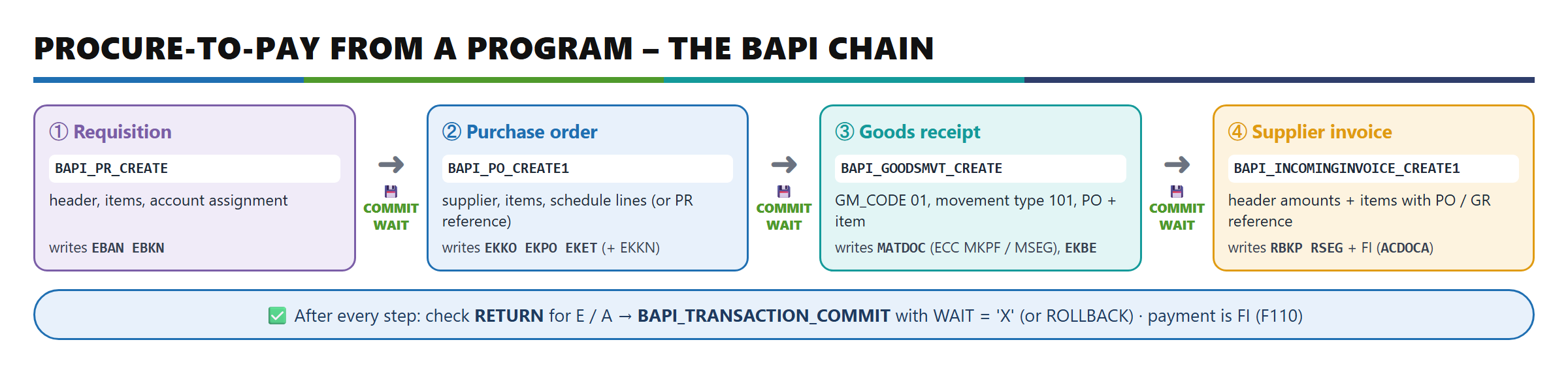
BAPI / FM | Purpose |
|---|---|
BAPI_PR_CREATE / BAPI_PR_CHANGE | Create / change a purchase requisition (ME51N logic) |
BAPI_PO_CREATE1 | Create a purchase order (ME21N logic, runs ME_PROCESS_PO_CUST) |
BAPI_PO_CHANGE | Change a PO; delete an item with POITEM-DELETE_IND = 'L' |
BAPI_PO_GETDETAIL1 | Read a PO with items, schedule lines, account assignment, history |
BAPI_PO_RELEASE / BAPI_PO_RESET_RELEASE | Release a PO with a release code / cancel the release |
BAPI_GOODSMVT_CREATE | Post any goods movement (MIGO logic) |
BAPI_GOODSMVT_CANCEL | Reverse a material document |
BAPI_INCOMINGINVOICE_CREATE1 | Post a supplier invoice with PO reference (MIRO); BAPI_INCOMINGINVOICE_PARK parks it |
BAPI_MATERIAL_SAVEDATA | Create or extend / change a material (all views) |
BAPI_MATERIAL_GET_DETAIL, BAPI_MATERIAL_STOCK_REQ_LIST | Read material data / the MD04 stock-requirements list |
BAPI_TRANSACTION_COMMIT / _ROLLBACK | End the LUW – BAPIs never commit themselves |
5.1 Example: create a purchase order
- Every structure has an …X partner that marks the fields you filled; item and schedule keys are repeated in the X tables (PO_ITEMX, SCHED_LINEX = 'X').
- Supplier numbers with leading zeros; the schedule line DELIVERY_DATE is a 10-character field in the user's date format – convert it with
DATE = USER.
|
- S/4HANA: for 40-character material numbers fill MATERIAL_LONG (and the X flag) instead of MATERIAL. Conditions go into POCOND / POCONDX; a PR reference into POITEM-PREQ_NO / PREQ_ITEM.
5.2 Example: goods receipt with BAPI_GOODSMVT_CREATE
GM_CODE | Transaction it replaces | Use |
|---|---|---|
01 | MB01 | Goods receipt for purchase order |
02 | MB31 | Goods receipt for production order |
03 | MB1A | Goods issue |
04 | MB1B | Transfer posting |
05 | MB1C | Other goods receipts |
06 | MB11 | Reversal of goods movements |
07 | MB04 | Subsequent adjustment for a subcontract order |
|
- MVT_IND: B purchase order, F production order, blank for other movements (then give MATERIAL, and e.g. COSTCENTER for 201 or MOVE_STLOC for 311).
- Call it once per LUW: commit (or roll back) before the next call. Test without posting with TESTRUN = abap_true.
- MB_DOCUMENT_BADI and MB_CHECK_LINE_BADI run for BAPI postings too.
5.3 Invoices and materials
- BAPI_INCOMINGINVOICE_CREATE1: HEADERDATA (INVOICE_IND = 'X' for an invoice, DOC_DATE, PSTNG_DATE, COMP_CODE, GROSS_AMOUNT, CURRENCY, CALC_TAX_IND), ITEMDATA per PO item (PO_NUMBER, PO_ITEM, REF_DOC / REF_DOC_YEAR / REF_DOC_IT for GR-based invoice verification, TAX_CODE, ITEM_AMOUNT, QUANTITY, PO_UNIT); returns INVOICEDOCNUMBER and FISCALYEAR. Tolerance checks and payment blocks work as in MIRO.
- BAPI_MATERIAL_SAVEDATA: HEADDATA (material, industry sector, material type, view flags such as BASIC_VIEW, PURCHASE_VIEW, ACCOUNT_VIEW), CLIENTDATA / CLIENTDATAX (MARA), PLANTDATA / PLANTDATAX (MARC), VALUATIONDATA / VALUATIONDATAX (MBEW), table MATERIALDESCRIPTION (MAKT). RETURN is a single structure; all messages are in RETURNMESSAGES. Internal numbers first with BAPI_MATERIAL_GETINTNUMBER. In S/4HANA the product API API_PRODUCT_SRV is the clean-core alternative.
Part 6 – IDocs in MM
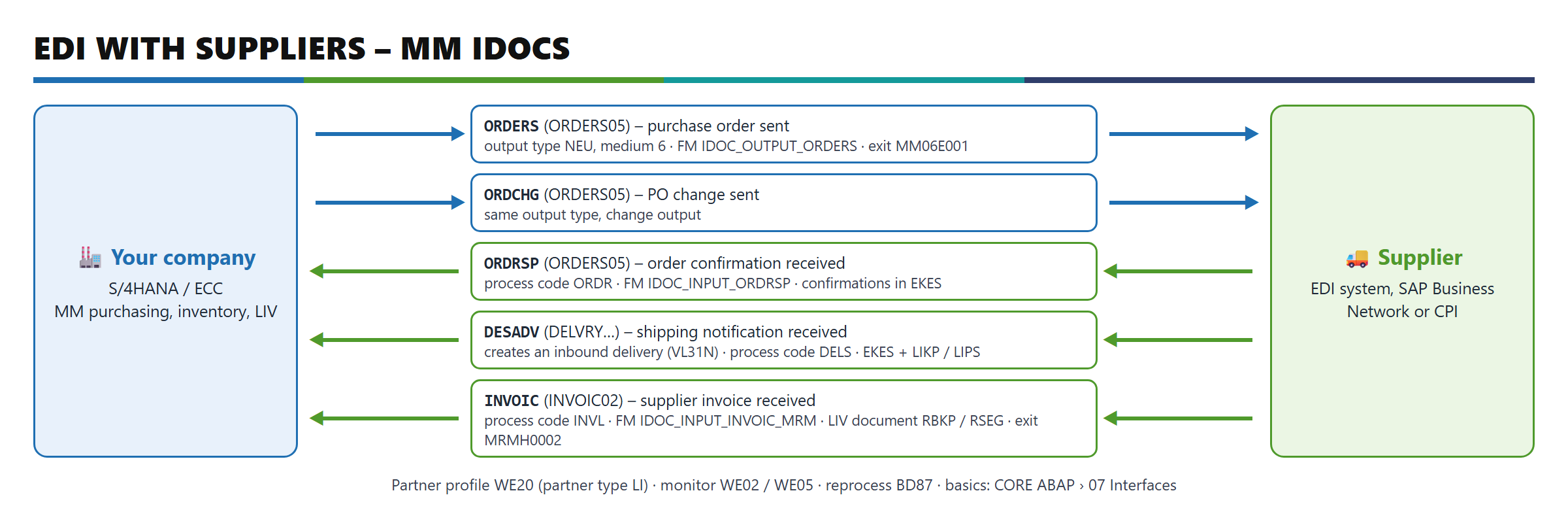
Message type | Basic type | Direction | Meaning | Processing |
|---|---|---|---|---|
ORDERS | ORDERS05 | Outbound | Purchase order to the supplier | Output type NEU with medium 6 (EDI); FM IDOC_OUTPUT_ORDERS; exit MM06E001 |
ORDCHG | ORDERS05 | Outbound | PO change | Change output of the PO; FM IDOC_OUTPUT_ORDCHG |
ORDRSP | ORDERS05 | Inbound | Order confirmation of the supplier | Process code ORDR, FM IDOC_INPUT_ORDRSP; confirmations in EKES |
DESADV | DELVRY03 (or later) | Inbound | Shipping notification → inbound delivery | Process code DELS; inbound delivery (VL31N) in LIKP / LIPS + confirmation in EKES |
INVOIC | INVOIC01 / INVOIC02 | Inbound | Supplier invoice → LIV document | Process code INVL, FM IDOC_INPUT_INVOIC_MRM; exit MRMH0002 |
MBGMCR | MBGMCR03 | Inbound | Goods movement (calls BAPI_GOODSMVT_CREATE) | ALE, e.g. from a warehouse system |
MATMAS / CREMAS / INFREC | MATMAS05 / CREMAS05 … | Both | Material, supplier, info record distribution (ALE) | – |
- Outbound PO IDocs are triggered by output determination: output type with medium 6 (EDI) and a partner profile (WE20, partner type LI = supplier) with message type ORDERS.
- Custom data: extend the basic type with a Z segment (WE31 / WE30), fill it in the customer exit (MM06E001 outbound, MRMH0002 inbound invoice).
- ALE / IDoc basics (ports, partner profiles, WE19 test tool, BD87 reprocessing): CORE ABAP › 07 Interfaces. In S/4HANA many companies connect suppliers through SAP Business Network or SAP Cloud Integration with SOAP / OData APIs instead of IDocs.
Part 7 – Purchase order output and forms
NACE application | Documents | Output type / program / form |
|---|---|---|
EF | Purchase order | NEU; program SAPFM06P, FORM ENTRY_NEU; SAPscript MEDRUCK |
EA | RFQ | NEU; SAPFM06P; MEDRUCK |
EV / EL | Contracts / scheduling agreements | NEU / LPH1 …; SAPFM06P |
ME | Inventory management (GR / GI slips) | WE01 / WE02 / WE03; program SAPM07DR; reprint with MB90 |
MR | Invoice verification (e.g. ERS notices) | Program and form per output type |
- Condition records for PO output: MN04 create, MN05 change, MN06 display; (re)send output: ME9F. The output record is in NAST (NAST-OBJKY = PO number).
- Custom form: copy MEDRUCK (or build a Smart Form / Adobe form), copy SAPFM06P only if the data retrieval must change, and enter program, FORM routine and form in NACE → output type → processing routines (TNAPR). Layout details: CORE ABAP › 11 Forms.
- SAPscript texts (PO header and item texts) are stored in STXH (header) and STXL (lines); read them with READ_TEXT (object EKKO / EKPO).
- S/4HANA output management: purchase orders use BRF+-based output determination (Fiori app Output Parameter Determination) with Adobe form templates (e.g. MM_PUR_PURCHASE_ORDER) and form data providers as the alternative to NAST and SAPFM06P; on-premise, NAST-based PO output is still supported (choose per object type in Customizing: Output Control → Manage Activation of Object Type) – the same model as SD ABAP › 03.
Part 8 – Common custom reports
Report | Main tables / views | Standard alternative |
|---|---|---|
Open purchase orders (not yet delivered) | EKKO + EKPO + EKET (MENGE > WEMNG), EKPO-ELIKZ / LOEKZ; I_PurchaseOrderItemAPI01 | ME2M, ME2L, ME2N, ME80FN |
GR/IR balances per PO item | EKBE summed by VGABE 1 (GR) and 2 (IR) | MB5S, Monitor GR/IR Account Balances |
Stock per material and storage location | MARD (ECC) / MATDOC via NSDM views; I_MaterialStock_2 | MMBE, MB52, MB5B |
Material documents of a period | MKPF + MSEG / MATDOC; I_MaterialDocumentItem_2 | MB51 |
Invoices per supplier | RBKP + RSEG | MIR6, Manage Supplier Invoices |
Purchasing value per supplier | EKKO + EKPO (S011 / S012 in ECC LIS) | ME81N, procurement analytics |
- The open-PO SELECT on EKKO / EKPO / EKET is on page 02 (Part 4.2); the same report on released CDS views is in Part 9.2 below.
Part 9 – S/4HANA for MM developers
9.1 Simplifications that change your code
Area | ECC | S/4HANA | What to do in code |
|---|---|---|---|
Material documents and stock | MKPF / MSEG + stock tables MARD, MCHB … | MATDOC; compatibility views NSDM_E_* | SELECTs still work; no writes to stock tables; new code on MATDOC or CDS views (page 03 Part 2) |
Material number | MATNR 18 characters | MATNR 40 characters | No hard-coded lengths or offsets; BAPI fields …_LONG (MATERIAL_LONG) |
Supplier master | XK01 / MK01 / FK01, LFA1 … | Business partner (BP, CVI); LFA1, LFB1, LFM1 still filled | Create / change suppliers via BP APIs (page 01) |
Goods movement t-codes | MB01, MB1A, MB1B, MB1C, MB31, MB11 … | MIGO only | Batch inputs on MB* → BAPI_GOODSMVT_CREATE |
Purchasing t-codes | ME21 / ME22 / ME23, ME51 / ME52 / ME53 | Enjoy ME21N … ME53N, Fiori apps | Replace batch inputs with BAPIs |
PO conditions | KONV | PRCD_ELEMENTS | Replace SELECTs on KONV |
Release | Classic release strategy | Release strategy or flexible workflow for PR / PO | BAdIs of the flexible workflow |
Services | ESSR / ESLL service entry sheets | Lean services (service items, Fiori service entry sheet) | Check reports on ESSR / ESLL |
MRP | MD01 / MD02 classic MRP | MRP Live (MD01N), runs in HANA | Check MRP exits / BAdIs |
Valuation | Material ledger optional, FAGLFLEXA | Material ledger mandatory, ACDOCA | Read values from ACDOCA / CDS views |
Statistics | LIS S011, S012, S013, S031 | Embedded analytics on CDS views | Replace LIS-based reports |
Output | NACE / NAST, SAPFM06P | Output management (BRF+, Adobe); NAST still supported for POs on-premise | Part 7 |
- Find affected custom code with ATC and the S/4HANA readiness checks / Custom Code Migration app (ABAP on HANA › 02 Migration & Performance).
9.2 Released CDS views and APIs
Released CDS view (VDM) | Content |
|---|---|
I_PurchaseOrderAPI01 / I_PurchaseOrderItemAPI01 | Purchase order header / items |
I_PurchaseRequisitionItemAPI01 | Purchase requisition items |
I_MaterialDocumentHeader_2 / I_MaterialDocumentItem_2 | Material documents (on MATDOC) |
I_MaterialStock_2 | Stock quantities by material, plant, storage location, stock type |
I_Product, I_ProductDescription, I_Supplier | Master data |
I_SupplierInvoiceAPI01 | Supplier invoices |
|
API | Protocol | Use |
|---|---|---|
API_PURCHASEORDER_PROCESS_SRV | OData V2 | Create, read, change purchase orders (deprecated in S/4HANA Cloud Public Edition since 2308 – successor API_PURCHASEORDER_2) |
API_PURCHASEORDER_2 | OData V4, RAP-based | Newer purchase order API |
API_PURCHASEREQ_PROCESS_SRV | OData V2 | Purchase requisitions |
API_MATERIAL_DOCUMENT_SRV | OData V2 | Post and read goods movements |
API_MATERIAL_STOCK_SRV | OData V2 | Read stock |
API_SUPPLIERINVOICE_PROCESS_SRV | OData V2 | Create and read supplier invoices |
API_PRODUCT_SRV, API_BUSINESS_PARTNER | OData V2 | Product master, suppliers as business partners |
All released APIs and views are listed on the SAP Business Accelerator Hub (api.sap.com). CDS and OData basics: ABAP on HANA › 05 CDS Views.
9.3 Clean-core extensibility for MM
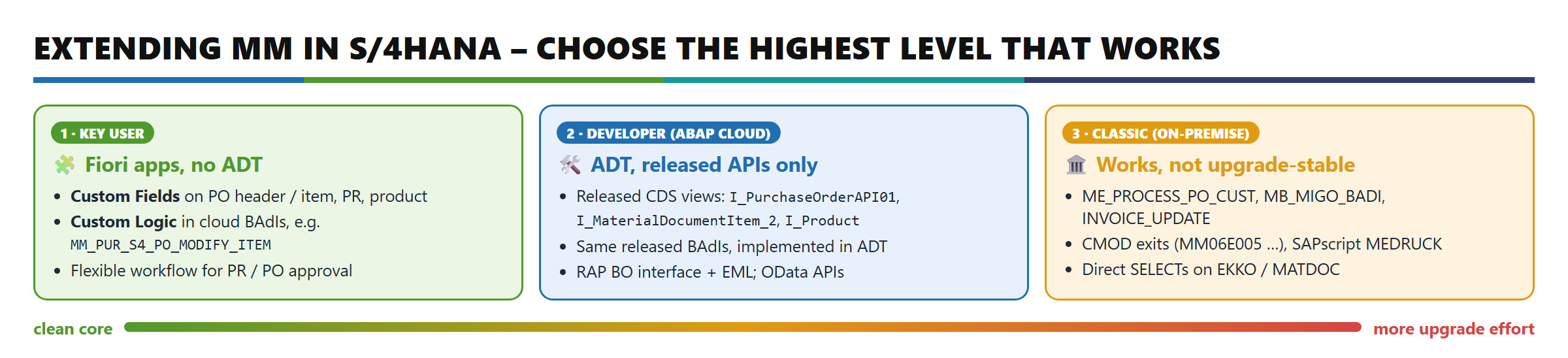
- Key user: Custom Fields on PO / PR / product and Custom Logic in released BAdIs such as MM_PUR_S4_PO_MODIFY_HEADER / MM_PUR_S4_PO_MODIFY_ITEM (change PO data) and MM_PUR_S4_PR_MODIFY_ITEM for requisition items.
- Developer extensibility (ABAP Cloud): the same released BAdIs in ADT, released CDS views, own RAP apps; the purchase order is available as a RAP business object interface for EML (I_PurchaseOrderTP_2) – see RAP › 08 · EML.
- Classic extensibility (on-premise only): ME_PROCESS_PO_CUST, MB_MIGO_BADI, CMOD exits, SAPscript forms, direct table reads – allowed, but not upgrade-stable. Choose the highest level that solves the requirement (Clean Core › 01 Clean Core).
Part 10 – Interview questions
Q1. Which BAdI do you use to validate a purchase order?
ME_PROCESS_PO_CUST: PROCESS_HEADER / PROCESS_ITEM for field checks and defaults, CHECK for checks over the whole document (CH_FAILED stops the save), POST to write own tables. Messages via the MM_MESSAGES_MAC macros and IM_ITEM->INVALIDATE( ).
Q2. How do you add a custom field to the purchase order?
Append it to CI_EKKODB / CI_EKPODB, add a screen with customer exit MM06E005 or BAdI ME_GUI_PO_CUST, check it in ME_PROCESS_PO_CUST, and for BAPIs extend BAPI_TE_MEPOITEM(X) for EXTENSIONIN. In S/4HANA use the Custom Fields app.
Q3. Which enhancements exist for MIGO?
MB_MIGO_BADI (own tab, line changes, checks, POST_DOCUMENT), MB_CHECK_LINE_BADI (line checks), MB_DOCUMENT_BADI (before / in the update of the material document), exits MBCF0002 (item text) and MB_CF001.
Q4. What is GM_CODE in BAPI_GOODSMVT_CREATE?
The transaction the posting is based on: 01 GR for PO, 02 GR for production order, 03 goods issue, 04 transfer posting, 05 other receipts, 06 reversal, 07 subcontracting adjustment. Together with movement type and MVT_IND it decides which fields are required.
Q5. Why does your second BAPI_GOODSMVT_CREATE call in a loop fail?
The BAPI must be called once per LUW: call BAPI_TRANSACTION_COMMIT (WAIT = 'X') or ROLLBACK after each document before the next call.
Q6. How do you create a purchase order from a program?
BAPI_PO_CREATE1 with POHEADER / POITEM / POSCHEDULE and their X structures, check RETURN for E / A, then BAPI_TRANSACTION_COMMIT with WAIT. The BAdI ME_PROCESS_PO_CUST runs as in ME21N.
Q7. Which IDocs are used in MM?
ORDERS (PO out, ORDERS05), ORDCHG (PO change), ORDRSP (order confirmation in → EKES), DESADV (shipping notification in → inbound delivery), INVOIC (supplier invoice in via IDOC_INPUT_INVOIC_MRM), MBGMCR for goods movements.
Q8. How is the purchase order printed?
ECC: NACE application EF, output type NEU, program SAPFM06P with SAPscript MEDRUCK (or a custom Smart Form / Adobe form), condition records MN04, output record in NAST. S/4HANA: output management with BRF+ and Adobe form templates; NAST-based output is still supported for POs on-premise.
Q9. Which BAdI changes the invoice in MIRO?
INVOICE_UPDATE (CHANGE_AT_SAVE for checks, CHANGE_BEFORE_UPDATE, CHANGE_IN_UPDATE); MRM_HEADER_CHECK for header checks; MRM_PAYMENT_TERMS for payment terms and blocks; exits LMR1M001 and MRMH0002 (EDI).
Q10. Your old report reads MKPF, MSEG and KONV and uses 18-character material numbers. What changes in S/4HANA?
MKPF / MSEG are served from MATDOC through compatibility views (works, but read MATDOC or I_MaterialDocumentItem_2 for new code); KONV is replaced by PRCD_ELEMENTS; MATNR has 40 characters, so remove fixed lengths and offsets and use the …_LONG BAPI fields.
Q11. How do you write an open purchase order report?
Join EKKO, EKPO and EKET: purchase orders (BSTYP F), items not deleted and not delivery-completed, schedule lines with WEMNG < MENGE. In S/4HANA or ABAP Cloud use I_PurchaseOrderAPI01 / I_PurchaseOrderItemAPI01.
Q12. How would you extend the purchase order in a clean-core way?
Custom Fields for new fields, Custom Logic or ADT implementations of released BAdIs (MM_PUR_S4_PO_…) for logic, released CDS views and APIs (API_PURCHASEORDER_PROCESS_SRV – OData V2, deprecated in Public Edition since 2308 – or its OData V4 successor API_PURCHASEORDER_2) for reading and integration – ME_PROCESS_PO_CUST and CMOD exits only on-premise when no released option exists.
🏠 Start Here · ◀ 03 · Inventory & Invoices · 05 · T-Codes & Tables ▶ · Sections: CORE ABAP | OOPS ABAP | ABAP on HANA | Clean Core | RAP | ABAP Points | SAP Fiori | SAPUI5 | Mobile Development (MDK) | BTP Foundations | BTP Development | CAP | SAP Build | ABAP on BTP | Integration Suite | SAP Business AI | SAP BASIS | Security | SAP SDLC
Functional: FICO ABAP | TRM ABAP | VIM | SAP BIS | SD ABAP | MM ABAP | PP ABAP | QM ABAP | PM ABAP | PS ABAP | EWM | TM ABAP | GTM ABAP | EHS ABAP | HR ABAP | BW | SAP Datasphere | SAP Business Data Cloud | SAP MDG | SAP Analytics Cloud | SAP Ariba | SAP CX | SAP IBP