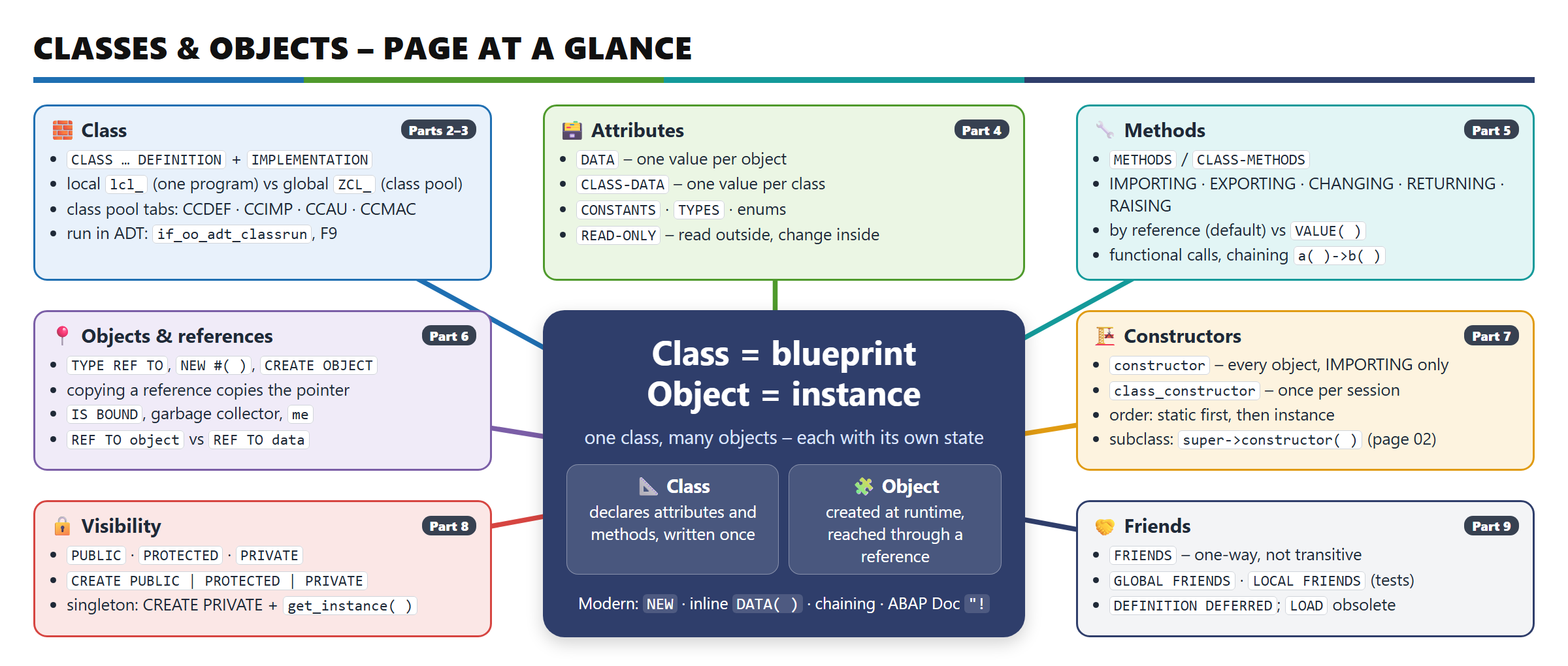
The foundation of ABAP Objects: what a class and an object are, how to define a class, its attributes and methods, how objects are created and referenced, constructors, visibility, friends and the modern syntax. Inheritance, polymorphism, interfaces and casting follow on page 02; exceptions, events and design patterns on page 03.
Page at a glance
Part 1 – Procedural vs object-oriented
Procedural (structured, modular) languages such as C, Pascal and COBOL put the emphasis on functions: data and functions are kept apart, any routine can read and change the data, and functions are grouped by modularization. Object-oriented languages (Java, C++, C#) bundle the data with the methods that guard it into objects that model real-world things (a car, a person, a traffic light).
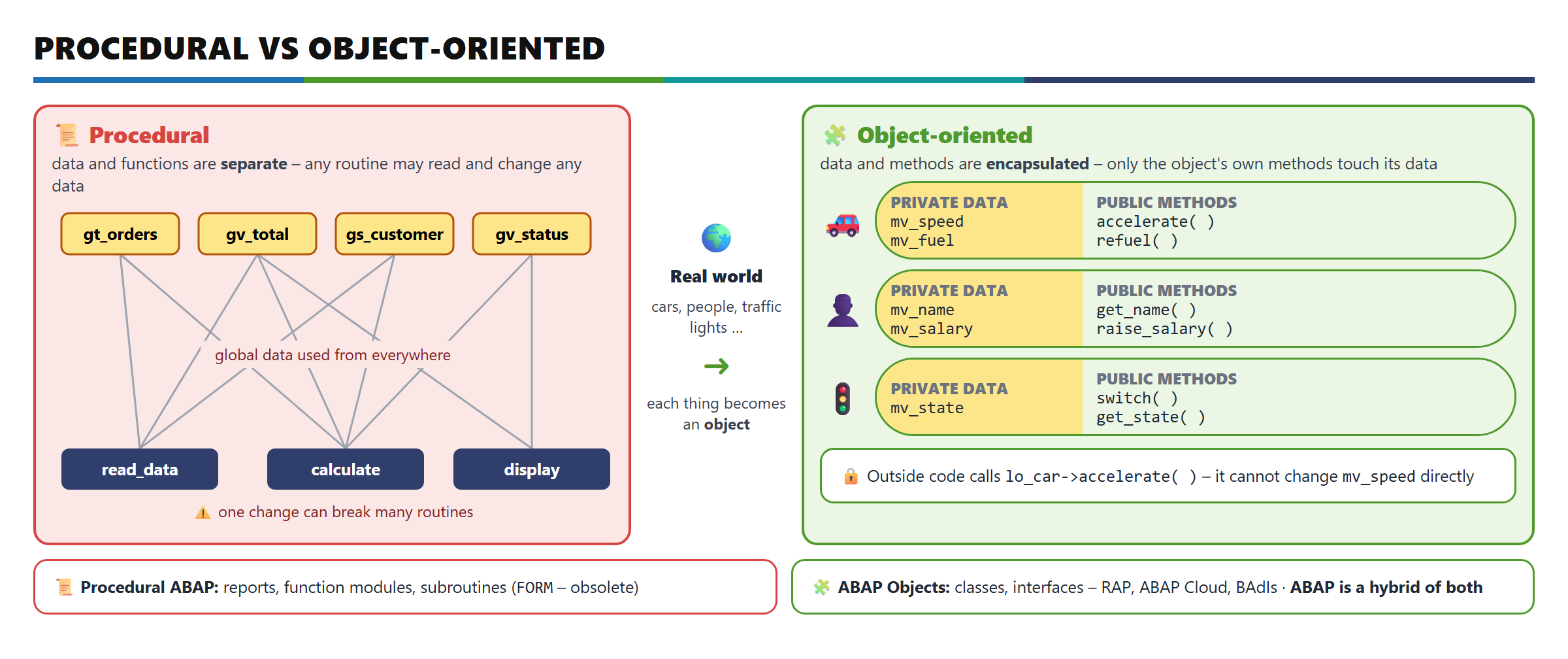
- ABAP is a hybrid language: classic procedural ABAP (reports, FORMs, function modules) plus ABAP Objects. New code – RAP, ABAP Cloud, BAdIs, ALV with classes – is object-oriented.
The four OO principles
Principle | Meaning | How ABAP achieves it |
|---|---|---|
Encapsulation | Bind data and the methods that work on it into one unit; hide the internals (information hiding) | The class; visibility sections PUBLIC / PROTECTED / PRIVATE |
Abstraction | Show only the essential behaviour, not how it is done | A small public API, abstract classes, interfaces (page 02) |
Inheritance | A subclass takes over the components of its superclass |
|
Polymorphism | "Many forms": one call, different behaviour depending on the object | Redefinition + interfaces with dynamic binding – reuse and enhancement (page 02) |
Access specifiers implement encapsulation; abstraction is about exposing only what callers need (interfaces, abstract classes).
Benefits of ABAP Objects
- Better reusability and data security (data can only change through the class's own methods).
- Less complexity: each class has one job; easy to maintain, modify and extend.
- Real-world entities (customer, sales order, connection) are modelled naturally.
- Required for modern frameworks: RAP, BAdIs, SALV / ALV grid, ABAP Unit, ABAP Cloud.
Part 2 – Class and object, local vs global
A class is a template (blueprint) for objects. It declares attributes (data = the object's state) and methods (functions = its behaviour). An object is an instance of a class, created at runtime with its own copy of the instance attributes. Example: class employee; Jack and Rose are two employee objects.
- Like
TYPESin classic ABAP, the class definition itself creates no instance data. Memory for instance attributes is allocated only byCREATE OBJECTorNEW. - A loaded class does take memory: once a class is loaded, its static attributes and its code are in memory. Only the instance attributes wait for object creation.
Kinds of classes you will meet
Kind | What it is | Where |
|---|---|---|
Usual class | Normal application logic | This page |
Exception class |
| Page 03 |
Test class | ABAP Unit test: | Page 03 |
Persistent class | Object Services: object state mapped to a DB table – Legacy, use RAP | Page 03 |
Abstract class |
| Page 02 |
Final class |
| Page 02 |
Public / protected / private class | Who may create instances: | Part 8 |
Test methods are not abstract – they are normal (concrete) methods marked FOR TESTING. "Friend class" is a relationship (Part 9) and "singleton" a design pattern (Part 8, page 03), not class kinds.
Local vs global classes
Local class | Global class | |
|---|---|---|
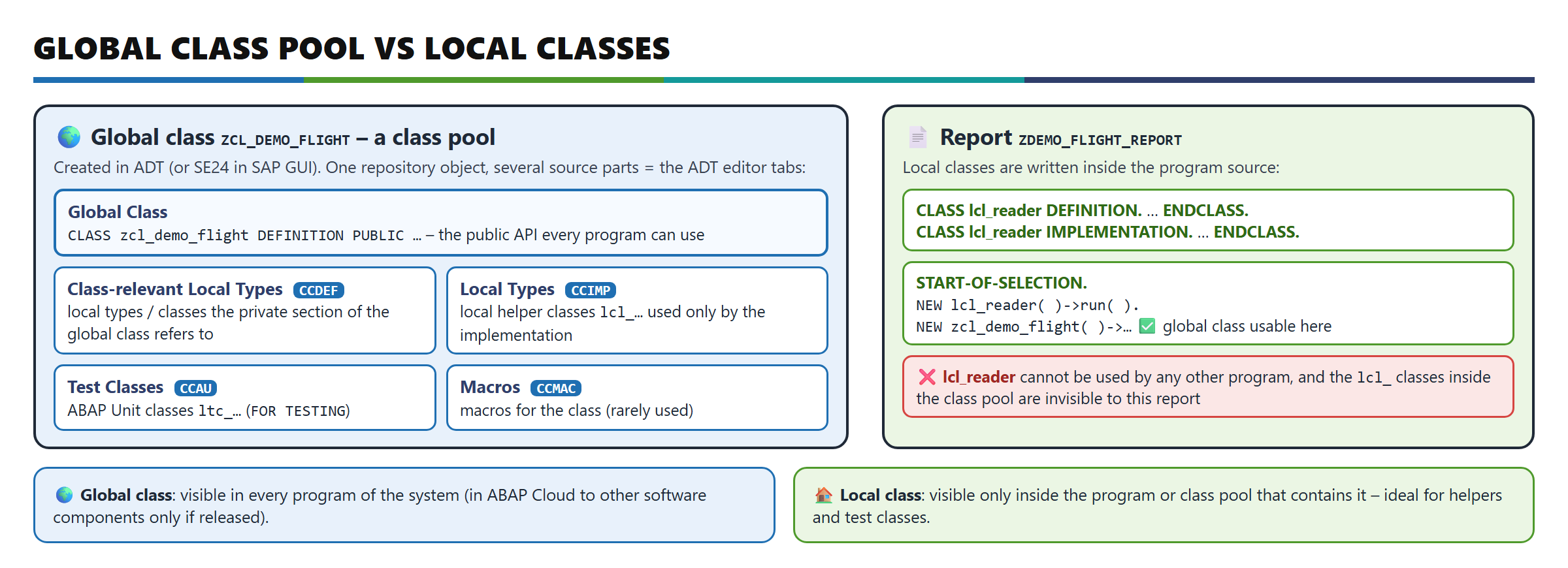
Defined in | One program (report, function group, class pool include) | Class Builder SE24 or ADT (Eclipse); stored in its own class pool |
Visible to | Only that program | Every program in the system (ABAP Cloud: if released / same software component) |
Naming |
|
|
Typical use | Helper classes, report logic, test classes | Reusable logic, BAdI implementations, RAP behaviour pools |
- A global class pool has extra includes for local helpers. In ADT they are the tabs Class-relevant Local Types (CCDEF), Local Types (CCIMP), Test Classes (CCAU) and Macros (CCMAC).
- SE24 is SAP GUI only; ABAP Cloud and RAP development is done in ADT.
Part 3 – Defining a class
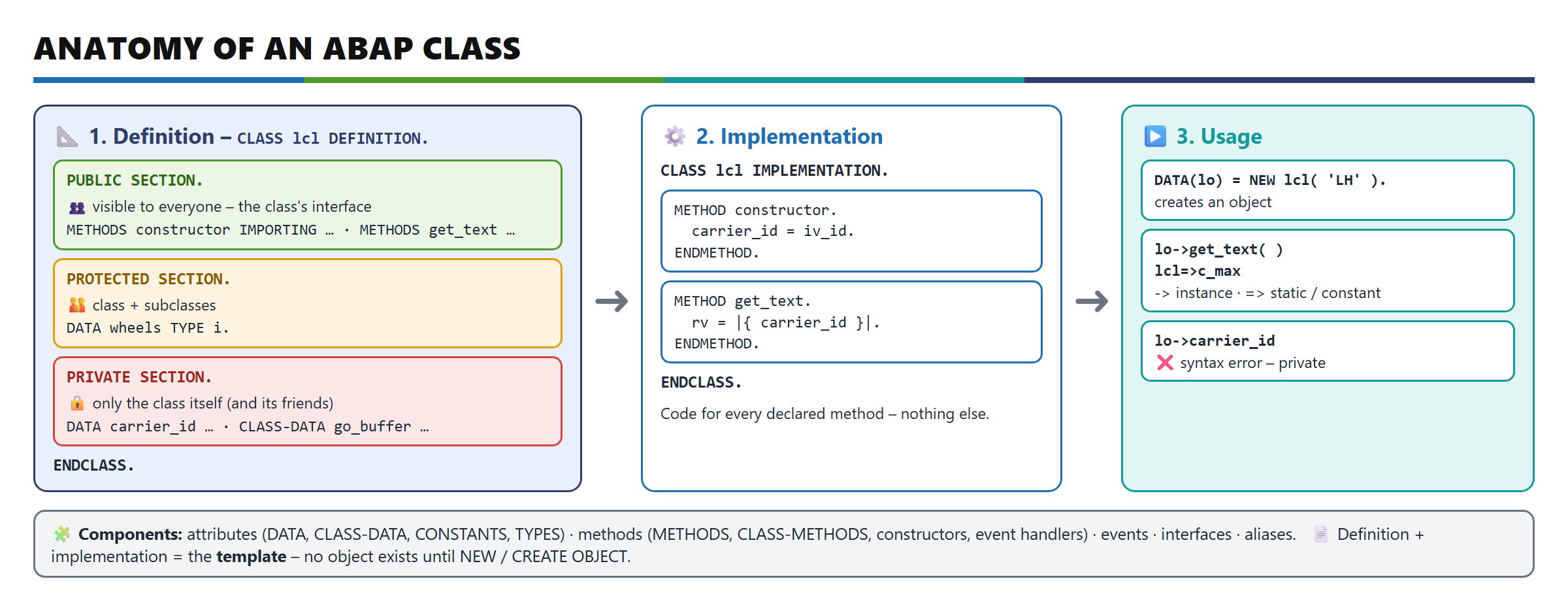
A class has two parts: the definition (declares the components, split into visibility sections) and the implementation (the code of the methods). Neither part creates an object – together they are the template.
|
- A class that declares methods needs an implementation part; a class with only attributes/types does not.
- Writing
PUBLICafter DEFINITION makes a class global only inside a class pool – you cannot turn a local class in a report into a global one.DEFERREDandLOADare separate statement variants (Part 9), not additions to combine with the others, and the instantiation addition is writtenCREATE PUBLIC | PROTECTED | PRIVATE. - Local classes: the sections must appear in the order PUBLIC, PROTECTED, PRIVATE.
- In a report, define and implement local classes at the top, then write
START-OF-SELECTION.explicitly to mark where execution starts.
Components of a class
Component | Kinds | Declared with |
|---|---|---|
Attributes | Instance, static, constants; plus local types |
|
Methods | Instance, static; special: instance and static constructor; event handler methods |
|
Events | Instance and static events (page 03) |
|
Interfaces | Implemented interfaces (page 02) | INTERFACES |
Aliases | Short names for interface components (page 02) | ALIASES |
Friends and macros are not components – friendship is a relationship (Part 9), macros are a source section of the class pool.
A complete local class (runnable report)
|
A global class skeleton (ADT)
|
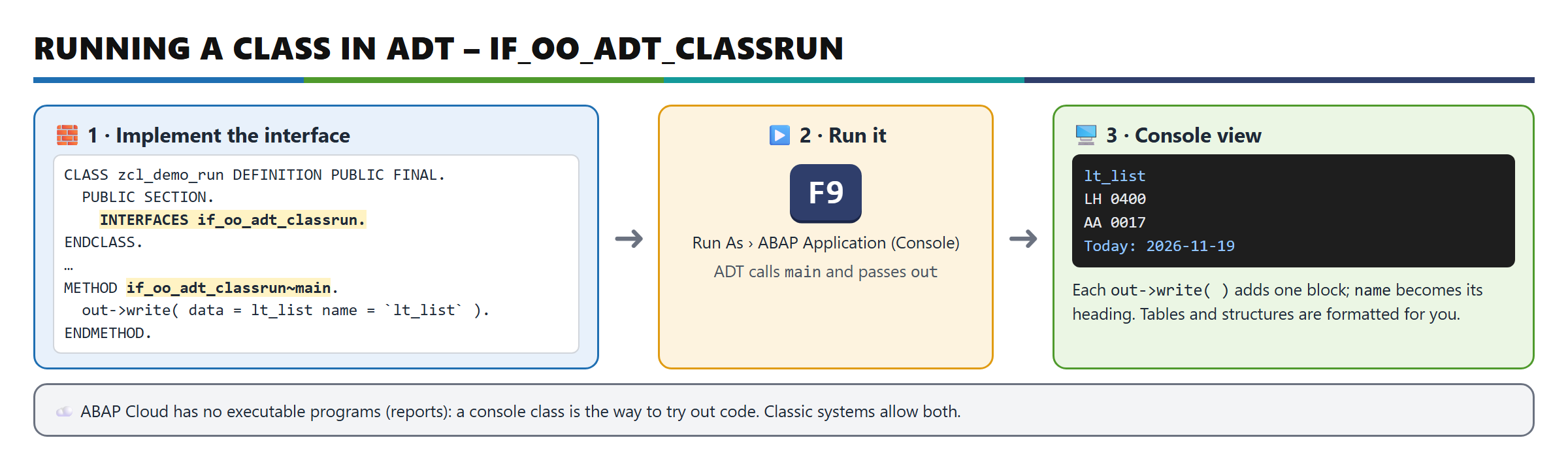
Running a class in ADT (IF_OO_ADT_CLASSRUN)
ABAP Cloud has no executable programs (reports), so the way to run code and see a result is a global class that implements the released interface IF_OO_ADT_CLASSRUN. When you press F9 (Run As › ABAP Application (Console)), ADT calls its method main and passes out, a reference to an output object. Everything written to out appears in the Console view. It works the same way in a classic system with ADT.
|
out->write( data = … name = … ):datatakes any data object – elementary, structure or internal table – and formats it; the optionalnamebecomes its heading. A string template works for plain text.- Only
mainis called: there is no selection screen and no user input. Put test values in the code, and use ABAP Unit (page 03) for checks you want to repeat. - Classic output such as
WRITElists and the demo classCL_DEMO_OUTPUTbelongs to classic ABAP. In ABAP Cloud useout->write( )(check the API state of any class in your system before you rely on it).
Documenting a class: ABAP Doc
ABAP Doc comments start with "! and stand directly before a declaration – the class, a method, an attribute or a type. ADT shows them in the ABAP Element Info view and in the F2 pop-up wherever the element is used, so callers see the documentation without opening the class.
|
@parameter <name> | <text>documents a parameter,@raising <exception class> | <text>a declared exception. A normal"comment is not ABAP Doc and is not shown in Element Info.- Clean ABAP: write ABAP Doc for public APIs – classes and methods meant for other teams or applications, and every released API – not for internal helpers.
- The example also shows the Clean ABAP naming style without prefixes (see Part 5);
zcx_demo_flightstands for an exception class like those on page 03.
Part 4 – Attributes
An attribute is a variable of the class that stores data. Three kinds hold data; TYPES only defines templates.
Instance attributes | Static attributes | Constants | |
|---|---|---|---|
Keyword | DATA |
|
|
Belongs to | One object: every object gets its own memory for each instance attribute | The class: memory allocated once when the class is loaded, shared by all objects | The class: allocated once when loaded, never changes |
Access | Only through an object: | Through the class: | lcl=>c_name |
Use it when | Each object needs a different value (carrier id) | All objects need one common value (object counter, buffer) | The value is fixed (max seats, status codes) |
- Types (
TYPES) allocate no memory. Use them to declare variables, work areas or internal tables inside the class (or outside, aslcl=>ty_name, if they are public). - Instances of the same class share the static values but their instance values are independent: in the example in Part 3,
lo_lhholds LH/0400 andlo_aaAA/0017, whileconn_counter= 2 exists once. (The picture in Part 6 creates a third object, so its counter shows 3.) - READ-ONLY (public section):
DATA status TYPE c LENGTH 1 READ-ONLY.– everyone may read it, only the class itself may change it. Details in Part 8. - Enumerations (7.51+): an enumerated type in the public section gives a method a parameter that accepts only the listed values. The enum constants are components of the class (
lcl_order=>released). Syntax details in ABAP on HANA › 03 ABAP New Syntax 7.4/7.5+; RTTI for enums (CL_ABAP_ENUMDESCR) on page 03.
|
Part 5 – Methods and parameters
A method is a block of code implemented once and called any number of times – the OO successor of subroutines and function modules (see CORE ABAP › 04 Modularization & Debugging).
Subroutine (obsolete) | Function module | Method | |
|---|---|---|---|
Defined | FORM … ENDFORM |
|
|
Called | PERFORM f | CALL FUNCTION 'F' |
|
Parameters | USING, CHANGING, TABLES | IMPORTING, EXPORTING, CHANGING, TABLES, EXCEPTIONS | IMPORTING, EXPORTING, CHANGING, RETURNING, RAISING |
Three steps: declare the method (prototype) in the definition, implement it in the implementation, call it from outside or from another method.
|
Instance vs static methods
Instance methods ( | Static methods ( | |
|---|---|---|
Can use directly | All components of the class: instance, static, constants, types | Only static components, constants and types – no instance attributes, no |
Called through | An object: | The class: |
Typical use | Behaviour of one object | Factories, utilities, |
A static method can still work with an object it receives as a parameter or creates – it just has no "current" object of its own. And "an instance method can access everything" holds within its own class: a subclass method cannot touch the superclass's private components.
Parameter kinds
Kind | Direction | Rules |
|---|---|---|
IMPORTING | Caller → method | Mandatory by default; |
EXPORTING | Method → caller | Always optional for the caller; any number. |
CHANGING | Both ways | Caller passes a variable, the method may change it. |
RETURNING | Method → caller, one result | Exactly one per method, always |
- Declaration order: IMPORTING, EXPORTING, CHANGING, RETURNING, then RAISING (or classic EXCEPTIONS).
- More additions:
PREFERRED PARAMETER(which optional importing parameter a single unnamed value goes to) andIS SUPPLIED(inside the method: did the caller pass this optional parameter?). - Naming: many classic projects use prefixes –
iv_ / ev_ / cv_ / rv_(v = value, s = structure, t = table, o = object) orim_ / ex_ / ch_ / re_. SAP's Clean ABAP style guide recommends the opposite: drop all encoding prefixes (result = a + binstead ofrv_result = iv_a + iv_b) and simply call the RETURNING parameterresult. Follow your project's convention and know both views for interviews. The examples on this page keep the prefixes so the parameter kind stays visible.
Pass by reference vs pass by value
By default all parameters except RETURNING are passed by reference. Any IMPORTING, EXPORTING or CHANGING parameter can be declared VALUE(p); RETURNING must be.
Kind | By reference (default) | By value – |
|---|---|---|
IMPORTING | Points to the caller's variable; writing to it is a syntax error. Fastest. | Local copy – the method may change it, the caller never sees the change. |
EXPORTING | Writes go straight into the caller's variable. Not cleared at the start – the method sees the caller's old value, so set it explicitly. | Starts initial, copied back only when the method ends normally (not after an exception). |
CHANGING | Changes are visible to the caller at once, even if an exception follows. | Copy in, copy back at normal end only. |
RETURNING | Not allowed | Always by value |
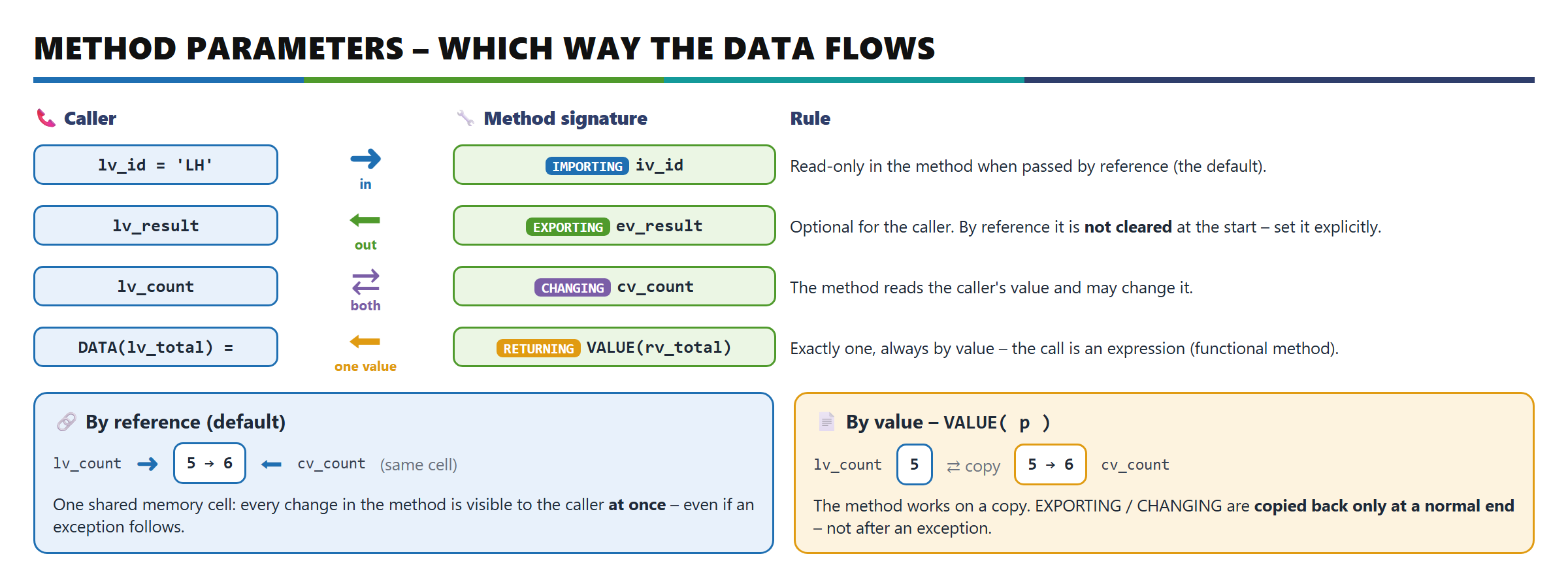
The same three passing kinds are drawn for subroutines in CORE ABAP › 04 Modularization & Debugging.
Functional methods – the modern rules
A method with a RETURNING parameter is a functional method. Its call is an expression, so it can be used wherever a value is expected.
- Since 7.40 SP02 a functional method may also have EXPORTING and CHANGING parameters. The old rule "only IMPORTING + RETURNING" (and "RETURNING cannot be combined with EXPORTING/CHANGING – prior EHP7") is outdated.
- Allowed is not the same as recommended. Clean ABAP: use either RETURNING or EXPORTING or CHANGING, not a combination – several kinds of output parameters show that the method does more than one thing. Prefer RETURNING: shorter calls and method chaining.
- One RETURNING parameter only; always by value. You cannot declare it OPTIONAL – but the caller may ignore the result (call it like a normal method).
- Where it can be used: right side of assignments, logical expressions (
IF,WHILE,CASE), arithmetic and string expressions, as an actual parameter of another method, and in method chains. - RETURN with a value (ABAP 7.58 and ABAP Cloud – check your release): in a functional method
RETURN <expression>.assigns the expression to the RETURNING parameter and leaves the method at once, e.g.RETURN lv_net * lv_rate.orRETURN VALUE #( carrier_id = 'LH' ).
|
Calling methods – all the shapes
|
Remember: the caller's keywords are the mirror image of the signature – the method IMPORTs what the caller EXPORTs.
Part 6 – Creating objects, references and ME
Creating an object (instantiating the class) is two steps: declare a reference variable (it allocates no object, it can only point to one), then create the object – memory for the instance attributes is allocated and the reference points to it.
|
NEW #( )takes the type from the target variable;NEW lcl_x( )names the class (needed with inlineDATA( )). With no parameters writeNEW #( )– at least one blank between the brackets.- Dynamic creation:
CREATE OBJECT lo TYPE (lv_class_name).– the class name is known only at runtime. OnlyCREATE OBJECTcan do this;NEWcannot take a dynamic class name. Constructor parameters are passed in a parameter table of typeABAP_PARMBIND_TAB(each value as a data reference). In ABAP Cloud the dynamic name must be a released class or one of your own.
|
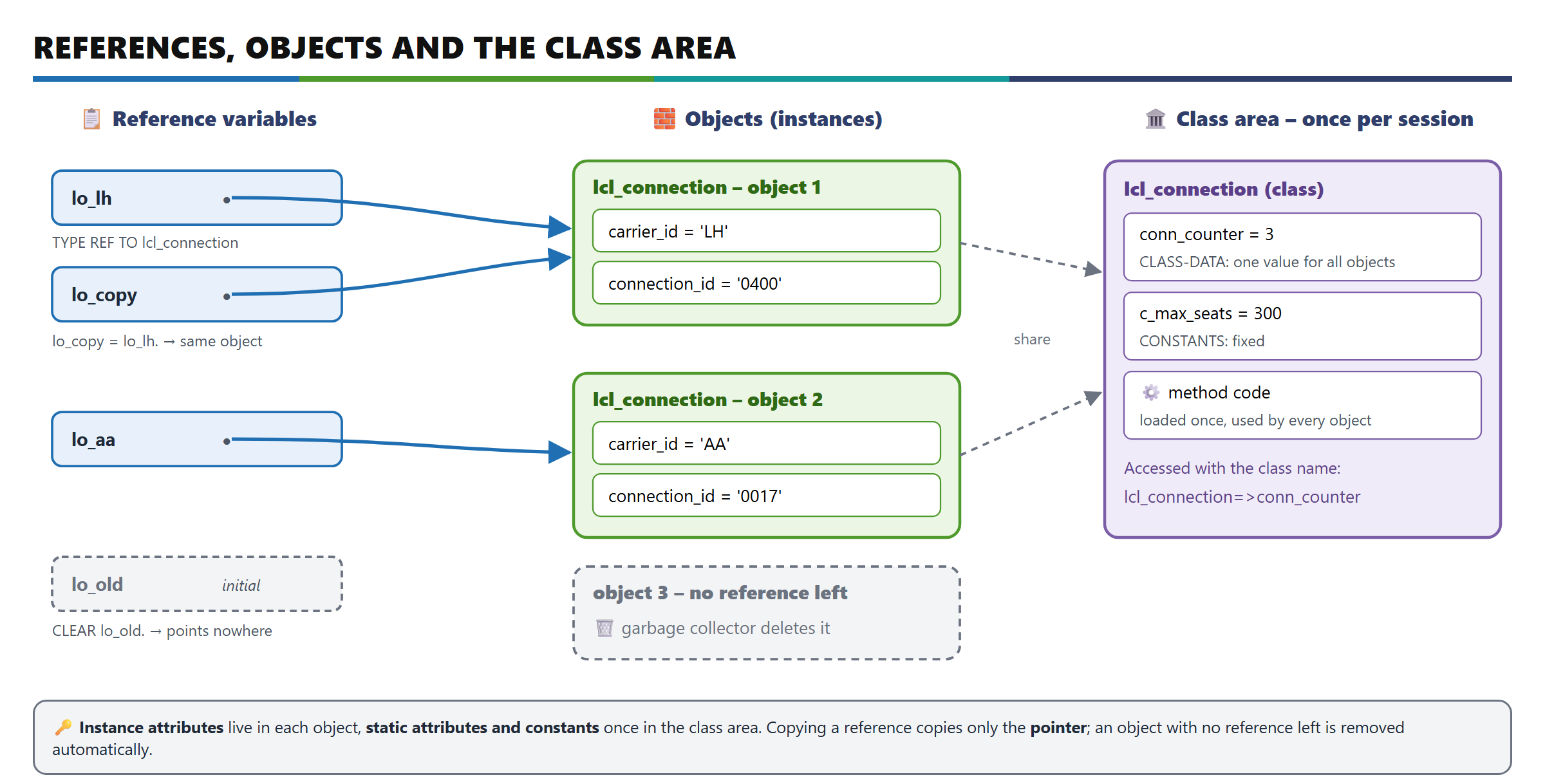
Reference semantics
lo_b = lo_a.copies the pointer, not the object – both variables now point to the same object; a change throughlo_bis visible throughlo_a.IF lo_a IS BOUND.– does it point to an object?IS INITIAL– is it empty?CLEAR lo_a.– drop the pointer.- Calling a method through an initial reference raises
CX_SY_REF_IS_INITIAL(short dump OBJECTS_OBJREF_NOT_ASSIGNED if not caught). - The garbage collector deletes an object as soon as no reference points to it any more – at the latest when the internal session ends. There is no explicit "delete object" statement.
Component selectors
Selector | Meaning | Example |
|---|---|---|
-> | Instance component through an object reference | lo_conn->get_description( ) |
=> | Static component or constant through the class (or interface) name | lcl_connection=>conn_counter |
~ | Interface component (page 02) | lo->zif_printable~print( ) |
->* | Dereference a data reference (not used for object references) | lr_data->* |
Generic references: REF TO object and REF TO data
ABAP has two kinds of reference variables. An object reference (TYPE REF TO <class or interface>) points to an instance of a class. A data reference (TYPE REF TO <data type>) points to a data object – a variable, a structure, a table row or an anonymous data object. Each has a fully generic form: REF TO object for any object and REF TO data for any data.
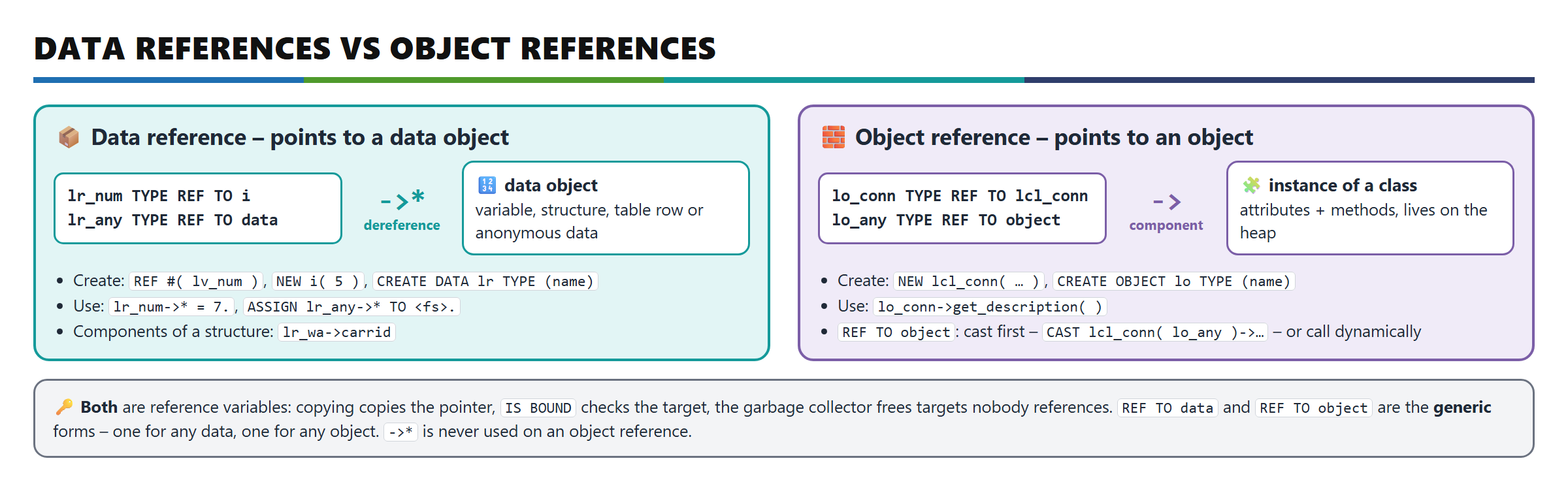
Data reference | Object reference | |
|---|---|---|
Declared |
|
|
Points to | A data object (named or anonymous) | An instance of a class |
Created with |
|
|
Access |
|
|
Generic form |
|
|
|
- Both kinds follow the same reference semantics: copying copies the pointer,
IS BOUNDchecks the target, and the garbage collector frees a target nobody references. - An object reference is never dereferenced with
->*, and methods cannot be called through a data reference.
ME – the self-reference
ME is an implicit, read-only reference variable that points to the object whose instance method is running. No object is created for it; ME is just a pointer to the current one. It does not exist in static methods.
- Use it to make an attribute explicit when a local variable or parameter has the same name:
me->carrier_id = carrier_id. - Pass the current object to others:
lo_logger->register( me ).,SET HANDLER on_click FOR me.(page 03), or returnro_self = me.to allow chaining.
Part 7 – Constructors
Constructors are special methods that initialise a class or an object. They are never called explicitly – the runtime calls them automatically.
Analogy: a report's INITIALIZATION event fills selection-screen fields with defaults. Without a constructor, a new object's attributes start with each type's initial value (or VALUE); with a constructor they start with whatever the constructor sets.
Instance constructor | Static constructor | |
|---|---|---|
Declaration | METHODS constructor IMPORTING … [RAISING …]. | CLASS-METHODS class_constructor. |
Parameters | Only IMPORTING (mandatory or optional) and exceptions | None, and no exceptions |
Runs | Once for every object, during | Once per class per internal session, just before the class is first used |
Visibility | Public normally. Local classes: may sit in a section at least as visible as the CREATE addition (e.g. PRIVATE in a local | Always public section |
Typical use | Check and store the values passed at creation | Fill static attributes once: buffers, customizing reads |
- The static constructor runs before the first of: creating an object, accessing a static attribute, calling a static method, registering a static event handler – also when a subclass is used first.
- Declaring
DATA lo TYPE REF TO lcl_x.triggers nothing – no constructor runs until the class is actually used. - If the instance constructor has mandatory IMPORTING parameters, you must pass them at creation:
NEW lcl_x( iv_id = 1 ). - If the instance constructor raises an exception, the object is not created and the reference keeps its old value.
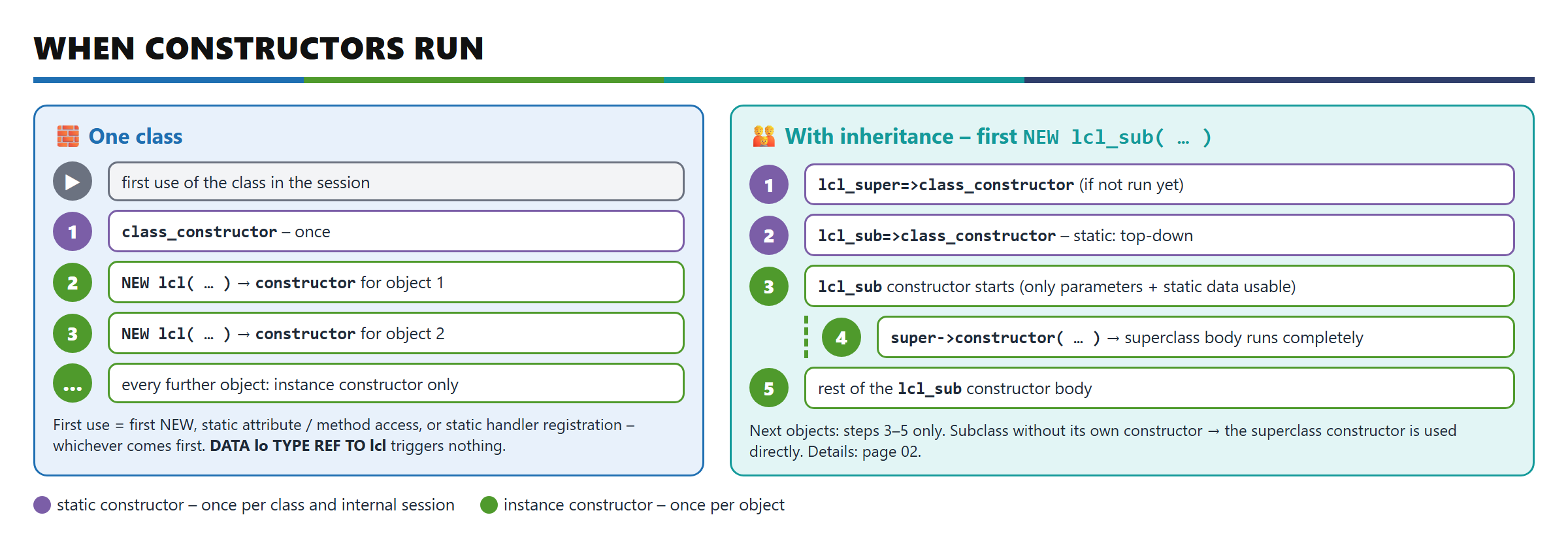
Sequence of execution
- Class with both constructors, first object created before any static access: static constructor, then the instance constructor for that object. From the second object on, only the instance constructor.
- Static access first (e.g.
lcl=>get_count( )): the static constructor runs then; later objects run only the instance constructor. - With inheritance: static constructors run top-down (superclass first, each once), and every subclass constructor must call
super->constructor( ). The five scenarios are on page 02 (Constructors in subclasses).
Normal vs special methods
Normal methods | Special methods (constructors) | |
|---|---|---|
Section | Any section | Static constructor public only; instance constructor usually public (see above) |
Call | Explicitly, any number of times on the same object | Implicitly: instance constructor once per object, static constructor once per class and session |
Parameters | IMPORTING, EXPORTING, CHANGING, RETURNING, RAISING | Instance: IMPORTING + exceptions; static: none |
Return values | Any number (EXPORTING/CHANGING) or one RETURNING | Never |
Only the static constructor must always be public; in a local class the instance constructor may also be declared in the protected or private section. In a global class, leave it public (Clean ABAP: "If your global class is CREATE PRIVATE, leave the CONSTRUCTOR public").
Part 8 – Visibility and encapsulation
Visibility works on two levels: component level – who may access an attribute or method – and class level – who may create instances (CREATE …).
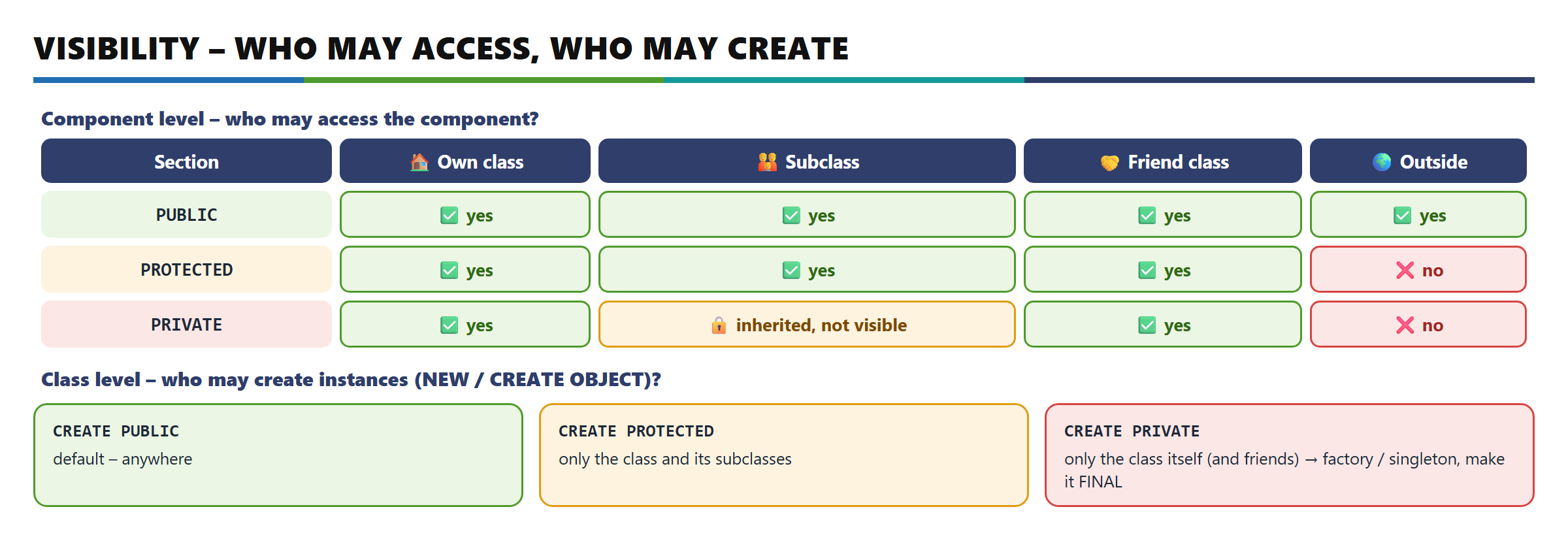
Section | Same class | Subclasses | Outside (other classes, programs) | Role |
|---|---|---|---|---|
PUBLIC | Yes | Yes | Yes | The class's interface to its users |
PROTECTED | Yes | Yes | No | A special interface between a class and its subclasses |
PRIVATE | Yes | No (inherited, but not visible) | No | Internal – not part of any interface |
Friends (Part 9) may access protected and private components too. Private components are inherited – they exist in every subclass object and the superclass's methods use them – but the subclass cannot see them (page 02).
Encapsulation in practice
Client programs should not change attributes directly. They call a method that checks consistency – for example whether the carrier and connection combination is valid – and rejects invalid values. Then no other part of the program can bypass the check, knowingly or by accident. This is one of the main advantages of OO.
|
Two ways to restrict access to an attribute:
Option | Declaration | Outside the class |
|---|---|---|
READ-ONLY | Keep it in the PUBLIC section: | Read allowed, write forbidden |
PRIVATE / PROTECTED | Move it to the PRIVATE (or PROTECTED) section | Read and write forbidden; offer getter/setter methods |
- READ-ONLY is used in the public section (and in interfaces).
- ADT quick fix: put the cursor on the attribute, press Ctrl+1, choose "Make <attribute> private".
- Rule of thumb: attributes in PRIVATE (or PROTECTED), methods in PUBLIC; access internal data only through public methods.
Class level: who may create instances
Addition | Instances can be created | Inheritance |
|---|---|---|
| Anywhere: in the class, in subclasses, outside | Can be inherited |
CREATE PROTECTED | Only in methods of the class and of its subclasses | Can be inherited |
CREATE PRIVATE | Only in methods of the class itself (and its friends) – outsiders get the object from a static method (factory, singleton) | Subclasses can only be instantiated if the superclass declares them a FRIEND – so make such classes FINAL |
- A subclass without its own CREATE addition takes over the superclass's setting and can override it explicitly (for CREATE PRIVATE only as a friend).
- ABSTRACT is not a fourth "class visibility" – it is a separate addition (page 02).
Singleton (only one instance per session) – the classic use of CREATE PRIVATE. More patterns on page 03.
|
Part 9 – Friends, DEFERRED and LOAD
Normally only public components are reachable from outside. A class can grant friendship to other classes (or interfaces): their methods may then access all its components, including protected and private ones.
|
- Direction:
CLASS a DEFINITION FRIENDS b.– A grants, B's methods get access to A. Objects of A used outside do not get extra access. - Friendship is one-way and not transitive (a friend of B is not a friend of A). Subclasses of the friend B are friends too; subclasses of A do not inherit A's friendships.
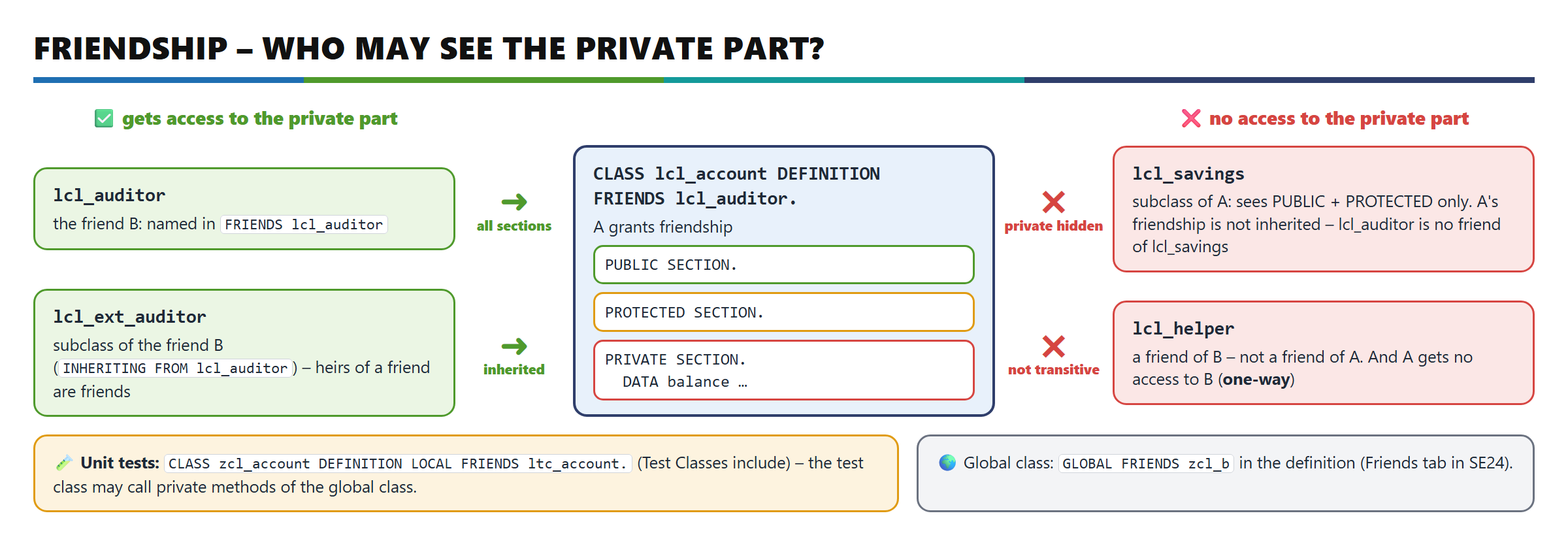
- Global classes:
GLOBAL FRIENDS zcl_b(SE24: Friends tab). For unit tests a global class grants access to its local test class:CLASS zcl_x DEFINITION LOCAL FRIENDS ltc_x.(page 03). - Use friendship sparingly – it breaks encapsulation. Typical uses: test classes, factories, tightly coupled helper classes.
DEFERRED
CLASS lcl_b DEFINITION DEFERRED. tells the compiler that lcl_b is defined later in the program, so it can already be referenced (as a friend, or in TYPE REF TO). Needed only when the class is used before its definition – not always for friends.
LOAD – Legacy
CLASS zcl_x DEFINITION LOAD. (and INTERFACE zif_x LOAD.) is obsolete. It was only ever needed when a program failed to compile because of recursive access to global classes or interfaces. Such recursions are now avoided and the compiler ignores the statement; know it only if an interviewer asks.
Part 10 – Modern syntax quick reference
Classic | Modern (7.40+) | Note |
|---|---|---|
| DATA(lo) = NEW lcl_x( ). | Inline declaration + NEW operator |
CREATE OBJECT lo EXPORTING iv_a = 1. | lo = NEW #( iv_a = 1 ). |
|
CALL METHOD lo->m EXPORTING iv = 1 RECEIVING rv = lv. | lv = lo->m( 1 ). | Functional call |
Helper variable for each step | lo->get_a( )->get_b( )->run( ). | Method chaining |
CREATE OBJECT lo. lo->run( ). | NEW lcl_job( )->run( ). | Chaining on a new object |
lo_sub ?= lo_super. | DATA(lo_sub) = CAST lcl_sub( lo_super ). | Down cast – page 02 |
All constructor expressions (VALUE, CORRESPONDING, CONV, COND, REF …) are covered in ABAP on HANA › 03 ABAP New Syntax 7.4/7.5+.
Part 11 – Interview questions
What is a class and what is an object? Does a class use memory?
A class is the blueprint: it declares attributes (state) and methods (behaviour). An object is an instance created at runtime with NEW or CREATE OBJECT, with its own copy of the instance attributes. The class itself creates no instance data, but once loaded its static attributes and code are in memory.
What are the OO principles, and what is the difference between encapsulation and abstraction?
Encapsulation, abstraction, inheritance, polymorphism. Encapsulation hides the data inside the class and allows changes only through its methods (visibility sections). Abstraction exposes only the essential behaviour – a small public API, abstract classes and interfaces – so callers don't depend on details.
Local vs global class?
A local class is defined inside one program and visible only there (lcl_…). A global class is created in SE24 or ADT, stored in a class pool and usable by all programs (ZCL_…). Global classes can have local helper and test classes in their own includes.
Instance vs static attributes and methods?
Instance components belong to one object (DATA, METHODS, accessed with ->). Static components belong to the class, exist once per session and are shared by all objects (CLASS-DATA, CLASS-METHODS, accessed with =>). Static methods cannot use instance attributes or ME directly.
What is a functional method? Can it have EXPORTING parameters?
A method with exactly one RETURNING parameter (always by value), so its call can be used in expressions, conditions and chains. Since 7.40 SP02 it may also have EXPORTING and CHANGING parameters; before that it could only have IMPORTING parameters besides RETURNING. Clean ABAP still advises using only one kind of output parameter per method.
Pass by value vs pass by reference in methods?
By reference (default) passes the address: IMPORTING is read-only, EXPORTING/CHANGING write directly into the caller's variable – and a by-reference EXPORTING parameter is not cleared at the start. By value (VALUE( )) works on a copy that is copied back only when the method ends normally. RETURNING is always by value.
What is ME?
An implicit, read-only reference variable pointing to the object whose instance method is running. It is used to address attributes hidden by local names (me->attr) or to pass the current object on. It does not exist in static methods.
CREATE OBJECT vs NEW?
Both create an object. NEW (7.40) is an expression: it can be used inline (DATA(lo) = NEW lcl_x( )), with # for the target type, directly in method calls and chains. CREATE OBJECT is the classic statement; its TYPE (name) variant creates an object of a class known only at runtime.
Instance vs static constructor – when do they run and in which order?
The static constructor (class_constructor, no parameters) runs once per internal session before the class is first used. The instance constructor (constructor, IMPORTING only) runs for every new object. For the first object: static first, then instance; afterwards only the instance constructor. With inheritance, static constructors run superclass first.
Explain PUBLIC, PROTECTED, PRIVATE and READ-ONLY.
Public components are visible everywhere, protected ones in the class and its subclasses, private ones only in the class (and its friends). READ-ONLY on a public attribute lets everyone read it but only the class change it.
What does CREATE PRIVATE do, and how do you build a singleton?
CREATE PRIVATE allows instances to be created only inside the class. A singleton combines CREATE PRIVATE (best also FINAL) with a private static attribute holding the one instance and a public static get_instance( ) method that creates it on first call and returns it.
What is a friend class? Is friendship inherited?
A class that has been granted access (CLASS a DEFINITION FRIENDS b) to all components of the granting class, including private ones. It is one-way and not transitive. Subclasses of the friend are also friends, but subclasses of the granting class do not pass the friendship on. Typical use: LOCAL FRIENDS for unit tests.
What is the difference between a data reference and an object reference?
A data reference (TYPE REF TO <data type>, generic REF TO data) points to a data object and is dereferenced with ->*; it is created with REF #( ), NEW type( ) or CREATE DATA. An object reference (TYPE REF TO <class or interface>, generic REF TO object) points to an instance of a class and reaches its components with ->; it is created with NEW or CREATE OBJECT. Through REF TO object you can call nothing until you cast it or use a dynamic call.
There are no reports in ABAP Cloud – how do you run a class?
Implement the released interface IF_OO_ADT_CLASSRUN in a global class and put the code in its method if_oo_adt_classrun~main. Pressing F9 in ADT runs it; out->write( data = … name = … ) sends data objects to the Console view. For repeatable checks use ABAP Unit tests instead.
What is ABAP Doc?
Documentation comments that start with "! directly before a declaration, with tags such as @parameter and @raising for the method signature. ADT shows them in the ABAP Element Info view and the F2 pop-up wherever the element is used. Clean ABAP recommends ABAP Doc for public APIs, not for internal code.
Should parameters have prefixes like iv_ and rv_? May one method mix RETURNING, EXPORTING and CHANGING?
Many classic projects use prefixes and you should follow the project's convention. SAP's Clean ABAP guide recommends dropping encoding prefixes and naming the RETURNING parameter result. Mixing output kinds is allowed since 7.40 SP02, but Clean ABAP says to use only one of RETURNING, EXPORTING or CHANGING, preferably RETURNING, because several output kinds suggest the method does more than one thing.
🏠 Start Here · 02 · Inheritance & Interfaces ▶ · Sections: CORE ABAP | OOPS ABAP | ABAP on HANA | Clean Core | RAP | ABAP Points | SAP Fiori | SAPUI5 | Mobile Development (MDK) | BTP Foundations | BTP Development | CAP | SAP Build | ABAP on BTP | Integration Suite | SAP Business AI | SAP BASIS | Security | SAP SDLC
Functional: FICO ABAP | TRM ABAP | VIM | SAP BIS | SD ABAP | MM ABAP | PP ABAP | QM ABAP | PM ABAP | PS ABAP | EWM | TM ABAP | EHS ABAP | HR ABAP | BW | SAP MDG | SAP Analytics Cloud | SAP Ariba | SAP CX | SAP IBP