How classes build on each other: inheritance, redefinition, constructors in subclasses, polymorphism, abstract and final classes, interfaces, and up/down casting with SAP's current terms. Classes, attributes, methods, constructors and visibility are on page 01; exceptions, events and design patterns on page 03.
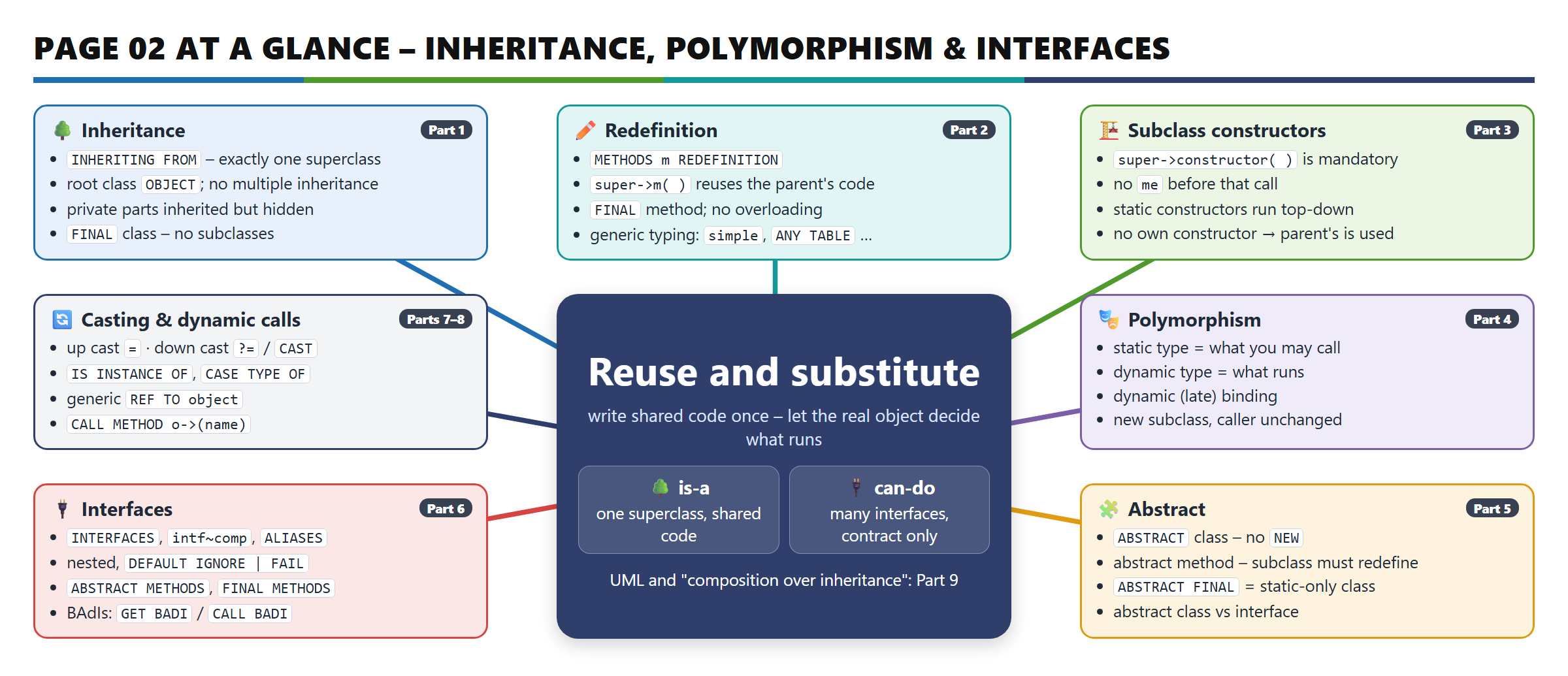
Page at a glance
Part 1 – Inheritance
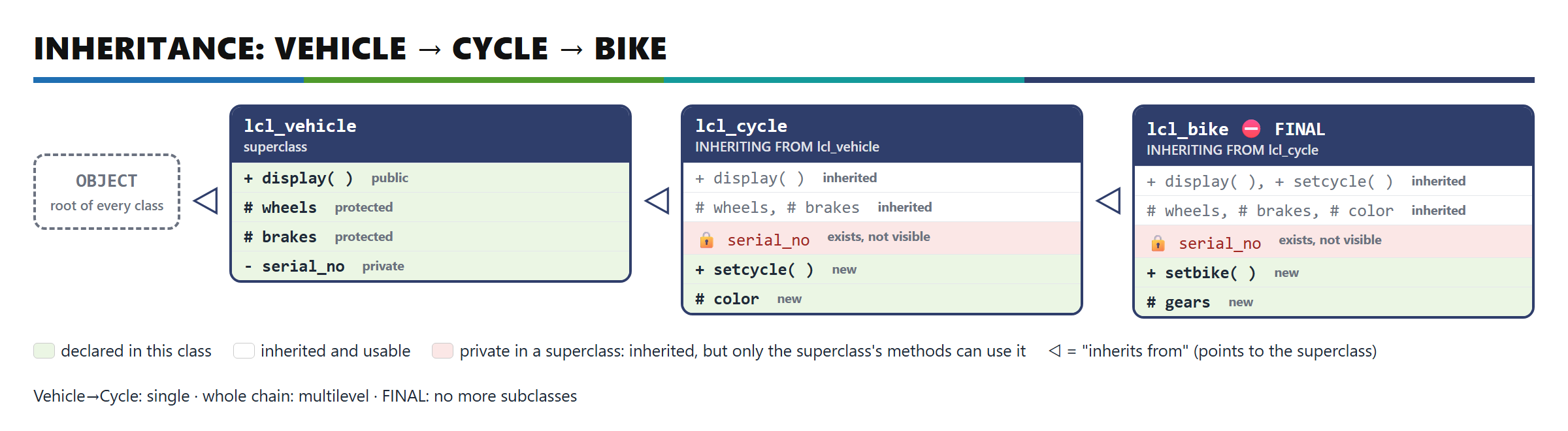
Inheritance = a new class (subclass, derived class) takes over all components of an existing class (superclass, base class) and adds or changes behaviour. The superclass gives, the subclass takes. Goal: reuse – write common code once – and an "is-a" relationship (a bike is a vehicle).
|
Rules
- A class has exactly one direct superclass. Classes without
INHERITING FROMinherit implicitly from the root class OBJECT. - Private components are inherited – they exist in every subclass object and the superclass's own methods keep using them – but they are not visible in the subclass. Public and protected components are visible.
- A subclass can add components and redefine instance methods (Part 2). It cannot remove inherited components or change their visibility.
- A static attribute exists once for the whole hierarchy: superclass and subclasses share the same value.
- A FINAL class cannot have subclasses:
CLASS lcl_bike DEFINITION INHERITING FROM lcl_cycle FINAL.
Kinds of inheritance
Kind | Shape | In ABAP? |
|---|---|---|
Single | One subclass, one superclass (Teacher ← Student) | Yes |
Multilevel | A subclass of a subclass (Grandparent ← Parent ← Child, Vehicle ← Cycle ← Bike) | Yes |
Hierarchical | One superclass, many subclasses (Vehicle ← Cycle, Vehicle ← Car) | Yes |
Multiple | One class with several superclasses | No for classes. A class can implement any number of interfaces – that gives multiple type inheritance, but no inherited code |
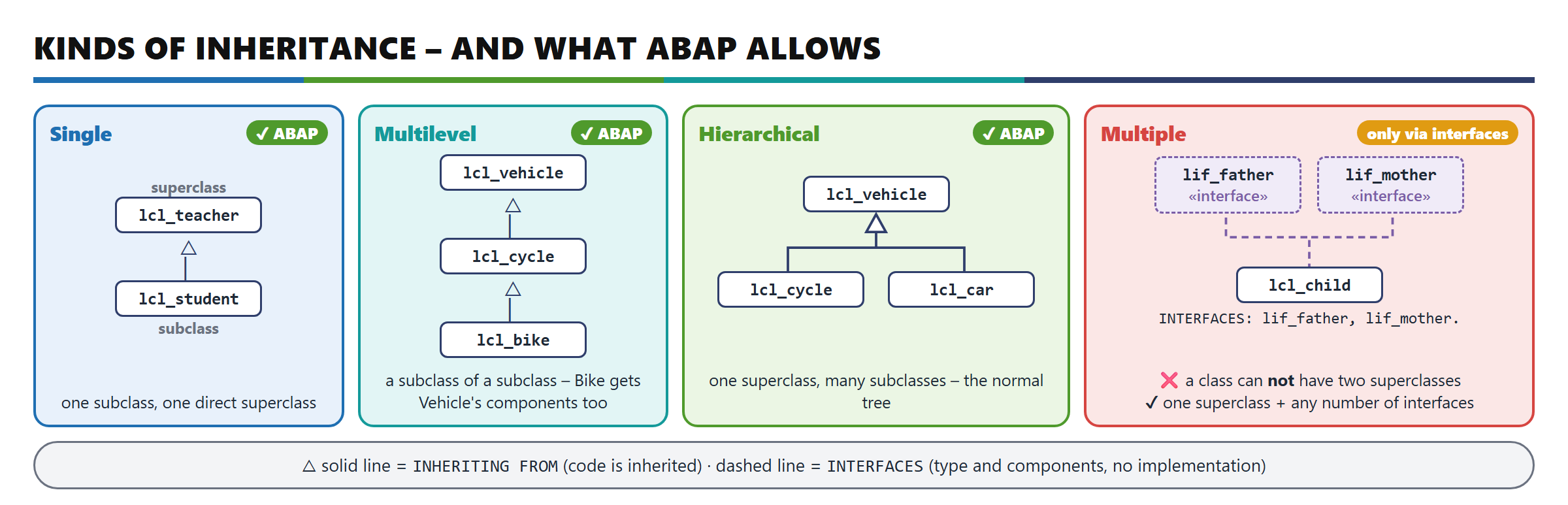
Multiple inheritance in ABAP means one superclass plus any number of interfaces – the picture's "multiple" case works only because Father and Mother are interfaces.
Part 2 – Redefinition, SUPER and FINAL
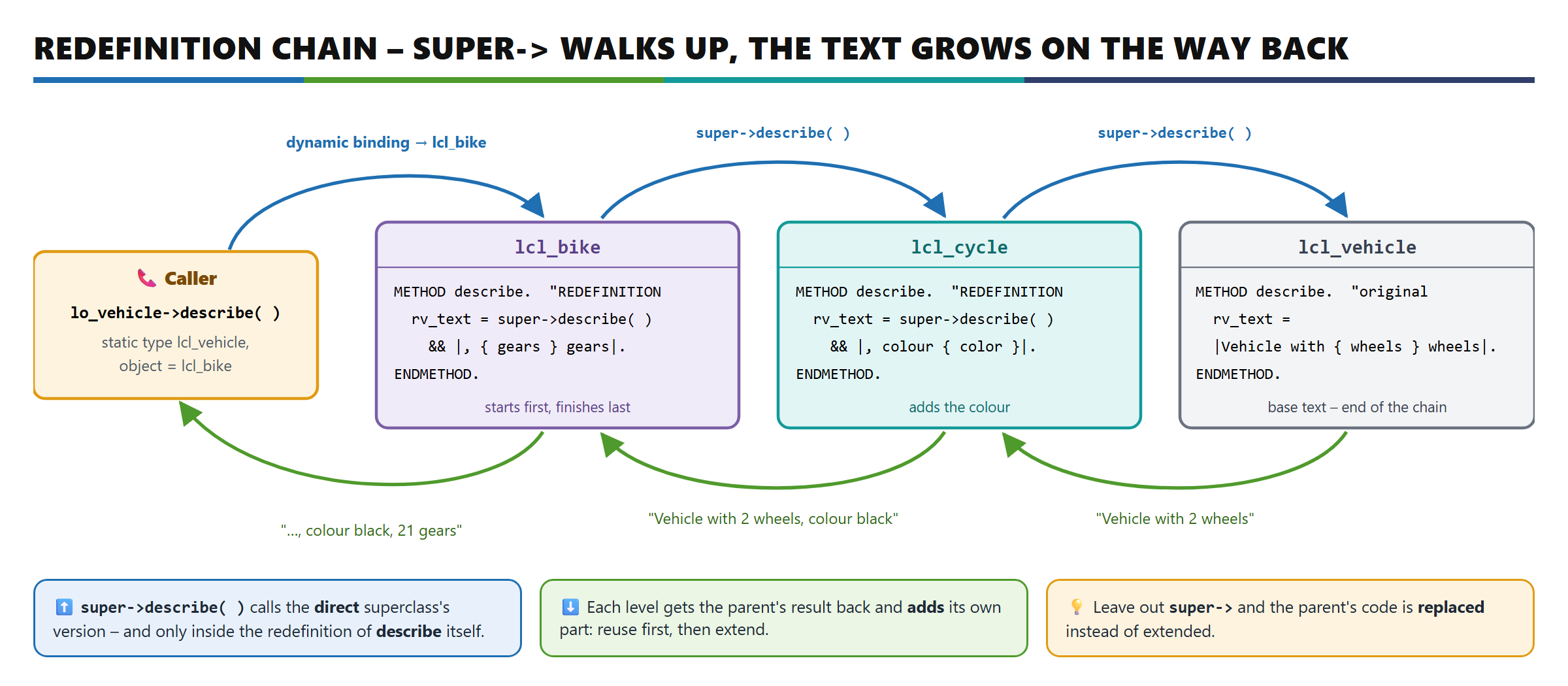
Method overriding (redefinition): a subclass gives an inherited instance method a new implementation. Re-declare it with REDEFINITION and implement it again. Inside, super->method( ) calls the superclass's implementation – reuse it, then add to it.
|
Output: "Vehicle with 4 wheels" / "Vehicle with 2 wheels, colour red" / "Vehicle with 2 wheels, colour black, 21 gears".
Redefinition rules
- Only instance methods that are public or protected and not FINAL can be redefined.
- The signature cannot change (parameters, types) and neither can the visibility section or the category (instance/static).
- Cannot be redefined: static methods, private methods, FINAL methods, constructors (each class has its own constructor instead – Part 3).
super->m( )works only inside the redefinition ofmitself. Calling it is recommended but not mandatory (exceptsuper->constructor( )).- A redefinition can itself be closed:
METHODS describe FINAL REDEFINITION. - Interface methods implemented in a superclass can be redefined too:
METHODS lif_x~m REDEFINITION.
FINAL – two levels
Effect | Syntax | |
|---|---|---|
FINAL class | No subclasses at all (all its methods are implicitly final) | CLASS lcl_x DEFINITION FINAL. |
FINAL method | Inherited, but cannot be redefined in subclasses. Useful only for public/protected instance methods – static and private methods can't be redefined anyway, so FINAL is not allowed or meaningless there | METHODS m FINAL. |
Overloading – not supported in ABAP
Method overloading (C++/Java) = several methods with the same name but different parameters. ABAP does not allow two methods with the same name in one class, so this is a syntax error:
|
- Workarounds: OPTIONAL / DEFAULT parameters with
IS SUPPLIED, generic types (next section), or different method names (create_from_id,create_from_name). - So in ABAP, polymorphism = redefinition + interfaces, not overloading.
Generic parameter typing instead of overloading
Where Java would overload log( int ), log( String ), log( Date ), ABAP declares one method with a generic type. The actual type is fixed by the argument at runtime; the method only uses operations that make sense for every type the generic type allows.
Generic type | Accepts | Typical use |
|---|---|---|
| Any data type (a | Fully generic helpers; work with |
simple | Any elementary type and flat character-like structures | Formatting, logging one value |
| Numeric types; character-like types; | Calculations; text handling |
| Any internal table; index tables; standard tables | Table utilities ( |
REF TO data | A reference to any data object (complete type) | Pass data of unknown type by reference |
REF TO object | A reference to any object – every class inherits from OBJECT (complete type) | Frameworks; to use the object, down cast or call dynamically (Parts 7 and 8) |
|
- Generic types are allowed for IMPORTING, EXPORTING and CHANGING parameters. A RETURNING parameter must be completely typed –
TYPE REF TO dataandTYPE REF TO objectcount as complete. objectcan only be written afterREF TO:TYPE REF TO objectis fine,TYPE objectis not.- The more generic the type, the less the compiler can check – errors move to runtime. For objects, an interface type (
TYPE REF TO lif_printable) is usually better thanREF TO object: it is still open to many classes, but the compiler knows the methods. - Data references vs object references (
->*vs->,CREATE DATA) are compared on page 01.
Part 3 – Constructors in subclasses
Every class has its own instance constructor – constructors are not redefined, and a subclass constructor may have a different signature from its superclass's.
- If a subclass declares its own instance constructor, it must call
super->constructor( … )– even if the superclass declares no constructor explicitly (only direct subclasses of OBJECT are exempt). - Before that call the subclass constructor cannot use instance attributes or
ME– only its parameters and static components. So in practicesuper->constructor( )is the first statement. - A subclass without its own constructor uses the superclass's constructor – including its parameters.
- Static constructors are independent: when a subclass is used first, the static constructors of all superclasses not yet run go first, top-down.
Scenario | Setup | What runs (first subclass object, no earlier access) | Later objects |
|---|---|---|---|
1 | Super: static + instance ctor. Sub: none | Super static → super instance | Super instance only |
2 | Super: static + instance. Sub: static only | Super static → sub static → super instance | Super instance only |
3 | Both have static + instance; sub calls | Super static → sub static → sub constructor starts → | Instance constructors only, same nesting |
4 | Both instance ctors have mandatory parameters | Pass the sub's parameters at | Same |
5 | Super ctor has mandatory parameters, sub has none | Pass the super constructor's parameters at | Same |
Order of execution (scenario 3): execution enters the subclass constructor first, but the superclass constructor body finishes before the rest of the subclass body runs – so attributes are effectively initialised top-down. The general sequence for a single class is on page 01 (Constructors); the "with inheritance" panel of its constructor-sequence picture shows this scenario step by step.
Part 4 – Polymorphism
Polymorphism (poly = many, morph = forms): the same call behaves differently depending on the object behind the reference. A superclass (or interface) reference can point to objects of any subclass; at runtime the object's own implementation of a redefined method runs. This is dynamic binding (late binding).
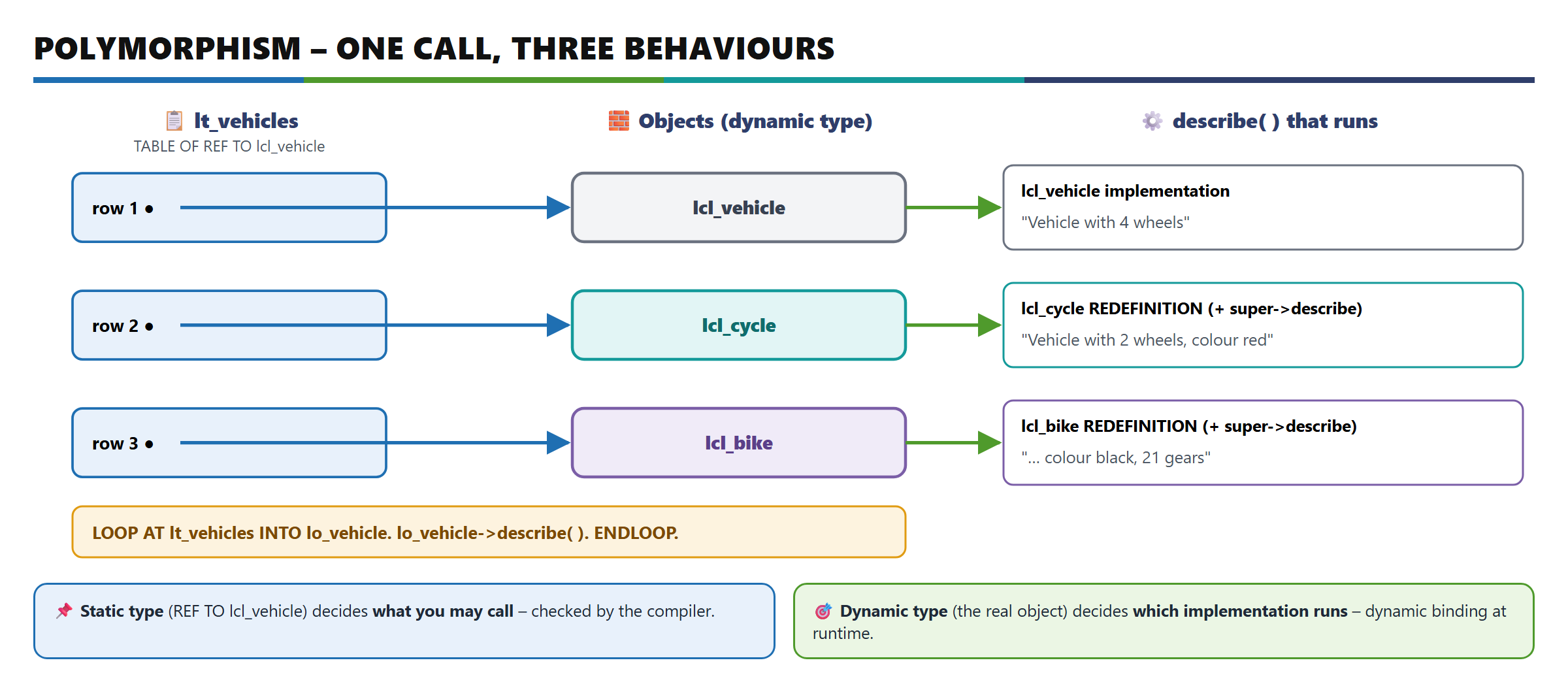
- In the Part 2 report,
lt_vehicleshas the static typeREF TO lcl_vehicle, but the loop prints three different texts – one per class. - Benefit: the calling code never changes when a new subclass is added (open/closed principle). This is how BAdIs work: SAP calls an interface method, your implementation runs (Part 6).
- Polymorphism is about objects behaving differently through one reference type – not about "a method" with several parameter lists (overloading, which ABAP does not have).
Part 5 – Abstract classes and methods
An abstract class (ABSTRACT) cannot be instantiated – it exists to be subclassed. An abstract method (METHODS m ABSTRACT) is declared but not implemented: every concrete subclass must implement it. Use it when each subclass must supply its own implementation, while shared code lives in the superclass.
|
- A class with at least one abstract method must be ABSTRACT. The reverse is not required – a class can be ABSTRACT without any abstract method.
- Abstract methods are allowed only in the PUBLIC and PROTECTED sections (private methods can't be redefined). They are also called non-concrete methods.
- Static methods and constructors cannot be abstract – they cannot be redefined.
- A subclass must implement (
REDEFINITION) all inherited abstract methods – otherwise it must be abstract too. - An abstract class can have attributes, concrete methods and a constructor (called by subclasses through
super->constructor( )). - Through an abstract-superclass reference you see only the superclass's components. To reach a subclass-only method use a down cast (Part 7); dynamic method calls are covered in Part 8.
- ABSTRACT + FINAL together (
CLASS lcl_util DEFINITION ABSTRACT FINAL.): no objects and no subclasses, so only the static components can be used – instance components can be declared but never used. This is the classic "static utility class".- Clean ABAP prefers objects to static classes: static methods cannot be replaced by test doubles or redefined. Use ABSTRACT FINAL only for small, stateless helpers.
How an abstract class differs from an interface, with a picture and a table, is at the end of Part 6.
Part 6 – Interfaces
An interface is a pure contract: it declares components but implements none. A class that implements the interface promises to provide all its methods. Interfaces give ABAP multiple type inheritance and are the basis of BAdIs, RAP handlers and testable code ("program to an interface").
Interfaces can contain | Interfaces cannot contain |
|---|---|
Methods and static methods ( | Method implementations, visibility sections (everything is public), constructors |
An interface is often called "a pure abstract class" – a useful picture, but it can hold more than abstract methods (attributes, constants, types, events), and since 7.40 SP08 methods can be optional (DEFAULT IGNORE | FAIL).
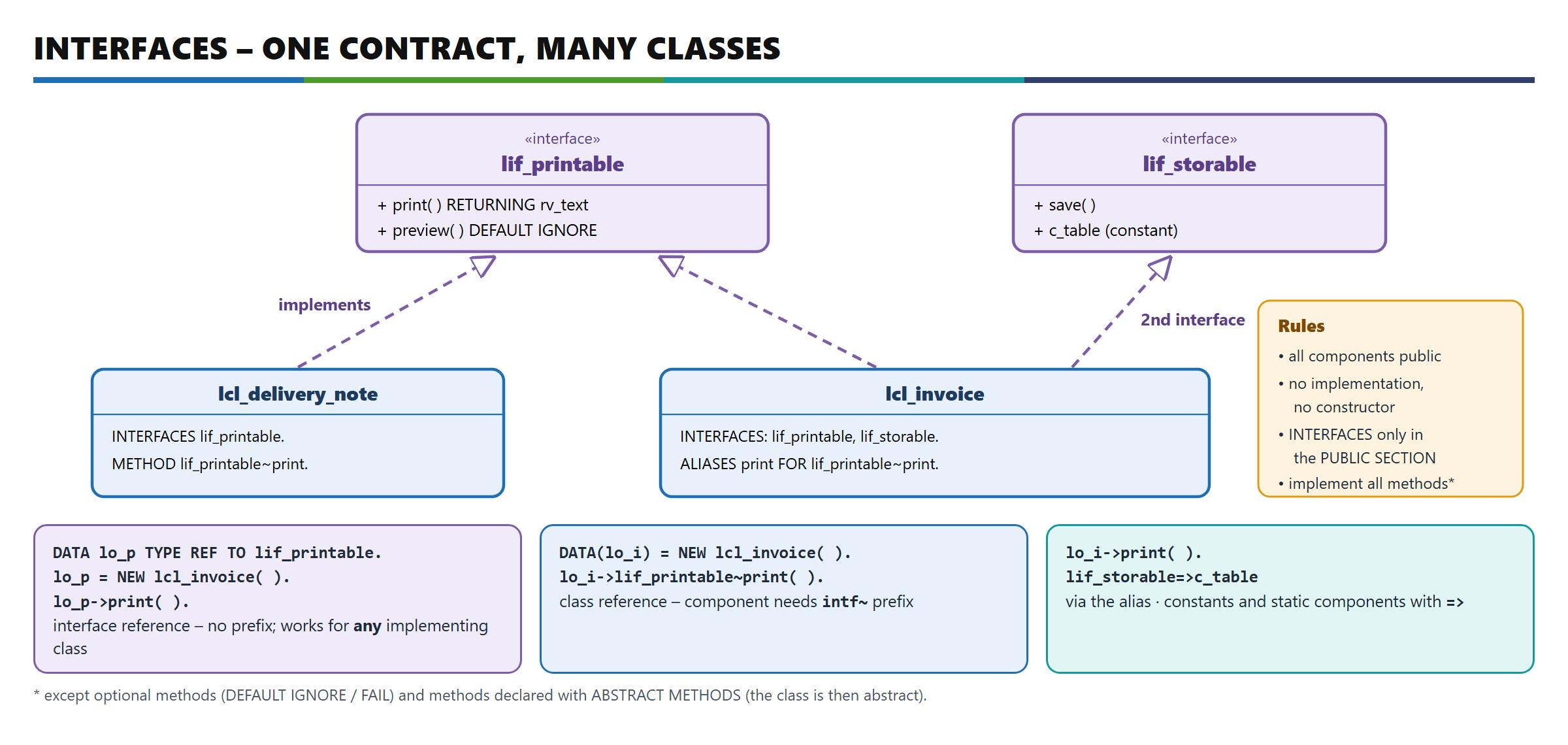
Defining and implementing an interface
|
- The implementing class ("implementation class") must implement all methods – except optional ones (
DEFAULT IGNOREreturns initial values; calling a skippedDEFAULT FAILmethod raisesCX_SY_DYN_CALL_ILLEGAL_METHOD) and those it declares abstract (below). - A class can implement any number of interfaces:
INTERFACES: lif_printable, lif_storable. - Outside the interface, components carry the interface prefix:
lif_printable~printin the class,lif_printable=>c_max_linesfor constants and static components. - An interface cannot be instantiated:
NEW lif_printable( )is impossible – you always create an object of an implementing class and assign it to the interface reference. - Global classes list their interfaces on the Interfaces tab in SE24 (in ADT: the INTERFACES statement).
Nested (component) interfaces
|
- If an implemented interface includes other interfaces, the class must implement their methods too.
- All component interfaces sit on one level in the implementing class: you write
lif_printable~print, neverlif_document~lif_printable~print.
Aliases
- Alternative names for interface components that avoid the long
intf~compprefix:ALIASES print FOR lif_printable~print. - In the implementing class an alias can be declared in any visibility section; aliases declared in an interface are always public and may only point to components of its component interfaces.
- Aliases are used only for interface components.
Partial implementation and other INTERFACES additions
Addition | Meaning |
|---|---|
INTERFACES lif_x ABSTRACT METHODS m2. | The class leaves |
| Optional method (7.40 SP08): a class need not implement it. IGNORE: calling it does nothing; FAIL: calling it raises an exception. |
INTERFACES lif_x FINAL METHODS m1. | Subclasses cannot redefine |
INTERFACES lif_x DATA VALUES attr = 'X'. | Start values for the interface's attributes in this class. |
INTERFACES lif_x PARTIALLY IMPLEMENTED. | Only in test classes (test doubles): unimplemented methods are allowed. |
Interfaces in practice: BAdIs
A BAdI (Business Add-In) is an SAP enhancement hook built entirely from the OO pieces on this page: the BAdI definition carries an interface, every BAdI implementation is a class that implements it, and SAP's code calls the interface method polymorphically – your class runs without any change to SAP's code. The full topic (enhancement spots, filters, finding BAdIs, classic BAdIs) is on CORE ABAP › 10 Enhancements, Part 5.
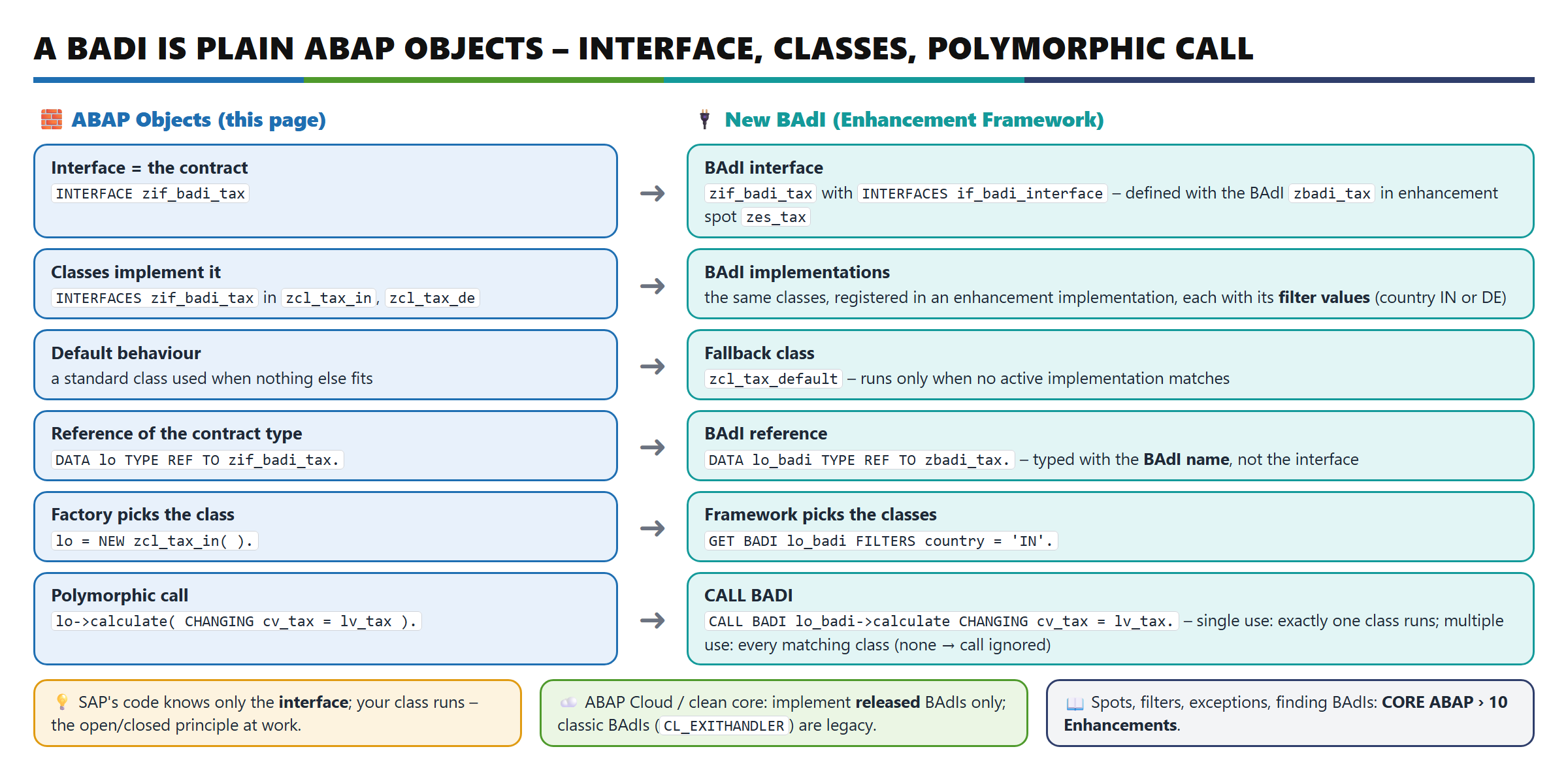
|
GET BADIplays the role of a factory: from the active implementations and the filter values it builds the BAdI object.CALL BADIthen calls the interface method – one implementation for a single-use BAdI, every matching one for a multiple-use BAdI (none found: the call is simply skipped).- The fallback class is the BAdI's default implementation: used only when no active implementation matches.
- Classic BAdIs – Legacy: interface
IF_EX_<name>, object fromCL_EXITHANDLER=>GET_INSTANCE, then an ordinary method call. Replaced by the new BAdIs above. - ABAP Cloud / clean core: you implement only BAdIs that SAP has released for extensions – a stable contract that survives upgrades.
Abstract class vs interface
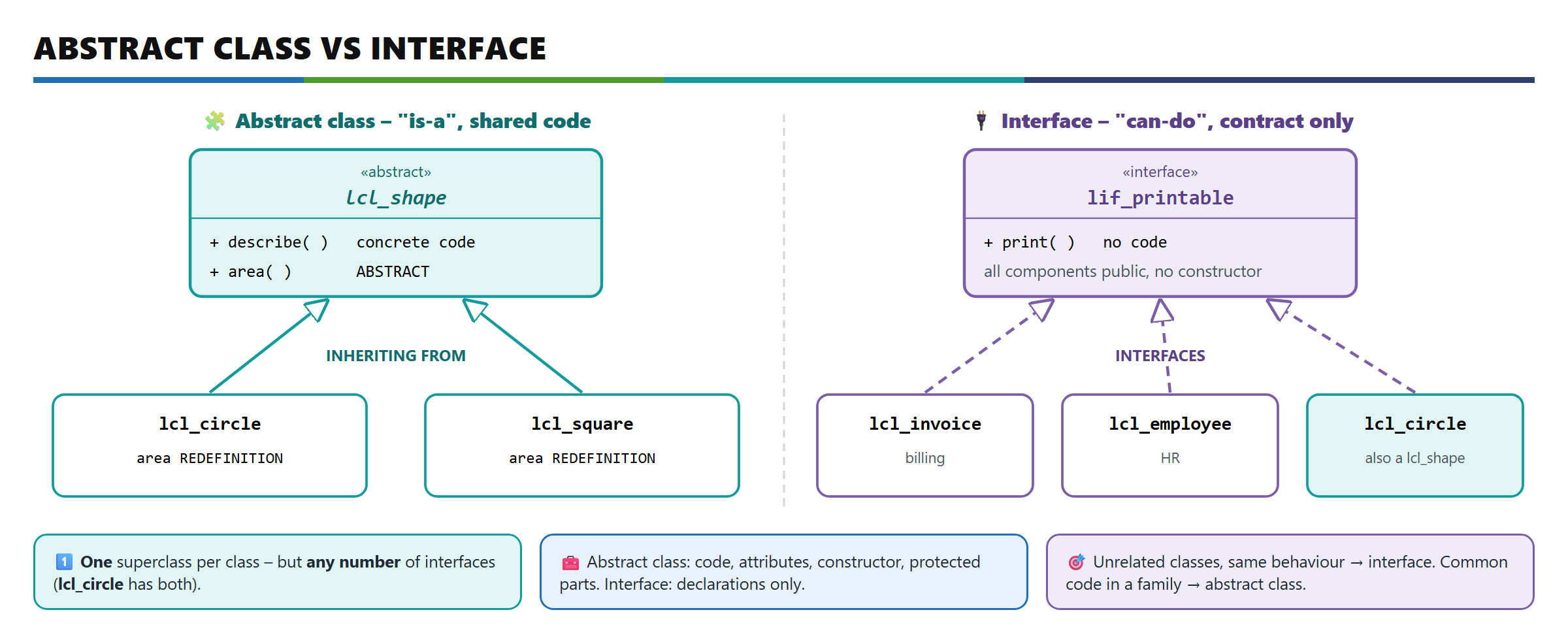
Abstract class | Interface | |
|---|---|---|
Methods | Abstract and concrete methods; ABSTRACT must be written explicitly | Only declarations – all methods are "abstract" by default (optional |
Visibility | Public, protected, private sections; abstract methods public or protected | No sections – all components public |
Attributes, constructor | Any attributes; can have a constructor | Attributes and constants; no constructor |
How many per class | One superclass | Any number of interfaces |
Access in subclass / class | Inherited components used directly | With prefix |
Use when | Subclasses share code and state ("is-a" with common implementation) | Unrelated classes must offer the same behaviour (contract, BAdI, test double) |
Part 7 – Casting: up cast and down cast
Every reference variable has a static type (the type in its declaration – it decides which components you may address) and a dynamic type (the class of the object it points to at runtime – it decides which implementation runs). Casting assigns references between related types.
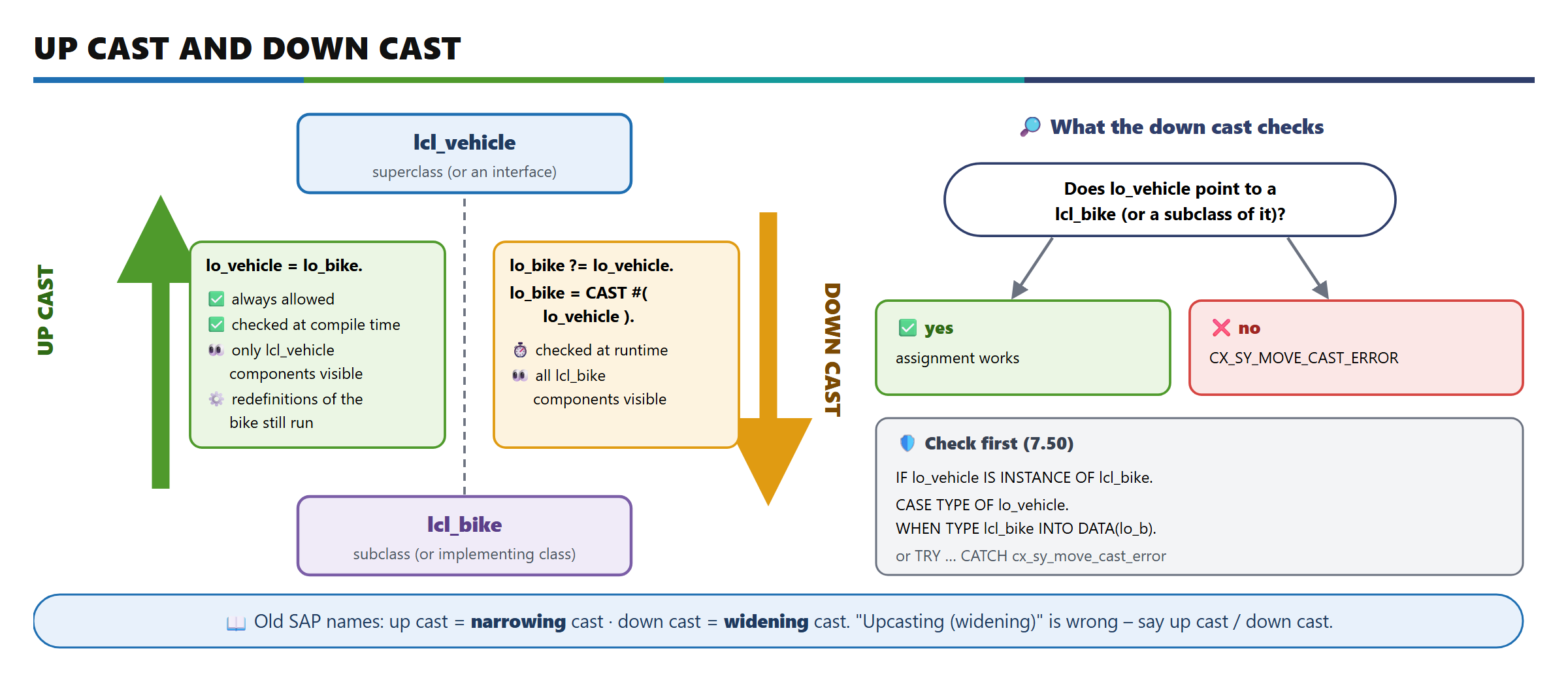
SAP's current term | Old SAP term | Direction | Operator | Check |
|---|---|---|---|---|
Up cast | narrowing cast | Subclass → superclass, class → interface | = | Compile time – always safe |
Down cast | widening cast | Superclass / interface → subclass or class |
| Runtime – fails with |
Terminology – the most important point: SAP called the up cast a narrowing cast (the view narrows to fewer components) and the down cast a widening cast; many blogs mix these names up. SAP documentation now uses only up cast / down cast – use those terms.
Up cast
|
- After an up cast only components known to the static type can be addressed – components that exist only in the subclass are not accessible through the superclass reference; but a redefined method still runs the subclass implementation.
Down cast
|
- A down cast succeeds only if the object really is of the target class (or one of its subclasses) – typically after an earlier up cast. A pure superclass object can never be down cast to a subclass.
- Check before casting (7.50) instead of catching the exception:
|
MOVE lo_vehicle ?TO lo_bike.is the obsolete long form – use?=orCAST.- Interfaces work the same way:
lo_invoice = CAST #( lo_printable ).is a down cast from interface to class.
Generic object references: REF TO object
Every class inherits from the root class OBJECT, so a variable TYPE REF TO object can hold any object – assigning to it is always an up cast. The price: the static type OBJECT has no components, so nothing can be called through it directly.
|
- Use it where code must accept objects of unrelated classes (generic containers, frameworks). Otherwise prefer an interface type – the compiler can then check the calls.
TYPE REF TO datais the counterpart for data objects; both kinds are compared on page 01.
Part 8 – Dynamic method calls
The method (and even the class) name is in a variable and resolved at runtime. It is sometimes used to reach subclass methods through a superclass reference.
|
- The method is searched in the static type and then in the dynamic type of the object – that is why it can reach subclass-only methods. But there is no syntax check: typos and wrong parameters only show up at runtime (
CX_SY_DYN_CALL_ILLEGAL_METHOD,CX_SY_DYN_CALL_PARAM_MISSING…).
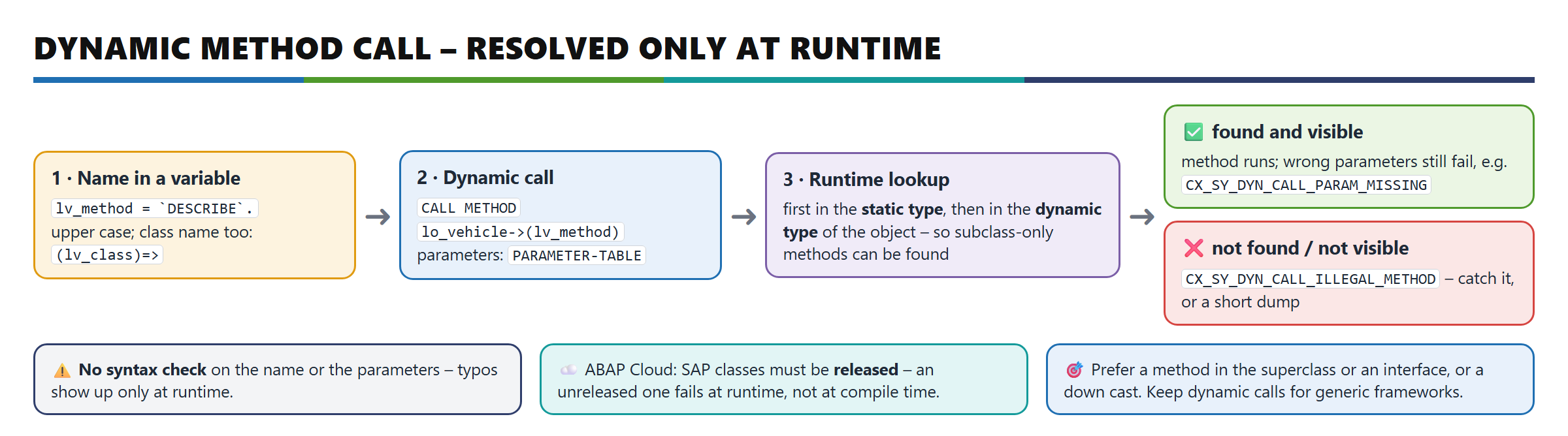
- Better: a down cast (Part 7) – or, as a design fix, declare the method in the superclass or an interface so a normal polymorphic call works. Use dynamic calls only for genuinely generic frameworks.
- ABAP Cloud: only released SAP classes and methods may be used. A dynamic name is not checked by the compiler, so a call to an unreleased SAP object is not caught at compile time – expect an error at runtime instead.
CL_ABAP_DYN_PRGhelps to validate names that come from outside. - Clean ABAP: write normal (functional) calls and keep
CALL METHODfor dynamic calls, where it is still required.
Part 9 – UML notation
UML class diagrams show classes, interfaces and their relationships. You will see them in design documents and interviews.
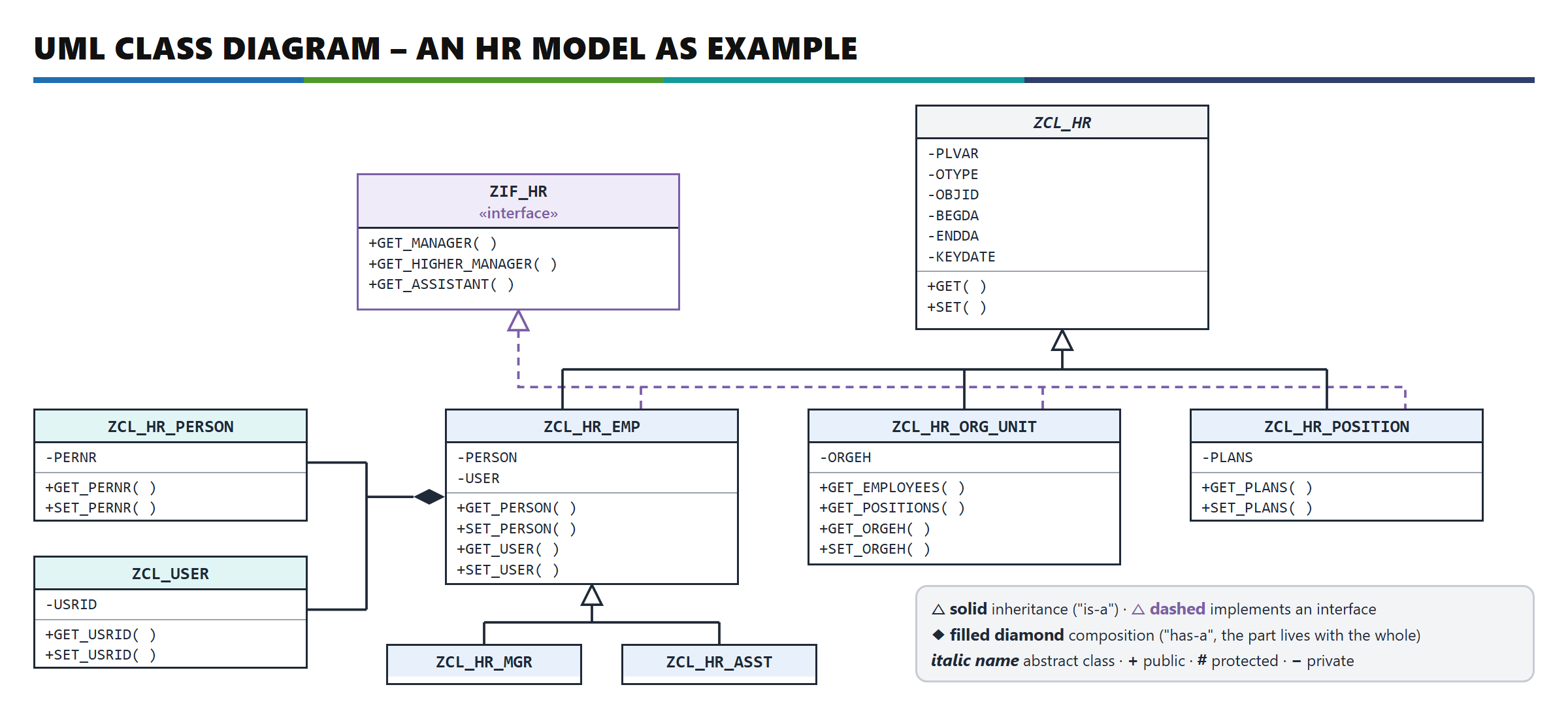
Symbol | Meaning | In the diagram |
|---|---|---|
Box with 3 compartments | Class name / attributes / methods |
|
<<interface>> | Interface |
|
Class name in italics | Abstract class | ZCL_HR |
| Public / protected / private | -PLVAR (private attribute), +GET( ) (public method) |
Solid line, hollow triangle | Inheritance ("is-a") | ZCL_HR_EMP, ZCL_HR_ORG_UNIT, ZCL_HR_POSITION inherit from ZCL_HR; ZCL_HR_MGR and ZCL_HR_ASST from ZCL_HR_EMP |
Dashed line, hollow triangle | Interface realisation ( | The HR classes implement ZIF_HR |
Filled diamond | Composition ("has-a", the part lives with the whole) | ZCL_HR_EMP has a ZCL_HR_PERSON and a ZCL_USER |
Composition over inheritance: inherit only for a true "is-a" relationship; otherwise hold a reference to another object ("has-a") and delegate to it – looser coupling, easier to test.
Part 10 – Interview questions
Does ABAP support multiple inheritance?
Not for classes: every class has exactly one superclass (root class OBJECT). A class can implement any number of interfaces, which gives multiple type inheritance – the class must still implement the methods itself.
Are private components inherited?
Yes, they exist in every subclass object and the superclass's methods use them, but they are not visible in the subclass. Only public and protected components can be addressed there.
Overloading vs overriding – which does ABAP support?
Only overriding (redefinition): a subclass re-declares an inherited instance method with REDEFINITION and implements it again, same signature. Overloading – one name, several parameter lists – is not supported; use optional parameters or different method names.
What are the rules for redefining a method?
Only public or protected, non-final instance methods; the signature, visibility and category stay the same; static, private, final methods and constructors cannot be redefined. super->m( ) calls the superclass version inside the redefinition. A redefinition can be made FINAL.
Why must a subclass constructor call super->constructor( )?
So the inherited part of the object is initialised by the superclass's own logic. It is mandatory whenever the subclass declares its own instance constructor, and before the call the subclass cannot use instance attributes. A subclass without its own constructor uses the superclass constructor and its parameters.
Abstract class vs interface – when do you use which?
An abstract class can hold concrete code, attributes, a constructor and protected components; a class inherits only one. An interface is a pure contract with public components only; a class can implement many. Use an abstract class for shared implementation in an is-a hierarchy, an interface for a contract that unrelated classes fulfil (BAdIs, test doubles).
Can you instantiate an abstract class? Must it have abstract methods?
No – NEW on an abstract class is a syntax error, but you can declare references of its type and create objects of concrete subclasses. An abstract class does not need abstract methods; a class that has an abstract method must be abstract.
Explain up cast and down cast. What are narrowing and widening casts?
Up cast: subclass or class reference to superclass or interface reference, always allowed with = (old name narrowing cast). Down cast: back to the more specific type with ?= or CAST, checked at runtime (old name widening cast); if the object is not of that type, CX_SY_MOVE_CAST_ERROR is raised. Check first with IS INSTANCE OF or CASE TYPE OF.
What is polymorphism / dynamic binding? Give an example.
One reference type, many behaviours: a superclass or interface reference points to objects of different classes, and calling a redefined method runs each object's own implementation. Example: a table of REF TO lcl_vehicle holding cycles and bikes – the same describe( ) call prints different texts. BAdIs rely on it.
How do you call a method of a nested interface? What are aliases?
Component interfaces are on one level: in the class you write lif_inner~m, and through a reference to the outer interface lo->lif_inner~m( ). An alias (ALIASES m FOR lif_inner~m) gives an interface component a short name in the class or the outer interface.
Can a class implement only part of an interface?
Yes: with INTERFACES lif_x ABSTRACT METHODS m (the class becomes abstract, a subclass implements m), or if the interface declares the method DEFAULT IGNORE or DEFAULT FAIL (7.40 SP08). PARTIALLY IMPLEMENTED is allowed only in test classes.
FINAL class vs FINAL method?
A FINAL class cannot have subclasses. A FINAL method is inherited but cannot be redefined; it makes sense only for public or protected instance methods, because static and private methods can't be redefined anyway.
What is a class that is both ABSTRACT and FINAL?
It can have neither objects nor subclasses, so only its static components can be used – a static utility class. Instance components may be declared but can never be used. Clean ABAP prefers objects to static classes because static methods cannot be replaced by test doubles.
How is a BAdI related to interfaces and polymorphism?
A new BAdI defines an interface (including IF_BADI_INTERFACE); each implementation is a class that implements it. GET BADI picks the active implementations by filter values (or the fallback class), and CALL BADI calls the interface method – SAP's code knows only the interface, the implementing class decides what runs. Classic BAdIs use CL_EXITHANDLER=>GET_INSTANCE and are legacy; in ABAP Cloud only released BAdIs can be implemented.
ABAP has no overloading – how can one method accept values of different types?
With generic typing: IMPORTING iv_value TYPE simple (or any, data, numeric, clike, ANY TABLE …). The actual type comes from the argument at runtime. A RETURNING parameter must be completely typed; REF TO data and REF TO object count as complete.
What can you do with a variable of TYPE REF TO object?
It can hold any object, because every class inherits from OBJECT. But OBJECT has no components, so to use the object you down cast it (after IS INSTANCE OF or with CASE TYPE OF) or call a method dynamically. Prefer an interface type when the methods are known.
🏠 Start Here · ◀ 01 · Classes & Objects · 03 · Exceptions & Events ▶ · Sections: CORE ABAP | OOPS ABAP | ABAP on HANA | Clean Core | RAP | ABAP Points | SAP Fiori | SAPUI5 | Mobile Development (MDK) | BTP Foundations | BTP Development | CAP | SAP Build | ABAP on BTP | Integration Suite | SAP Business AI | SAP BASIS | Security | SAP SDLC
Functional: FICO ABAP | TRM ABAP | VIM | SAP BIS | SD ABAP | MM ABAP | PP ABAP | QM ABAP | PM ABAP | PS ABAP | EWM | TM ABAP | EHS ABAP | HR ABAP | BW | SAP MDG | SAP Analytics Cloud | SAP Ariba | SAP CX | SAP IBP