PM (Plant Maintenance) – in S/4HANA part of Asset Management, often called EAM (Enterprise Asset Management) – keeps a company's physical assets working: pumps, lines, vehicles, buildings, networks. It records what the assets are (technical objects), what went wrong (notifications), what work is done (maintenance orders with operations, spare parts and services), when work is due (maintenance plans) and what it cost (settlement to CO). This page gives the big picture: the maintenance strategies, the sub-areas, the organization units that appear as key fields everywhere, the integration map and where EAM sits in S/4HANA and on SAP BTP. Master data and tables: page 02; processes and customizing: page 03; integration postings and reporting: page 04; development: page 05; S/4HANA and architect decisions: page 06.
Part 1 – What PM / EAM does: maintenance strategies
A maintenance strategy answers one question: what triggers the work? Companies mix strategies per asset – cheap, non-critical assets are run to failure, critical ones are inspected on a schedule or watched by sensors. In SAP every strategy ends in the same objects (notification and / or maintenance order); what differs is who or what creates them.
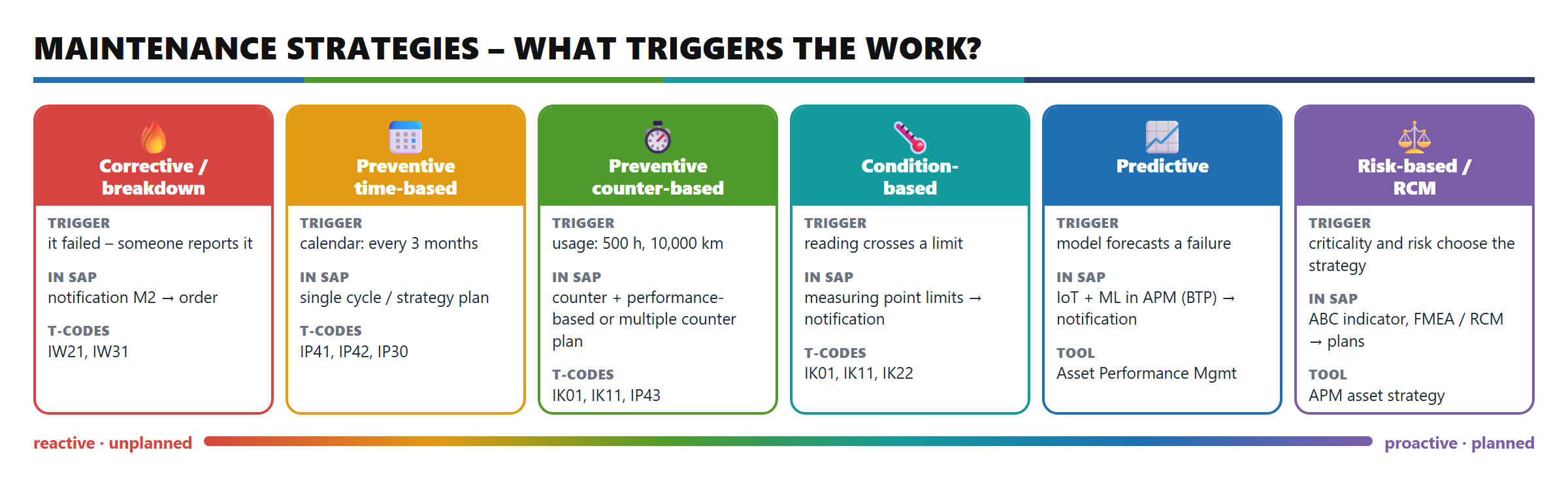
Strategy | Trigger | How SAP supports it |
|---|---|---|
Corrective / breakdown (reactive) | Something failed or is about to fail; a person reports it | Malfunction report (notification type M2) → maintenance order (e.g. PM01); breakdown indicator and malfunction start / end in the notification feed MTBR / MTTR |
Preventive – time-based | Calendar: every 3 months, every year | Single cycle plan (IP41) or time-based strategy plan (IP42); deadline monitoring (IP30; in S/4HANA also the HANA-optimised IP30H) creates call objects |
Preventive – counter-based (performance-based) | Usage: every 10,000 km, 500 operating hours | Counter measuring points (IK01) + counter readings (IK11) + performance-based plan; multiple counter plan (IP43) for "whichever comes first" |
Condition-based | A measured condition crosses a limit (temperature, wear, vibration) | Measuring points with limits + measurement documents; a reading outside the limit leads to a notification (condition-based maintenance function, rules in APM or custom logic – page 05) |
Predictive | A model predicts failure from sensor data before limits are reached | IoT and machine learning in SAP Asset Performance Management (BTP) creates notifications in S/4HANA |
Risk-based / reliability-centred | Criticality and risk decide which strategy each asset gets | Criticality (ABC indicator), FMEA / RCM assessments in APM; result: updated plans and task lists |
- Planned vs unplanned: preventive work is planned and scheduled weeks ahead; corrective work interrupts the schedule. A key KPI of a maintenance organisation is the share of planned work.
- Breakdown KPIs: MTTR (mean time to repair) and MTBR (mean time between repairs) are calculated from the malfunction start / end and the breakdown indicator of notifications (page 04).
Part 2 – Sub-areas and the maintenance cycle
Sub-area (ECC component) | What it covers | Main objects |
|---|---|---|
Technical objects (PM-EQM) | The asset register of maintenance: where things are and what is installed | Functional locations, equipment, serial numbers, PM BOMs, measuring points |
Notifications | Reporting a problem or a request; documenting damage, cause and activities | Notification types M1 maintenance request, M2 malfunction report, M3 activity report |
Maintenance orders (PM-WOC) | Planning and executing the work, collecting costs | Order with operations, components, external services, confirmations |
Maintenance planning (PM-PRM) | Recurring work that is due on time or counter | Task lists, maintenance strategies, maintenance plans and items |
Work clearance management (PM-WCM) | Safe working: isolating equipment (lockout / tagout) and approvals before work starts | Work clearance applications and documents; on-premise / private cloud only |
Refurbishment | Repairing spare parts (rotables) instead of buying new ones | Refurbishment order, split-valuated material (page 03 Part 6) |
Calibration (QM link) | Inspecting test and measuring equipment on a schedule | Maintenance plan → order + inspection lot (origin 14) → results and usage decision in QM |
Information system (PM-IS) | Breakdown statistics, costs, object history | PMIS / S/4HANA analytics (page 04) |
All sub-areas meet in one cycle that every PM consultant draws on the whiteboard:
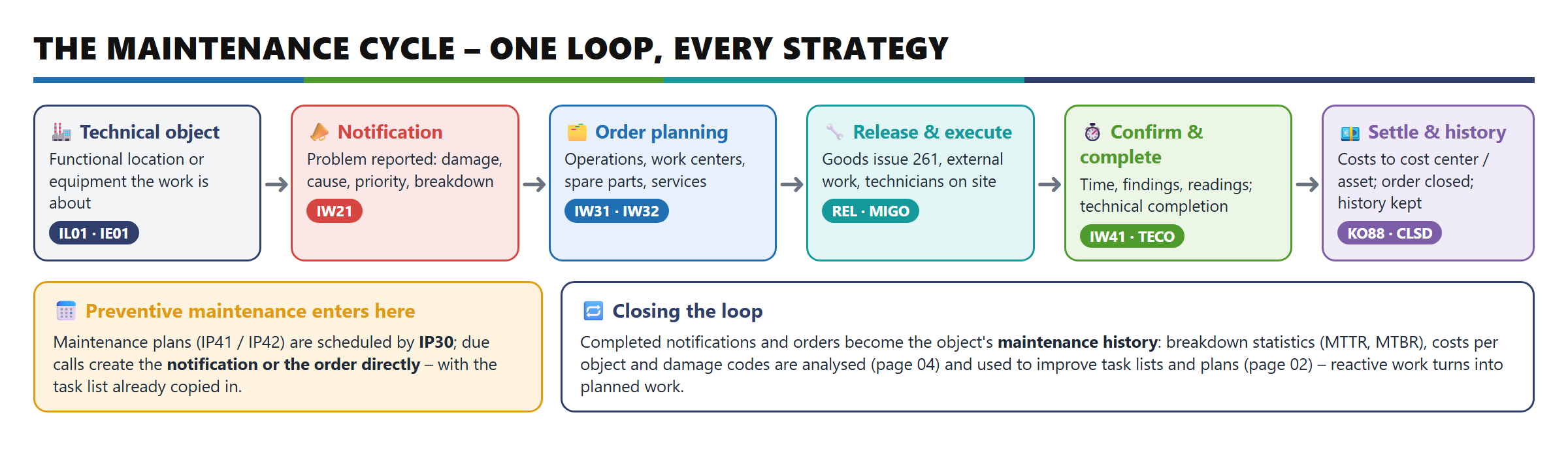
- Technical object – the functional location or equipment the work is about (page 02).
- Notification – who reports what problem, with catalog codes for damage, cause and activity.
- Order – planned operations (work centers, hours), components (stock / non-stock), services; release, goods issue, time confirmation, technical completion (TECO), settlement, business completion (page 03 Part 1).
- History – the completed notification and order become the object's maintenance history, used for analysis and to improve the plans.
Part 3 – Organization structure
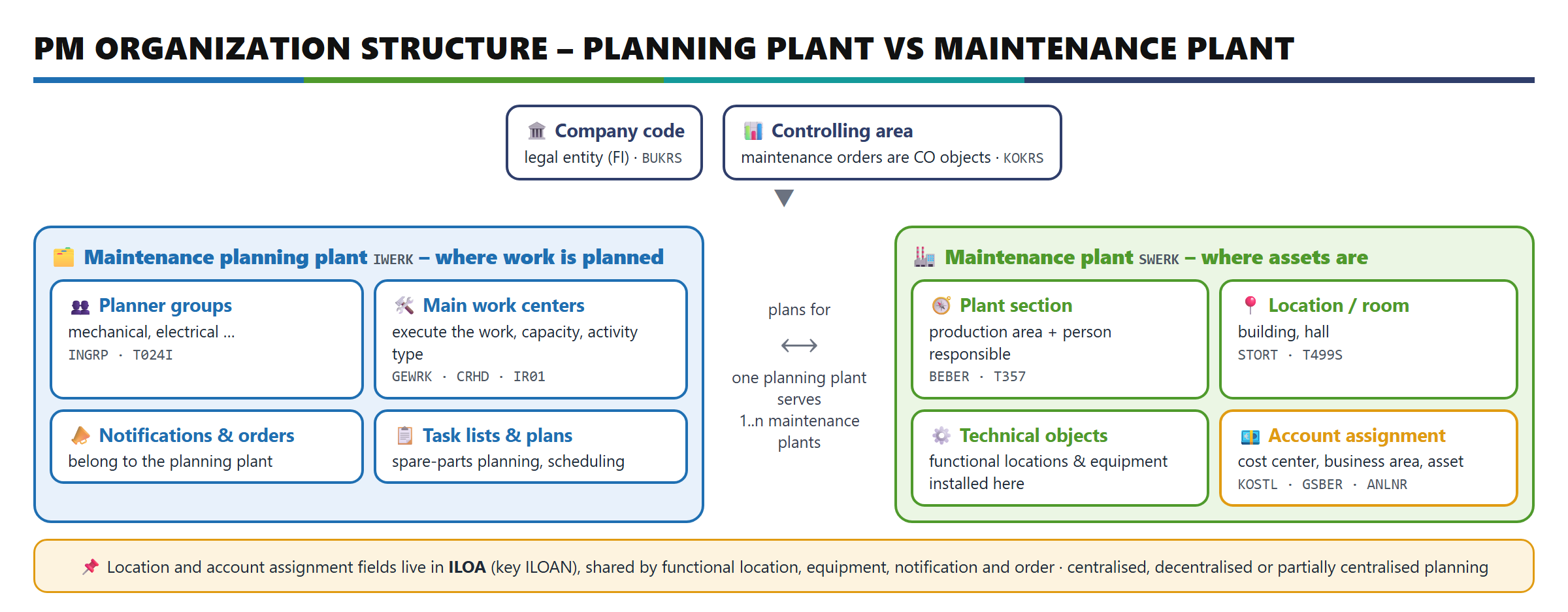
PM uses the logistics organization of MM and PP (plant, company code) and adds a few PM-specific units. The most important design question is the split between the plant where the assets are (maintenance plant) and the plant where the work is planned (planning plant).
3.1 The units
Unit | Meaning | Field | Table |
|---|---|---|---|
Maintenance plant | Plant where the technical objects are installed. Every functional location and equipment belongs to one maintenance plant. | SWERK | T001W |
Maintenance planning plant | Plant where maintenance is planned: notifications, orders, task lists, maintenance plans, planner groups and spare-parts planning belong to it. | IWERK | T001W, T399I |
Maintenance planner group | Team of planners responsible for planning and processing work (e.g. mechanical, electrical). Defined per planning plant. | INGRP / INGPR | T024I |
Main work center | Work center responsible for carrying out the work; supplies capacity and activity type for costing (IR01 create, IR02 change, IR03 display). | GEWRK (+ plant WERGW) | CRHD |
Plant section | Area of production responsibility inside a maintenance plant, with a person responsible who is told about breakdowns. | BEBER | T357 |
Location | Physical place inside a maintenance plant (building, hall) – used for selection and reporting. | STORT | T499S |
Company code / business area / cost center | Account assignment of the technical object; the order inherits it and settles costs to it. | BUKRS, GSBER, KOSTL | T001, TGSB, CSKS |
Controlling area | CO unit above the cost centers; maintenance orders are CO objects in it. | KOKRS | TKA01 |
3.2 Planning organization variants
Variant | Set-up | When to choose |
|---|---|---|
Centralised planning | One planning plant plans for several maintenance plants | Central planning department, small or similar sites, central spare-parts store |
Decentralised planning | Every maintenance plant is its own planning plant | Large, independent sites with their own planners |
Partially centralised | Some plants plan themselves, others are planned by a central plant | Mixed organisations (one big site, several small ones) |
- Customizing: Enterprise Structure → Definition → Plant Maintenance → Maintain maintenance planning plant; Assignment → Plant Maintenance → Assign maintenance planning plant to maintenance plant.
- Planner groups, plant sections and locations: IMG Plant Maintenance and Customer Service → Master Data in Plant Maintenance and Customer Service → Basic Settings.
- Developer rule: maintenance authorizations check the planning plant, planner group and order type (e.g. object I_IWERK for planning plant, I_INGRP for planner group). Org fields are the first filter in every report and every custom authorization check.
Part 4 – Location and account assignment data
Functional locations, equipment, notifications and orders do not store location and account assignment fields themselves. They point to a shared record in table ILOA (location and account assignment) via the field ILOAN. When equipment is installed at a functional location, it can inherit these fields from the functional location (data origin / data transfer).
ILOA field | Meaning | Data screen |
|---|---|---|
SWERK | Maintenance plant | Location |
STORT / MSGRP | Location / room | Location |
BEBER | Plant section | Location |
ABCKZ | ABC indicator (criticality) | Location |
TPLNR | Functional location (of the object or where equipment is installed) | Structure |
BUKRS / GSBER | Company code / business area | Organization |
KOSTL / KOKRS | Cost center / controlling area – default settlement receiver of orders | Organization |
ANLNR / ANLUN | Fixed asset (main number / sub-number) – link to FI-AA | Organization |
PROID | WBS element | Organization |
- Planning plant, planner group and main work center are stored in the object itself (equipment: EQUZ-IWERK / INGRP / GEWRK; functional location: IFLOT; order: AFIH) – not in ILOA.
- Reading location data of an equipment always means EQUZ → ILOA (current time segment); details and a SELECT example on page 02.
Part 5 – Integration map
PM is a heavy consumer of other modules: it buys and issues material, uses people and their hours, collects costs and hands them to CO and FI. The postings and documents created are on page 04; here is the map you should be able to draw from memory.
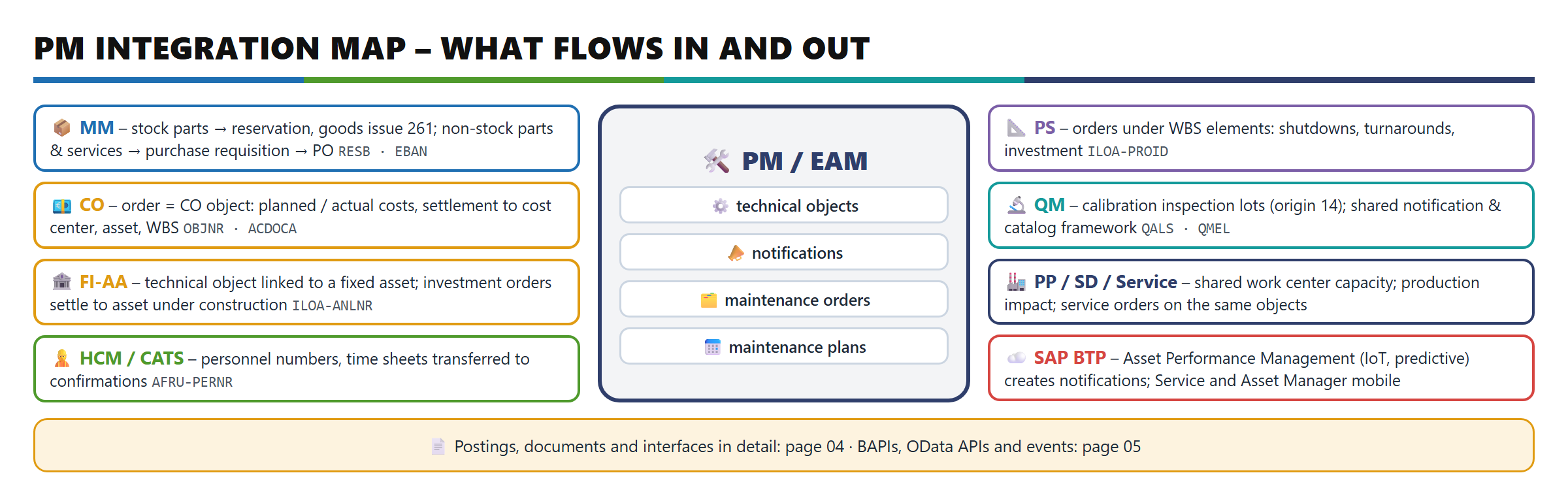
Module | What flows | Objects you meet in code |
|---|---|---|
MM | Stock components → reservation, goods issue 261; non-stock components and external operations → purchase requisition → PO → goods receipt / service entry | RESB, EBAN, EKKO / EKPO, MATDOC (MM ABAP page 03) |
CO | The order is a CO object: planned costs, actual costs from confirmations, goods issues and invoices; periodic settlement to cost center, asset, WBS | AUFK-OBJNR, settlement rule, ACDOCA |
FI-AA | Technical object linked to a fixed asset; investment orders settle to an asset under construction | ILOA-ANLNR |
HCM / CATS | Personnel number in operations and confirmations; time sheets transferred to PM confirmations | AFRU-PERNR, CATSDB |
PS | Orders assigned to WBS elements (shutdowns, turnarounds, investment) | ILOA-PROID, AUFK-PSPEL |
QM | Calibration inspections; catalogs and notification framework shared with QM | QMEL, inspection lots (QALS) |
PP | Work center capacity shared; production impact of breakdowns | CRHD, KBED |
SD / Service | Customer service uses the same objects (service notifications and orders); resource-related billing | QMEL, AUFK (service order types) |
Part 6 – EAM in S/4HANA and on SAP BTP
In S/4HANA, maintenance is the Maintenance Management part of the Asset Management line of business. It is embedded: it runs in the same system and database as MM, FI and CO, with no separate PM installation. The core data model (EQUI, IFLOT, QMEL, AUFK …) is the ECC model; S/4HANA adds Fiori apps, a phase-based maintenance process and analytics. Intelligence and collaboration run side by side on SAP BTP.
Product / component | Where it runs | Purpose |
|---|---|---|
S/4HANA Maintenance Management | S/4HANA (all editions) | Technical objects, notifications, orders, preventive maintenance, phase-based process, Fiori apps |
SAP Asset Performance Management (APM) | SAP BTP (SaaS) | Asset health, condition monitoring with IoT data, predictive models, criticality / FMEA / RCM; combines the former SAP Asset Strategy and Performance Management and SAP Predictive Asset Insights; creates notifications in S/4HANA |
SAP Business Network Asset Collaboration | SAP Business Network (cloud) | Shared asset master data, documents and strategies between operators, manufacturers and service providers; formerly SAP Asset Intelligence Network |
SAP Service and Asset Manager | Mobile app (iOS, Android, Windows) on BTP | Technicians work orders, confirm time, take readings offline |
Intelligent Asset Management (IAM) | Umbrella name | SAP's name for the portfolio of cloud asset solutions around S/4HANA Asset Management |
Editions in one line each
- On-premise / private cloud: full PM functionality including classic transactions (IW21, IW31, IP10 …), WCM, refurbishment and custom code; the phase-based process is available from S/4HANA 2021 and is optional.
- Public cloud: maintenance through best-practice scope items – 4HH reactive, 4HI proactive, 4VT improvement, 4WM operational and overhead maintenance – built on the phase model (introduced with S/4HANA Cloud 2011); no WCM; extensions only with released objects.
- Simplification items, migration objects and the architect's decisions (embedded vs BTP, phase model or classic, mobile strategy) are on page 06.
Part 7 – Interview questions
Q1. What is PM / EAM and what are its main sub-areas?
Plant Maintenance (in S/4HANA: Maintenance Management in Asset Management) keeps physical assets running. Sub-areas: technical objects, notifications, maintenance orders, maintenance planning (preventive), work clearance management, refurbishment, calibration with QM and the information system.
Q2. Explain the maintenance strategies and how SAP supports each.
Corrective (notification → order), preventive time-based (single cycle or strategy plan, IP30), counter-based (counter measuring points + performance-based or multiple counter plan), condition-based (measuring points with limits + measurement documents), predictive (APM on BTP with IoT and ML) and risk-based (criticality, FMEA / RCM deciding the strategy per asset).
Q3. What is the difference between a maintenance plant and a maintenance planning plant?
The maintenance plant is where the technical objects are installed (ILOA-SWERK). The planning plant is where the work is planned: notifications, orders, task lists, plans and planner groups belong to it (IWERK). One planning plant can plan for several maintenance plants (centralised planning).
Q4. What is a planner group and what is a main work center?
A planner group (T024I, per planning plant) is the team of planners responsible for the object or order. The main work center (CRHD) is the group that executes the work; it supplies capacity and the activity type used to cost confirmed hours.
Q5. What is table ILOA used for?
It holds location and account assignment data (maintenance plant, location, plant section, company code, business area, cost center, asset, WBS) shared by functional locations, equipment, notifications and orders through the ILOAN key. Installed equipment can inherit it from the functional location.
Q6. Which modules does PM integrate with?
MM (reservations, goods issue 261, purchase requisitions for non-stock parts and services), CO (order costs and settlement), FI-AA (asset link), HCM / CATS (time confirmations), PS (WBS), QM (calibration, shared notification and catalog framework), PP (work center capacity), SD / Service (service orders) and BTP products such as APM and mobile.
Q7. What are the standard notification types?
M1 maintenance request, M2 malfunction report, M3 activity report (documents work already done). Customers usually copy them into their own types.
Q8. Why does the planning organization matter to a developer?
Planning plant, planner group and order type are the main selection and authorization fields (objects I_IWERK, I_INGRP …). Every custom report, workflow and interface filters by them, and centralised planning means orders of one planning plant can belong to several maintenance plants.
Q9. Where does EAM run in S/4HANA, and what runs on BTP?
Maintenance Management is embedded in the S/4HANA core (same system and database as MM and FI). On BTP run SAP Asset Performance Management (asset health, predictive, FMEA / RCM), SAP Business Network Asset Collaboration (shared asset data) and the SAP Service and Asset Manager mobile app.
Q10. What is work clearance management?
The PM component that makes work safe: isolation of equipment (lockout / tagout) and approvals before execution, with work clearance applications and documents linked to the order. It is available on-premise and in private cloud, not in public cloud.
Q11. How does calibration connect PM and QM?
Test equipment (equipment category for test equipment) gets a maintenance plan; the call creates a maintenance order and an inspection lot with origin 14. Results and the usage decision are entered in QM and can update the equipment status.
Q12. As an architect, when would you use centralised planning?
When one planning department and one spare-parts store serve several sites with similar assets – fewer planner groups and task lists to maintain. Large, independent sites with their own planners are better modelled as their own planning plants.
🏠 Start Here · 02 · Master Data ▶ · Sections: CORE ABAP | OOPS ABAP | ABAP on HANA | Clean Core | RAP | ABAP Points | SAP Fiori | SAPUI5 | Mobile Development (MDK) | BTP Foundations | BTP Development | CAP | SAP Build | ABAP on BTP | Integration Suite | SAP Business AI | SAP BASIS | Security | SAP SDLC
Functional: FICO ABAP | TRM ABAP | VIM | SAP BIS | SD ABAP | MM ABAP | PP ABAP | QM ABAP | PM ABAP | PS ABAP | EWM | TM ABAP | GTM ABAP | EHS ABAP | HR ABAP | BW | SAP Datasphere | SAP Business Data Cloud | SAP MDG | SAP Analytics Cloud | SAP Ariba | SAP CX | SAP IBP