PP (Production Planning and Control) is the SAP module that decides what to make, how much and when, and then runs production on the shop floor: demand and planning (independent requirements, MPS, MRP, capacity), production orders or process orders, goods issue of components, confirmations, goods receipt of the product and the hand-off to CO for order costs. In S/4HANA PP is part of the Manufacturing line of business and works closely with MM (stock, purchasing), SD (sales order demand), QM, PM, CO and EWM. This page gives the big picture: scope, manufacturing types, planning levels, organization units, the integration map and the system architecture (embedded PP/DS, APO, IBP). Master data and tables: page 02; processes and customizing: page 03.
Part 1 – What PP does: scope and sub-components
PP covers the whole chain from a demand forecast to a finished product in stock. Its sub-components follow that chain; you see the codes in SAP Help, in support notes and in the application component of every PP object (SE80 / ADT package hierarchy).
Component | What it does | Main objects |
|---|---|---|
PP-BD Basic Data | Master data for production | BOM, work center / resource, routing / master recipe, production version |
PP-SOP Sales & Operations Planning | Rough, aggregated planning of sales and production (legacy – successor SAP IBP) | Planning hierarchies, info structures |
PP-MP Master Planning | Demand management (PIRs), master production scheduling (MPS), long-term planning (simulation) | Planned independent requirements, MPS planned orders |
PP-MRP Material Requirements Planning | Net requirements, lot sizes, BOM explosion, procurement proposals | Planned orders, purchase requisitions, dependent requirements |
PP-CRP Capacity Requirements Planning | Capacity load and leveling per work center | Capacity requirements, planning table |
PP-SFC Production Orders (shop floor control) | Discrete manufacturing execution | Production order, confirmation, goods movements |
PP-PI Production Planning for Process Industries | Batch-oriented process manufacturing | Process order, master recipe, resource, control recipe, PI sheet |
PP-REM Repetitive Manufacturing | Period- and quantity-based production on lines | Run schedule quantities, backflush, product cost collector |
PP-KAB KANBAN | Pull-based replenishment with control cycles | Control cycle, kanban |
Key business terms
Term | Meaning |
|---|---|
Independent requirement | Demand that comes from outside the BOM: a forecast (planned independent requirement, PIR) or a sales order |
Dependent requirement | Demand for a component, calculated by exploding the BOM of a planned or production order |
Planned order | MRP's internal proposal to produce (or procure) a quantity by a date; it is converted into a production / process order or a purchase requisition |
Production order | The binding execution document: what to produce, which components, which operations on which work centers, and the order costs |
Low-level code | The lowest BOM level at which a material occurs; MRP plans level by level so that all dependent requirements of a component exist before it is planned |
Lead time | In-house production time or planned delivery time; MRP schedules backwards from the requirement date |
Backflush | Automatic goods issue of components at confirmation instead of a manual goods issue |
Planning time fence | Period in which MRP does not change firm planned orders automatically |
Part 2 – Manufacturing types and production strategies
Two independent choices shape every PP implementation: how the product is made (manufacturing type → which execution object) and when production starts relative to the customer order (production strategy → which planning strategy).
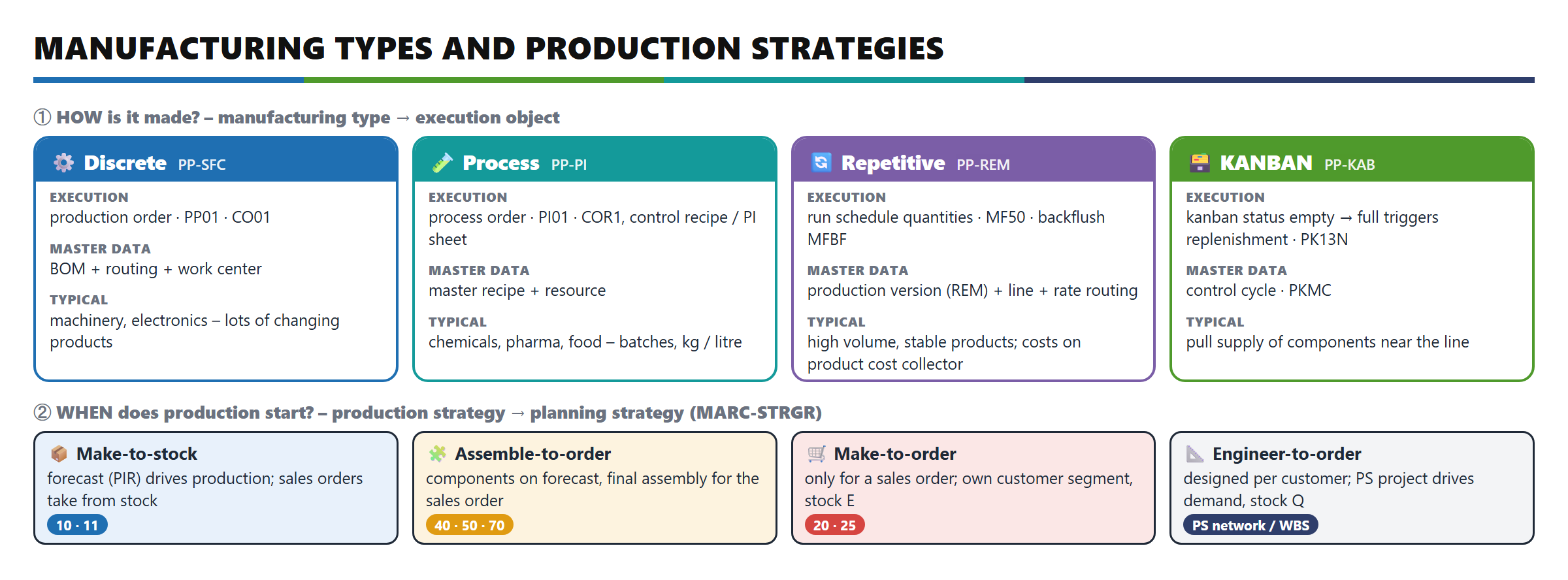
2.1 Manufacturing types
Type | Typical industry | Execution object | Master data | Key t-codes |
|---|---|---|---|---|
Discrete (PP-SFC) | Machinery, electronics, automotive parts – changing products in lots | Production order (order type e.g. PP01) | BOM + routing + work center | CO01, CO02, CO11N |
Process (PP-PI) | Chemicals, pharma, food – recipes, batches, units in kg / litre | Process order (e.g. PI01), control recipe | Master recipe + resource | COR1, COR2, COR6N |
Repetitive (PP-REM) | High volume, stable products on production lines | Run schedule quantities (planned orders) + product cost collector | Production version with REM flag, rate routing | MF50, MFBF |
KANBAN (PP-KAB) | Stable consumption of components near the line | Kanban (container) and its replenishment element | Control cycle | PKMC, PK13N |
- A plant can use several types at the same time; the choice is made per material (MRP and work scheduling views, production version).
- Discrete and process orders share the same order tables (AUFK, AFKO, AFPO – page 02); the order category (AUFK-AUTYP 10 production order, 40 process order) tells them apart.
2.2 Production strategies
Strategy | When production starts | Typical planning strategy | Stock |
|---|---|---|---|
Make-to-stock (MTS) | Before any customer order, driven by forecast (PIRs); sales orders are delivered from stock | 10 net requirements planning (PIR type LSF), 11 gross requirements planning | Anonymous plant stock |
Assemble-to-order (ATO) | Components and assemblies are planned on forecast; final assembly only for a sales order | 40 planning with final assembly (VSF), 50 planning without final assembly (VSE), 70 planning at assembly level | Components anonymous, final product often sales order stock |
Make-to-order (MTO) | Only when a sales order exists; the order quantity is planned in its own individual customer segment | 20 make-to-order, 25 make-to-order for configurable materials | Sales order stock (special stock E) |
Engineer-to-order (ETO) | Product is designed and built for one customer as a project | Project-driven (PS network and WBS elements); MRP plans the project requirements | Project stock (special stock Q) |
- The planning strategy is chosen through the strategy group in the material master (MRP 3 view, field MARC-STRGR) – details on page 02 Part 2 and page 03 Part 5.
- Interview trap: MTS vs MTO is not a manufacturing type. A discrete or a process product can be made to stock or to order.
Part 3 – Planning levels: from S&OP to the shop floor
Planning goes from long-term and aggregated to short-term and detailed. Each level hands a more precise plan to the next one.
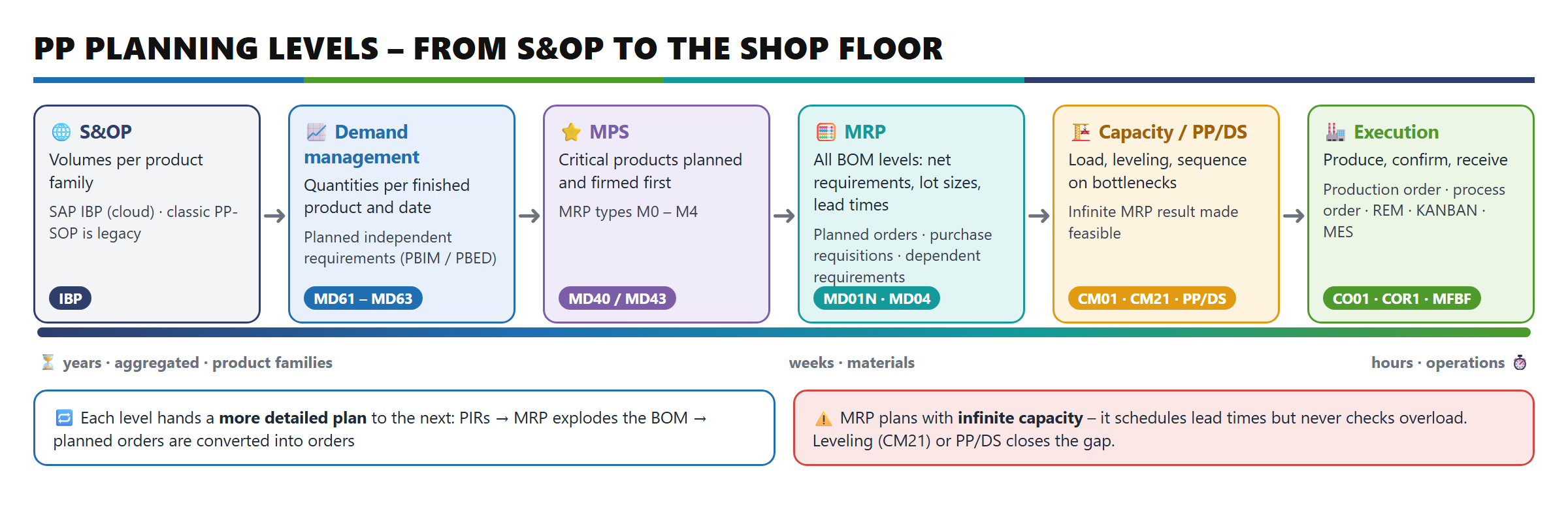
Level | Question answered | Horizon | In S/4HANA | Output |
|---|---|---|---|---|
S&OP | Which volumes per product family can we sell and produce? | Months – years | SAP IBP (cloud); classic PP-SOP is legacy | Sales and production plan per family |
Demand management | Which quantities of which finished product by when? | Weeks – months | PIRs in MD61 – MD63 or Fiori; forecast from IBP | Planned independent requirements |
MPS | Plan the critical products separately and firm them first | Weeks – months | MRP types M0 – M4, run before MRP | Firmed MPS planned orders |
MRP | What must be produced or bought for all levels of the BOM? | Days – months | MRP Live (MD01N, Schedule MRP Runs); DDMRP and Predictive MRP as options | Planned orders, purchase requisitions, dependent requirements |
Capacity planning / detailed scheduling | Is there enough machine and labour capacity? In which sequence? | Hours – weeks | CM01; CM21 / CM25 only compatibility scope (apps Capacity Scheduling Table / Capacity Scheduling Board); embedded PP/DS for finite, optimised scheduling | Dispatched operations |
Execution | Produce, confirm, receive | Today | Production / process orders, REM, KANBAN; MES such as SAP Digital Manufacturing | Goods movements, confirmations, costs |
- Classic MRP plans with infinite capacity: it schedules lead times but never checks whether the work center is overloaded. Capacity leveling (CM21) or PP/DS closes that gap.
- Demand-driven MRP (DDMRP) places decoupling buffers in the BOM and replenishes against buffer levels instead of exploding every requirement; it is an S/4HANA option with its own Fiori apps.
- Predictive MRP (S/4HANA) simulates the effect of demand changes on capacity and suppliers in the medium term – the newer alternative to classic long-term planning.
Part 4 – Organization structure
PP needs few organization units of its own; most of them are shared with MM. The plant is the central unit: material planning data, BOMs, routings, work centers and orders all exist per plant. Below and beside it come the MRP area and the people responsible for planning and scheduling.
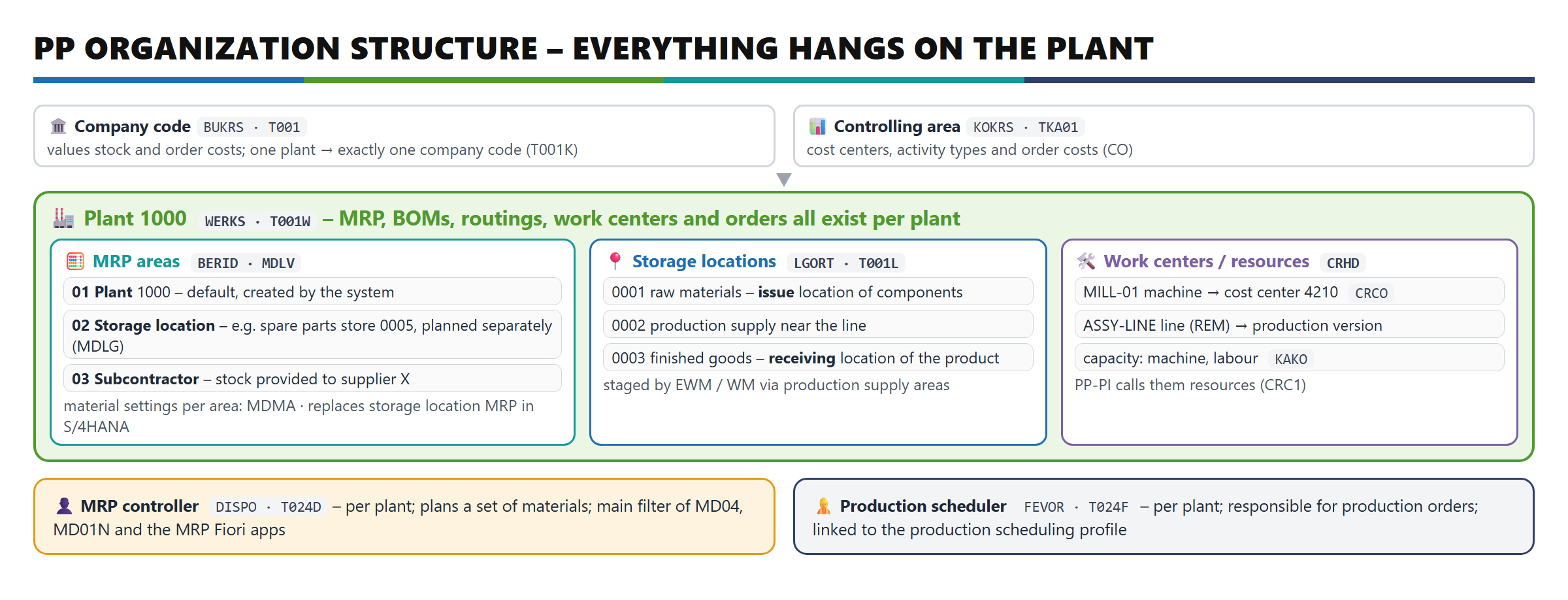
Unit | Meaning in PP | Field | Table |
|---|---|---|---|
Plant | Production site; planning (MRP), master data and orders are per plant. Belongs to one company code (via the valuation area). | WERKS | T001W |
MRP area | Planning unit inside a plant. Types: 01 plant (default, one per plant), 02 storage location(s), 03 subcontractor. Material-specific settings per MRP area. | BERID | MDLV (areas), MDLG (storage locations), MDMA (material data) |
Storage location | Stock place in a plant: receiving location of the product, issue location of components (production storage location). | LGORT | T001L |
MRP controller | Person or group responsible for planning a set of materials; key filter of MD04, MD01N and all MRP Fiori apps. | DISPO | T024D |
Production scheduler | Person or group responsible for production orders of a material; linked to the production scheduling profile. | FEVOR | T024F |
Work center / resource | Machine, line, group of people or (PP-PI) resource where operations run; carries capacity, scheduling formulas and the cost center for activity costing. | ARBPL (internal OBJID) | CRHD |
Production line | In REM a work center (or line hierarchy) assigned in the production version. | MDV01 | MKAL |
Company code / controlling area | Valuation of stock and order costs (CO). | BUKRS / KOKRS | T001 / TKA01 |
Assignment rules
- Plant → company code: exactly one (T001K). A company code can have many plants.
- MRP area → plant: an MRP area belongs to one plant; a storage location can belong to only one MRP area. Plant MRP areas are created by the system; storage location and subcontractor areas are defined in customizing (OMIZ) and assigned to the material with an MRP area segment.
- S/4HANA: the classic storage location MRP (separately planned or excluded storage location in MRP 4) is not available any more; MRP areas replace it (report MRP_AREA_STORAGE_LOC_MIGRATION during conversion).
- Work center → plant: exactly one; work center → cost center: one per validity period (CRCO), which supplies the activity types and rates for costing.
- MRP controller and production scheduler are per plant keys, not users – authorizations and worklists use them as filters.
Part 5 – Integration map
PP consumes demand from SD and forecasts, uses MM for stock and purchasing, asks QM to inspect, depends on PM for machine availability, and feeds CO / FI with costs and values. The postings and interfaces in detail are on page 04.
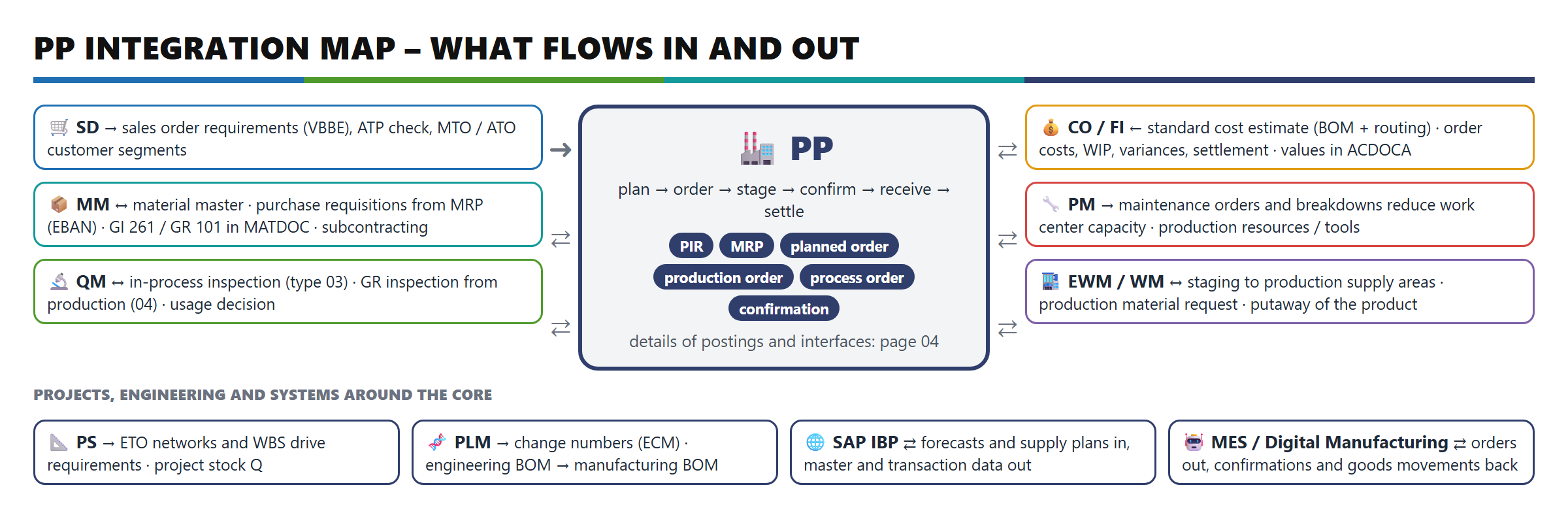
Module | What flows to or from PP | Objects / tables |
|---|---|---|
SD | Sales order requirements for MRP; ATP check; MTO and ATO create individual customer segments | VBBE (requirements), sales order stock MSKA |
MM | Material master; MRP creates purchase requisitions and schedule lines for bought parts; goods issue 261 and goods receipt 101; subcontracting | EBAN, MATDOC (ECC MKPF / MSEG), MARC |
QM | In-process inspection (inspection type 03) with an inspection plan; goods receipt inspection from production (04); usage decision releases the stock | QALS inspection lot |
PM | Maintenance orders and breakdowns reduce work center availability; production resources / tools (PRT) | Maintenance orders, equipment |
CO / FI | Standard cost estimate from BOM + routing (CK11N); actual costs on the order; WIP, variances, settlement; stock values posted in the Universal Journal | ACDOCA (ECC COEP / BSEG), cost estimates |
EWM / WM | Staging of components to production supply areas; production material request in EWM; putaway of the finished product | PSA, warehouse tasks |
PS | ETO: networks and WBS elements drive requirements; project stock | PRPS, MSPR |
PLM | Engineering change management (change numbers), engineering BOM → manufacturing BOM | AENR (change master) |
External | IBP (demand and supply plans), MES / SAP Digital Manufacturing (dispatch, confirmations), machine data | APIs, IDocs, events (page 04) |
Part 6 – System architecture: embedded PP/DS, APO, IBP and MES
PP itself always runs inside the S/4HANA core. The architect's question is where the advanced planning and the shop floor execution run.
Topic | Legacy (ECC world) | S/4HANA world |
|---|---|---|
Detailed scheduling (finite capacity, optimisation) | SAP APO PP/DS in a separate SCM system with its own liveCache; master and transaction data transferred through the CIF (core interface, integration models) | Embedded PP/DS inside S/4HANA (since 1610): liveCache runs in the SAP HANA database, no second system; materials and work centers flagged for Advanced Planning; a simplified CIF still works internally |
S&OP, demand and supply planning | APO DP / SNP, classic PP-SOP | SAP IBP for Supply Chain (cloud), integrated with S/4HANA |
MRP | Classic MRP in ABAP (MD01, MD02, MD03) | MRP Live (MD01N) executed in SAP HANA; classic MRP still callable on-premise |
Shop floor (MES) | SAP ME / MII or third-party MES | SAP Digital Manufacturing (cloud) or third-party MES, connected via APIs and events |
Embedded PP/DS vs APO PP/DS
- Same planning engine and heuristics, but no separate system, no data replication delay and one set of master data (material, work center, production version become PP/DS products, resources and production data structures).
- It is an optional scenario with extra licensing; many plants stay with MRP Live + capacity leveling.
- Legacy: SAP APO (SCM 7.0) – customers move to embedded PP/DS (detailed scheduling) and IBP (planning).
Deployment options (overview – details on page 06)
- On-premise / private cloud: full PP scope including PP-PI, REM, KANBAN, classic transactions and embedded PP/DS.
- Public cloud: standard manufacturing scope through scope items and Fiori apps, extensions only through released APIs, BAdIs and CDS views (clean core).
Part 7 – Interview questions
Q1. What does PP cover and which sub-components does it have?
Planning and execution of production: basic data (BOM, work center, routing), S&OP, demand management, MPS, MRP, capacity planning, production orders (SFC), process orders (PP-PI), repetitive manufacturing and KANBAN.
Q2. Difference between discrete, process and repetitive manufacturing?
Discrete uses production orders with BOM and routing for changing lots; process (PP-PI) uses process orders with master recipes, resources and batches; repetitive (REM) plans quantities per period on a line and backflushes without individual orders, costs on a product cost collector.
Q3. What is the difference between MTS, MTO and ATO in planning terms?
MTS produces on forecast into anonymous stock (strategy 10/11). MTO plans only for a sales order in an individual customer segment (20). ATO plans components on forecast and final assembly on the sales order (40, 50, 70); the sales order consumes the PIRs.
Q4. What is an MRP area and why is it important in S/4HANA?
A planning unit inside a plant (plant, storage location or subcontractor type) with its own MRP settings per material (MDMA). In S/4HANA storage location MRP no longer exists, so separately planned storage locations and subcontractor stock are planned with MRP areas.
Q5. What is the MRP controller and where is it used?
A per-plant key (MARC-DISPO, T024D) for the person or group planning a material. It is the main selection field of MRP runs, MD04 / MD07 and the Fiori MRP apps, and is often used in authorization checks and custom reports.
Q6. How does PP integrate with CO?
The standard cost estimate uses BOM and routing with activity prices from the work center's cost center. The production order collects plan and actual costs (material from goods issue, activities from confirmations), then WIP and variances are calculated and the order is settled to stock or the sales order.
Q7. Which planning levels exist between S&OP and execution?
S&OP (IBP) → demand management (PIRs) → MPS (critical items) → MRP (all levels) → capacity planning or PP/DS → execution with production orders, process orders, REM or KANBAN.
Q8. Embedded PP/DS vs APO PP/DS?
APO PP/DS runs in a separate SCM system connected via CIF integration models. Embedded PP/DS runs inside S/4HANA with liveCache in SAP HANA, uses the same master data flagged for Advanced Planning and avoids a second system and replication.
Q9. Does MRP consider capacity?
No – classic MRP and MRP Live plan with infinite capacity and only schedule lead times. Capacity is checked afterwards with capacity evaluation and leveling (CM01, CM21) or with finite scheduling in PP/DS.
Q10. Which tables tell a production order from a process order?
Both are in AUFK / AFKO / AFPO; AUFK-AUTYP is 10 for production orders and 40 for process orders, and the order type (AUFK-AUART, e.g. PP01 / PI01) carries the detailed control.
Q11. As an architect, when would you propose embedded PP/DS or IBP?
Embedded PP/DS when finite, sequence-dependent scheduling of bottleneck resources is needed close to execution. IBP when the company needs collaborative S&OP, statistical forecasting and multi-plant supply planning. Plain MRP Live with capacity leveling stays the default for simpler plants.
🏠 Start Here · 02 · Master Data ▶ · Sections: CORE ABAP | OOPS ABAP | ABAP on HANA | Clean Core | RAP | ABAP Points | SAP Fiori | SAPUI5 | Mobile Development (MDK) | BTP Foundations | BTP Development | CAP | SAP Build | ABAP on BTP | Integration Suite | SAP Business AI | SAP BASIS | Security | SAP SDLC
Functional: FICO ABAP | TRM ABAP | VIM | SAP BIS | SD ABAP | MM ABAP | PP ABAP | QM ABAP | PM ABAP | PS ABAP | EWM | TM ABAP | GTM ABAP | EHS ABAP | HR ABAP | BW | SAP Datasphere | SAP Business Data Cloud | SAP MDG | SAP Analytics Cloud | SAP Ariba | SAP CX | SAP IBP