This page is the architect's view of PP in S/4HANA: what changed against ECC (and what that means for custom code), which new planning options exist, what each edition offers, how PP data is migrated, and the design decisions a solution architect makes for manufacturing – plus clean-core rules for PP developments. The individual objects are explained on pages 01 – 05; this page connects them into decisions.
Part 1 – ECC → S/4HANA: simplification items for PP
The Simplification Item Catalog lists every change per release; the Readiness Check and the ATC S/4HANA checks show which ones hit your system and custom code (ABAP on HANA › 02 Migration to S/4HANA). The PP items an architect must know:
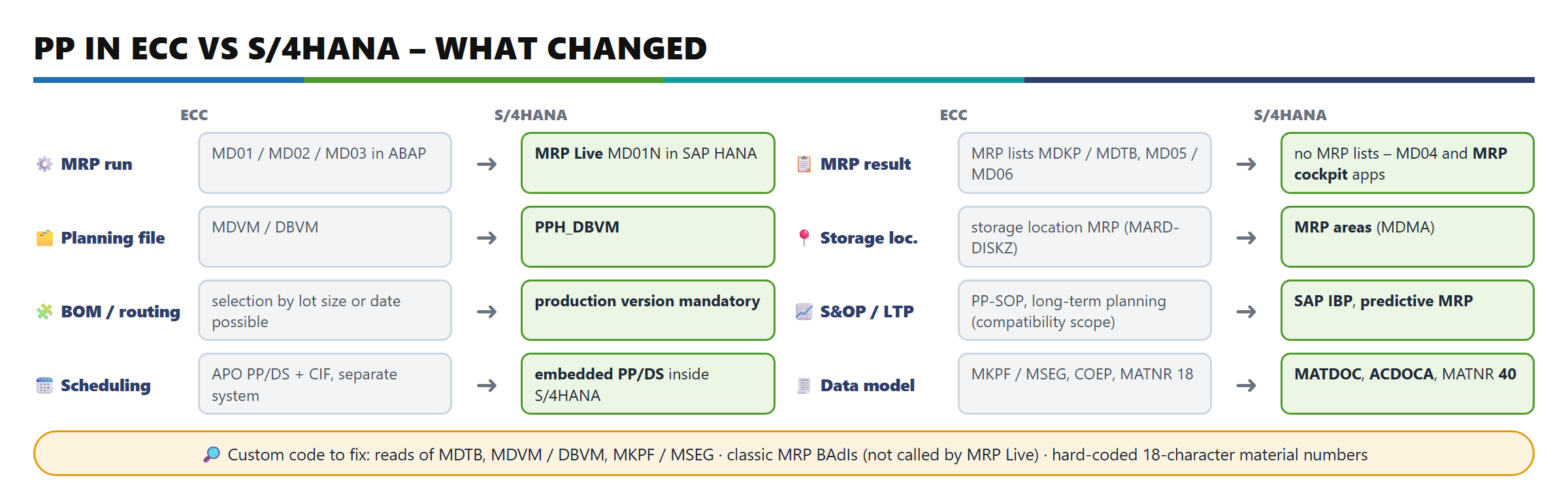
Area | ECC | S/4HANA | Impact on custom code / design |
|---|---|---|---|
MRP run | MD01 / MD02 / MD03 in ABAP | MRP Live MD01N in SAP HANA (classic MRP still callable on-premise) | Classic MRP BAdIs not called (page 05 Part 4); MD_MRP_FORCE_CLASSIC as fallback |
MRP list | MDKP / MDTB, MD05 / MD06 | Not written by MRP Live; MRP cockpit Fiori apps | Reports on MDTB must move to MD04 APIs, API_MRP_MATERIALS_SRV_01 or CDS |
Planning file | MDVM / DBVM | PPH_DBVM | Direct reads of MDVM / DBVM break |
Storage location MRP | Separately planned / excluded storage locations (MARD-DISKZ) | Not available – MRP areas | Conversion report MRP_AREA_STORAGE_LOC_MIGRATION; MRP area design (Part 5) |
Production version | Optional (BOM selection by lot size / date possible) | Mandatory for BOM / routing selection | CS_BOM_PRODVER_MIGRATION02 creates missing versions |
Creation indicators in MRP | Purchase requisition vs planned order, schedule lines yes / no | Removed in MRP Live: always purchase requisitions, or schedule lines if a scheduling agreement is the source | Variants and jobs using the old indicators must be changed |
SOP (PP-SOP) and long-term planning | Standard functions | Compatibility scope – successors SAP IBP and predictive MRP | Plan the move; do not build new on them |
Detailed scheduling | SAP APO PP/DS (separate system, CIF) | Embedded PP/DS | No CIF landscape; PP/DS flags on material and work center |
Inventory / costs | MKPF / MSEG, COEP / COSS, BSEG | MATDOC, ACDOCA | Compatibility views exist, but new code reads the new tables or released views |
Material number | 18 characters | 40 characters | Use |
Shop floor info system | LIS info structures (S0xx), MCP… reports | Not the target – COOIS, Fiori analytics, CDS | Rebuild LIS-based reports on CDS |
- Compatibility scope (SAP Note 2269324, compatibility scope matrix): functions that still run in S/4HANA but with limited usage rights; for on-premise licences these rights ended at the end of 2025 unless SAP's note says otherwise for an item. Check the current note and the Readiness Check before relying on any of them (SOP, LTP, graphical planning table CM21 – CM25, MRP lists).
Part 2 – New planning and manufacturing capabilities
Capability | What it does | When to propose it |
|---|---|---|
MRP Live + MRP cockpit apps | Net requirements calculation in SAP HANA; Fiori apps for coverage and exception handling instead of MRP lists | Always – target architecture for MRP |
Demand-driven MRP (DDMRP) | Decoupling buffers at strategic BOM levels; replenishment against buffer zones (S/4HANA since 1709) | Volatile demand, long lead times, bullwhip effect |
Predictive MRP (pMRP) | Medium-term simulation of demand changes on capacity and suppliers (since 1909) | Replace long-term planning; S&OP-light without IBP |
Embedded PP/DS | Finite, sequence-dependent scheduling and optimisation inside S/4HANA (since 1610) | Bottleneck resources, setup optimisation, capable-to-promise |
Handover purchase requisitions | MRP controller hands requisitions over to purchasing explicitly; switched on per MRP group (since 2020) | When purchasing must not see unconfirmed MRP proposals |
Event-based production accounting | WIP, variances, settlement in real time | Public cloud standard; on-premise when real-time production costs matter (page 04 Part 4) |
EWM advanced production integration | Production material requests, staging, consumption in EWM | Plants with EWM-managed warehouses |
SAP Digital Manufacturing | Cloud MES: execution, insights, operator UI | When a MES is needed and the plant fits the standard integration |
Production engineering and operations (PEO) | Separately licensed S/4HANA solution for complex discrete manufacturing: version-controlled MBOM and shop floor routings, shop floor orders, work instructions | Engineer-heavy industries (e.g. aerospace, machinery) |
Part 3 – Editions: on-premise, private cloud, public cloud
Topic | On-premise / private cloud | Public cloud |
|---|---|---|
Scope | Full PP: discrete, PP-PI, REM, KANBAN, embedded PP/DS, classic transactions | Standard scope items, e.g. BJ5 make-to-stock discrete, BJE make-to-order, BJH repetitive, BJ8 make-to-stock process manufacturing; check the scope item list per release |
Configuration | SPRO / IMG, any customizing | Central Business Configuration, self-service configuration UIs for allowed settings |
Extensibility | Classic (exits, BAdIs, modifications) plus key-user and ABAP Cloud | Key user and developer extensibility on released objects only (ABAP Cloud) |
Integration | IDocs, BAPIs / RFC, OData, SOAP, events | Released APIs and events, a limited set of IDocs; communication arrangements |
Costing | Period-end or event-based | Event-based production accounting (3F0) |
MTO stock | Valuated or non-valuated sales order stock | Valuated sales order stock only |
Upgrades | Customer-driven (private cloud: contractual windows) | SAP-driven, twice a year |
- Private cloud (RISE) is technically the on-premise product run by SAP – same PP scope, same extensibility options, but clean core is expected contractually and by the upgrade cadence.
- A greenfield public cloud project fits standard discrete, MTO and repetitive processes; heavy PP-PI with PI sheets, complex variant configuration or deep MES modifications usually point to private cloud.
Part 4 – Data migration of PP objects
In a greenfield project PP master data is loaded with the SAP S/4HANA Migration Cockpit (Fiori app Migrate Your Data, staging tables or files). Order matters because each object refers to the previous one.
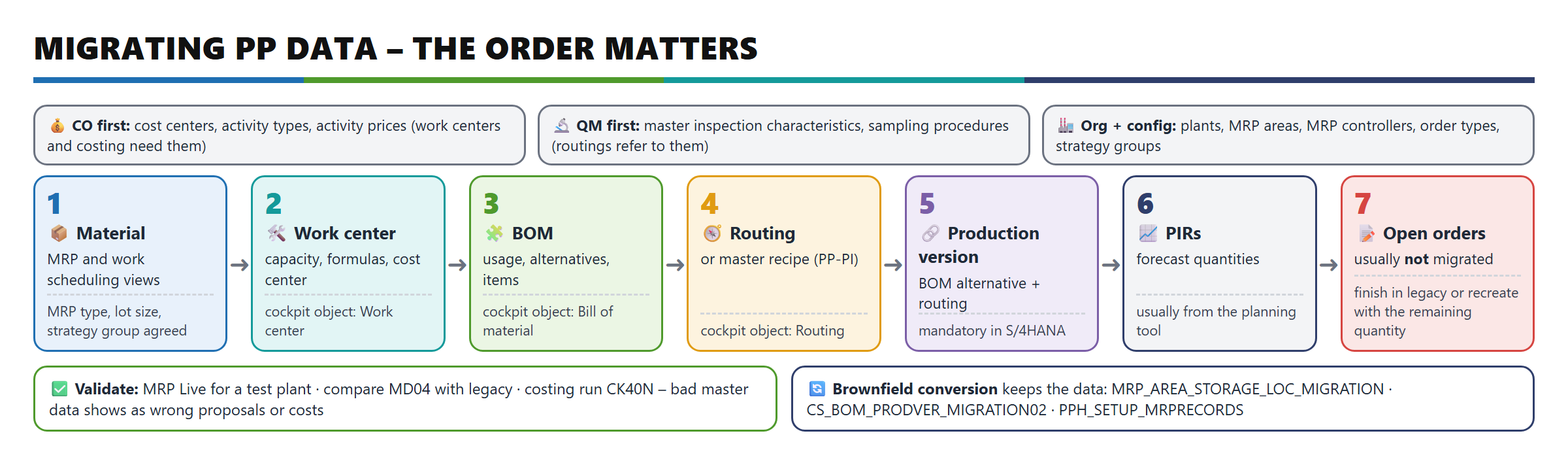
Order | Object | Migration Cockpit object | Watch out for |
|---|---|---|---|
1 | Material (MRP, work scheduling views) | Product (material master) object | MRP type, lot size, MRP areas, strategy group – agreed with the business first |
2 | Work center / resource | Work center (with cost center and capacity) | Cost centers and activity types must exist (CO first) |
3 | Bill of material | Bill of material | Components must exist; usage and alternatives |
4 | Routing / master recipe | Routing (master recipe where offered) | Work centers, inspection characteristics and sampling procedures must exist |
5 | Production version | Production version | Mandatory in S/4HANA – one per BOM / routing combination |
6 | Planned independent requirements | PIR object where offered, or BAPI_REQUIREMENTS_CREATE | Usually reloaded from the planning tool |
7 | Open production / process orders | Usually not migrated | Finish in the legacy system or recreate open orders in S/4HANA (BAPI / CO01) with the remaining quantity |
- Check the object list of the Migration Cockpit for your release – objects and their templates differ between releases and between on-premise and public cloud.
- System conversion (brownfield) keeps the data; the conversion reports do the PP work: MRP_AREA_STORAGE_LOC_MIGRATION, CS_BOM_PRODVER_MIGRATION02, PPH_SETUP_MRPRECORDS for the planning file. Custom code: replace MDKP / MDTB, MDVM / DBVM, MKPF / MSEG reads.
- After the load: run MRP Live for a test plant, compare MD04 with the legacy system, and cost the products (CK40N) – wrong master data shows up immediately as wrong proposals or cost estimates.
Part 5 – Architect decisions
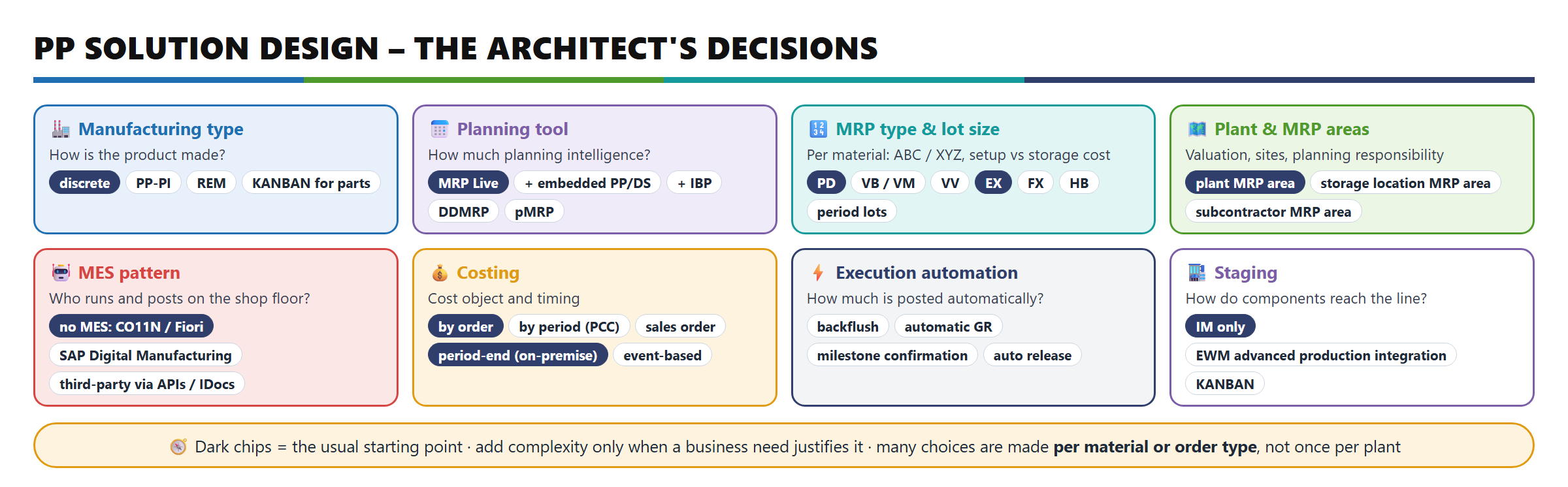
Decision | Options | Decide by |
|---|---|---|
Manufacturing type | Discrete (production orders), PP-PI (process orders), REM (run schedules), KANBAN for components | Product and process: recipes and batches → PP-PI; stable high volume on lines → REM; changing lots with operations → discrete. Mixed per material is allowed |
Planning tool | MRP Live only; + embedded PP/DS; + IBP; DDMRP; pMRP | Capacity bottlenecks (PP/DS), multi-site S&OP and forecasting (IBP), demand volatility (DDMRP), medium-term simulation (pMRP) |
MRP type and lot sizing | PD MRP, VB / VM reorder point, VV forecast-based, ND; EX lot-for-lot, FX fixed, HB replenish to maximum, period lots | Value and consumption pattern (ABC / XYZ), setup cost vs storage cost, supplier constraints |
Plant and MRP area design | One plant per site; MRP areas for separately planned storage locations and subcontractors | Legal and valuation needs (plant = valuation area), physical sites, separate planning responsibility |
MES integration pattern | No MES (CO11N / Fiori), SAP Digital Manufacturing, third-party MES via APIs / IDocs / Integration Suite | Shop floor complexity, genealogy, machine integration; who posts goods movements |
Costing approach | Product cost by order, by period (product cost collector), sales order controlling; period-end vs event-based | Manufacturing type, reporting needs, edition |
Execution automation | Backflush vs manual issue; automatic GR; milestone confirmation; order release automatic or manual | Data quality of BOMs, discipline on the shop floor, need for real-time stock |
Warehouse staging | Inventory management only, EWM advanced production integration, KANBAN | Warehouse size and automation, line-side storage |
Typical trade-offs to explain in an interview
- Backflush everything reduces postings but makes stock wrong when BOMs are inaccurate; COGI becomes a daily task.
- Embedded PP/DS gives finite scheduling but needs clean master data (setup matrices, resources) and planners trained in a new tool; plain MRP Live + capacity leveling is cheaper.
- One plant vs several plants at one site: separate plants separate valuation and planning but add stock transfers; MRP areas often give the planning separation without a new plant.
- MES posts goods movements vs S/4HANA backflushes: decide per order type; never both.
Part 6 – Clean core for PP developments
Clean core means: extend through released, upgrade-stable interfaces, keep modifications out (Clean Core › 01 Clean Core). For PP the typical classic objects map to these targets:
Classic (ECC habit) | Clean-core target |
|---|---|
PPCO / CONFPP customer exits, WORKORDER_… BAdIs | Released BAdIs via Custom Logic or ABAP Cloud where offered; otherwise keep on-premise with a documented exception, or move the rule to the integration layer |
Z reports with SELECTs on AFKO, PLAF, RESB, MDTB | Released CDS views (I_PlannedOrder, I_ManufacturingOrder …), analytical queries, Fiori elements |
Z programs calling BAPI_PRODORD_… BAPIs via RFC from outside | Released OData APIs (SAP_COM_0104) and business events |
Custom MES IDoc logic in user exits | SAP Digital Manufacturing standard integration or Integration Suite mapping outside the core |
Classic MRP BAdIs | AMDP BAdIs for MRP Live; fewer customizations of the planning logic |
Appends on AFKO / AFPO with screen modifications | Custom Fields app where a business context exists; otherwise a side table keyed by order |
Copied standard print programs for shop floor papers | Output forms on released interfaces where supported |
- Side-by-side on SAP BTP for whole new functions (operator apps, quality dashboards, AI scrap prediction) on released APIs and events – ③ SAP BTP section group.
Part 7 – Roadmap and successor products
Legacy | Successor |
|---|---|
PP-SOP (Flexible Planning, info structures) | SAP IBP for Supply Chain (S&OP, demand, supply) |
Long-term planning (LTP) | Predictive MRP; IBP for multi-site scenarios |
SAP APO PP/DS, SNP, DP | Embedded PP/DS, IBP |
Classic MRP with MRP lists | MRP Live + MRP cockpit apps |
SAP ME / SAP MII | SAP Digital Manufacturing |
Classic WM staging | EWM (embedded or decentralised) |
LIS shop floor information system | Embedded analytics (CDS), SAP Analytics Cloud, Datasphere |
- SAP's innovation for PP goes into S/4HANA public cloud first (two releases a year) and reaches private cloud / on-premise with the next release (since 2023 every two years, with feature packs in between); the What's New documents list the changes per release.
Part 8 – Interview questions
Q1. What are the main PP simplification items in S/4HANA?
MRP Live (MD01N) without MRP lists, the single planning file PPH_DBVM, MRP areas instead of storage location MRP, mandatory production versions, removed MRP creation indicators, SOP and long-term planning in compatibility scope with IBP and pMRP as successors, embedded PP/DS instead of APO, MATDOC and ACDOCA, 40-character material numbers.
Q2. What changes for custom code that reads MRP results?
MDKP / MDTB are not written by MRP Live, so such reports show old data. Read live data through the stock / requirements list API (MD_STOCK_REQUIREMENTS_LIST_API), API_MRP_MATERIALS_SRV_01 or released CDS views; planning file reads move to PPH_DBVM.
Q3. Why is the production version mandatory and how do you prepare for it?
S/4HANA selects BOM and routing only through the production version in MRP and order creation. Before conversion run CS_BOM_PRODVER_MIGRATION02 to generate missing versions; in greenfield load them with the Migration Cockpit after BOMs and routings.
Q4. When would you recommend embedded PP/DS, IBP, DDMRP or pMRP?
Embedded PP/DS for finite, sequence-dependent scheduling of bottlenecks; IBP for collaborative S&OP, statistical forecasting and multi-site supply planning; DDMRP for volatile demand with long lead times; pMRP for medium-term what-if simulation instead of long-term planning.
Q5. What is the difference between the editions for manufacturing?
On-premise and private cloud have the full PP scope (PP-PI, REM, KANBAN, PP/DS) with classic and clean-core extensibility. Public cloud offers standard scope items such as BJ5, BJE, BJH and BJ8, released extensibility only, event-based production accounting and valuated sales order stock only.
Q6. In which order do you migrate PP master data?
Material, work centers (after cost centers and activity types), BOMs, routings / master recipes, production versions, then PIRs. Open orders are usually completed in the legacy system or recreated.
Q7. How do you choose between discrete, process and repetitive manufacturing?
By the product and process: recipes, batches and quantities in kg or litres → PP-PI; stable high volume on lines → REM with period costing; changing lots with routings → discrete. A plant can mix them per material.
Q8. How would you design MRP areas for a plant?
Keep the plant MRP area as default; add storage location MRP areas only where a location must be planned separately (e.g. a remote spare-parts store) and subcontractor MRP areas for provided components. Each storage location belongs to at most one MRP area.
Q9. Which MES integration pattern would you choose?
With SAP Digital Manufacturing the standard integration (order IDocs out, APIs back) via Integration Suite and Cloud Connector; for a third-party MES the released OData APIs and events, IDocs where the MES expects them. In both cases one system owns goods movements and confirmations.
Q10. How do you keep PP developments clean-core?
Released CDS views for reading, released APIs and events for integration, released BAdIs or Custom Logic for logic, Custom Fields for fields, side-by-side apps on BTP; classic exits only on-premise with a documented exception and a plan to replace them.
Q11. What happens to SOP and long-term planning in S/4HANA?
They are compatibility scope with limited usage rights. The successors are SAP IBP for S&OP and demand / supply planning and predictive MRP for medium-term simulation.
Q12. What would you check first in a brownfield PP conversion?
The Readiness Check and simplification items (storage location MRP, production versions, MRP lists, compatibility scope usage), custom code reading MDTB, MDVM, MKPF / MSEG and COEP, classic MRP BAdIs that MRP Live will not call, and APO / CIF dependencies.
🏠 Start Here · ◀ 05 · Development · 07 · Interview Questions ▶ · Sections: CORE ABAP | OOPS ABAP | ABAP on HANA | Clean Core | RAP | ABAP Points | SAP Fiori | SAPUI5 | Mobile Development (MDK) | BTP Foundations | BTP Development | CAP | SAP Build | ABAP on BTP | Integration Suite | SAP Business AI | SAP BASIS | Security | SAP SDLC
Functional: FICO ABAP | TRM ABAP | VIM | SAP BIS | SD ABAP | MM ABAP | PP ABAP | QM ABAP | PM ABAP | PS ABAP | EWM | TM ABAP | GTM ABAP | EHS ABAP | HR ABAP | BW | SAP Datasphere | SAP Business Data Cloud | SAP MDG | SAP Analytics Cloud | SAP Ariba | SAP CX | SAP IBP