The Project System is still a core part of SAP S/4HANA on-premise and private cloud – the structures, profiles and tables you learnt on pages 01 – 03 are the same. What changed is around them: costs live in the Universal Journal, several old functions and interfaces were removed or put into the compatibility scope, Fiori apps replace parts of the information system, and the public cloud uses enterprise projects instead of classic PS. This page collects the simplification items, the editions, data migration and the decisions a solution architect makes on a PS project. Finance simplifications in general: FICO ABAP › 07 S/4HANA, Cloud & Architect View.
Part 1 – PS in S/4HANA: what stayed and what changed
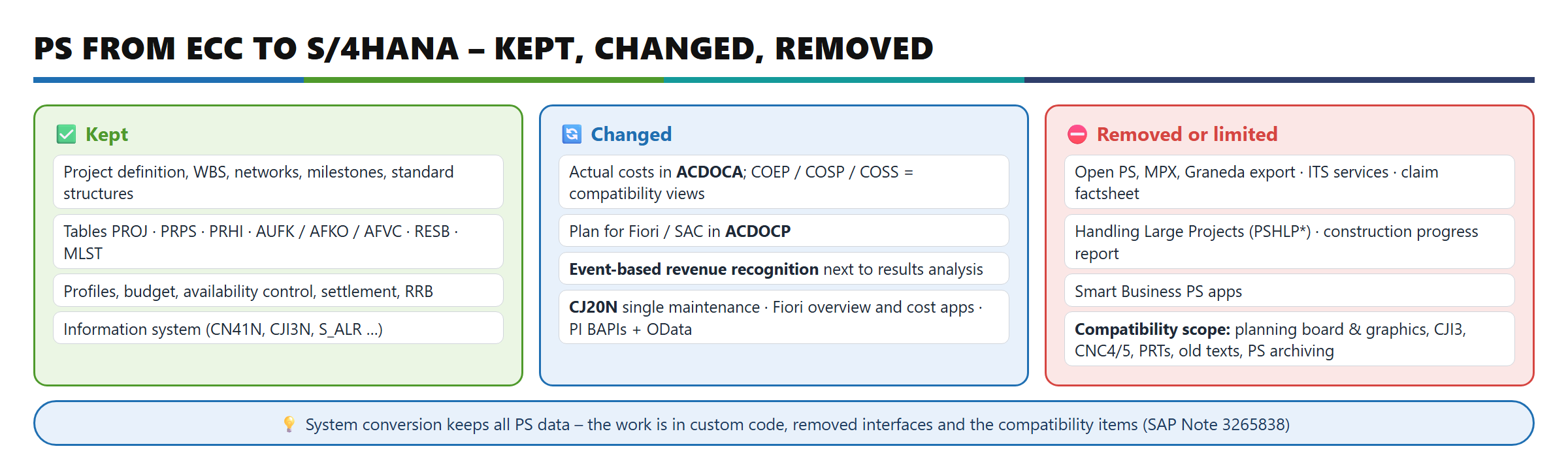
Area | SAP ERP (ECC) | SAP S/4HANA | Impact for developers |
|---|---|---|---|
Project master data | PROJ, PRPS, PRHI, AUFK / AFKO / AFVC, RESB, MLST | Unchanged | Old reports on the structure tables keep working |
Actual costs | COEP line items, COSP / COSS totals | ACDOCA (Universal Journal); COEP, COSP, COSS are compatibility views | Read ACDOCA or released CDS views; no writes to CO tables |
Plan data | COSP / COSS plan records | ACDOCP for the new planning and Fiori reporting; classic planning still writes CO plan tables | Plan reports must know which source is used |
Revenue recognition | Results analysis at period end | Event-based revenue recognition in addition to results analysis | New posting logic, new reports |
Maintenance UI | CJ01 / CJ02, CJ11, Handling Large Projects … | Project Builder (CJ20N) as the single maintenance transaction; HLP transactions removed | Enhancements must work in CJ20N |
Customers, materials, stock | KNA1, MATNR 18, MKPF / MSEG | Business partner, MATNR 40, MATDOC | Use |
Reporting | Information system, Smart Business apps | Information system + new Fiori apps on ACDOCA / ACDOCP; Smart Business apps removed | CDS-based reports (page 05 Part 7) |
Interfaces | Open PS, MPX, ITS services, old BAPIs | PI BAPIs and OData APIs only | Rebuild external integrations (page 04 Part 7) |
- A system conversion keeps all PS data; the simplification item check and the readiness check tell you which of the items in Part 2 apply, ATC with the S/4HANA checks finds affected custom code (ABAP on HANA › 02 Migration to S/4HANA).
Part 2 – Simplification items for PS
The simplification list (chapter Logistics – PS) contains these items. "Not available" means the function is gone; "not target architecture" means it still works but will not be developed further.
Item (SAP Note) | What happens | Alternative |
|---|---|---|
Selected Project System Interfaces (2267288) | Not available: Open PS for Microsoft Project, MPX up / download (CN06, CN07), export to Graneda / Access | PS BAPIs or OData APIs |
Selected Project System BAPIs (2267386) | BAPIs of ProjectDefinition, WorkBreakdownStruct, Network: not target architecture | PI BAPIs (ProjectDefinitionPI, WBSPI, NetworkPI), OData Project / Project Network |
Handling Large Projects (2352369) | Business functions OPS_PS_HLP_1 / _2 obsolete; PSHLP10 … PSHLP90 not usable | Project Builder CJ20N |
Navigation to Project Builder (2270261) | Links from CJI3N, CJI4N, CN41, CNS0 go to CJ20N instead of special maintenance transactions | Enable custom code for CJ20N |
Project Claim Factsheet (2267283) | Not available | Fiori app Project Claim Overview (F6497, S/4HANA 2022) or Project Issue and Change Management |
Construction Progress Report and Valuation (2267289) | Not available (/SAPPCE/PNV… transactions) | Customer solution or standard functions |
Project System ITS Services (2267331) | Not available: CNW1 confirmation, CNW4 project documents, SR10 claims | Fiori apps, CATS |
Project System Analytical Apps (3112420) | Smart Business for Project Execution apps (F0293 …) not available | Overview apps F1974 / F1975 / F1976, Manage Project Procurement F2930 |
Deprecation of Project Cost Reports (3331626) | F2513 / F2538 deprecated as of 2023 | Project Cost Overview F6991, Project Cost Line Items F6992 |
Hierarchy graphics (3000979), PRT for projects (2270262), PS archiving transactions (2270265), project texts (2270266) | Compatibility scope (Part 3) | CJ20N hierarchy; central archiving SARA; renewed PS texts |
- Project texts: renewed PS texts with the Fiori app Project Text exist since S/4HANA 2021 FPS1; report CN_PS_TEXT_MIGRATION migrates old texts (client by client), then activate the renewed texts in the IMG.
Part 3 – The compatibility scope for PS
The compatibility scope is functionality that still runs in S/4HANA on-premise and private cloud but with limited usage rights. SAP Note 3265838 (S4TWL – Project System – Compatibility Scope) collects the PS items; the dates are in the matrix of SAP Note 2269324.
Compatibility item (matrix ID) | Examples | Alternative |
|---|---|---|
Project reporting (459) | CJCD, CODC, CN65 change documents; CJI3; CJSA, CJSB | CN60, CJI3N; no alternative for the EIS transfer |
Consistency checks (460) | CNC4, CNC5, S_ALR_87013595 … 597 | Validations |
Selected financial planning and control (462) | CNPRG network progress, CNFOWB forecast workbench, transfer price agreements CJF1 … CJG5 | Review per process |
PRT functions for projects (463) | Production resources / tools in network activities | Other resource modelling |
Progress tracking and monitoring dates (464) | NWTM monitoring network dates | Progress tracking |
Planning board, Gantt chart, hierarchy and network graphics (465) | Project planning board, hierarchy graphic | CJ20N; no graphical successor planned for the hierarchy graphic |
Project texts (466) | CN04 / CN05 PS text catalog | Renewed PS texts |
Selected PS business function capabilities (468) | Parts of OPS_PS_CI_1 (access control lists, statistical key figure tabs, forecast workbench) and OPS_PS_CI_3 (RRB optimisation) | SAP Note 2677564 or RRB source actual costs from the Universal Journal |
PS-specific archiving (470) | CN80 … CN85, CN99 | Central archiving SARA |
- Usage rights: for on-premise licences the compatibility pack rights ended on 31 May 2026 (after a final extension from 31 December 2025; only isolated exceptions run to 2030). Systems run under a cloud subscription contract (private cloud, RISE with SAP) may use them until the end of 2030. SAP Note 2269324 holds the official matrix.
- Architect action: run the readiness check, list the compatibility items in use, and plan their replacement as part of the project – not after go-live.
Part 4 – Editions: on-premise, private cloud, public cloud
Topic | On-premise / private cloud | Public cloud |
|---|---|---|
Project object | Classic PS projects: project definition, WBS, networks, standard structures | Enterprise projects on the PS data model, no networks; resource and material needs as project demands |
Maintenance | CJ20N and Fiori apps | Fiori apps only (e.g. Project Control – Enterprise Projects) |
Scope | Full PS incl. investment management, assembly processing, RRB, results analysis, compatibility scope | Scope items such as Project Financial Control (1NT), R&D Project Management (35E), Capital Investment Project Management (35F), Sales Order Processing with Project Account Assignment (4I9); service companies: customer projects (J11) with Project Billing (4E9) |
Revenue recognition | Results analysis or event-based | Event-based revenue recognition |
Add-ons | CPM, PPM (separately licensed), partner tools | Enterprise portfolio and project functions delivered in the cloud releases |
Extensibility | Everything incl. CMOD, CI includes, classic BAdIs | Key-user and developer extensibility with released objects only |
APIs | API_PROJECT_V3, Project Network, PI BAPIs | API_ENTERPRISE_PROJECT_SRV_0002 and related released APIs |
- Private cloud is technically the on-premise product run by SAP: same PS scope, same compatibility items, but clean-core rules of the contract and the hyperscaler operations apply.
Part 5 – PS, CPM, PPM or enterprise projects?
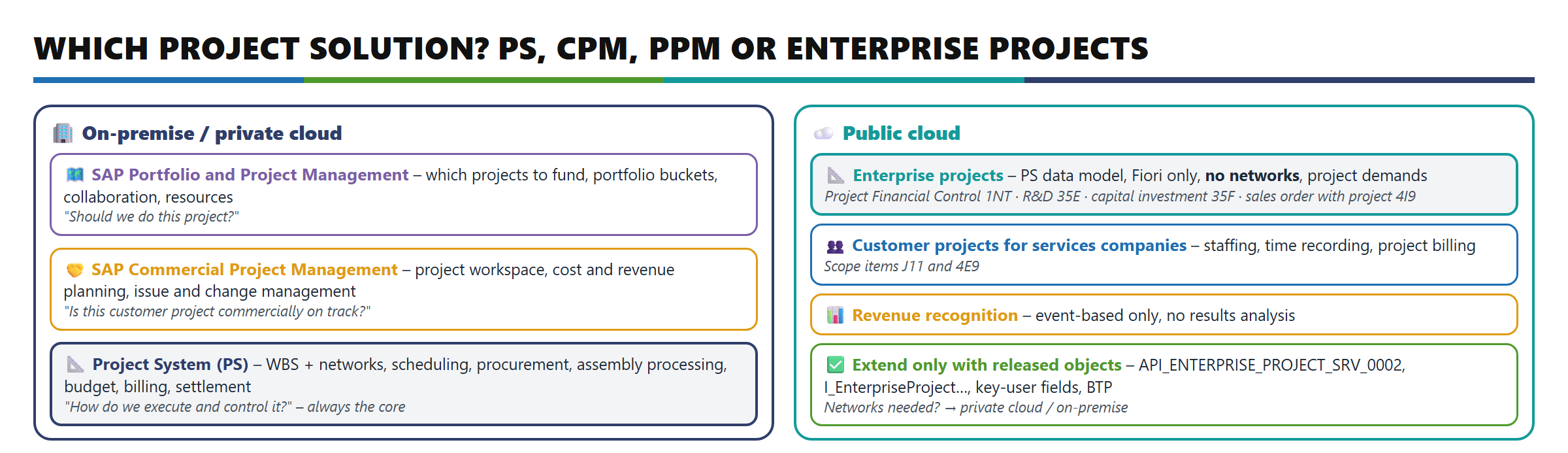
Need | Solution | Why |
|---|---|---|
Execute and control projects with scheduling, procurement, materials, billing and settlement | PS (on-premise / private cloud) | Full logistics and controlling integration |
Investment / overhead / R&D projects in a public-cloud ERP | Enterprise projects (1NT, 35E, 35F) | Standard cloud processes, no networks needed |
Customer projects of a services company (staffing, time, billing) | Customer projects in the public cloud (J11, 4E9) | Built for professional services |
Commercial control of large customer projects: financial planning, issues and changes, project workspace | SAP Commercial Project Management on top of PS and SD | Adds what PS lacks commercially; separate licence |
Decide which projects to fund, portfolio buckets, collaboration projects, resource management | SAP Portfolio and Project Management on top of PS | Strategic layer; financials stay in PS / CO |
- CPM components: Project Workspace, Project Cost and Revenue Planning and Project Issue and Change Management; it reads PS, SD and CO data and writes plans back.
- Interview trap: PPM and CPM do not replace PS – they sit on top of it. Enterprise projects replace classic PS only in the public cloud.
Part 6 – Data migration
In a new implementation (greenfield) projects are loaded with the SAP S/4HANA migration cockpit; in a system conversion (brownfield) the PS data stays in place. Tools in general: ABAP on HANA › 02 Migration to S/4HANA.
Migration object | Edition | Content |
|---|---|---|
PS – Project | On-premise / private cloud | Project definitions (file or staging tables) |
PS – WBS element | On-premise / private cloud | WBS elements below a superior element |
PS – Network | On-premise / private cloud | Networks assigned to the projects |
Enterprise project | Public cloud | Project header and WBS elements |
Load sequence
- 1. Organisational and CO master data: company codes, controlling area, cost and profit centers, activity types; PS customizing (project profiles, coding mask, status profiles).
- 2. Business partners and materials; then projects, WBS elements and networks.
- 3. Statuses: migrated projects arrive in status created (CRTD) – release them afterwards (BAPI_BUS2054_SET_STATUS or CNMASSSTATUS).
- 4. Settlement rules (CJB1 / CJB2), budget (KBPP_EXTERN_UPDATE_CO) and plan values.
- 5. Open documents with project account assignment: purchase orders, sales orders with billing plans, open reservations; then balances (AuC values through Asset Accounting migration, other project balances as G/L balances with WBS assignment).
- Plan the cut-over date at a period end so that settlement and revenue recognition of the legacy system are complete; only closed periods are reconciled.
Part 7 – Architect decisions on a PS project
Decision | Options | Guidance |
|---|---|---|
Structure | WBS only vs WBS + networks | Networks only when dates, capacities, external services or materials must be planned in detail (page 01 Part 3) |
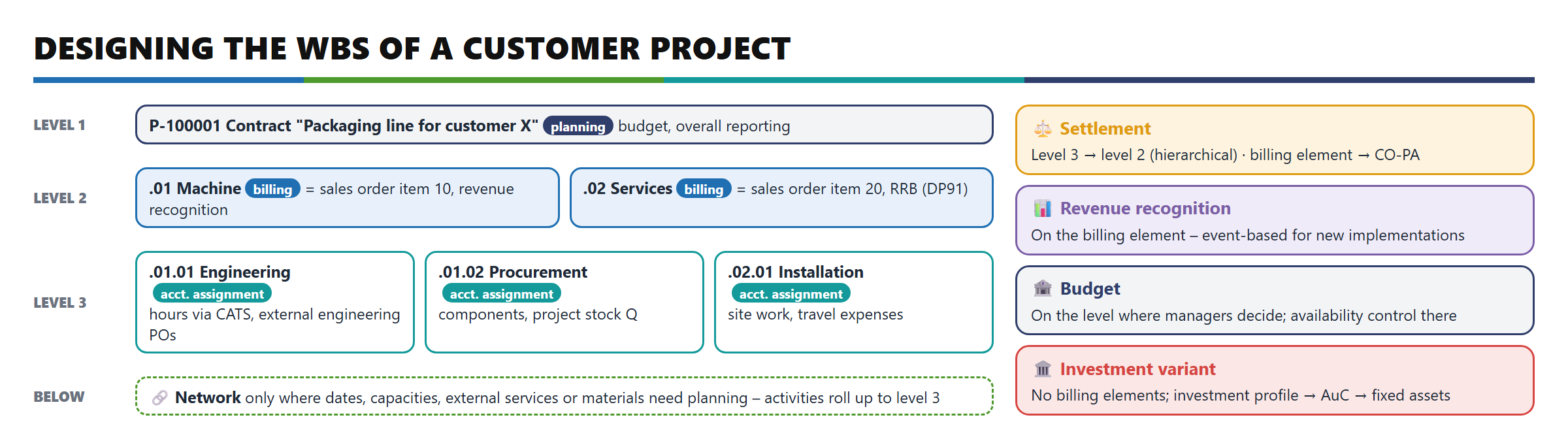
WBS design: billing vs cost collection | One billing element per sales order item; account assignment elements below it | Billing element level = level of revenue recognition and CO-PA settlement; keep cost collectors as deep as reporting needs, not deeper |
Settlement design | AuC → assets, cost center, CO-PA, hierarchical settlement | Settle bottom-up inside the project, then one rule per receiver type; generate rules with strategies instead of manual entry |
Revenue recognition | Results analysis vs event-based | Event-based for new implementations (real-time margin, cloud-ready); RA only for proven legacy methods |
Investment management | IM programs + appropriation requests vs simple budget | IM when the capital budget is planned top-down across many projects; otherwise WBS budget only |
Budget control | Availability control level and tolerances | Budget on the level where managers decide; tolerances by activity group (page 03) |
External scheduling | S/4HANA only vs Primavera / MS Project | Define a system of record per data type; integrate through Integration Suite and APIs, never via removed Open PS |
Solution choice | PS, CPM, PPM, enterprise projects | Part 5 |
Reporting | Classic info system vs Fiori / SAC | Write plans to ACDOCP if Fiori and SAC reports are the target |
Compatibility scope | Keep vs replace | Replace items before the usage right ends (Part 3) |
- Numbering: a coding mask (e.g. P-######.##.##) makes WBS keys readable and drives authorizations and selections; decide it early – changing it later affects every report.
- Status management: system statuses (CRTD, REL, TECO, CLSD) plus a user status profile for approvals; workflows and interfaces can react to user statuses.
Part 8 – Clean core for PS
Clean core in general: Clean Core › 01 Clean Core. Applied to PS:
Level | PS examples |
|---|---|
Key user | Custom fields and logic for enterprise projects; Manage KPIs and Reports; custom CDS views on released project views |
Developer (ABAP Cloud) | Released CDS views (public cloud I_EnterpriseProject, I_EnterpriseProjectElement; private cloud I_ProjectData_2, I_WBSElementBasicData), RAP interface I_EnterpriseProjectTP_3, released APIs; on-premise also wrappers around PI BAPIs in tier 2 |
Side-by-side (SAP BTP) | Scheduling-tool integration via SAP Integration Suite, project dashboards and apps using the OData APIs |
Classic (avoid where possible) | CMOD exits CNEX…, CI includes, validations with user exits, direct table reads, modifications |
- Replace compatibility-scope transactions and removed interfaces first; prefer validations and substitutions (configuration) over exits; wrap old BAPIs behind the PI BAPIs or OData APIs.
- Every custom PS report on PRPS / ACDOCA is a candidate for a CDS view – it then works in Fiori, SAC and the cloud alike.
Part 9 – Interview questions
Q1. What changes for PS in S/4HANA?
The PS structures and tables stay. Costs move to ACDOCA, plans for new reporting to ACDOCP, event-based revenue recognition is added, CJ20N becomes the single maintenance transaction, Fiori apps are added, and Open PS, MPX, ITS services, Handling Large Projects and the claim factsheet are removed.
Q2. What is the compatibility scope and which PS functions are in it?
Functions that still run but with limited usage rights (SAP Note 3265838, matrix in 2269324): e.g. CJI3, CNC4 / CNC5, forecast workbench, transfer prices, PRTs in networks, planning board and graphics, old PS texts, PS-specific archiving.
Q3. Which BAPIs should you use for projects in S/4HANA?
The PI BAPIs of ProjectDefinitionPI, WBSPI and NetworkPI (BAPI_BUS2001_…, BAPI_BUS2054_…, BAPI_BUS2002_…) or the OData APIs; the old BAPI_PROJECT_MAINTAIN family is not target architecture (SAP Note 2267386).
Q4. Can a public cloud customer use networks?
No. The public cloud uses enterprise projects on the PS data model without networks; demands for resources and materials are project demands. Networks need on-premise or private cloud.
Q5. When do you add CPM or PPM to PS?
CPM for commercial control of customer projects (project workspace, cost and revenue planning, issue and change management). PPM for portfolio decisions, collaboration and resource management. Both sit on top of PS.
Q6. How do you migrate projects in a greenfield implementation?
Migration cockpit objects PS – Project, PS – WBS element and PS – Network (public cloud: Enterprise project), after org and master data; then release statuses, settlement rules, budget, open purchase and sales documents, and balances at a period-end cut-over.
Q7. How do you design the WBS of a customer project?
Top element for the contract, one billing element per sales order item where revenue and revenue recognition are measured, account assignment elements below for cost collection, networks only where scheduling or procurement needs them; settle the billing element to CO-PA.
Q8. Results analysis or event-based revenue recognition in a new implementation?
Event-based: margins are correct in real time, it posts in the Universal Journal and is the cloud standard. Results analysis only when a legacy method is required and accepted by auditors.
Q9. A customer uses Open PS with Microsoft Project. What do you tell them?
Open PS and MPX are not available in S/4HANA and EPC is out of mainstream maintenance. Plan a new integration via SAP Integration Suite or a partner connector on the Project / Project Network APIs or the PI BAPIs, with clear data ownership.
Q10. How do you decide between IM programs and a simple WBS budget?
IM programs when the capital budget is planned and approved top-down across many investment projects with appropriation requests; a simple WBS budget with availability control is enough for isolated projects.
Q11. Why does it matter where project plans are stored?
Fiori project cost apps and SAP Analytics Cloud read plans from ACDOCP. Classic planning writes CO plan tables, so a Fiori-first reporting design needs planning that writes to ACDOCP.
Q12. How do you keep a PS implementation clean-core?
Configuration first (validations, substitutions, profiles), released APIs and CDS views for integration and reports, RAP / key-user extensibility for new logic, side-by-side apps on SAP BTP, and a plan to replace compatibility-scope items and removed interfaces.
🏠 Start Here · ◀ 05 · Development · 07 · Interview Questions ▶ · Sections: CORE ABAP | OOPS ABAP | ABAP on HANA | Clean Core | RAP | ABAP Points | SAP Fiori | SAPUI5 | Mobile Development (MDK) | BTP Foundations | BTP Development | CAP | SAP Build | ABAP on BTP | Integration Suite | SAP Business AI | SAP BASIS | Security | SAP SDLC
Functional: FICO ABAP | TRM ABAP | VIM | SAP BIS | SD ABAP | MM ABAP | PP ABAP | QM ABAP | PM ABAP | PS ABAP | EWM | TM ABAP | GTM ABAP | EHS ABAP | HR ABAP | BW | SAP Datasphere | SAP Business Data Cloud | SAP MDG | SAP Analytics Cloud | SAP Ariba | SAP CX | SAP IBP