SAP Ariba is SAP's family of cloud solutions for procurement and supplier management: spend analysis, sourcing, contracts, buying, invoicing, supplier lifecycle and supplier risk. Together with SAP Business Network (formerly Ariba Network), where buyers and suppliers exchange orders and invoices, it covers the whole source-to-pay process. SAP Ariba decides from whom and at what terms a company buys and talks to the suppliers; SAP S/4HANA (or ECC) executes, posts and pays. This page explains the solution families, the network, the predecessor SAP SRM, the split with S/4HANA procurement, the cloud architecture (realms and sites), the user interfaces and the release cycle. The processes and business objects in detail: page 02; integration with S/4HANA: page 03.
Part 1 – Source-to-pay and what SAP Ariba is
Source-to-pay (S2P) is the full chain from understanding what a company spends to paying the supplier. It has an upstream half – decide what to buy, from whom and under which contract – and a downstream half – order, receive, invoice and pay (procure-to-pay, P2P). SAP Ariba covers both halves in the cloud and connects the buyer to its suppliers through SAP Business Network.
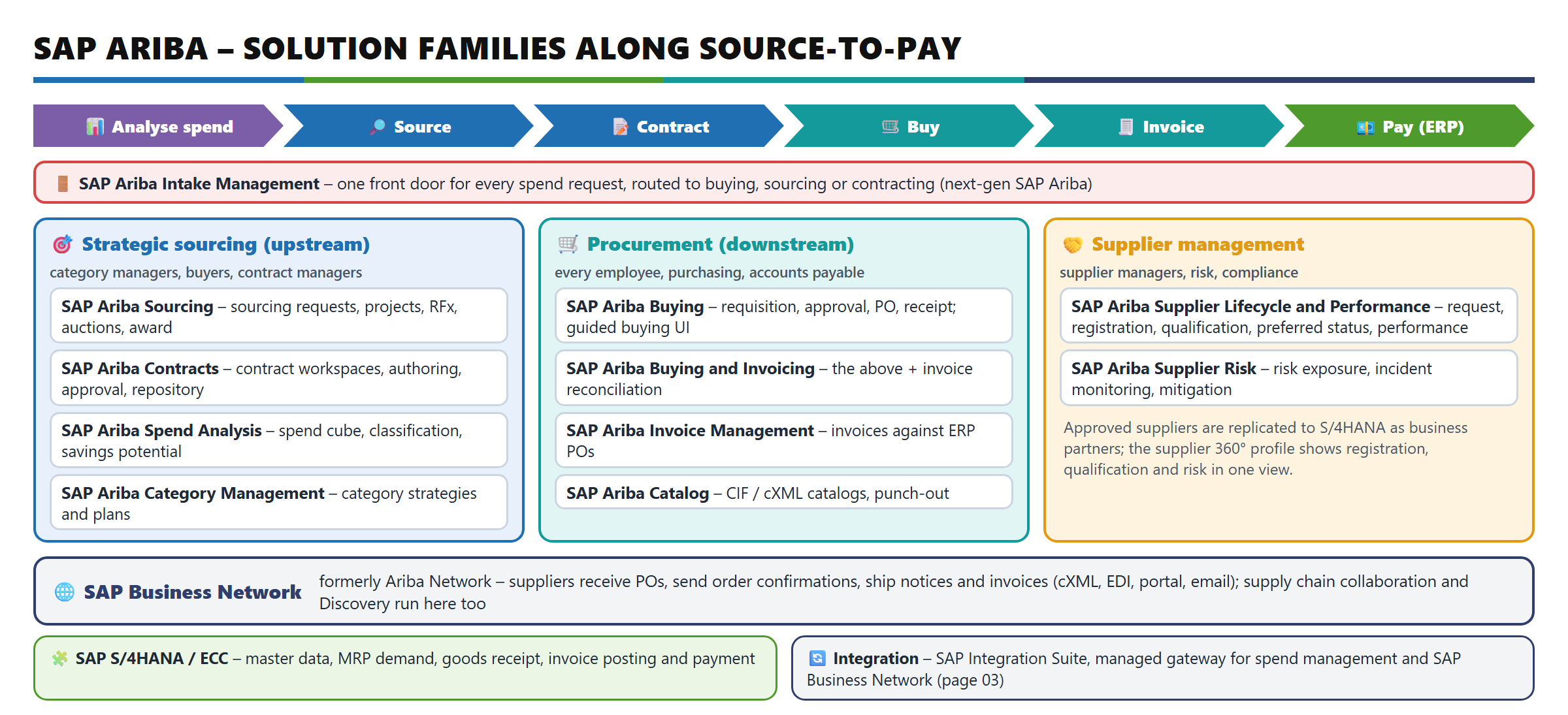
Stage | Question | SAP Ariba solution |
|---|---|---|
Analyse spend | What do we spend, with whom, in which category? | SAP Ariba Spend Analysis |
Source | Who is the best supplier at which price? | SAP Ariba Sourcing (RFx, auctions, award) |
Contract | Under which terms do we buy? | SAP Ariba Contracts (contract workspaces) |
Manage suppliers | Is the supplier registered, qualified, preferred, low-risk? | SAP Ariba Supplier Lifecycle and Performance, SAP Ariba Supplier Risk |
Buy | How does an employee order what he needs, within policy? | SAP Ariba Buying with guided buying, SAP Ariba Catalog |
Invoice | Does the invoice match order, receipt and contract? | SAP Ariba Buying and Invoicing, SAP Ariba Invoice Management |
Collaborate | How do orders, confirmations and invoices reach the supplier? | SAP Business Network |
Pay | Who posts the liability and pays? | The ERP (S/4HANA FI-AP), not Ariba |
1.1 Key terms
Term | Meaning |
|---|---|
Direct spend | Materials that go into the product (raw materials, components) – usually planned by MRP in the ERP |
Indirect spend | Everything else: office supplies, IT, services, travel, facilities – typically bought by employees through guided buying and catalogs |
Upstream / downstream | Upstream = sourcing, contracts, supplier management (strategic); downstream = requisition to payment (operational) |
Realm / site | The customer's Ariba instance in a data centre; every customer gets a test site and a production site (Part 6) |
ANID | Ariba Network ID – the unique ID of a buyer or supplier account on SAP Business Network |
cXML | Commerce XML – the XML standard used between Ariba, SAP Business Network and suppliers (orders, confirmations, ship notices, invoices, punch-out) |
Approvable | Any Ariba document that runs through an approval flow: requisition, invoice reconciliation, contract request, supplier request (page 02) |
Commodity code | Category of goods or services (Ariba uses UNSPSC), mapped to ERP material groups |
Part 2 – Solution families
SAP Ariba is not one product but a family of subscriptions. SAP groups them into strategic sourcing, procurement and supplier management; the network is a separate product line (Part 3). A customer can license a single solution (e.g. only Sourcing) or the full suite.
Solution | What it does | Main users |
|---|---|---|
SAP Ariba Sourcing | Sourcing requests, sourcing projects (quick / full), RFI, RFP, reverse and forward auctions, bid comparison, award; direct-spend sourcing features | Category managers, buyers |
SAP Ariba Contracts | Contract workspaces, contract authoring with clause libraries, approval, signature, repository, milestones; compliance contracts for buying | Contract managers, legal |
SAP Ariba Spend Analysis | Loads spend from ERP and other sources, classifies and enriches it, spend reports and savings opportunities | Procurement analysts |
SAP Ariba Category Management | Category strategies, market analysis and category plans that feed sourcing projects | Category managers |
SAP Ariba Buying | Requisitions (catalog, non-catalog, forms), approval flows, purchase orders, receipts; guided buying is the employee UI of Buying | All employees, purchasing |
SAP Ariba Buying and Invoicing | Buying plus invoices, invoice reconciliation with exception handling and tolerances (full P2P) | Employees, purchasing, accounts payable |
SAP Ariba Invoice Management | Invoice capture and reconciliation for POs created in the ERP – invoice automation without Ariba Buying | Accounts payable |
SAP Ariba Catalog | Static catalogs (CIF, cXML), punch-out catalogs, catalog approval, content management | Catalog managers, suppliers |
SAP Ariba Supplier Lifecycle and Performance | Supplier requests, registration and qualification questionnaires, preferred status, performance reviews, supplier 360° profile | Supplier managers |
SAP Ariba Supplier Risk | Risk exposure per supplier, news and incident monitoring, risk assessments and mitigation | Risk and compliance teams |
SAP Ariba Intake Management | One entry point for every spend request, from a simple purchase to a sourcing event; routes the request to the right process | All employees |
- Guided buying is not a separate product: it is the persona-based user experience of SAP Ariba Buying for casual users. Professional buyers still work in the full procurement UI (demand aggregation, invoice reconciliation).
- Suites: the strategic solutions (Sourcing, Contracts, Supplier Lifecycle and Performance, Supplier Risk) are often sold together as a strategic sourcing suite; Buying, Invoicing and Catalog as the procurement suite. This grouping is also how the realms are built (Part 6).
- Spend management portfolio: SAP Ariba sits next to SAP Fieldglass (external workforce and services procurement) and SAP Concur (travel and expenses). Fieldglass and Concur are not Ariba products, but guided buying can link to them.
Part 3 – SAP Business Network
SAP Business Network is a single, shared, multi-tenant network that connects buyers and suppliers. In 2021 SAP unified Ariba Network, SAP Logistics Business Network and SAP Asset Intelligence Network under this name; the procurement part is still often called Ariba Network, and many documents and IDs (ANID) keep the old name. Functions and logins did not change with the rename.
Network area | What runs there |
|---|---|
Procurement / commerce | POs, order confirmations, ship notices (ASN), service entry sheets, goods receipt notices, invoices, payment remittance, catalogs – the P2P collaboration with suppliers |
SAP Business Network Supply Chain Collaboration | Direct-material collaboration: forecast and commit, scheduling agreement releases, quality and inventory collaboration (formerly SAP Ariba Supply Chain Collaboration; licensed separately) |
SAP Business Network Discovery | Buyers post sourcing opportunities, suppliers respond to leads |
SAP Business Network for Logistics | Freight collaboration with carriers (formerly SAP Logistics Business Network) – see TM ABAP |
SAP Business Network Asset Collaboration | Equipment data shared between manufacturers, operators and service providers (formerly SAP Asset Intelligence Network) |
3.1 How suppliers connect
Account / channel | How it works | Typical supplier |
|---|---|---|
Standard account | Free; the supplier works from interactive emails and a light portal: confirm the PO, create the invoice by flipping the PO | Small and occasional suppliers |
Enterprise account | Full portal: inboxes, reports, archiving, catalogs, CSV upload; fees may apply depending on volume and relationship | Regular suppliers |
Integrated (cXML / EDI) | Supplier's own ERP connected to the network – documents flow system to system | Large suppliers with high volume |
- Buyer side: the buyer company also has an account (ANID) on the network. Ariba solutions talk to the network automatically; an ERP-only buyer (no Ariba Buying) connects its S/4HANA to the network directly – see page 03.
- Trading relationship: a supplier must accept the buyer's relationship request before documents flow. Supplier enablement (onboarding suppliers to the network) is a separate work stream in every Ariba project (page 05).
- Scale: SAP describes the network as connecting millions of companies with trillions of dollars of commerce per year – this network effect is the main reason customers choose Ariba.
Part 4 – History: Ariba, SAP SRM and the successors
- Ariba was an independent US company and an early e-procurement and supplier network vendor. SAP announced the acquisition in May 2012 (about USD 4.3 billion) and completed it in October 2012; SAP's own cloud supplier assets were merged into Ariba.
- SAP SRM (Supplier Relationship Management, release 7.0 with enhancement packages) was SAP's on-premise procurement system: shopping carts, sourcing cockpit, RFx and live auctions, central contracts, supplier self-services. As a SAP Business Suite 7 core application its mainstream maintenance ends on 31 December 2027, with optional extended maintenance to the end of 2030.
- There is no technical migration from SRM to Ariba or to S/4HANA. SRM functions move to two places: the strategic and supplier-facing functions to SAP Ariba, the operational functions to S/4HANA (self-service requisitioning, central procurement). SRM shopping carts, contracts and supplier data are re-implemented, not converted (page 05).
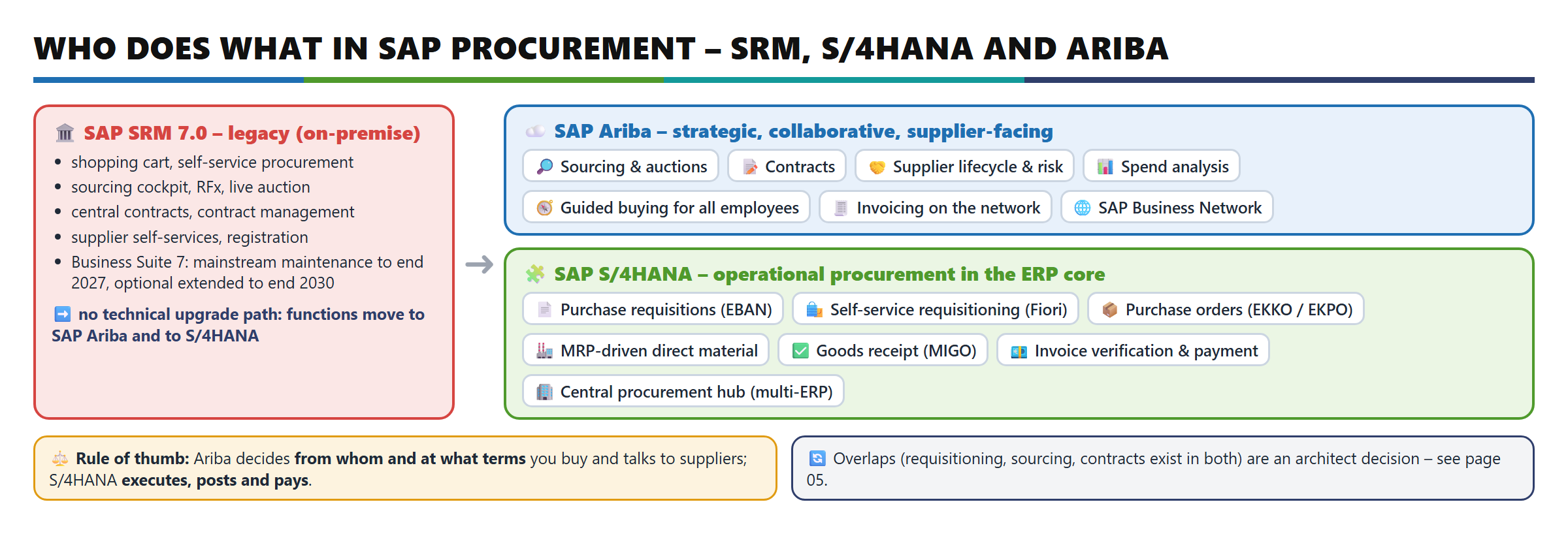
SRM function (legacy) | Successor |
|---|---|
Shopping cart, self-service procurement | SAP Ariba Buying with guided buying, or self-service requisitioning in S/4HANA |
Sourcing cockpit, RFx, live auction | SAP Ariba Sourcing |
Central contract, contract management | SAP Ariba Contracts; central purchase contracts in S/4HANA central procurement |
Supplier self-services (SUS), registration (ROS) | SAP Business Network and SAP Ariba Supplier Lifecycle and Performance |
SRM-MDM catalog | SAP Ariba Catalog (or catalogs in S/4HANA self-service requisitioning) |
Multi-backend shopping cart (classic / extended classic scenario) | S/4HANA central procurement hub or Ariba parent / child realms (Part 6) |
Part 5 – SAP Ariba vs procurement in S/4HANA
S/4HANA has a complete operational procurement in the core (purchase requisitions, purchase orders, goods receipts, invoice verification – see MM ABAP › 02 Procure-to-Pay and 03 Inventory & Invoices). SAP Ariba adds the strategic and collaborative layer on top. The two are designed to work together, not as alternatives.
Aspect | SAP Ariba | SAP S/4HANA procurement |
|---|---|---|
Focus | Sourcing, contracts, supplier management, spend analysis, employee buying, supplier collaboration | Operational procurement, MRP-driven direct material, inventory, financial posting |
Deployment | SaaS, multi-tenant, operated by SAP | On-premise, private cloud or public cloud ERP |
Users | Every employee (guided buying), buyers, category managers, suppliers | Purchasers, warehouse, MRP controllers, accounts payable |
Supplier access | Native through SAP Business Network | Through SAP Business Network integration (page 03) |
Documents | Requisition, PO copy, receipt, invoice reconciliation, sourcing event, contract workspace | EBAN, EKKO / EKPO, MSEG / MATDOC, RBKP / RSEG, BKPF / ACDOCA |
Payment | No – status and remittance are shown only | Yes – FI-AP and payment run |
- Indirect spend pattern: requisition in Ariba guided buying → PO created in Ariba (or in S/4HANA) → supplier on the network → receipt → invoice reconciled in Ariba → invoice posted and paid in S/4HANA.
- Direct spend pattern: demand from MRP in S/4HANA → purchase requisition can be sent to Ariba Sourcing for a quote → PO created in S/4HANA → sent to the supplier through SAP Business Network → confirmation, ASN and invoice back into S/4HANA.
- Central procurement (S/4HANA): an S/4HANA hub system that runs requisitioning, purchasing, contracts and approvals centrally for several connected back-end ERPs. SAP positions guided buying as the recommended requisition UI in this scenario; the hub then talks to Ariba and the network.
- Where the line is drawn – which documents are created in Ariba and which in S/4HANA – is the most important architect decision of an Ariba project (page 05).
Part 6 – Cloud architecture: realms, sites, data centres, next-gen SAP Ariba
SAP Ariba is multi-tenant SaaS: SAP operates the application, database, network and upgrades; many customers share the same infrastructure with logically separated instances. When a customer subscribes, SAP provisions its solutions on a site, also called a realm, in a data centre. By default every customer gets a test site and a production site.
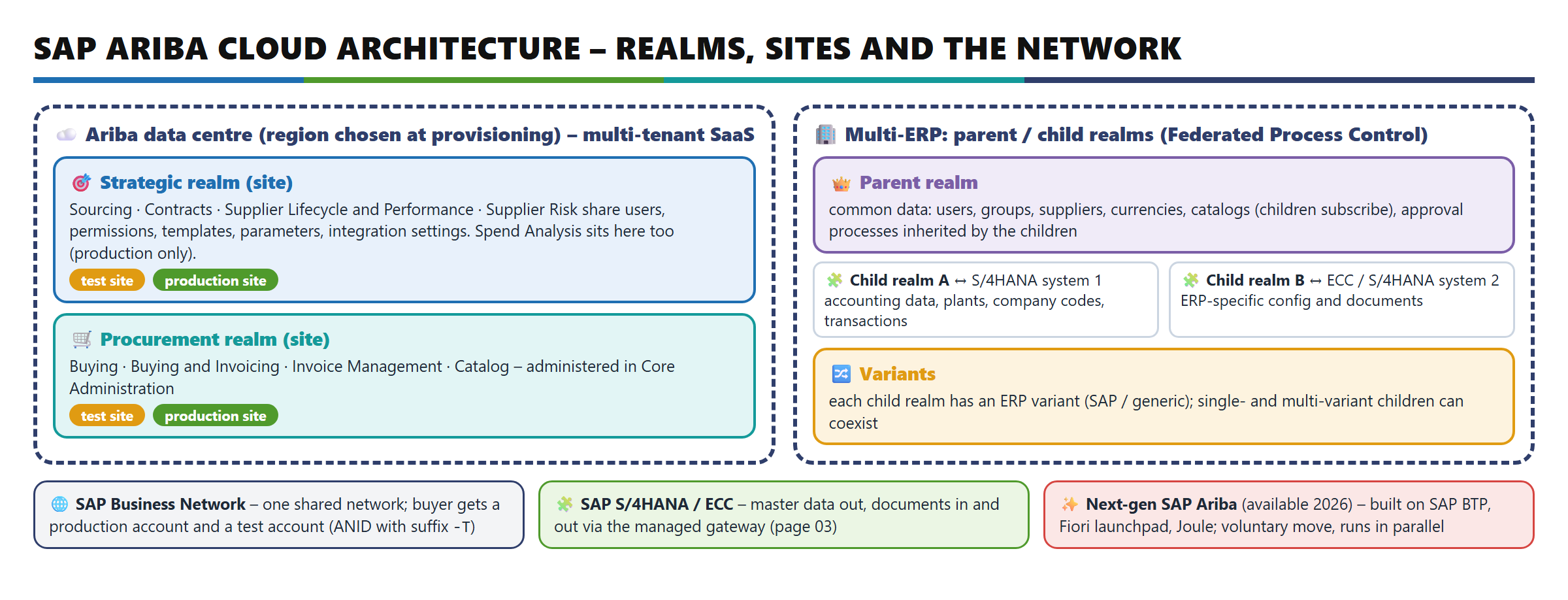
Concept | What it means | Why it matters |
|---|---|---|
Strategic realm | Sourcing, Contracts, Supplier Lifecycle and Performance and Supplier Risk on one site; Spend Analysis on the same site but production only | Shared users, permissions, templates, parameters, feature toggles, integration settings |
Procurement realm | Buying, Buying and Invoicing, Invoice Management and Catalog on a separate site, administered in Core Administration | Own master data load from the ERP |
Test / production site | Two separate realms per suite | Configuration is built and tested in test, then deployed or repeated in production |
Parent / child realms | Multi-ERP model (Federated Process Control): a parent holds common data (users, suppliers, currencies, catalogs); each child is linked to one ERP and holds its accounting data and transactions | Mirrors a landscape with several ERPs; approval processes are inherited from the parent |
Variant | The ERP flavour of a realm (SAP or generic); a child can be single- or multi-variant | Decides which ERP fields (company code, plant, purchasing org) the realm knows |
Network accounts | The buyer's production ANID and a test ANID with suffix -T | Test site talks to the test account, production to production |
6.1 Data centres
- SAP runs SAP Ariba and SAP Business Network in several regional data centres – among them the US, Europe (Germany), China, Japan, Australia, Saudi Arabia and the UAE (Middle East data centres since 2018). The region is chosen at provisioning; one customer can have solutions in more than one data centre.
- Several regions run on Google Cloud Platform; SAP's trust centre (audit reports for SAP Ariba and SAP Business Network) lists the data centres and their hosting.
- The data centre matters for data residency (where supplier and invoice data are stored), for the integration endpoints and for release timing (some fixes reach some data centres earlier).
6.2 Next-gen SAP Ariba
SAP introduced next-gen SAP Ariba at SAP Connect in October 2025 and made it available on 12 March 2026. It is a re-engineered source-to-pay suite built on SAP BTP with a unified, real-time data foundation, a SAP Fiori-based experience through a central launchpad, open APIs and tighter integration with SAP Cloud ERP.
Aspect | Next-gen SAP Ariba (as announced by SAP) |
|---|---|
Platform | SAP Business Technology Platform; embedded analytics |
User experience | Fiori-based, central launchpad, guided workflows; SAP Ariba Intake Management as the single entry point for requests |
AI | Joule embedded in the workflows: Joule Agent for bid analysis, AI supplier-response summaries for questionnaires, Joule for simplified invoice creation, intelligent contracting (term extraction, summaries) |
Contracts | Contract lifecycle modernised through integration with Icertis Contract Intelligence |
Adoption | Capabilities delivered step by step through 2026 and 2027; moving is voluntary, current and next-gen environments can run in parallel |
- For interviews: know that both exist. Most live customers still run the "classic" Ariba realms described above; new features increasingly arrive in the next-gen experience.
Part 7 – User interfaces and release cycle
Interface | Users | Used for |
|---|---|---|
Guided buying | Casual users (all employees) | Search catalogs, forms for non-catalog items, quote requests, policies and warnings, landing page tiles, approvals |
Classic Ariba UI (dashboard) | Professional buyers, category and contract managers, AP clerks | Sourcing projects and events, contract workspaces, requisitions and POs, invoice reconciliation, reports |
Guided sourcing | Buyers | Newer, simplified sourcing UI (single event, full project) next to the classic sourcing UI |
Administration | Customer administrators | Ariba Administrator / Core Administration: master data imports, approval processes, parameters, users and groups |
SAP Ariba mobile app | Approvers, requesters | Approvals and requisitions on the phone |
SAP Business Network portal | Suppliers (and buyer admins) | Orders, confirmations, ship notices, invoices, catalogs, trading relationships |
Fiori launchpad + Joule | All users (next-gen) | Single entry point and AI assistant of next-gen SAP Ariba (Part 6.2) |
7.1 Release cycle
- SAP Ariba ships quarterly feature releases in February, May, August and November, named YYMM (e.g. 2511, 2602, 2605, 2608). Between them, smaller monthly releases deliver fixes and minor changes.
- Each release has an Early Release Series (webcasts per area: source-to-contract, procure-to-pay, supplier management), a What's New guide and a feature list on the SAP Ariba support site.
- Features are flagged as Automatically On (active after the upgrade) or Customer Configured (the customer enables them, often by a self-service parameter or a service request). Customer-configured features let a project control change; automatic ones must be regression-tested.
- Test sites can receive new features shortly before production; the exact calendar per solution and data centre is published in the release readiness pages. The integration add-ons on the S/4HANA side have their own release schedule (page 03).
Part 8 – Interview questions
Q1. What is SAP Ariba?
SAP's cloud (SaaS) family for procurement and supplier management – spend analysis, sourcing, contracts, buying, invoicing, supplier lifecycle and risk – connected to suppliers through SAP Business Network. It covers source-to-pay; the ERP (S/4HANA) posts and pays.
Q2. What is the difference between source-to-pay and procure-to-pay?
Procure-to-pay is the operational part: requisition, PO, receipt, invoice, payment. Source-to-pay adds the strategic part before it: spend analysis, sourcing, contracting and supplier management.
Q3. Name the main SAP Ariba solutions.
Sourcing, Contracts, Spend Analysis and Category Management (strategic); Buying, Buying and Invoicing, Invoice Management and Catalog (procurement); Supplier Lifecycle and Performance and Supplier Risk (supplier management); plus SAP Ariba Intake Management. Guided buying is the UI of SAP Ariba Buying.
Q4. What is SAP Business Network and how does it relate to Ariba Network?
The shared buyer-supplier network. In 2021 SAP unified Ariba Network, SAP Logistics Business Network and SAP Asset Intelligence Network under the name SAP Business Network. Suppliers receive POs and send confirmations, ship notices and invoices through it, via a free standard account (interactive email), an enterprise account or cXML / EDI integration.
Q5. What happened to SAP SRM?
SRM 7.0 is a Business Suite 7 application: mainstream maintenance ends at the end of 2027, optional extended maintenance at the end of 2030. There is no technical migration; strategic and supplier functions move to SAP Ariba, operational functions to S/4HANA (self-service requisitioning, central procurement).
Q6. If S/4HANA has purchasing, why would a customer buy Ariba?
For what S/4HANA does not do natively: professional sourcing and auctions, contract lifecycle management, supplier onboarding and risk, an easy buying UI for every employee, invoice automation and, above all, the supplier network. S/4HANA remains the system that executes, posts and pays.
Q7. What is a realm?
The customer's Ariba instance (site) in an SAP data centre. Strategic solutions share one realm, procurement solutions another; each has a test and a production site. Multi-ERP customers use a parent realm with child realms, one per ERP.
Q8. How does the parent / child model work?
The parent holds common data – users, suppliers, currencies, catalogs – and approval processes that the children inherit. Each child realm is linked to one ERP and holds that ERP's accounting data, configuration and transactions. It mirrors a multi-ERP landscape.
Q9. Is SAP Ariba multi-tenant, and can it be installed on-premise?
It is multi-tenant SaaS operated by SAP in regional data centres; there is no on-premise version. Customers configure (parameters, approval rules, templates, master data loads) but cannot change the code. Next-gen SAP Ariba runs on SAP BTP.
Q10. What is next-gen SAP Ariba?
A re-engineered source-to-pay suite on SAP BTP, announced in October 2025 and available since March 2026: Fiori launchpad, Intake Management as the single entry point, embedded Joule features (bid analysis agent, supplier-response summaries, invoice creation, intelligent contracting). Moving is voluntary and features roll out through 2026–2027.
Q11. How often is SAP Ariba upgraded?
Quarterly feature releases named YYMM (e.g. 2602) plus service packs. Features are Automatically On or Customer Configured; teams follow the Early Release Series, regression-test the automatic features and plan when to enable the optional ones.
Q12. As an architect, how do you split procurement between Ariba and S/4HANA?
Sourcing, contracts, supplier management, spend analysis and employee buying in Ariba; MRP-driven direct procurement, goods movements, invoice posting and payment in S/4HANA; all supplier communication over SAP Business Network. The details – where the PO is created, where receipts and invoices are processed, which master data is replicated – are decided per process (page 05).
🏠 Start Here · 02 · Capabilities & Data ▶ · Sections: CORE ABAP | OOPS ABAP | ABAP on HANA | Clean Core | RAP | ABAP Points | SAP Fiori | SAPUI5 | Mobile Development (MDK) | BTP Foundations | BTP Development | CAP | SAP Build | ABAP on BTP | Integration Suite | SAP Business AI | SAP BASIS | Security | SAP SDLC
Functional: FICO ABAP | TRM ABAP | VIM | SAP BIS | SD ABAP | MM ABAP | PP ABAP | QM ABAP | PM ABAP | PS ABAP | EWM | TM ABAP | GTM ABAP | EHS ABAP | HR ABAP | BW | SAP Datasphere | SAP Business Data Cloud | SAP MDG | SAP Analytics Cloud | SAP Ariba | SAP CX | SAP IBP