This page steps back from apps and code to the questions a solution architect asks: where BIS comes from and where SAP is taking it, how it relates to the classic GRC products, which deployment and sizing decisions matter, how to choose between rules and predictive models and between online and mass detection, how to keep alert volumes manageable, how to plug BIS into payment runs and partner processes, and what clean core means for BIS extensions. Architecture basics: page 01; development: page 04.
Part 1 – Product history and versions
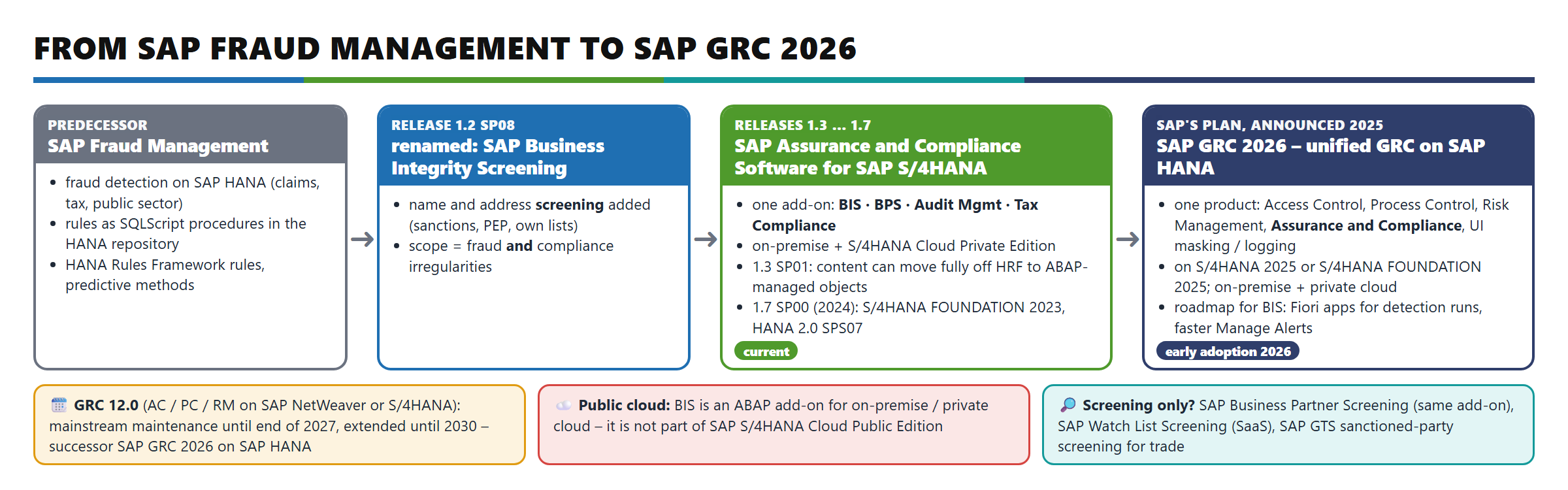
BIS started life as SAP Fraud Management, one of SAP's early applications built natively on SAP HANA: detection rules as SQLScript procedures that scan large volumes of claims, tax declarations or payments. The scope grew from fraud to compliance irregularities in general and the product was renamed SAP Business Integrity Screening as of release 1.2 SP08.
Stage | What changed | What it means for you |
|---|---|---|
SAP Fraud Management | Fraud detection on SAP HANA; methods as SQLScript procedures in the SAP HANA repository, rules in the HANA Rules Framework, predictive models | Old systems still contain repository procedures and HRF rules – migration candidates |
SAP Business Integrity Screening (1.2 SP08) | Renamed in November 2017 (also SAP Fraud Management for SAP S/4HANA → SAP Business Integrity Screening for SAP S/4HANA) | Same technical components (FRA_ objects, SAPFRA back end) – the old name lives on in object names |
SAP Assurance and Compliance Software for SAP S/4HANA (1.3 … 1.7) | One add-on with BIS, SAP Business Partner Screening, SAP Audit Management and SAP Tax Compliance on a common foundation; ABAP-managed content (CDS, AMDP) becomes the standard | As of 1.3 SP01 customer content can move completely off HRF; the Extensibility Guide recommends ABAP-managed methods |
ACS 1.7 SP00 (2024) | Runs on SAP HANA 2.0 SPS07 and SAP S/4HANA FOUNDATION 2023 | Upgrades follow the S/4HANA foundation release – plan them with the S/4HANA (or hub) upgrade |
- Application component GRC-BIS for incidents and SAP Notes; documentation on the SAP Help Portal under SAP Business Integrity Screening (application help, Business Content guide, Extensibility Guide, installation, security and operations guides).
- Technology replaced along the way: HANA repository procedures → AMDP; HRF business rules → scripted ABAP-managed methods; SAP Predictive Analytics → HANA APL with Predictive Analytics integrator; SAP Web IDE → SAP Business Application Studio; SAP Jam → SAP Build Work Zone (closest alternative).
Part 2 – Positioning today: editions, screening products and the roadmap
Question | Answer |
|---|---|
Where does BIS run? | As part of the ACS add-on on SAP S/4HANA (on-premise) and SAP S/4HANA Cloud Private Edition – either co-deployed in the productive S/4HANA or in a separate S/4HANA hub (page 01 Part 5) |
Public cloud? | BIS is an ABAP add-on and not part of SAP S/4HANA Cloud Public Edition; public-cloud customers who need screening look at SaaS offerings |
Only sanctioned-party screening needed? | SAP Business Partner Screening (same ACS add-on, screening without the fraud rules); SAP Watch List Screening (SaaS, restricted and denied party screening with prebuilt S/4HANA integration and APIs); SAP Global Trade Services sanctioned-party list screening when the driver is export control and trade compliance |
Fraud rules, predictive models, investigation? | BIS – the only one of these with detection strategies, calibration, alerts, tasks and network analysis |
2.1 Roadmap: SAP GRC for SAP HANA 1.0
SAP's unified GRC platform on SAP HANA is SAP GRC for SAP HANA 1.0, incl. Access Control / Process Control for SAP HANA (release information note 3709892; presented in 2025 as SAP GRC 2026, SAP Note 3326989):
- One product that combines SAP Access Control, SAP Process Control, SAP Risk Management, Assurance and Compliance (the ACS products including BIS) and UI masking / UI logging, with one UI stack (SAP Fiori) and AI-supported scenarios.
- SAP HANA only, on SAP S/4HANA 2025 or SAP S/4HANA FOUNDATION 2025, on-premise and private cloud. Existing GRC customers on S/4HANA upgrade within their contracts; GRC 12.0 on any database needs a conversion to S/4HANA first.
- Shipped first in 2026 as a restricted shipment through SAP's early adoption programme, with general availability planned for the second half of 2026.
- Roadmap items for BIS include SAP Fiori apps for detection runs and better performance of Manage Alerts.
- Architect takeaway: build BIS extensions only on the documented extension points (page 04) so that they move with the product, and align ACS and GRC upgrade plans.
Part 3 – GRC context: Access Control, Process Control, Risk Management
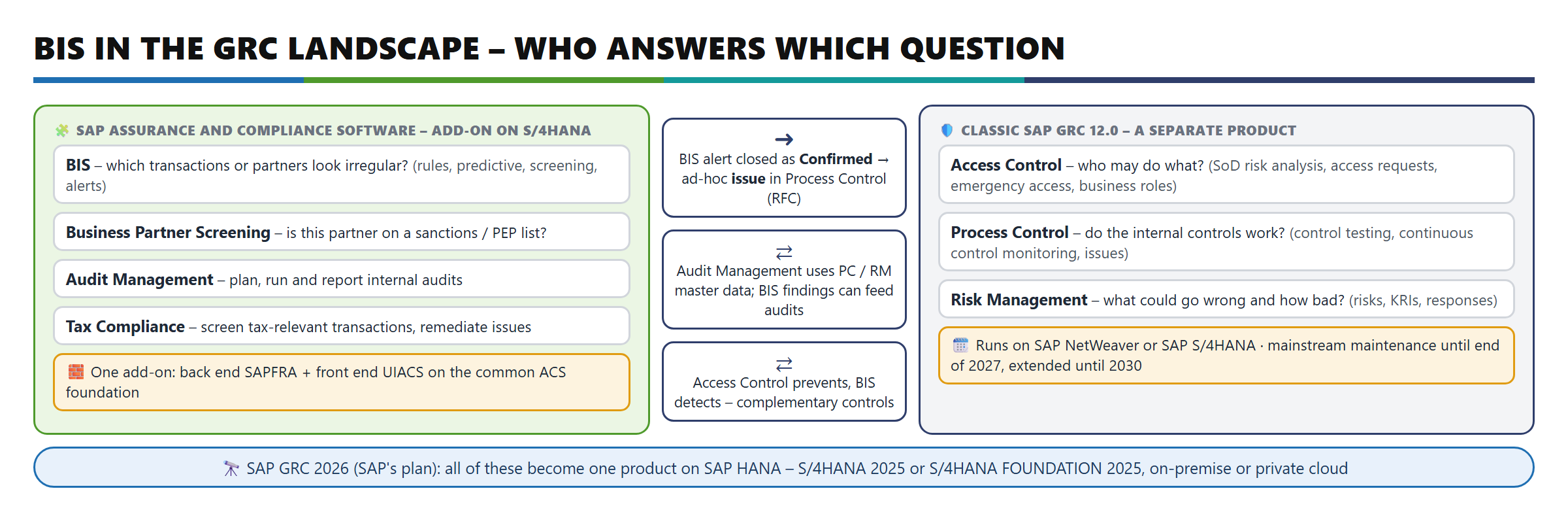
Interviewers like to test whether you can place BIS among SAP's GRC products. Until the unified platform, SAP Access Control, Process Control and Risk Management form the separate product SAP GRC 12.0 (installed on SAP NetWeaver or SAP S/4HANA), while BIS belongs to the Assurance and Compliance family on S/4HANA. Access Control in depth: Security › 03 Secure ABAP Coding & System Security, Part 12.
Product | Question it answers | Typical objects |
|---|---|---|
SAP Access Control | Who may do what? Preventive access controls | Access risk analysis (segregation of duties rule set), access requests, emergency access (firefighter), business roles |
SAP Process Control | Do our internal controls work? | Control documentation and testing, continuous control monitoring, issues and remediation |
SAP Risk Management | What could go wrong and how bad is it? | Risks, key risk indicators, responses |
SAP Audit Management | How do we plan and run internal audits? | Audit plans, audits, findings, reports |
BIS | Which transactions and partners look irregular right now? | Detection strategies, alerts, tasks, screening lists |
- BIS → Process Control: when an alert is closed with finding Confirmed, BIS creates an ad-hoc issue in SAP Process Control (RFC destination in Customizing Maintain Alert RFC Destinations, flag Call SAP Process Control per investigation object type in Define Investigation Settings). Mapping: issue name from the investigation object IDs and item, description = detection summary, priority from the risk rating (≥ 4 → 1, 2–3 → 2, below 2 → 3), source Fraud, due date of the alert.
- Access Control and BIS complement each other: Access Control stops one user from creating a supplier and paying it; where such a conflict must be accepted, a BIS strategy over the resulting transactions is a detective control that can be documented as mitigation.
- Maintenance: mainstream maintenance of SAP Access Control, Process Control and Risk Management 12.0 runs until the end of 2027, extended maintenance until 2030 – one reason SAP is moving GRC onto S/4HANA and SAP HANA.
Part 4 – Deployment, data volumes and HANA sizing
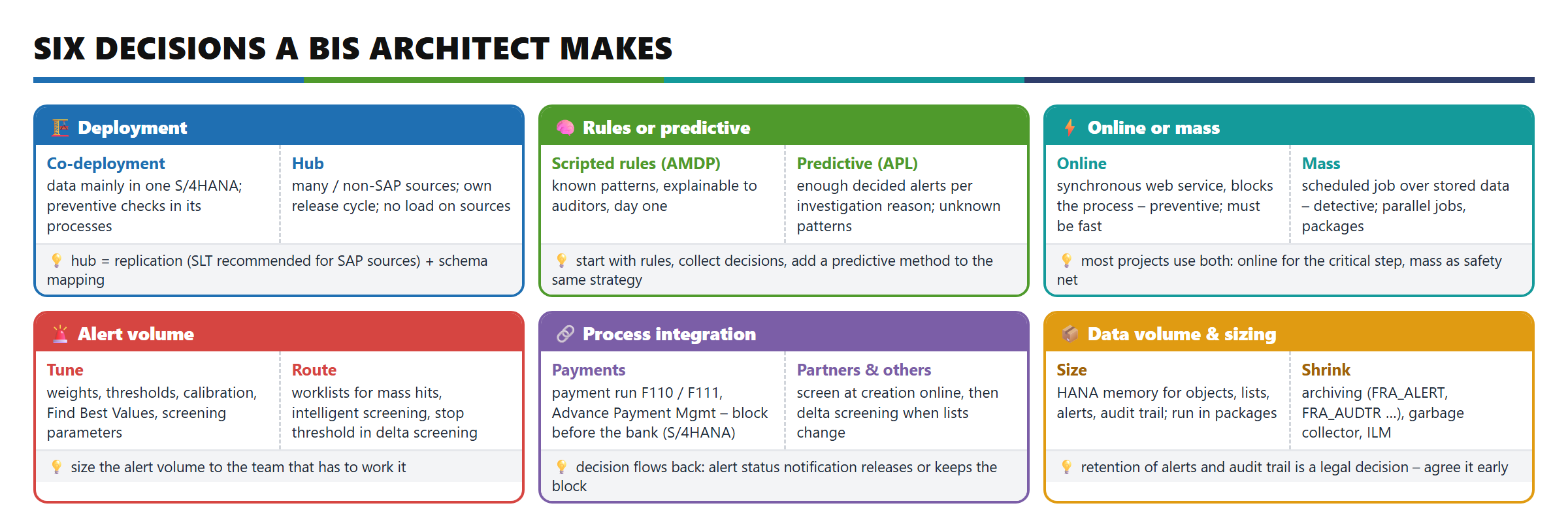
The two deployment options and their pros and cons are on page 01 Part 5. The architect's job is to map the customer's landscape onto them:
Criterion | Points to co-deployment | Points to a hub |
|---|---|---|
Where the screened data lives | Mostly in one S/4HANA system | Several ERPs, non-SAP systems, ECC not on HANA |
Preventive integration | Needed in S/4HANA processes (payment run, S/4HANA Finance for advanced payment management) | Mainly detective scans; online checks via web service only |
Release and downtime coupling | Acceptable to upgrade ACS with S/4HANA | BIS must move independently; no extra load or patch risk on the sources |
Data movement | None for local data | Replication – SAP LT Replication Server recommended for SAP sources (except SAP BW); schema mapping; full-use DB licence for third-party sources |
Several source systems | Possible, replicate the others in addition | Natural fit: one schema per source, cross-system CDS layer with BUSINESS_SYSTEM (page 04 Part 2.4) |
4.1 Sizing and run-time settings
- Size SAP HANA with SAP's sizing tools (Quick Sizer, sizing guides) for the real drivers: number of detection objects per run and history read by methods, number and size of screening lists and partners, alerts, audit trail and simulation data kept, and the replicated tables in a hub.
- When the business partner volume cannot be screened in one mass run, screen in smaller packages (SAP Note 2819024).
- Parallelism: number of parallel jobs per application type in Customizing Maintain Job Distribution – FRA_MDECT for mass detection, FRA_DLTSCR for delta address screening; package size (alert items per work package, default 100) on the mass detection run; one strategy cannot run twice in parallel.
4.2 Data lifecycle
Data | Tool |
|---|---|
Alerts with task lists, tasks and documents | Archiving object FRA_ALERT (lifecycle Completed and residence period reached) |
Audit trail (FRA_D_AUD_TRAIL) | Archiving object FRA_AUDTR – keep as long as auditors need proof of screening |
Screening list entities and relations | FRA_SCRL_E, FRA_SCRL_R (archive alerts first – they reference entities) |
Worklists | FRA_WLIST; report FRA_DEL_WORKLIST by residence time |
Mass detection input, simulation and calibration results, delta screening intermediate results | Garbage Collector (ACS_DP_GCO) |
Personal data | Remove user names (ACS_DP_ANONYMIZATION), ILM retention rules and data destruction, read access logging |
- Retention periods for alerts and the audit trail are a legal and compliance decision – agree them with compliance and data protection before go-live.
Part 5 – Detection design: rules or predictive, online or mass
Scripted rules (AMDP) | Predictive (APL) | |
|---|---|---|
Use when | The pattern is known (duplicate invoice, new supplier, high-risk country) | Patterns are unknown or too many to write as rules |
Needs | Developer, business expert, test data | Enough completed alerts (Confirmed / False Alarm) per investigation reason or own historical decisions; APL and PAi in HANA |
Explainability | High – the text says exactly why | Score with model quality KPIs; harder to explain to auditors and regulators |
Maintenance | Parameters and weights tuned by calibration; code changes for new logic | Retrain as decisions accumulate; score threshold is a parameter |
- Common path: go live with rules (SAP standard content plus own AMDP methods), let investigators classify alerts, then add a predictive method as one more weighted method in the same strategy.
- Business rules on HRF are not an option for new work (legacy, page 04 Part 6).
Online detection | Mass detection | |
|---|---|---|
Control type | Preventive – the process waits for the result and can be halted | Detective – scans stored data on a schedule |
Trigger | Synchronous web service from the source process; strategy determined from the request data | Background job FRA_MASS_DETECTION_PP (or from the strategy) |
Design concerns | Response time, behaviour when BIS cannot answer, cost of blocking a good business case (false positive) | Run windows, package size and parallel jobs, delta logic so that objects are not re-alerted |
Typical | Payment release, claim registration, new partner | Nightly invoice scan, monthly master data checks, delta address screening after list updates |
- Most designs combine both: online checks at the step where money or goods leave the company, mass detection as the safety net for everything else.
Part 6 – Alert volume management
A BIS project fails when investigators drown in false positives. Plan the volume the team can handle and use these levers:
Lever | Where | Effect |
|---|---|---|
Thresholds and weights, negative weights | Detection strategy (page 02 Part 2, 5) | Fewer, more relevant alerts; mitigating facts lower the score |
Calibration, Find Best Values, profit / cost factor | Calibration (page 02 Part 7) | Tune on history before activating a version |
Score threshold of predictive methods | Method parameter | Raise or lower the alert volume of the model |
Investigation reason and delta threshold | Strategy | Group items into one alert per investigation object; reopen closed alerts only on a real change |
Exactness, minimum score, excluded terms, address screening filter | Address screening method (page 02 Part 6, page 04 Part 5) | Fewer weak name matches |
Intelligent screening | Address screening | Repeats of rejected hits are closed automatically |
Stop threshold (weak alias protection) | Optional settings of the strategy, delta address screening | A run stops when a strategy exceeds its alert-item threshold (strategy Optional Settings); exclude entities, then run in production |
Worklists instead of alerts | Page 03 Part 6, page 04 Part 8 | Mass, low-risk hits handled as a list |
Alert Update Determination BAdI | Page 04 Part 10 | Control when existing alerts are updated |
Two-phase review, approvals | Page 03 Parts 3 – 4 | Cheap first-level review; four eyes only where needed |
Part 7 – Process integration: payment runs, business partners, external systems
Scenario | Integration | Architect notes |
|---|---|---|
Payment run (F110 / F111) and SAP S/4HANA Finance for advanced payment management | BIS executes controls in preventive mode – suspicious payments are blocked and not sent to the bank | Available for S/4HANA only, i.e. with co-deployment; agree who releases a blocked payment and how fast. Payment run: FICO ABAP › 03 |
Business partner creation / change | Online address screening when the partner is created or changed, plus mass and delta address screening when lists change | Designed into the partner process as an online detection call; SAP's standard preventive integration covers the payment run and S/4HANA Finance for advanced payment management |
Any SAP or non-SAP process | FraudDetection_GenericTable_Request_Sync_In (synchronous, generic input tables) – or FraudDetectionRequest_In / FraudDetectionConfirmation_Out | Input table names = execution procedure inputs; simulation mode for testing |
Feedback to the source | AlertStatusChangeNotification_Out when an alert is created, closed or reopened (logical port in Customizing; BAdI FRA_BADI_CHANGED_ITEMS) | Lets the source keep or release a block or start mitigation |
External case management | BAdI Transfer Alert Action (FRA_BADI_AL_ACT_TRANSFER) with AlertDecisionRequest_In / AlertRevokeTransferRequest_In | Alert status Transferred (page 03 Part 2) |
SAP Process Control | Ad-hoc issue for confirmed alerts via RFC | Part 3 |
Middleware | SOAP enterprise services – direct or through SAP Integration Suite | Integration Suite › 02 SAP Cloud Integration (CPI) |
- Preventive integration always raises the question fail-open or fail-closed: if BIS does not answer in time, does the payment or partner go ahead? Decide it with the business and document it as part of the control design.
Part 8 – Clean core and extension governance
BIS extension points are documented and supported, but most of them are classic extensibility, not released ABAP Cloud APIs: BOBF extension includes and DDIC appends, DDIC-based CDS view extensions, freestyle SAPUI5 extension points and controller hooks, Customizing BAdIs, AMDP classes in assigned packages (clean core principles: Clean Core › 01 Clean Core).
Rule | Why |
|---|---|
Use only the extension points of the Extensibility Guide; never modify SAP objects | They are kept stable across releases and into the unified GRC platform |
New logic as ABAP-managed objects (AMDP, CDS) in Z packages assigned per source domain | Transportable, testable, secured by the package restriction |
Retire HANA repository procedures and HRF rules | Legacy, kept only for backward compatibility – not for new implementations |
Business-tunable values as method parameters or assorted lists, not hard-coded | Calibration and business users change them without transports |
Reuse SAP standard content (BC sets, standard methods) and copy before changing | Faster start; standard updates stay possible |
Document every extension with its requirement and owner | Upgrades to new ACS / GRC releases need a clear inventory |
Part 9 – Presenting BIS: pitch, stories and traps
Thirty-second pitch: "BIS is SAP's add-on on S/4HANA for detecting fraud and compliance irregularities in very large volumes. Detection strategies weight several methods – AMDP rules, address screening against sanctions lists, predictive models – into a risk score; objects above the threshold become alerts that investigators work through with tasks and approvals. Because it shares the S/4HANA database, it can scan millions of documents in HANA and block suspicious payments before they leave."
If asked about … | Show that you know |
|---|---|
Your role as ABAP developer | Object type CDS entities, AMDP detection methods with the three procedures, address views and filters, network providers, BAdIs, Manage Alerts extensions |
Architecture | Add-on sharing the S/4HANA schema, co-deployment versus hub, embedded front end, HANA doing the heavy work |
Quality of detection | Calibration, simulation, weights and thresholds, alert volume levers |
Integration | Online web service, payment run blocking, alert status notification, Process Control issues |
Future | ACS today, SAP GRC for SAP HANA 1.0 unified on HANA, HRF and repository procedures as legacy |
- Story to prepare: a rule you would build (e.g. new supplier paid within days, duplicate invoice) – data model, method logic, parameters, how you test and calibrate it, how alerts are worked.
- Traps: BIS is not SAP Access Control; BRF+ is not a BIS method type; online detection does not run the selection procedure; BIS is not available in S/4HANA Cloud Public Edition.
Part 10 – Interview questions
Q1. What was BIS called before and why was it renamed?
SAP Fraud Management. The scope widened from fraud to compliance irregularities in general, and the product was renamed SAP Business Integrity Screening as of release 1.2 SP08. Object names still start with FRA.
Q2. In which SAP product is BIS delivered today and on which platforms?
In SAP Assurance and Compliance Software for SAP S/4HANA together with Business Partner Screening, Audit Management and Tax Compliance – an add-on for S/4HANA on-premise and S/4HANA Cloud Private Edition. Release 1.7 SP00 runs on S/4HANA FOUNDATION 2023 and HANA 2.0 SPS07; the newer line is SAP GRC for SAP HANA 1.0.
Q3. What is SAP GRC for SAP HANA 1.0?
SAP's unified GRC platform on SAP HANA (presented as SAP GRC 2026) that combines Access Control, Process Control, Risk Management, Assurance and Compliance and UI masking / logging in one product on S/4HANA 2025 or S/4HANA FOUNDATION 2025, on-premise and private cloud; early adoption in 2026, general availability planned for the second half of 2026 (SAP Note 3326989).
Q4. How does BIS differ from SAP Access Control and SAP Process Control?
Access Control prevents risky access (segregation of duties, emergency access); Process Control documents and tests internal controls; BIS screens the actual transactions and partners for irregularities. BIS can create a Process Control issue for every confirmed alert.
Q5. A customer has three ECC systems and one S/4HANA. Co-deployment or hub?
Usually a hub: all sources are replicated (SLT for SAP sources) into one S/4HANA with ACS, read through a cross-system CDS layer with BUSINESS_SYSTEM, and BIS upgrades independently. Co-deployment fits when the data is in one S/4HANA and preventive payment-run integration is the main goal.
Q6. When would you choose predictive methods over rules?
When patterns are unknown and there are enough classified alerts or historical decisions per investigation reason. Rules come first because they are explainable and need no history; predictive methods are added later as further weighted methods in the strategy.
Q7. How do you keep the number of alerts manageable?
Calibrate thresholds and weights on history, use negative weights and investigation reasons, tune screening parameters and filters, rely on intelligent screening and stop thresholds in delta screening, route mass low-risk hits to worklists, and size volumes to the team's capacity.
Q8. How does BIS stop a suspicious payment?
With co-deployment, BIS is integrated into the S/4HANA payment run (F110 / F111) and S/4HANA Finance for advanced payment management in preventive mode: suspicious payments are blocked and not sent to the bank, and the alert decision later releases or confirms them.
Q9. What are the main HANA sizing and data volume concerns?
Detection object volumes and history read by methods, screening lists and partners, alerts, audit trail and simulation data – plus replicated tables in a hub. Mitigate with packages and parallel jobs, archiving objects FRA_ALERT, FRA_AUDTR, FRA_SCRL_E/R, FRA_WLIST and the garbage collector.
Q10. Is BIS clean-core compliant?
Its extension points are documented and supported but mostly classic: BOBF extension includes, DDIC-based CDS extensions, SAPUI5 controller hooks, Customizing BAdIs and AMDP. Clean core here means using only those points, no modifications, ABAP-managed objects instead of HANA repository and HRF, and tunable values as parameters.
Q11. What should a public-cloud customer use for sanctioned-party screening?
BIS is not available in S/4HANA Cloud Public Edition; SaaS screening such as SAP Watch List Screening (prebuilt S/4HANA integration and APIs) fits, or SAP Global Trade Services when trade compliance is the driver.
Q12. What must be decided when BIS checks a process online?
Which step is checked, the response time budget, what happens if BIS does not answer (fail-open or fail-closed), who releases a blocked case and how fast, and how the alert decision flows back (alert status notification).
🏠 Start Here · ◀ 04 · Development · 06 · Interview Questions ▶ · Sections: CORE ABAP | OOPS ABAP | ABAP on HANA | Clean Core | RAP | ABAP Points | SAP Fiori | SAPUI5 | Mobile Development (MDK) | BTP Foundations | BTP Development | CAP | SAP Build | ABAP on BTP | Integration Suite | SAP Business AI | SAP BASIS | Security | SAP SDLC
Functional: FICO ABAP | TRM ABAP | VIM | SAP BIS | SD ABAP | MM ABAP | PP ABAP | QM ABAP | PM ABAP | PS ABAP | EWM | TM ABAP | GTM ABAP | EHS ABAP | HR ABAP | BW | SAP Datasphere | SAP Business Data Cloud | SAP MDG | SAP Analytics Cloud | SAP Ariba | SAP CX | SAP IBP