SAP Business Data Cloud (BDC) is SAP's fully managed SaaS solution that unifies and governs data from SAP and non-SAP applications to power analytics, planning and AI. It is not one product but a package of components that work together: the BDC cockpit and SAP-managed foundation services that turn the data of SAP applications into ready-to-use data products, SAP Datasphere for integration and semantic modelling, SAP Analytics Cloud (SAC) for dashboards and planning, SAP Databricks and SAP Snowflake for data engineering and ML, SAP BDC Connect for zero-copy sharing with partner platforms, plus SAP HANA Cloud, SAP BW private cloud edition, SAP Master Data Governance and SAP Reltio. SAP announced BDC on 13 February 2025; it changes fast, so facts that may change are marked "as of <month year>". This page explains why BDC exists, its design principles, the reference architecture, the components, the landscape and how BDC relates to Datasphere and BW. Data products in depth: page 02; intelligent content and Joule: page 03; SAP Databricks and partners: page 04; BW: page 05; licensing, provisioning and governance: page 06.
Part 1 – Why SAP built BDC
SAP customers run many SAP applications (S/4HANA, SuccessFactors, Ariba, Concur, Fieldglass …) and many non-SAP systems. To use this data for analytics and AI they traditionally build their own extraction pipelines – ODP, SLT, replication tools, a BW or a lakehouse – and every copy loses part of the business meaning. SAP Learning names the problems BDC is designed to solve:
Problem | What BDC does about it |
|---|---|
Extraction from SAP is complex – different technologies, middleware, special skills, fragile pipelines | SAP extracts, transforms and loads the data of its applications as a managed service and delivers business-ready data products |
Semantics get lost – labels, currencies, associations and aggregation rules stay behind in the source | Every data product carries its metadata (CSN) along with the data (page 02) |
Same object, many definitions – S/4HANA material vs Concur product | One domain model: SAP harmonises the definitions so users do not care which application the data came from |
Data is incomplete – one application's data without the others | Data products from all SAP applications in one catalog, joined with non-SAP data in Datasphere or a partner platform |
Analytics take too long to build | Ready-to-use intelligent content per line of business (page 03) |
AI cannot trust the data – errors, gaps, stale copies | One governed, SAP-maintained copy that every consumer shares instead of private copies |
Storage at scale is expensive | Lakehouse storage in files, storage scaled separately from compute |
Governance is difficult – who has which copy, why and for how long | Central catalog, access requests and agreements, lineage and audit log (page 02, page 06) |
- One-line pitch: BDC is the data layer between SAP's business applications and SAP Business AI – trusted SAP data with its business context, shared without copying.
Part 2 – What BDC is: definition, history and names
SAP Help defines BDC as "a fully managed SaaS solution that unifies and governs all SAP data and seamlessly connects with third-party data". SAP Learning adds the key point for architects: BDC is the next step of the business data fabric that started with SAP Datasphere – it does not replace Datasphere; Datasphere is its central modelling component, and BDC adds the components a complete data fabric needs (managed data products, a lakehouse, partner engines, intelligent content).
2.1 Where BDC sits in SAP's stack (as of November 2026)
- SAP describes the Autonomous Enterprise with three layers: Joule (AI interaction layer), SAP Autonomous Suite (SAP and non-SAP AI agents across business domains) and the SAP Business AI Platform (the AI and data platform underneath).
- The SAP Business AI Platform brings together SAP BTP, AI Foundation, SAP BDC, SAP HANA Cloud and selected Business Transformation Management services. Its three pillars are Build, Contextualize and Reason and Govern.
- BDC belongs to Contextualize and Reason, together with SAP Knowledge Graph (relationships and business logic as a semantic network) and SAP and non-SAP models (LLMs plus SAP's own models such as SAP RPT-1 for predictions on tabular business data).
- SAP's "flywheel": applications generate business data → BDC unifies and contextualises it → AI (Joule, agents, embedded AI) uses the context to improve decisions → the decisions create new data.
2.2 Timeline and names
When | Milestone (official SAP sources) |
|---|---|
Before BDC | SAP Data Warehouse Cloud (2019) → renamed SAP Datasphere (2023), positioned as the business data fabric |
13 Feb 2025 | SAP Business Data Cloud announced and released, together with the SAP Databricks partnership; packaged content was called insight apps |
May 2025 | Insight apps renamed intelligent applications (SAP Databricks already generally available since 30 April 2025) |
Oct 2025 | SAP BDC Connect released – zero-copy sharing with a customer's own Databricks and further platforms |
May 2026 (Sapphire) | SAP HANA Cloud and SAP Master Data Governance become core components; SAP Snowflake available |
Jun 2026 | Intelligent applications are now called intelligent content, sold in intelligent packages (page 03) |
Jul 2026 | SAP BDC Connect for Google BigQuery |
Oct 2026 (TechEd) | SAP Reltio generally available in BDC; native Apache Iceberg support; universal catalog built on Apache Polaris; Dremio query engine (acquisition completed); BDC Ontology Manager introduced; SAP Application Data Foundation announced to make SAP application data available to any BDC engine |
- Full roadmap and planned items: page 06 Part 7. Always check What's New in the BDC help and the SAP Roadmap Explorer – names and availability change several times a year.
- Names to know: BDC cockpit (control plane), BDC core (core capacity and cockpit), SAP BW, private cloud edition (listed under SAP BW Capacity Services, e.g. SAP BW NetWeaver Cloud, private edition), SAP BDC Connect, intelligent content (formerly insight apps / intelligent applications), Cloud ERP Intelligence (formerly Core Enterprise Analytics).
Part 3 – Design principles
SAP Learning lists the principles BDC is built on. They explain most design decisions you will meet on the next pages.
Principle | Meaning | Consequence for the project |
|---|---|---|
Data product economy | Data is treated as a product: extracted with its metadata, refined, packaged, discoverable and reusable; enriched products go back into the catalog | Model on data products, not on raw source tables (page 02) |
SAP-managed data | SAP owns extraction, transformation, loading and lifecycle of SAP data products | No own extractors for SAP sources; you cannot pick fields or filters of an SAP data product |
One domain model | Harmonisation stage unifies different definitions of the same business entity across SAP applications | Fewer mapping layers in your own models |
Ready-to-use intelligent content | Dashboards, models and data products per line of business and industry, maintained by SAP | Start with SAP content where it exists, extend by copy (page 03) |
Open data ecosystem | Bidirectional, zero-copy sharing with partner platforms through Delta Sharing | Keep existing Databricks / Snowflake / BigQuery investments (page 04) |
Storage at scale | Lakehouse: data in files, storage decoupled from compute | Large history in the object store, compute only where needed |
Many personas, one copy | Business users, analysts, modelers, data engineers and scientists, developers and administrators use the same data products | No private copies; govern access centrally |
Part 4 – Reference architecture: four layers
The SAP Architecture Center reference architecture RA0013 "Enterprise Data Strategy with SAP Business Data Cloud" (github.com/SAP/architecture-center, updated 21 October 2026) describes BDC as a business data fabric in four layers, with governance across all of them and an open ecosystem at the side.
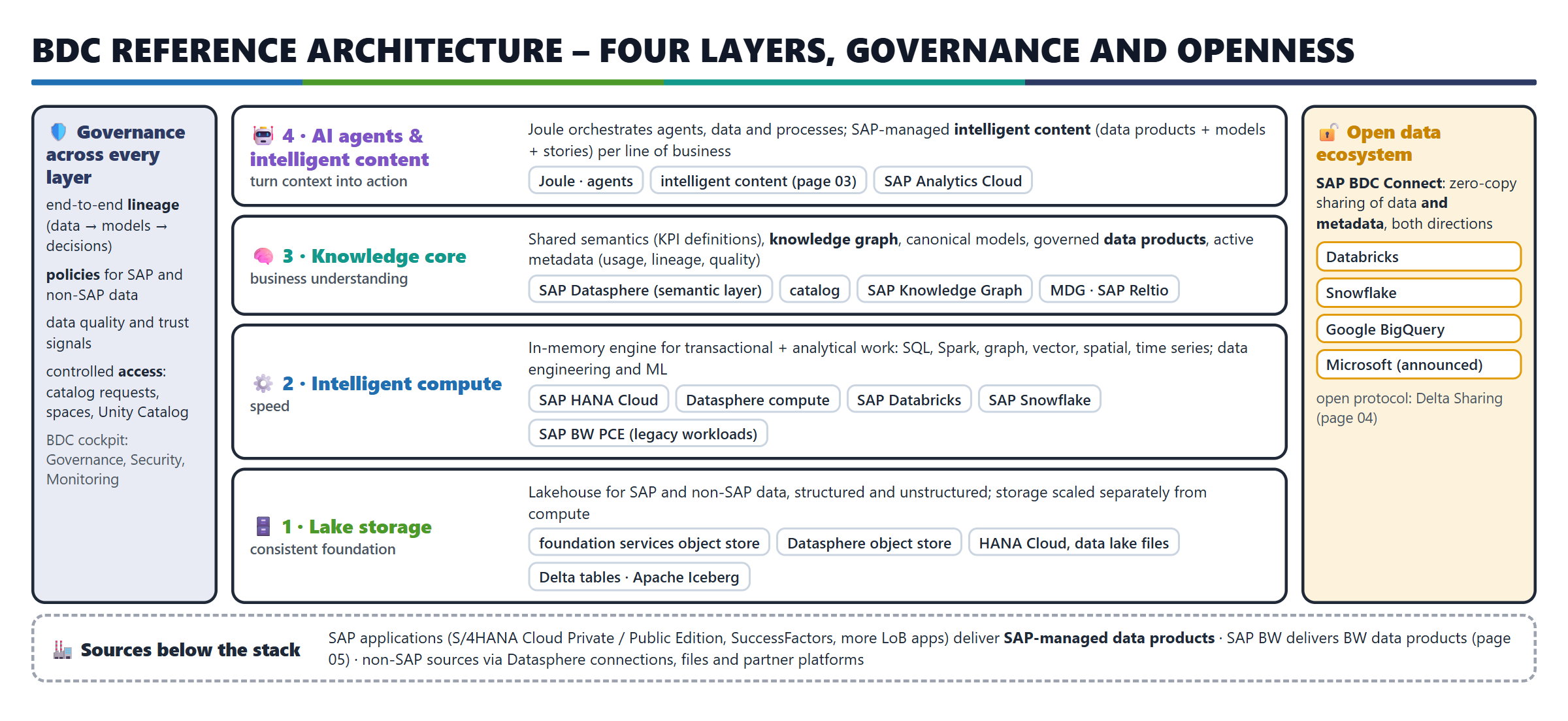
Layer | What it does | BDC components (mapping for study) |
|---|---|---|
1 Lake storage | Lakehouse that brings SAP and non-SAP data together across cloud, hybrid and on-premise; structured and unstructured | Foundation services object store and Datasphere object store, both on SAP HANA Cloud, data lake files; Delta tables, Apache Iceberg |
2 Intelligent compute | Processing: SQL, Spark, multi-model (graph, vector, spatial, time series), data engineering and ML; workloads adapt to cost and priority | SAP HANA Cloud, Datasphere compute, SAP Databricks, SAP Snowflake; BW PCE for existing BW workloads |
3 Knowledge core | Business understanding: shared semantics (KPI definitions), knowledge graphs, canonical models, governed data products, analytics and simulations, active metadata | Datasphere semantic layer, catalog, SAP Knowledge Graph, MDG and SAP Reltio for master data |
4 AI agents and intelligent applications | Turn context into action; Joule orchestrates agents, data and processes | Joule, intelligent content, SAP Analytics Cloud (page 03) |
Governance | Lineage across data, models and decisions; policy enforcement; quality signals; controlled access | BDC cockpit governance, catalog access requests, Datasphere spaces, Unity Catalog (page 06) |
Open ecosystem | Zero-copy sharing of data and metadata with partner platforms | SAP BDC Connect (page 04) |
- RA0013 stresses that the knowledge core is the new part: without shared context, agents in procurement, finance and compliance optimise for their own goals and their decisions conflict.
- The layer-to-component mapping above is a study aid; SAP's diagram groups the same components into SAP-managed data products, the business data fabric (Datasphere, SAC, BW PCE), the open ecosystem (SAP Databricks, BDC Connect, SAP Snowflake) and the BDC cockpit (data product installation, security and governance, entitlement management).
- The other RA0013 sub-pages go deeper: data products (page 02), intelligent content (page 03), BW modernisation (page 05), SAP Databricks, Cloud Identity Services, SAP AI Core and Joule analytical insights (pages 03, 04, 06).
Part 5 – Components and their roles
Customers choose which components they include – a landscape can start small (cockpit, one source, Datasphere, SAC) and grow. All components are provisioned from SAP for Me and paid from the same pool of capacity units (page 06).
Component | Role in BDC | In a formation? | More |
|---|---|---|---|
BDC cockpit (BDC core) | Control plane: activate data packages, install intelligent content, catalog and governance, landscape monitoring, users and roles | Yes – exactly one, required | Part 6 |
Foundation services | SAP-managed extraction, transformation, data product generation, object store, sharing; part of BDC core | No – runs behind the cockpit, no customer access | page 02 |
SAP Datasphere | Heart of BDC: data integration and modelling on top of data products, semantic layer, non-SAP data, data access controls, customer-managed data products | Yes – one per formation | SAP Datasphere section |
SAP Analytics Cloud | Stories and dashboards of intelligent content, own dashboards, planning, natural-language queries | Yes – one per formation | SAP Analytics Cloud section |
SAP Databricks | Embedded edition of Databricks for data engineering, data science and ML on data products | Yes – one or more | page 04 |
SAP Snowflake | Snowflake inside BDC for data scientists and engineers (own entitlements) | Yes – one or more | page 04 |
SAP BDC Connect | Zero-copy sharing with the customer's own Databricks, Snowflake, Google BigQuery | Yes – one or more | page 04 |
SAP HANA Cloud (database, data lake) | Multi-model apps (calculation views, CDS, CAP) on data products without replication; can publish custom data products | Yes – one or more | page 02 |
SAP BW, private cloud edition | Lifted BW 7.5 / BW/4HANA; Data Product Generator turns BW data into data products | No – pushes data to the formation's Datasphere | page 05 |
SAP Master Data Governance | Governance of SAP master data (core component since 2026) | – | MDG section |
SAP Reltio | Multi-domain MDM for non-SAP data with AI entity resolution; golden profiles as data products (GA October 2026) | Yes – one per formation | page 06 |
SAP Datasphere, data composer · SAP Customer Data Platform | Further consumers into which data products can be installed (data composer: EU10 only, not EU Access, as of November 2026) | Yes | page 02 |
Source systems | S/4HANA Cloud Private / Public Edition, SuccessFactors and other SAP applications that produce data products – at least one is required | Yes | page 02 |
5.1 Content and services outside the formation
- Intelligent content – SAP-managed packages of data products, Datasphere models and SAC stories; needs Datasphere and SAC in the formation (page 03).
- Joule – natural-language questions on the content for business users; for IT it assists in building data products, models and dashboards (page 03).
- SAP Knowledge Graph and BDC Ontology Manager – business context for AI agents; the Ontology Manager creates domain-specific views of the knowledge graph (introduced October 2026, page 03).
- SAP BW – connected through BW PCE; data products from BW can be a one-time onboarding or a continuous pipeline fed by the existing BW loads (page 05).
Part 6 – Control plane and data plane: cockpit, foundation services, catalog
A useful way to explain BDC in an interview: the BDC cockpit is the control plane where administrators decide what is activated, installed and shared; the foundation services are the SAP-run data plane that moves and stores SAP data; the consumers in the formation read the results.
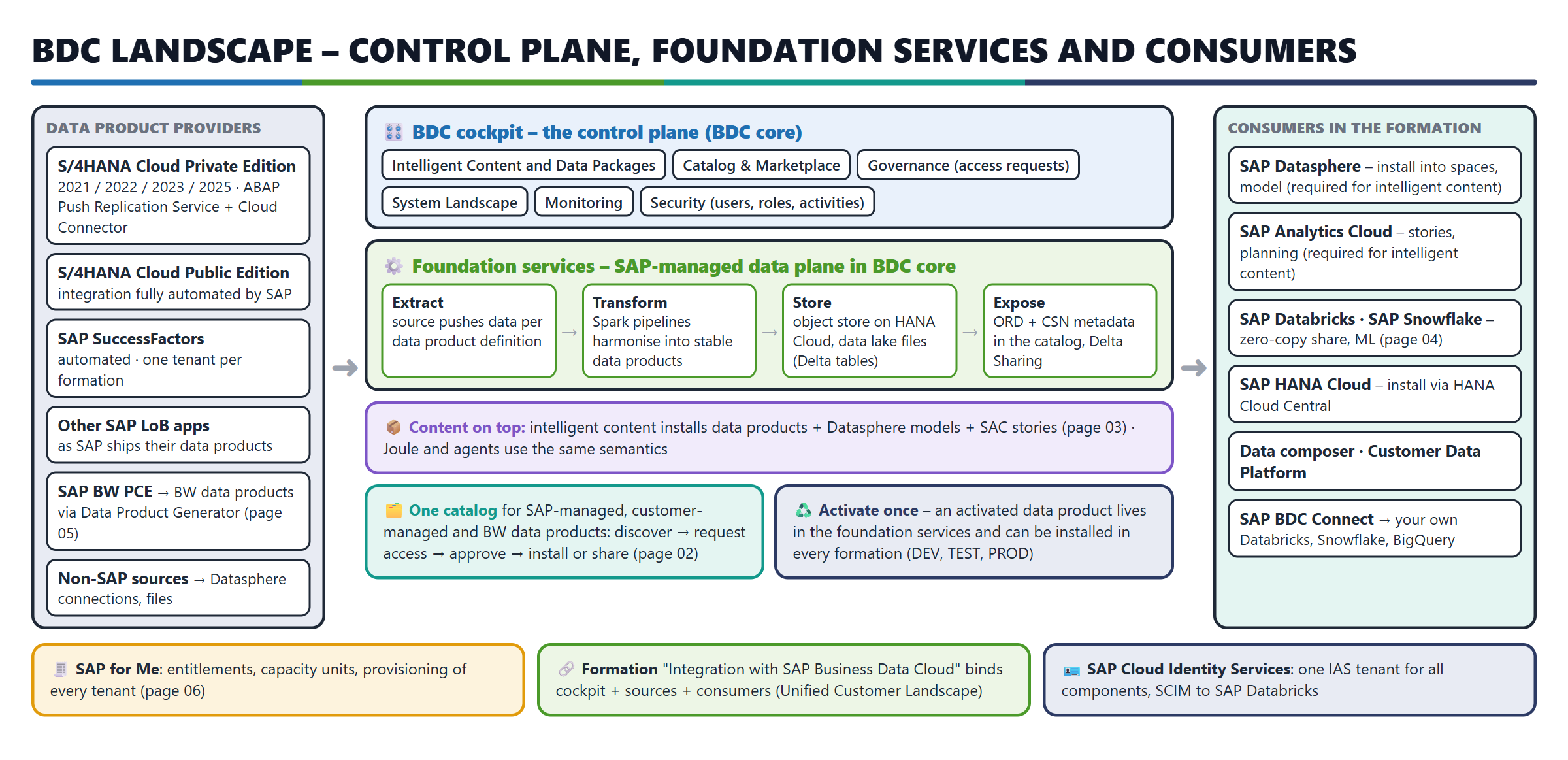
6.1 BDC cockpit
Area (side navigation) | What you do there | Typical role |
|---|---|---|
Intelligent Content and Data Packages | Available / Installed tabs: activate data packages, install, update, uninstall intelligent content | BD Administrator |
Catalog & Marketplace | Search data products, view details, impact and lineage, request access or sharing | Catalog User / Administrator |
Governance | Domains with default terms and conditions, Access Management (requests, agreements), Data Product Management (auto-approval) | BDC administrator, data steward |
System Landscape | Formations and systems, Test Connection, system mapping for transports | BD Administrator / Viewer |
Monitoring | Status of lifecycle actions and data pipeline health per data product | BD Viewer |
Security | Users, roles, Activities (audit log) | BD Administrator |
6.2 Foundation services in one paragraph
The foundation services are the "backbone" of BDC: SAP-managed services that extract and harmonise data from SAP applications, generate data products, run initial and delta loads, store the data in the object store (SAP HANA Cloud, data lake files, Delta table format) and share it with consumers. They are mandatory, part of BDC core, invisible to the customer and monitored by SAP. They serve SAP-managed data products only; customer- and partner-managed products live in the Datasphere object store. Flow, layers and activation: page 02.
6.3 Catalog
- Systems added to a formation become catalog sources; the catalog lists data products from all sources and, with several formations, can be set up as a central "catalog of catalogs".
- The same catalog is reached from the BDC cockpit and from Datasphere (Catalog & Marketplace); it can also be exposed to enterprise catalogs such as Collibra (SAP partnership).
- Discovery, access workflow and lineage: page 02 Part 7; catalog governance tasks: page 06 Part 5.
Part 7 – Landscape, tenants and formations
BDC has no editions in the S/4HANA sense. There is one product package in SAP for Me with two commercial building blocks – BDC core capacity (capacity units for all services) and intelligent packages (SAP data products and content per source application) – and you provision as many tenants as the capacity allows (details page 06).
Tenant / system | Created how | Rules to remember (as of November 2026) |
|---|---|---|
BDC cockpit system | "Enable SAP Business Data Cloud Core" wizard in SAP for Me | Region fixed at creation; all solutions of the package in the same region; owner gets the first access |
Datasphere, SAC tenants | Provisioned with a CU quota or rewired from standalone subscriptions | Same data center and hyperscaler as the cockpit; one of each per formation |
SAP Databricks, SAP Snowflake, BDC Connect, HANA Cloud | Provisioned with a CU quota | Data center availability differs per solution; quotas are planning values, billing is actual use |
Source systems | Your existing S/4HANA, SuccessFactors … tenants, integrated per source (page 02 Part 5) | May run in any data center; SAP recommends BDC close to the sources and users |
Demo data | Entitlement Cloud TDD SAP Business Data Cloud core for SAP partners | Demo Data for SAP BDC service to explore features without real business data |
7.1 Formations
- A formation of type Integration with SAP Business Data Cloud groups the systems that work together: the BDC cockpit, at least one data product provider and the consuming components. It uses the BTP Unified Customer Landscape (UCL) service to bind the systems.
- Typical set-up: one formation per tier (DEV, TEST, PROD) or a combined non-production formation – rules, cardinalities and system mapping: page 06 Part 2.
- An activated data product is not tied to one formation: it lives in the foundation services and can be installed in the Datasphere tenants of several formations.
- Identity: SAP recommends one SAP Cloud Identity Services tenant (IAS) for all BDC components (page 06 Part 4).
Part 8 – BDC compared with Datasphere, BW and a classic data lake
Aspect | SAP Datasphere (standalone) | SAP BDC | SAP BW / BW/4HANA | Classic data lake |
|---|---|---|---|---|
What it is | Cloud data warehouse and data fabric service | SaaS package of components incl. Datasphere | Application-based data warehouse | Storage + compute platform |
Getting SAP data | Own replication flows, connections | SAP-managed data products pushed by the source | Own extractors (ODP), process chains | Own pipelines or third-party tools |
Semantics | Modelled by you (business layer, analytic models) | Delivered with the data (CSN) + Datasphere models | InfoObjects, queries | Mostly lost |
Ready content | Business content packages | Intelligent content | BI Content | None |
ML / data science | Limited – HANA ML libraries via the Open SQL schema | SAP Databricks, SAP Snowflake, HANA Cloud | Limited | Native |
Sharing | Data marketplace, OData / SQL | Zero-copy Delta Sharing both ways | Open Hub (copy) | Platform-specific |
Future | Continues; central component of BDC | SAP's strategic data offering | Lift to BW PCE, then modernise (page 05) | Connect via BDC Connect |
- Existing Datasphere and SAC customers do not migrate: their tenants are rewired into BDC – mainly a commercial change to capacity units with minimal, non-disruptive technical steps (page 06 Part 1.4).
- Non-RISE SAP ERP systems can be onboarded to build own data products with Datasphere object store and integration capacity – they get no SAP-managed data products or intelligent content (as of November 2026).
Part 9 – Architect view: starting patterns and pitfalls
Pattern | Components | When it fits |
|---|---|---|
SAP analytics first | Cockpit + S/4HANA Cloud Private Edition + Datasphere + SAC + Cloud ERP Intelligence | Customer on RISE wants ready finance / ERP analytics quickly |
Data science on SAP data | + SAP Databricks or SAP Snowflake | ML, forecasting, data engineering on governed SAP data; results shared back as data products |
Existing lakehouse | + SAP BDC Connect to the own Databricks / Snowflake / BigQuery | Company standard is a partner platform; SAP data must arrive with semantics, without copies |
BW modernisation | + BW PCE with Data Product Generator | Large BW estate; time to move use cases step by step (page 05) |
Apps and agents on business data | + HANA Cloud, Joule, SAP AI Core | Custom multi-model apps, agents grounded in data products (pages 03, 04) |
Master data quality | + MDG and SAP Reltio | Trusted customer / supplier / product views across SAP and non-SAP sources |
9.1 Questions an architect asks first
- Which SAP applications are the sources, and is there an intelligent package for them? Without the package there are no SAP-managed data products for that source.
- Are the sources supported releases (e.g. S/4HANA Cloud Private Edition 2021, 2022, 2023, 2025 as of November 2026) and in which data center should BDC sit?
- Which consumers are needed – Datasphere and SAC only, or also SAP Databricks, partner platforms, HANA Cloud – and are they available in that data center (EU Access!)?
- What happens to the existing BW, Datasphere and SAC tenants (lift, rewire, new)?
9.2 Pitfalls
- Treating BDC as "Datasphere with a new name" – the managed data products, catalog governance and partner engines change how you design pipelines.
- Building custom extractors for SAP sources that already have SAP-managed data products – you lose harmonisation, versioning and SAP content compatibility.
- Expecting field selection or filters on SAP data products – they are complete by design; reduce data in your own Datasphere views.
- Choosing the cockpit region without checking where Databricks, BDC Connect or EU Access are offered – the region cannot be changed (page 06).
- Copying data out by replication when zero-copy sharing would do – more cost, ungoverned copies.
Part 10 – Interview questions
Q1. What is SAP Business Data Cloud?
A fully managed SaaS solution that unifies and governs SAP and non-SAP data for analytics, planning and AI. It is a package of components – BDC cockpit and foundation services with SAP-managed data products, SAP Datasphere, SAP Analytics Cloud, SAP Databricks, SAP Snowflake, SAP BDC Connect, HANA Cloud, BW private cloud edition, MDG and Reltio – announced by SAP on 13 February 2025.
Q2. Does BDC replace SAP Datasphere?
No. BDC is the next step of the business data fabric that started with Datasphere, and Datasphere is its central integration and modelling component. Existing Datasphere and SAC tenants are rewired into BDC instead of being migrated.
Q3. Which problems does BDC solve compared with building your own data warehouse?
SAP takes over extraction from its applications, delivers business-ready data products with their semantics, harmonises definitions across applications (one domain model), adds ready intelligent content, stores data cheaply in a lakehouse and governs access centrally – so no private copies and no lost semantics.
Q4. What is the role of the BDC cockpit?
It is the control plane created when BDC core is enabled: administrators activate data packages, install intelligent content, manage the catalog and access governance, monitor formations and data pipelines, and manage users, roles and the audit log. Every formation contains exactly one cockpit.
Q5. What are the foundation services?
SAP-managed background services in BDC core that extract and harmonise data from SAP applications, generate data products, run initial and delta loads, store them in the object store on SAP HANA Cloud, data lake files, and share them via Delta Sharing. Customers have no access; SAP monitors them. They serve SAP-managed data products only.
Q6. Describe the BDC reference architecture.
RA0013 describes four layers: lake storage, intelligent compute, the knowledge core (semantics, knowledge graph, data products, active metadata) and AI agents with intelligent applications on top; governance runs across all layers and SAP BDC Connect opens it to partner platforms with zero-copy sharing.
Q7. Which components must be in a formation for intelligent content?
The BDC cockpit, the entitled source system (for example S/4HANA Cloud Private Edition with Cloud ERP Intelligence), one SAP Datasphere and one SAP Analytics Cloud tenant. SAP Databricks is optional and only needed for content with ML notebooks.
Q8. How does BW fit into BDC?
BW 7.5 or BW/4HANA is lifted as SAP BW private cloud edition; the Data Product Generator publishes BW data as data products into the Datasphere object store, either once or continuously. BW PCE is not a formation member – it pushes data to the formation's Datasphere. Use cases are then modernised step by step.
Q9. Where does BDC sit in SAP's AI strategy?
In the Contextualize and Reason pillar of the SAP Business AI Platform, next to SAP Knowledge Graph and SAP's and partners' AI models. BDC delivers complete, current, contextual data so that Joule and the agents of the SAP Autonomous Suite reason on trusted business context.
Q10. What does "zero-copy" mean in BDC?
Data products stay in the object store; consumers such as SAP Databricks or a customer's Databricks read them through the open Delta Sharing protocol, which authorises the request and hands out short-lived URLs to the files. No second copy has to be loaded and governed.
Q11. A customer runs a non-RISE SAP ERP. What can they get from BDC?
They can onboard the ERP and build their own data products with Datasphere object store and integration capacity, and use Datasphere, SAC and the partner engines on them. SAP-managed data products and intelligent content require the supported source application and its intelligent package, so they are not available.
Q12. As an architect, how would you start a BDC landscape?
Clarify sources, intelligent packages and target consumers; choose the region and data center once (near sources and users, checking availability of Databricks, BDC Connect and EU Access); enable BDC core, rewire or provision Datasphere and SAC, integrate the sources, create formations per tier, activate the needed data packages and install the intelligent content first – then extend with own models and partner engines.
🏠 Start Here · 02 · Data Products ▶ · Sections: CORE ABAP | OOPS ABAP | ABAP on HANA | Clean Core | RAP | ABAP Points | SAP Fiori | SAPUI5 | Mobile Development (MDK) | BTP Foundations | BTP Development | CAP | SAP Build | ABAP on BTP | Integration Suite | SAP Business AI | SAP BASIS | Security | SAP SDLC
Functional: FICO ABAP | TRM ABAP | VIM | SAP BIS | SD ABAP | MM ABAP | PP ABAP | QM ABAP | PM ABAP | PS ABAP | EWM | TM ABAP | GTM ABAP | EHS ABAP | HR ABAP | BW | SAP Datasphere | SAP Business Data Cloud | SAP MDG | SAP Analytics Cloud | SAP Ariba | SAP CX | SAP IBP