SAP Customer Experience (SAP CX) is SAP's portfolio of cloud solutions for the front office: everything a company does to win, sell to, serve and keep its customers. SAP groups it into five areas – commerce, customer data, marketing (engagement), sales and service. SAP S/4HANA is the back office: it owns the customer and material master, pricing, credit, stock, delivery, billing and accounting. This page explains each CX product, the predecessors (SAP CRM, SAP Cloud for Customer, Hybris), the split with S/4HANA, the architecture of each product, the user interfaces and the release cycles. Processes and business objects in detail: page 02; integration with S/4HANA: page 03.
Part 1 – Front office and back office: what SAP CX is
CRM (customer relationship management) is the classic name for the front office: marketing, sales force automation and customer service. SAP now uses customer experience for the wider scope that also includes the online shop (commerce) and customer identity, consent and profile data. A CX system is used by sales reps, service agents, marketers and – through the shop and self-service portals – by the customers themselves.
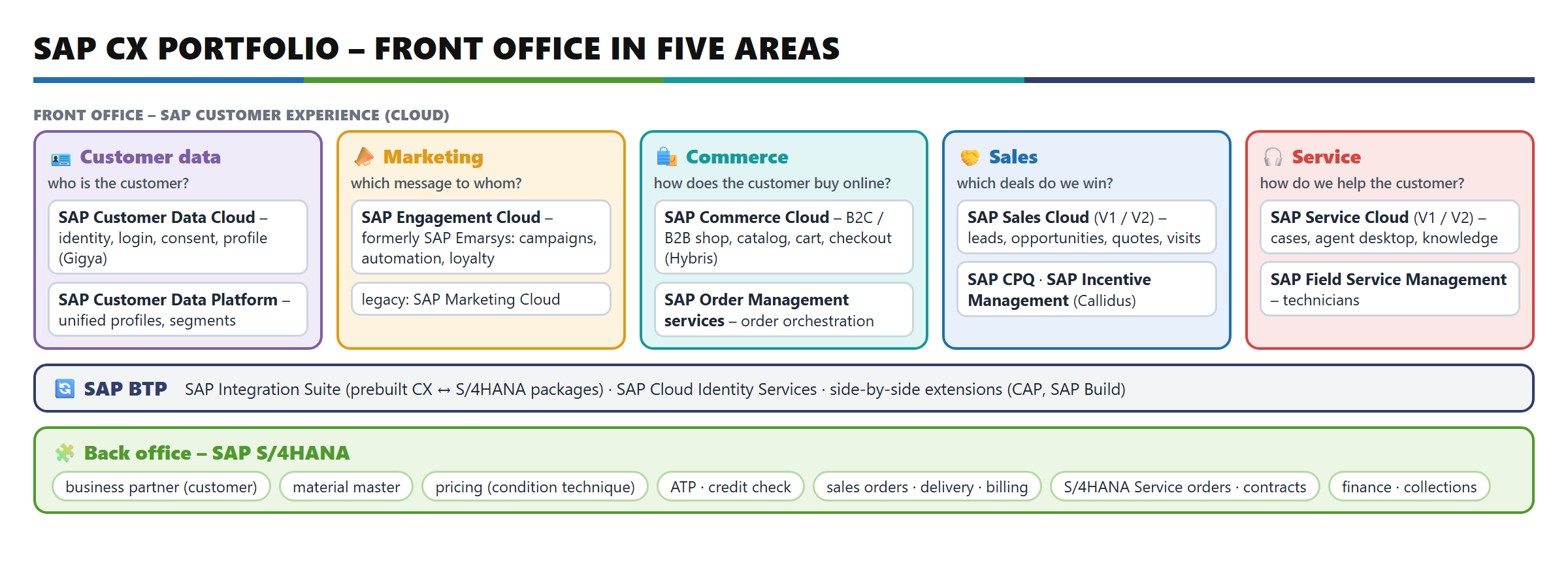
Area | Business question | Main SAP CX product |
|---|---|---|
Customer data | Who is this customer, did he log in, what did he consent to, what do we know about him across all channels? | SAP Customer Data Cloud, SAP Customer Data Platform |
Marketing | Which message, offer or campaign do we send to whom, on which channel? | SAP Engagement Cloud (formerly SAP Emarsys) |
Commerce | How does a consumer or business buyer find products, fill a cart and order online? | SAP Commerce Cloud |
Sales | Which leads and deals do we pursue, what do we quote, how do we plan visits and forecast? | SAP Sales Cloud, SAP CPQ |
Service | How do we handle a customer's question, complaint or repair across channels and in the field? | SAP Service Cloud, SAP Field Service Management |
Back office | Who delivers, bills, posts and collects the money? | SAP S/4HANA (not part of CX) |
1.1 Key terms
Term | Meaning |
|---|---|
Lead-to-cash | End-to-end sales process: lead → opportunity → quote → order → delivery → invoice → payment. The front half runs in CX, the back half in S/4HANA (page 02) |
Account | A company the business sells to (B2B). It becomes a business partner (customer) in S/4HANA |
Individual customer | A private person as customer (B2C) – a person account rather than a company |
Contact | A person who works for an account (buyer, decision maker); in S/4HANA a contact-person relationship of the business partner |
Prospect | An account that has not bought yet; usually exists only in CX until the first order |
Omnichannel | Same customer, same history and same rules across phone, email, chat, web shop, social media and stores |
CIAM | Customer identity and access management – registration, login, single sign-on and consent for consumers (SAP Customer Data Cloud) |
CDP | Customer data platform – merges data from many systems into one customer profile for segmentation and activation (SAP Customer Data Platform) |
Part 2 – The product portfolio
SAP CX is a set of separately licensed cloud products, most of them acquired and then integrated. A customer can license only one of them (for example only SAP Commerce Cloud) or several. Product names change regularly; the names below are the ones SAP uses in 2026.
Product | What it does | Origin |
|---|---|---|
SAP Sales Cloud | Sales force automation: accounts, contacts, leads, opportunities, activities and visits, sales quotes and orders, pipeline and forecasting, territory management, sales analytics; add-ons such as field sales (intelligent visit planning, route optimisation) | SAP Cloud for Customer (C4C); Version 2 rebuilt (Part 4) |
SAP Service Cloud | Customer service: omnichannel contact centre, agent desktop, cases (tickets), routing, service levels, knowledge, registered products, service orders; industry add-ons (e.g. utilities) | SAP Cloud for Customer; Version 2 rebuilt |
SAP Field Service Management | Planning, dispatching and mobile execution of field service technicians | Acquired company Coresystems |
SAP Enterprise Service Management | Service desk for internal (employee) services with a self-service catalog – e.g. HR service delivery | Newer SAP product |
SAP Commerce Cloud | B2C, B2B and B2B2C online commerce: product catalog, search, cart, checkout, promotions, customer accounts, storefront, content management | Hybris (acquired 2013) |
SAP Order Management services | Cloud order orchestration across channels: sourcing the order to a fulfilment location, split, status | Built by SAP (the product pages also use the name SAP Order Management foundation) |
SAP Customer Data Cloud | Customer identity (registration, login, SSO), consent and preference management, customer profile for consumers | Gigya (acquired 2017) |
SAP Customer Data Platform | Unifies customer data from many sources into one profile, segments, activates segments in marketing and commerce | Built by SAP |
SAP Engagement Cloud | Omnichannel marketing: segmentation, campaigns and automation across email, mobile, web and messaging, loyalty, personalisation | Emarsys (acquired 2020); renamed from SAP Emarsys in 2026 |
SAP CPQ | Configure, price, quote: product configuration rules, pricing and approvals, quote documents for complex products | CallidusCloud (acquired 2018) |
SAP Incentive Management | Sales commissions and incentive compensation plans | CallidusCloud |
- Legacy – SAP Marketing Cloud: SAP's own marketing automation product (successor of SAP Hybris Marketing). SAP supports it for the term of existing contracts, which for most customers ends with 2026; new marketing projects use SAP Engagement Cloud.
- Joule and AI: SAP adds Joule and AI features to the CX products each quarter (for example AI summaries of opportunities in Sales Cloud, Joule in SAP Engagement Cloud, AI agents buying through an MCP server in Commerce Cloud – SAP CX Q2 2026 release). Many AI features need extra AI licences (page 05).
- What an ABAP developer touches: mostly the S/4HANA side of the integration (business partner, material, pricing, sales and service orders, IDocs, OData / SOAP APIs, AIF monitoring) – page 03. The CX products themselves are extended with their own tools and SAP BTP, not with ABAP (page 04).
Part 3 – History: SAP CRM, Cloud for Customer, Hybris and the acquisitions
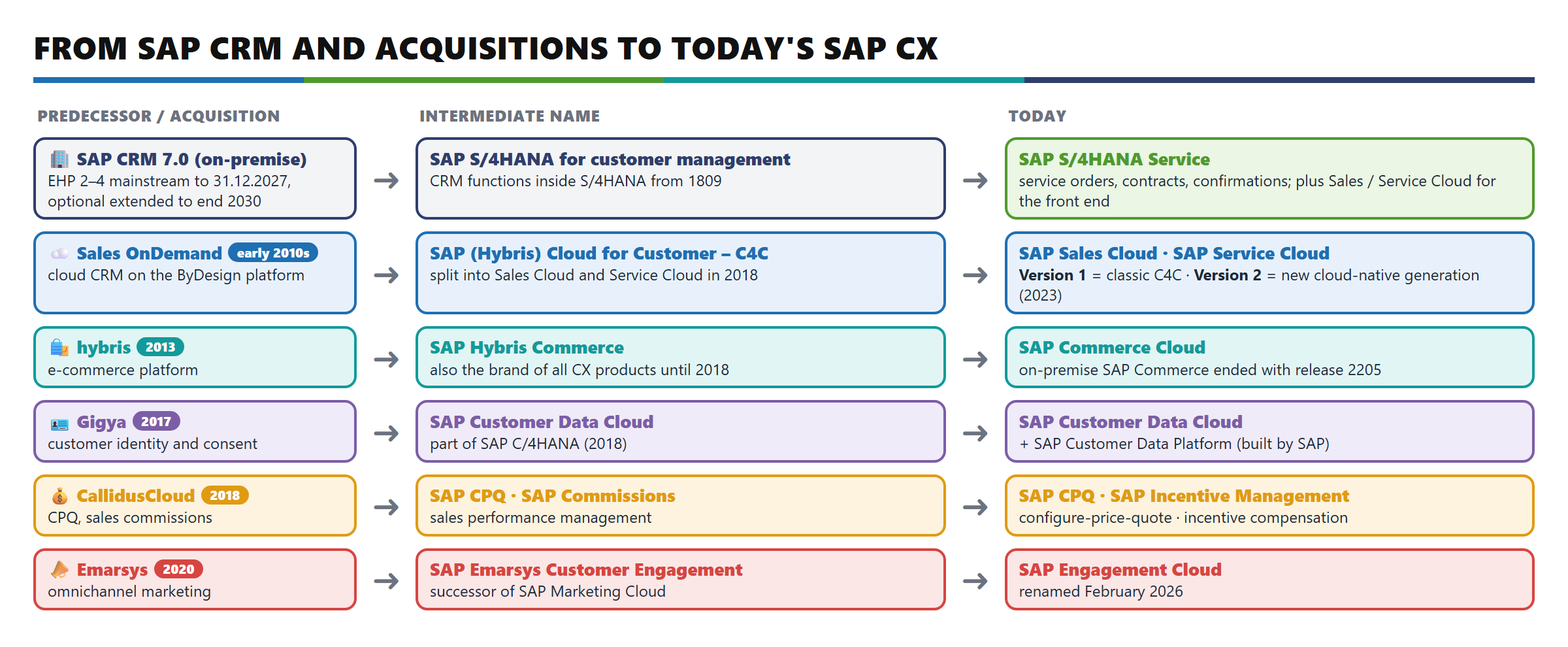
Year | Event |
|---|---|
2000s | SAP CRM (on-premise, SAP NetWeaver ABAP) becomes SAP's CRM product; last release SAP CRM 7.0 with enhancement packages 1–4, WebClient UI, part of SAP Business Suite 7 |
early 2010s | SAP builds a cloud CRM on the SAP Business ByDesign platform (Sales OnDemand) – later called SAP Cloud for Customer (C4C) |
2013 | SAP acquires hybris (e-commerce); hybris becomes the brand for SAP's customer-facing products (C4C is sold as SAP Hybris Cloud for Customer) |
2017 | SAP acquires Gigya (customer identity and consent) → SAP Customer Data Cloud |
2018 | SAP acquires CallidusCloud (CPQ, commissions; closed April 2018). In June SAP launches SAP C/4HANA, retires the Hybris brand and names the products SAP Sales Cloud, SAP Service Cloud, SAP Commerce Cloud, SAP Marketing Cloud and SAP Customer Data Cloud |
2020 | C/4HANA is renamed SAP Customer Experience. SAP completes the acquisition of Emarsys (November 2020) |
2023 | SAP Sales Cloud and SAP Service Cloud Version 2 – a new cloud-native generation – become available next to the classic C4C-based Version 1 (Part 4) |
2026 | SAP Emarsys is renamed SAP Engagement Cloud (February 2026) |
3.1 SAP CRM maintenance and successors
- SAP CRM 7.0 is a SAP Business Suite 7 core application. Mainstream maintenance ended at the end of 2025 for enhancement packages 0–1 and ends on 31 December 2027 for enhancement packages 2–4. Optional extended maintenance (at extra cost) runs to the end of 2030; afterwards only customer-specific maintenance (no new legal changes or support packages).
- SAP S/4HANA for customer management brought CRM functions (CRM one-order transactions, WebClient UI) into the S/4HANA system as an add-on from release 1709 FPS01 (2018) with a simplified data model. With 1909 the service part moved into the core as SAP S/4HANA Service (Part 5).
- There is no technical upgrade from SAP CRM to SAP Sales Cloud or Service Cloud: the cloud products are re-implemented and the data is migrated with migration tools (page 05).
SAP CRM function (legacy) | Successor |
|---|---|
Account and contact management, activities, territories | SAP Sales Cloud |
Leads, opportunities, sales pipeline and forecast | SAP Sales Cloud |
Quotations and orders in CRM (with ERP pricing) | SAP Sales Cloud sales quotes / orders with S/4HANA pricing, SAP CPQ for complex products; or SAP S/4HANA Sales |
Interaction Center, service tickets, complaints | SAP Service Cloud (cases, agent desktop) |
Service orders, service contracts, confirmations, in-house repair | SAP S/4HANA Service, with SAP Service Cloud as the front end and SAP Field Service Management for technicians |
CRM Marketing (segmentation, campaigns) | SAP Engagement Cloud, SAP Customer Data Platform |
CRM Web Channel / Internet Sales (e-commerce) | SAP Commerce Cloud |
Part 4 – SAP Sales Cloud and SAP Service Cloud: Version 1 and Version 2
Since 2023 SAP sells two generations under the same product names. Version 1 is the classic SAP Cloud for Customer (C4C) solution; Version 2 is a new product built from scratch on a new, cloud-native platform. Version 2 is not an upgrade of Version 1 – a customer moves by re-implementing, supported by SAP's migration assessment and migration tools. SAP still supports Version 1; new customers are sold Version 2.
Aspect | Version 1 (classic C4C) | Version 2 |
|---|---|---|
Platform | SAP Business ByDesign-based cloud platform (monolithic application) | New cloud-native microservice architecture, API-first |
Hosting | SAP-operated multi-tenant SaaS | Multi-tenant SaaS built on AWS – SAP's audit reports list AWS data centres in Frankfurt, Virginia, Sydney and São Paulo |
Upgrades | Quarterly releases with a downtime window | Releases named YYMM, test tenant upgraded first (Part 7) |
Extensibility | Key-user adaptation, SAP Cloud Applications Studio (in-app code in the tenant) | Low-code / no-code tools in the tenant, side-by-side on SAP BTP (SAP Build, CAP), APIs and events – no custom code inside the core (page 04) |
Service objects | Tickets | Cases (case designer, routing, service levels) |
Analytics | Own embedded reports | Embedded SAP Analytics Cloud dashboards (SAP Analytics Cloud section) |
Licensing | Sales Cloud or Service Cloud | Sales Cloud or Service Cloud as the base; the other side as an add-on (e.g. Service Cloud Version 2, sales capabilities add-on) |
- Shared platform: in Version 2 sales and service run on one platform with one account, contact and product model. A service agent can create leads, opportunities, appointments and sales orders from the agent desktop (SAP CX Q2 2026 release).
- Version 2 add-ons listed by SAP: sales capabilities add-on for Service Cloud, service capabilities add-on for Sales Cloud, field sales add-on (intelligent visit planning, route and visit scheduling optimisation, account geotagging), utilities add-on for Service Cloud (contract accounts, premises, move-in / move-out, installment plans) with S/4HANA Utilities integration.
- Interview angle: always ask which version a project uses – the objects, extensibility and integration packages differ, and many blogs and older courses describe only Version 1.
Part 5 – SAP CX vs sales and service in S/4HANA
S/4HANA has complete back-office sales (SD) and service processing. SAP CX adds the customer-facing layer that S/4HANA does not provide: lead and opportunity management, activity and visit planning, the contact centre, the online shop, identity and consent, marketing. The standard pattern is CX in front, S/4HANA behind, connected by SAP Integration Suite.
Topic | SAP CX (front office) | SAP S/4HANA (back office) |
|---|---|---|
Customers | Prospects, accounts, contacts, relationships, consumer identities and consents | Business partner (customer role) for sold-to, ship-to, bill-to; credit data |
Sales | Leads, opportunities, activities, visits, quotes, pipeline, forecast | Sales quotations and orders (VBAK / VBAP), pricing, ATP, credit check |
Order execution | Order capture (Sales Cloud, CPQ, Commerce Cloud) | Delivery, picking, goods issue, billing, revenue posting, collections |
Service | Cases, agent desktop, knowledge, field technicians (FSM) | S/4HANA Service: service orders, contracts, confirmations, billing; spare parts |
Products and prices | Product data and rich content for selling; internal price lists where used | Material master and condition-technique pricing (the usual price master) |
Users | Sales reps, agents, marketers, consumers | Order management, logistics, finance |
5.1 Sales and service functions inside S/4HANA
- SAP S/4HANA Sales: quotations, sales orders, contracts, scheduling agreements, pricing, ATP, credit management, deliveries and billing (SD ABAP › 02 Order-to-Cash Process & Sales Documents, 03 Pricing, Output, Credit & Other SD Functions). S/4HANA has no lead or opportunity management of its own.
- SAP S/4HANA Service: service orders, service quotations, service contracts, service confirmations, solution orders and in-house repair, built on the CRM one-order model with simplified flat tables (service header CRMS4D_SERV_H, items CRMS4D_SERV_I). It is available in the private and public cloud editions (as service management) and on-premise. ECC counterpart: Customer Service (CS) with PM-based service orders and service contracts (or SAP CRM Service); in S/4HANA, CS remains only as compatibility scope – a bridge to S/4HANA Service.
- Recommended split: SAP Service Cloud for the customer interaction (cases, channels, knowledge, agent desktop), S/4HANA Service for the commercial and logistical execution (orders, contracts, parts, confirmations, billing), SAP Field Service Management for technicians (page 02).
- When CX is not needed: a company with few, stable B2B customers and orders by EDI can run sales fully in S/4HANA. CX becomes worth it when there is a field or inside sales force, a contact centre, an online shop or consumer marketing.
Part 6 – Architecture of each product
All SAP CX products are cloud services operated by SAP, but they are built on different technology stacks because most of them were acquired. That is why integration (SAP Integration Suite, APIs, events, a common identity provider) is a central topic in every CX project.
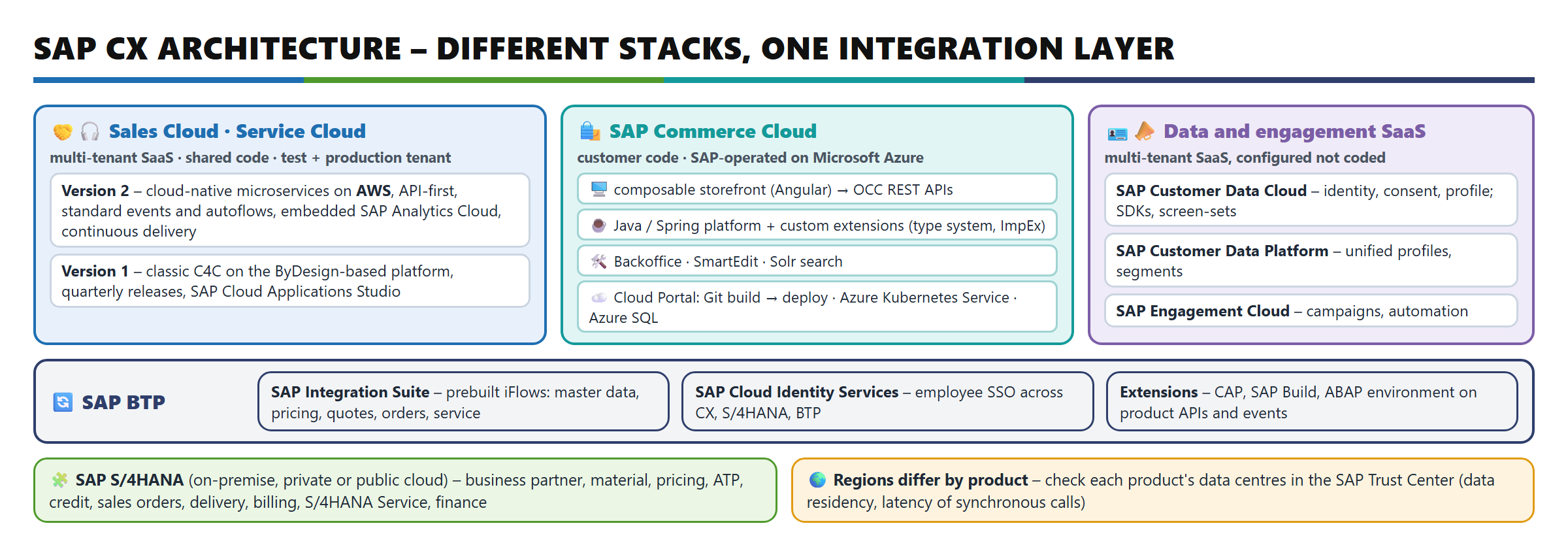
Product | Architecture and hosting | Customer controls |
|---|---|---|
Sales / Service Cloud V2 | Multi-tenant SaaS, microservices on AWS; test and production tenants; API-first (REST APIs), standard events and autoflows, embedded SAP Analytics Cloud | Configuration, low-code extensions, side-by-side apps on SAP BTP |
Sales / Service Cloud V1 | Multi-tenant SaaS on the C4C platform (ByDesign heritage); test and production tenants | Adaptation, SAP Cloud Applications Studio solutions |
SAP Commerce Cloud | Java platform (Spring) with modular extensions and a type system; SAP runs it on Microsoft Azure (Azure Kubernetes Service, Azure SQL Database) through the Commerce Cloud Cloud Portal; Solr search; environments such as development, staging, production | Own code: custom extensions from the customer's Git repository are built and deployed by the Cloud Portal |
SAP Customer Data Cloud | Multi-tenant SaaS (Gigya platform); REST APIs and web / mobile SDKs, screen-sets for registration and login | Configuration, screen-sets, extensions via web hooks |
SAP Customer Data Platform | Multi-tenant SaaS; connectors to source and target systems | Schemas, matching rules, segments, activations |
SAP Engagement Cloud | Multi-tenant SaaS (Emarsys platform) | Configuration, content, automation programs, APIs |
6.1 SAP Commerce Cloud in more detail
SAP Commerce Cloud is the exception in the portfolio: it is a platform the customer develops on, not a pure SaaS application. It is SAP's managed cloud edition of the SAP Commerce (Hybris) code base; the on-premise edition ended with release 2205 (Part 7).
Layer | What it is |
|---|---|
Storefront | Composable storefront (official name of project Spartacus): an Angular single-page app that calls Commerce Cloud through the OCC REST APIs (headless). Older projects use the JSP accelerator storefronts |
Commerce platform | Java / Spring application made of extensions: catalog, pricing, promotions, cart and checkout, order management, B2B, customer accounts; data model defined in the type system (items.xml) and loaded with ImpEx |
Business tools | Backoffice (product, catalog, order and customer administration) and SmartEdit (page and content editing) |
Integration | Integration API module (OData-based inbound and outbound) with SAP Integration Suite packages for S/4HANA; Data Hub is legacy and no longer the strategic integration path |
Cloud operations | Cloud Portal: environments, builds, deployments, endpoints, monitoring; SAP operates the Azure infrastructure |
- Single-tenant code, shared operations: every customer has its own environments and its own custom code, unlike Sales Cloud where all customers share one code line. This gives full flexibility but means the customer owns the upgrade effort for its extensions (Part 7).
6.2 Cross-product architecture
- Integration: SAP Integration Suite (Cloud Integration) with prebuilt integration packages for each CX ↔ S/4HANA scenario; synchronous APIs for pricing and availability, asynchronous messages for master data and orders (page 03).
- Identity: SAP Cloud Identity Services (Identity Authentication) as the employee login across CX, S/4HANA and SAP BTP; SAP Customer Data Cloud for consumer login.
- Extensions: side-by-side on SAP BTP (CAP, SAP Build, ABAP environment) using the products' APIs and events – the clean-core idea also applies to CX (page 04, BTP Development › 01, Clean Core › 01 Clean Core).
- Data residency: each product is provisioned in a chosen region; the regions differ by product (Sales and Service Cloud V2 on AWS, Commerce Cloud on Azure), so an architect checks every product's data centre list in the SAP Trust Center.
Part 7 – User interfaces and release cycles
Interface | Users | Used for |
|---|---|---|
Sales / Service Cloud V2 web client | Sales reps, managers, service agents | Responsive browser UI: workspaces for accounts, leads, opportunities, quotes, cases; embedded analytics; AI assistance |
Agent desktop / customer hub | Service agents | Omnichannel inbox, case handling, customer context, knowledge search, telephony (CTI) integration |
Mobile apps | Field sales, approvers | Accounts, visits, activities, offline work |
Microsoft Teams, Outlook / groupware | Sales reps | Collaborate on deals, sync emails, appointments and contacts |
Commerce storefront | Consumers, business buyers | Shop: search, product pages, cart, checkout, order history, B2B self-service |
Backoffice, SmartEdit | Commerce merchandisers, administrators | Catalog and content maintenance, promotions, order and customer administration |
Customer Data Cloud screen-sets | Consumers | Registration, login, consent and preference centre in the shop, apps and portals |
SAP CRM WebClient UI (legacy) | CRM users | Browser UI of SAP CRM 7.0 – replaced by the cloud UIs |
7.1 Release cycles
- Sales / Service Cloud Version 2: releases are named YYMM (e.g. 2608); the test tenant is upgraded first, production about two weeks later, with an optional customer test period. SAP summarises the features in quarterly release overviews and "What's New" documents.
- Sales / Service Cloud Version 1: quarterly releases named YYMM (e.g. 2502, 2505); test tenants first, production about two weeks later; SAP communicates release highlights in the SAP Community.
- SAP Commerce Cloud: since release 2211 (November 2022) SAP ships monthly update releases on the 2211 base instead of a new major version every year; the version number stays 2211. Since February 2024 the composable storefront uses matching 2211.x numbers. Customers must move to a current update within the support window – after the end-of-maintenance date they can no longer create new builds on an old update.
- On-premise SAP Commerce: release 2205 is the last on-premise release; its mainstream maintenance ended on 31 July 2026 (afterwards customer-specific maintenance only) – the driver for moves to Commerce Cloud 2211.
- Other products: the SaaS products (SAP Engagement Cloud, Customer Data Cloud, Customer Data Platform) are updated by SAP for all tenants; SAP publishes a quarterly "What's new in SAP CX" overview for the whole portfolio. Dates per product and region are in the release calendars on SAP for Me and the SAP Help Portal.
Part 8 – Interview questions
Q1. What is SAP CX?
SAP's cloud portfolio for the front office – commerce, customer data, marketing, sales and service: SAP Commerce Cloud, SAP Customer Data Cloud and Customer Data Platform, SAP Engagement Cloud, SAP Sales Cloud, SAP CPQ, SAP Service Cloud and SAP Field Service Management. S/4HANA remains the back office.
Q2. What is the difference between front office and back office?
The front office faces the customer: marketing, selling, the shop and service interactions (SAP CX). The back office executes and accounts: customer and material master, pricing, credit, delivery, billing, finance (S/4HANA). Orders and service requests flow from the front to the back; status, prices and invoices flow back.
Q3. What replaced SAP CRM 7.0 and when does its maintenance end?
Mainstream maintenance ends on 31 December 2027 (enhancement packages 2–4; EHP 0–1 already at the end of 2025), optional extended maintenance to the end of 2030. Successors: SAP Sales Cloud and Service Cloud for sales and customer service, S/4HANA Service for service execution, SAP Engagement Cloud for marketing, SAP Commerce Cloud for e-commerce. There is no technical upgrade – it is a re-implementation.
Q4. What is the difference between Sales Cloud Version 1 and Version 2?
Version 1 is the classic SAP Cloud for Customer on the ByDesign-based platform, extended with SAP Cloud Applications Studio. Version 2 is a new cloud-native microservice product on a hyperscaler (AWS), API-first, extended with low-code tools and side-by-side on SAP BTP, with embedded SAP Analytics Cloud. Moving from V1 to V2 is a re-implementation, not an upgrade.
Q5. What is SAP Commerce Cloud and how is it different from the other CX products?
The former Hybris e-commerce platform for B2C and B2B shops, run by SAP on Microsoft Azure. Unlike the SaaS products, the customer writes its own Java extensions, builds them from Git in the Cloud Portal and owns their upgrades; the storefront is usually the Angular composable storefront calling the OCC REST APIs.
Q6. What does SAP Customer Data Cloud do, and how does it differ from SAP Customer Data Platform?
Customer Data Cloud (Gigya) is consumer identity and consent: registration, login, SSO, consent and preferences, a customer profile. Customer Data Platform unifies data from many systems into one profile and builds segments for marketing and commerce. One answers "who is logged in and what may we do with his data", the other "what do we know about him and which segment is he in".
Q7. What is SAP Engagement Cloud?
SAP's omnichannel marketing and engagement solution – the former SAP Emarsys (acquired 2020, renamed in February 2026): segmentation, automated campaigns across email, mobile, web and messaging, personalisation and loyalty, with SAP Customer Data Platform data available for audiences.
Q8. Why use SAP Sales Cloud if S/4HANA has sales orders?
S/4HANA starts at the quotation or order. Sales Cloud covers everything before it – leads, opportunities, activities, visits, pipeline, forecast, territory and account planning – plus mobile and groupware integration for reps. It then creates quotes and orders in S/4HANA using S/4HANA pricing, so execution and accounting stay in the back office.
Q9. Where does service processing run – Service Cloud or S/4HANA Service?
Usually both: SAP Service Cloud for the customer interaction (cases, channels, knowledge, agent desktop), S/4HANA Service for service orders, contracts, confirmations, parts and billing, SAP Field Service Management for technicians. A service order created from a case is replicated to S/4HANA.
Q10. Is SAP CX multi-tenant?
The SaaS products – Sales and Service Cloud, Customer Data Cloud, Customer Data Platform, Engagement Cloud – are multi-tenant with shared code. Commerce Cloud runs customer-specific code in customer environments on shared, SAP-operated Azure infrastructure. None of the cloud products can be installed on-premise (on-premise SAP Commerce ended with release 2205).
Q11. How often are the CX products upgraded?
Sales and Service Cloud V2 by YYMM releases (test tenant about two weeks before production); V1 quarterly; Commerce Cloud by monthly update releases on the 2211 base, which customers must adopt within the support window; the other SaaS products are updated by SAP for all tenants. Regression testing of integrations and extensions is part of every release.
Q12. As an architect, what is your first question in a CX project?
Which processes run in the front office and which in S/4HANA, and who owns which master data – for example where prices are calculated, where the account is created, where the order is created and where service is executed. Next: which CX products and versions are licensed, and the integration approach through SAP Integration Suite (pages 02, 03 and 05).
🏠 Start Here · 02 · Capabilities & Data ▶ · Sections: CORE ABAP | OOPS ABAP | ABAP on HANA | Clean Core | RAP | ABAP Points | SAP Fiori | SAPUI5 | Mobile Development (MDK) | BTP Foundations | BTP Development | CAP | SAP Build | ABAP on BTP | Integration Suite | SAP Business AI | SAP BASIS | Security | SAP SDLC
Functional: FICO ABAP | TRM ABAP | VIM | SAP BIS | SD ABAP | MM ABAP | PP ABAP | QM ABAP | PM ABAP | PS ABAP | EWM | TM ABAP | GTM ABAP | EHS ABAP | HR ABAP | BW | SAP Datasphere | SAP Business Data Cloud | SAP MDG | SAP Analytics Cloud | SAP Ariba | SAP CX | SAP IBP