This page is the architect's view of SAP CX: how a CX implementation is run, how the tenants are set up and paired with S/4HANA, how licensing works at a conceptual level, which migration paths lead from SAP CRM and from Version 1 to Version 2, which functions belong in CX and which in S/4HANA, and the decisions an architect documents in every project. It ends with the interview angle for an ABAP developer. Products and versions: page 01; processes and data ownership: page 02; integration: page 03; extensions: page 04.
Part 1 – Implementation approach with SAP Activate
CX projects follow SAP Activate like S/4HANA projects, with a cloud-style fit-to-standard approach: show the standard in a test tenant, decide gaps, configure and extend only where the standard does not fit. SAP publishes Activate roadmaps for its cloud products in the SAP Activate Roadmap Viewer.
Phase | CX-specific activities |
|---|---|
Discover | Scope the products and version (Version 2 for new customers), trial or demo, business case; check which integration scenarios the current packages cover |
Prepare | Provision the test tenant through SAP for Me, set up identity (SAP Cloud Identity Services), plan the landscape pairing with S/4HANA and Cloud Integration, project team and governance |
Explore | Fit-to-standard workshops per process (lead-to-cash, service, commerce); data ownership matrix, pricing source, order handover, extension list (page 04 ladder), integration design, data migration plan |
Realize | Configuration in short sprints; integration packages deployed and mapped; extensions on BTP; data migration test loads; end-to-end tests with the S/4HANA quality system |
Deploy | Production tenant, Change Project transport of configuration, cutover (initial loads from S/4HANA, migration of open opportunities and cases), user onboarding, hypercare |
Run | Release management for the YYMM releases (test tenant first), monitoring of integration, adoption of new features each release |
- Work streams: configuration, integration, data migration, extensions, analytics, identity and roles, testing, change management and training. Integration is usually the longest critical path because it depends on S/4HANA readiness.
- Commerce Cloud projects behave like software development projects: agile sprints, Git, automated builds and deployments through the Cloud Portal, performance and load tests before go-live.
- Testing: end-to-end tests always cross systems – quote in Sales Cloud, order in S/4HANA, status back; web order in Commerce, delivery and invoice in S/4HANA.
Part 2 – Tenant landscape, transports and pairing with S/4HANA
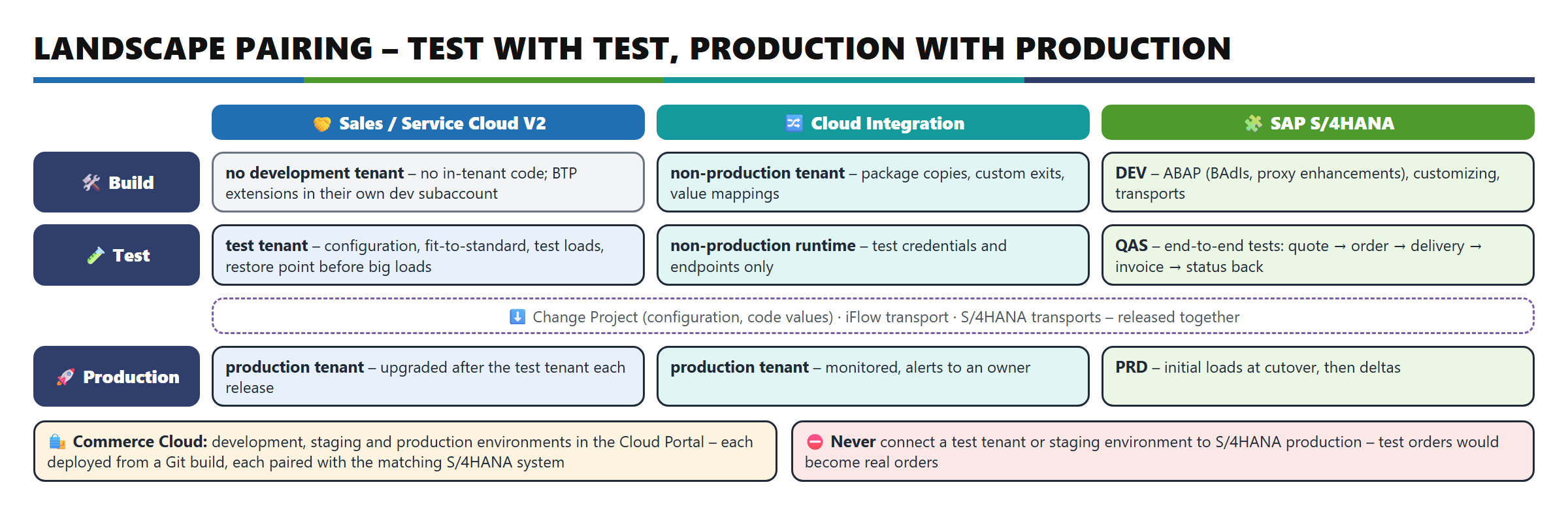
Topic | Sales and Service Cloud V2 |
|---|---|
Tenants | Each purchase includes a test and a production tenant; additional test tenants can be bought. Sales and Service Cloud in the same tenant or in separate tenants depends on the entitlement sets in the order |
Provisioning | Through SAP for Me › Systems & Provisioning; the IT contact receives the handover mail with initial credentials (valid 90 days). Set up the test tenant first |
Tenant copy | New tenant as a complete copy of a source tenant (configuration, master and transactional data, users) or as a copy of configuration only |
Transports | Change Project moves configuration from a source tenant (test) to a target tenant (production) after the landscape is set up in the administration settings; it transports configuration and code values, not instance data such as org-unit records; newer releases add selected objects (business roles, business partners) |
Restore point | Snapshot of a tenant requested before data migration or other risky work; one active restore point, kept 14 days |
Releases | YYMM releases; test tenant upgraded before production (page 01 Part 7) |
- Pair end to end: CX test tenant ↔ non-production Cloud Integration ↔ S/4HANA quality system; CX production ↔ production Cloud Integration ↔ S/4HANA production. Never connect a test tenant to S/4HANA production.
- No development tenant in Version 2: there is no in-tenant code; BTP extensions have their own dev / test / prod subaccounts and are paired with the CX tenants.
- Commerce Cloud: environments (e.g. development, staging, production) in the Cloud Portal, each deployed from a build of the Git repository.
Part 3 – Licensing and subscriptions (conceptual)
All CX products are subscriptions (cloud services for a contract term), licensed separately per product. No prices here – the concepts that drive architecture:
Product | Licensing concepts |
|---|---|
Sales / Service Cloud V2 | Base product SAP Sales Cloud Version 2 or SAP Service Cloud Version 2, typically per user; add-ons such as the sales capabilities add-on (for Service Cloud), service capabilities add-on (for Sales Cloud), field sales add-on, utilities add-on; a limited use licence with the core capabilities except SAP Build, server-side groupware integration and HERE maps |
AI features | Generative AI features such as AI-assisted content generation are available only with purchased SAP AI Units; some AI tools (e.g. the CX AI Toolkit) need an additional licence |
Version 1 → Version 2 | Version 2 is a separate product with separate licensing – a move is a contract change, not an upgrade |
SAP Commerce Cloud | Own commercial metrics and environment sizing in the order form – check what the contract includes (environments, capacity) |
SAP CPQ, Customer Data Cloud, Customer Data Platform, Engagement Cloud, FSM | Separate subscriptions with their own metrics |
SAP BTP | Integration Suite, Event Mesh, Build and runtime for extensions are BTP services (credits or subscriptions) – plan them in the business case unless SAP operates the integration (e.g. SAP-managed integration for qualifying S/4HANA Cloud Public Edition customers) |
Identity | SAP Cloud Identity Services tenants come with the cloud products; Identity Provisioning is bundled, not sold standalone |
- Architect angle: the licence decides the tenant layout (same or separate tenant for sales and service), which add-on features exist, whether AI features can be switched on, and whether BTP extensions are affordable.
Part 4 – Migration paths: SAP CRM, Version 1 and SAP Commerce on-premise
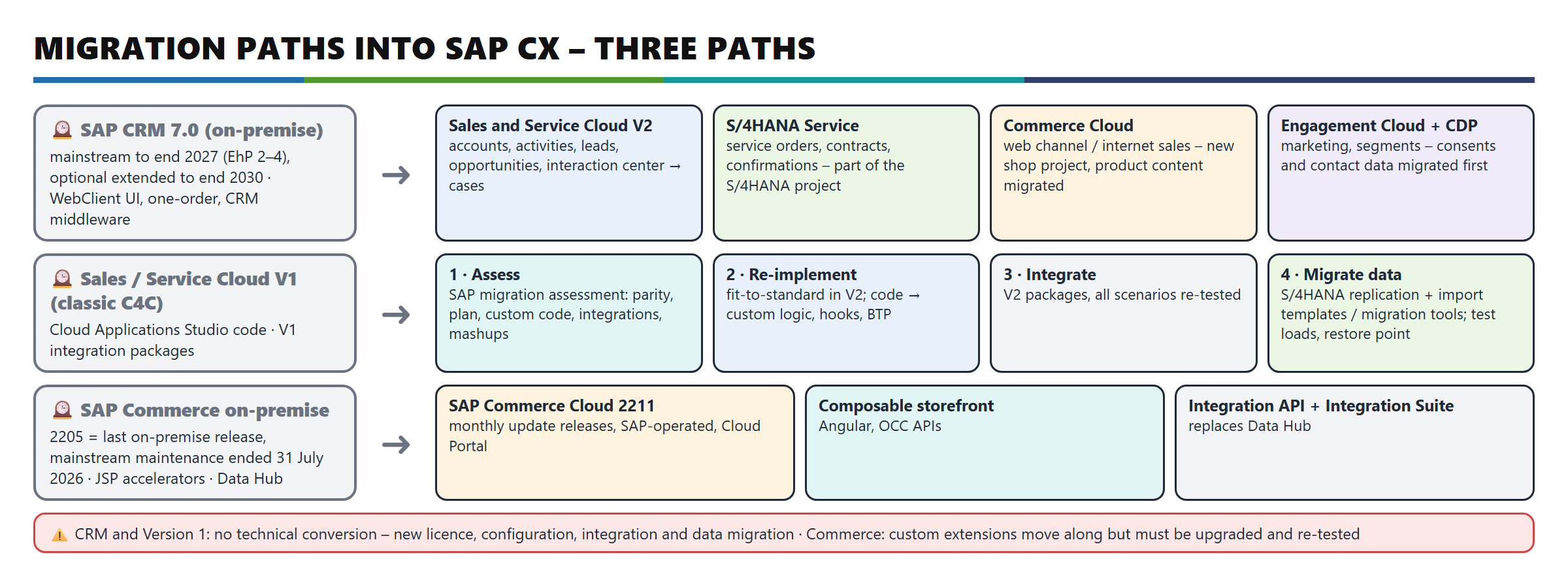
4.1 From SAP CRM 7.0
Maintenance dates and the function-by-function successors are on page 01 Part 3.1. There is no technical conversion from SAP CRM to a cloud CX product – it is a re-implementation.
CRM scope | Target | Migration notes |
|---|---|---|
Sales (accounts, activities, leads, opportunities) | Sales Cloud V2 | Extract from CRM, load with CX import templates or migration tools; customers that exist in S/4HANA come through the standard business partner replication |
Interaction Center, service tickets | Service Cloud V2 | Open cases migrated, closed history often archived or loaded as read-only reference |
Service orders, contracts, confirmations | S/4HANA Service | Part of the S/4HANA project (on-premise / private: S/4HANA for customer management and S/4HANA Service evolved from CRM's one-order model) |
Web channel / e-commerce | Commerce Cloud | New shop project; product content migrated |
Marketing | SAP Engagement Cloud, Customer Data Platform | Consents and contact data first |
CRM middleware, BDocs, ABAP enhancements | – | Not reused; replaced by Integration Suite packages and BTP extensions – each enhancement re-evaluated against the standard |
4.2 From Version 1 (classic C4C) to Version 2
Step | What happens |
|---|---|
Assess | SAP's migration assessment service for Version 1 customers: feature parity, process review, plan for configuration, setup and data, recommendations for custom code, integrations and mashups |
Re-implement | Version 2 is configured fresh (fit-to-standard); Cloud Applications Studio logic is redesigned as custom logic, hooks or BTP services (page 04 Part 6) |
Integrate | New Version 2 integration packages; every scenario re-tested (page 03 Part 5) |
Migrate data | S/4HANA-owned data (business partners, products) through the standard integration – only for the objects it covers; CX-owned data with the data import templates (fixed structure) or SAP's migration tools; test loads first, restore point before the final load |
Users | Users migrated or re-created; roles and security policies assigned afterwards |
4.3 From SAP Commerce on-premise
- Move to SAP Commerce Cloud on the 2211 update line (on-premise 2205 mainstream maintenance: page 01 Part 7); custom extensions are migrated and upgraded, infrastructure becomes SAP-operated.
- Storefront: JSP accelerator → composable storefront; integration: Data Hub → Integration API module with SAP Integration Suite.
Part 5 – What belongs where: CX, S/4HANA Sales and S/4HANA Service
The basic front-office / back-office split is on page 01 Part 5. In design workshops the question comes as concrete requirements – this table gives the usual answer and the reason.
Requirement | Usual place | Why |
|---|---|---|
Field sales with pipeline, forecast and visit planning | Sales Cloud | S/4HANA has no lead or opportunity management |
Inside sales entering standard orders for known customers | S/4HANA Sales (or Sales Cloud with transfer) | No CRM value if there is no sales cycle; avoids an extra system |
Quotes for standard products with S/4HANA prices | Sales Cloud quote with external pricing | Rep works in one UI; S/4HANA stays the price master |
Quotes for complex configurable products | SAP CPQ (with S/4HANA order) | Rules, guided selling, approvals |
B2B self-service ordering portal | Commerce Cloud (B2B) | Catalog, search, cart, approvals for buyers |
EDI orders from large customers | S/4HANA (IDoc / API) | System-to-system, no front-office step |
Contact centre, email, chat, cases | Service Cloud | Omnichannel, routing, service levels, knowledge |
Service contracts, billing of service, spare parts | S/4HANA Service | Commercial and logistical execution with finance integration |
Technician scheduling and mobile work | SAP Field Service Management | Dispatching, mobile app |
Credit limit, ATP, delivery, billing | S/4HANA | Back-office truth; CX only reads it |
Part 6 – Architect decisions
Write each decision down (decision record: options, choice, reason, consequences). The ones below come up in nearly every CX project with S/4HANA.
Decision | Options | Usual choice and trade-off |
|---|---|---|
Master data ownership | S/4HANA leads / CX leads / MDG hub | S/4HANA leads released customers and products; CX owns prospects and contacts; field-level ownership for shared objects (page 02 Part 9). MDG when several ERPs or strict governance |
Prospect to customer | Create BP in S/4HANA at once / at release / at first order | Release step (approval) or first order – avoids prospects polluting S/4HANA, but needs a clear trigger and duplicate check |
Pricing source | External pricing / internal price lists / CPQ / replicated price rows | S/4HANA pricing via simulation for binding prices; replicated or internal prices only when indicative (page 02 Part 4) |
Quote-to-order handover | Follow-up order from the CX quote / quote replicated as S/4HANA quotation / CPQ quote → order | Transfer creates the S/4HANA order; afterwards changes only in S/4HANA, status back to CX. Replicate quotes to S/4HANA only if the back office needs them |
Product configuration | Rules in CPQ / variant configuration in S/4HANA / both | One owner of the configuration knowledge; the S/4HANA order must receive valid characteristic values – test BOM and pricing results end to end |
Commerce order management | Asynchronous / synchronous / order management system | Asynchronous for B2C volume and resilience; synchronous pricing / ATP for B2B; OMS for omnichannel fulfilment (page 02 Part 6.1) |
Integration technology | Prepackaged iFlows / custom iFlows / point-to-point / events | Packages first, custom exits for gaps, events for extensions; no direct point-to-point calls that bypass monitoring |
Integration operations | Customer-run Integration Suite / SAP-managed (public edition) | Who monitors and fixes errors at night must be named before go-live |
Extension strategy | In-app / BTP / Commerce code | Lowest rung of the ladder (page 04 Part 1); BTP for code, with its own lifecycle |
Identity | IAS with corporate IdP / product logins | IAS as the single employee IdP for CX, S/4HANA and BTP; Customer Data Cloud for consumers |
Data residency and latency | Regions per product | Check every product's data centres; synchronous calls across regions add latency |
Part 7 – AI and Joule
SAP adds AI features to the CX products every release; availability (early adopter or generally available) and licensing are defined per feature and release.
Feature | What SAP states |
|---|---|
AI Sales Intelligence / AI Service Intelligence | Listed as capabilities in SAP's functional specification for Sales and Service Cloud Version 2 |
AI-assisted content generation | Generative features (e.g. drafts, summaries) – only with purchased SAP AI Units |
Joule in Sales Cloud Version 2 | SAP's generative AI copilot for sellers (informational questions, account overview, email drafts); availability and licence conditions are defined per release and contract |
CX AI Toolkit | Configurable AI agents, data sources and prompt templates for Sales Cloud Version 2; needs its own licence |
- Architect checklist: licence (AI Units), data protection and data residency for prompts, which data the AI may read, human review of generated content, early-adopter vs generally available.
Part 8 – Talking points for an ABAP developer
In a CX project the ABAP developer usually owns the S/4HANA side and often helps in Cloud Integration and on BTP. Prepare one concrete story for each row.
Topic | What to be able to explain |
|---|---|
Business partner replication | DRF with 986_3, filters, DRFOUT / DRFLOG, SOAMANAGER, BAdI MDG_SE_BP_BULK_REPLRQ_OUT, key mapping (page 03 Part 4) |
Orders from CX | Follow-up order iFlow, sales order API, custom fields enabled for the API, order status back |
Pricing calls | Why S/4HANA stays the price master; simulation returns price, ATP and credit |
Custom field end to end | CX extension field → iFlow custom exit → S/4HANA custom field (page 04 Part 10) |
Monitoring | SRT_MONI, WE02 / BD87, DRFLOG, /IWFND/ERROR_LOG, Cloud Integration monitor, Cloud ALM |
Events and BTP | S/4HANA business events, a CAP or RAP service consumed by CX |
Clean core | Released APIs, BAdIs instead of modifications, no copies of standard iFlows |
- Show architect thinking: for every technical answer add the decision behind it – who owns the data, what happens if S/4HANA is down, how it is monitored, how it survives the next release.
Part 9 – Interview questions
Q1. How do you implement SAP Sales Cloud Version 2?
With SAP Activate: provision the test tenant via SAP for Me, fit-to-standard workshops in Explore, configuration and integration in Realize sprints with end-to-end tests against the S/4HANA quality system, data migration test loads, Change Project transport to production, cutover with initial loads from S/4HANA, then continuous release management.
Q2. How are configuration changes moved from test to production in Version 2?
With a Change Project from the source (test) tenant to the target (production) tenant, after the landscape is defined in the administration settings. It moves configuration and code values, not instance data (newer releases add selected objects such as business roles and business partners). Before risky loads a restore point can be requested.
Q3. Can SAP CRM be upgraded to Sales Cloud?
No. It is a re-implementation: sales and interaction-center scope moves to Sales and Service Cloud, service orders and contracts to S/4HANA Service, the web channel to Commerce Cloud, marketing to SAP Engagement Cloud. Data is migrated; CRM middleware and enhancements are replaced, not reused.
Q4. How does a Version 1 customer move to Version 2?
Version 2 is a separate product and licence. SAP's migration assessment checks feature parity and gives a plan for configuration, data, custom code, integrations and mashups. Then Version 2 is configured fresh, integration rebuilt with the Version 2 packages, data migrated with the migration tools and S/4HANA replication, and users and roles set up.
Q5. What drives the licensing of Sales and Service Cloud V2?
A base product (Sales Cloud or Service Cloud Version 2), typically per user, plus add-ons – sales or service capabilities, field sales, utilities – and AI Units for generative features. BTP services for integration and extensions are licensed separately unless SAP runs the integration.
Q6. When would you not use Sales Cloud and stay in S/4HANA Sales?
When there is no real sales cycle: few known B2B customers, orders by EDI or inside sales entering standard orders. Sales Cloud pays off with field or inside sales teams managing leads, opportunities, visits and forecasts.
Q7. Where should service contracts and service billing run?
In S/4HANA Service, because they need logistics and finance integration. Service Cloud handles the customer interaction (cases, channels, knowledge) and creates or shows service orders; SAP Field Service Management handles technicians.
Q8. Who should own pricing in a Sales Cloud and S/4HANA landscape?
S/4HANA. Quotes and orders use external pricing (simulation) for binding prices; internal price lists only for indicative prices. The S/4HANA order price is the one that is invoiced.
Q9. How do you design the quote-to-order handover?
The accepted CX quote creates a follow-up sales order in S/4HANA through the transfer; the order number returns to CX, later changes are made in S/4HANA and replicated back. Quotes are replicated to S/4HANA only if the back office needs them; with CPQ the Quote 2.0 iFlow creates the order.
Q10. Which order management pattern do you choose for Commerce Cloud?
Asynchronous for B2C – the shop keeps selling when S/4HANA is down; synchronous pricing and ATP for B2B with customer-specific prices and credit; an order management system for omnichannel fulfilment. Patterns can be combined.
Q11. What do you check before switching on AI features in Sales Cloud?
Licence (SAP AI Units, extra licences such as the CX AI Toolkit), availability (early adopter or generally available), data protection and residency, which data the AI reads, and human review of generated texts.
Q12. What is the role of an ABAP developer in a CX project?
The S/4HANA side: DRF and web-service configuration, BAdIs in business partner replication, custom fields enabled for APIs, IDocs and OData services, monitoring and error handling, often Groovy in Cloud Integration custom exits and CAP or RAP services on BTP – always within clean-core rules.
🏠 Start Here · ◀ 04 · Extensibility · 06 · Interview Questions ▶ · Sections: CORE ABAP | OOPS ABAP | ABAP on HANA | Clean Core | RAP | ABAP Points | SAP Fiori | SAPUI5 | Mobile Development (MDK) | BTP Foundations | BTP Development | CAP | SAP Build | ABAP on BTP | Integration Suite | SAP Business AI | SAP BASIS | Security | SAP SDLC
Functional: FICO ABAP | TRM ABAP | VIM | SAP BIS | SD ABAP | MM ABAP | PP ABAP | QM ABAP | PM ABAP | PS ABAP | EWM | TM ABAP | GTM ABAP | EHS ABAP | HR ABAP | BW | SAP Datasphere | SAP Business Data Cloud | SAP MDG | SAP Analytics Cloud | SAP Ariba | SAP CX | SAP IBP