This page looks at MDG from the architect's side: what MDG on S/4HANA changed compared with ECC, cloud-ready mode, SAP Master Data Governance, cloud edition with federation, how MDG relates to SAP Master Data Integration and SAP Business Data Cloud, the migration paths from MDG on ECC, the design decisions an architect makes (domains, central governance vs consolidation, hub vs co-deployed, rules ownership, replication, CVI) and clean core. The product versions and deployment options are introduced on page 01 Parts 5 and 7; this page adds the decisions behind them. Clean core in general: Clean Core › 01 Clean Core.
Part 1 – MDG on S/4HANA: what changed
MDG is part of every SAP S/4HANA release (on-premise and SAP S/4HANA Cloud Private Edition) and is switched on with an MDG licence (page 01 Part 6). S/4HANA 1809 corresponds to MDG 9.2, the last release on SAP ERP; everything since then is S/4HANA-only.
Area | MDG on ECC (legacy) | MDG on S/4HANA |
|---|---|---|
Business partner | MDG-C / MDG-S use the BP with CVI; the rest of ECC may still use classic customer / vendor transactions | BP is the only way to maintain customers and suppliers (CVI mandatory) |
Material | Material master (MARA …) | Product master – same tables, longer material number (40 characters) available |
User interface | Web Dynpro / FPM, NWBC | Fiori launchpad with Fiori apps; Web Dynpro apps as tiles; cloud-ready mode apps |
Search and matching | Enterprise Search, database or HANA search | SAP HANA fuzzy search as standard for duplicate check and matching |
Consolidation, mass processing | First versions in the last ERP releases | Further developed framework with process templates and Fiori apps (page 03) |
Data quality | SAP Information Steward | Built-in DQM: rules, evaluation, scores, rule mining |
Analytics | Classic reports; SAP HANA-based Analytics for MDG (content generation not available in S/4HANA) | Process analytics on CDS views, change analytics |
New modes | – | Cloud-ready mode (2023), federation with the cloud edition |
Maintenance | MDG 9.2 mainstream maintenance to end of 2027 | Innovation with every S/4HANA release |
- Classic mode keeps working in S/4HANA: data models, CR types, BRF+ rules and BAdI implementations from ECC are still valid concepts (pages 02–05).
- S/4HANA Cloud Public Edition contains master data governance for business partner and product with cloud-ready concepts only – no classic MDGIMG, no own data models, no classic BAdIs.
Part 2 – Cloud-ready mode
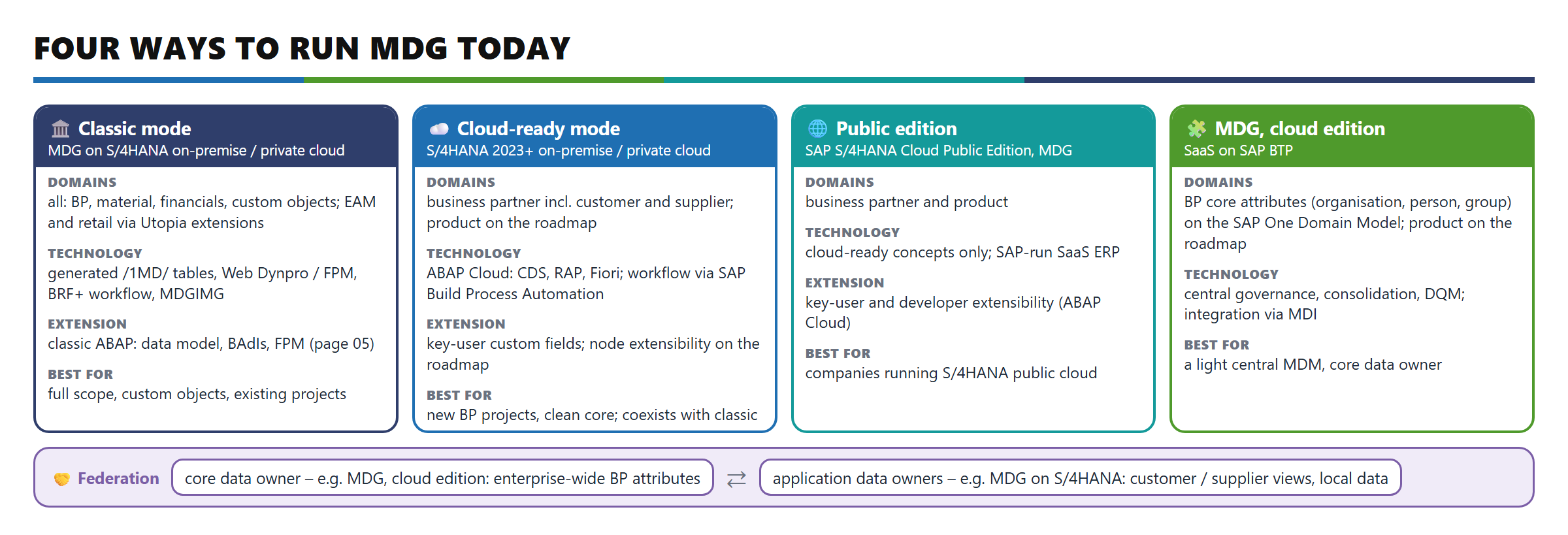
Cloud-ready mode was introduced with SAP S/4HANA 2023 as a second way to run MDG inside S/4HANA (on-premise and private cloud). It is built on ABAP Cloud and follows clean-core principles strictly.
Aspect | Classic mode | Cloud-ready mode |
|---|---|---|
Domains | All domains and custom objects | Business partner incl. customer and supplier; product data is planned (SAP Road Map Explorer) |
Data model | MDG data model with generated /1MD/ staging tables | Based on the S/4HANA BP data model (both modes are), implemented with CDS and RAP |
UI | Web Dynpro / FPM, classic Fiori apps | New Fiori apps for central governance (single and mass processing, e.g. Manage Business Partners – Governance, F7204) and consolidation |
Process / workflow | CR types, rule-based workflow in BRF+ | Process templates in Customizing; optional workflows with SAP Build Process Automation |
Extensibility | Data model extension, BAdIs, FPM (page 05) | Key-user extensibility for fields; node (entity) extensibility on the roadmap |
Data quality | DQM apps, BRF+ rules, rule-service BAdIs | The same DQM apps; checks only as DQM rules (no USMD_RULE_SERVICE BAdIs or classic BRF+ rules) |
Analytics | Process analytics apps | The process analytics apps stay usable |
- Coexistence: classic and cloud-ready mode can run side by side for central governance, so BP can move to cloud-ready while material and financials stay classic.
- Processes created in cloud-ready mode cannot be finished in classic apps – switch a domain cleanly and train users on one set of apps.
- Choose cloud-ready for new BP implementations on S/4HANA 2023 or later, especially when clean core is a programme goal; stay classic where custom objects, heavy BAdI logic or not-yet-supported domains are needed.
Part 3 – Cloud edition, federation, MDI and Business Data Cloud
3.1 SAP Master Data Governance, cloud edition
- A SaaS solution on SAP BTP, run by SAP. It uses the SAP One Domain Model, not the full S/4HANA data model.
- Domain today: business partner core attributes – roles organisation, person and group (the employee role is not supported); product governance is on the roadmap.
- Capabilities: central governance, consolidation and data quality management for these attributes; integration with SAP applications through SAP Master Data Integration.
- Typical role: a light central MDM for enterprise-wide BP data, or the core data owner in federation.
3.2 Federated governance
Federation splits governance by ownership instead of forcing everything into one hub.
Role | Owns | Example system |
|---|---|---|
Core data owner | Enterprise-wide core attributes: name, address, tax numbers, bank details | SAP MDG, cloud edition |
Application data owner | Application-specific data: customer sales area data, supplier purchasing data, local fields | MDG on S/4HANA (central governance of customer / supplier views) |
- Each owner governs its part with its own processes; the core record is distributed to the application data owners, which extend it.
- Fits large groups where business units run their own S/4HANA and MDG but must share one golden business partner.
3.3 SAP Master Data Integration (MDI)
- MDI distributes master data between SAP applications on the SAP One Domain Model (page 04 Part 5.1); MDG governs it. MDI has no change requests, workflow or quality rules.
- On-premise S/4HANA and MDG on S/4HANA keep the Data Replication Framework and feed MDI from it; the cloud edition and SAP cloud applications consume and publish through MDI.
3.4 SAP Business Data Cloud
- SAP presents SAP Master Data Governance as part of SAP Business Data Cloud – the governance layer that delivers consistent, governed master data (with its semantics) to the business data fabric and its data products.
- In one sentence: MDG curates trusted master data and feeds it into Business Data Cloud as a data product; Business Data Cloud uses governed data products for analytics, planning and AI.
Part 4 – Migration paths
Start | Option | Consider |
|---|---|---|
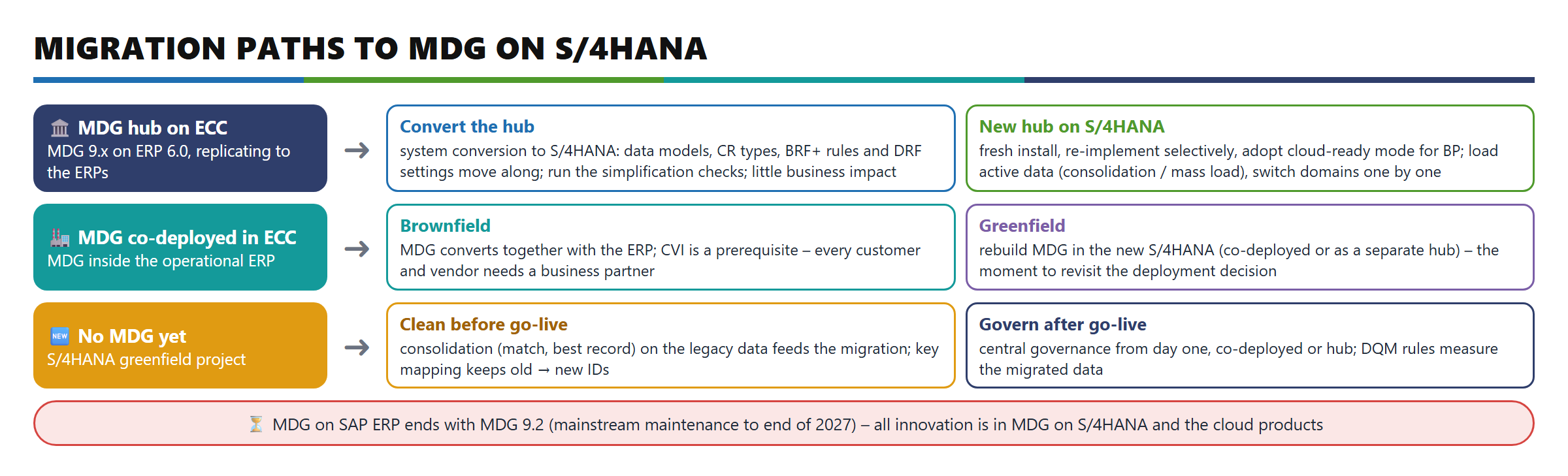
MDG hub on ECC | Convert the hub with a system conversion | Fast, keeps data models, CR types, rules and DRF settings; simplification checks, custom code check of BAdI implementations; BP / CVI already used for customer and supplier |
New hub on S/4HANA (greenfield) | Clean restart, adopt cloud-ready mode for BP and Fiori apps; load active data with consolidation or mass load; key mapping to the existing clients must be rebuilt; old and new hub run in parallel per domain | |
MDG co-deployed in ECC | Converts together with the ERP (brownfield) | CVI conversion of all customers and vendors to BP is a prerequisite of the system conversion |
Rebuild in a greenfield S/4HANA | Re-decide hub vs co-deployed (Part 5) | |
No MDG yet | Start with the S/4HANA project | Consolidate and cleanse legacy data before the migration; central governance from go-live; DQM rules measure the migrated data |
- A hub can be migrated independently of the ERPs – it keeps replicating to ECC clients while they move to S/4HANA one by one. That decoupling is one of the strongest arguments for a hub during transformation programmes.
- Central Finance projects reuse MDG's key and value mapping; an MDG hub can provide the harmonised master data for the central finance system.
- Plan the move before the end of mainstream maintenance of MDG 9.2 (end of 2027).
Part 5 – Architect decisions
5.1 Domains first
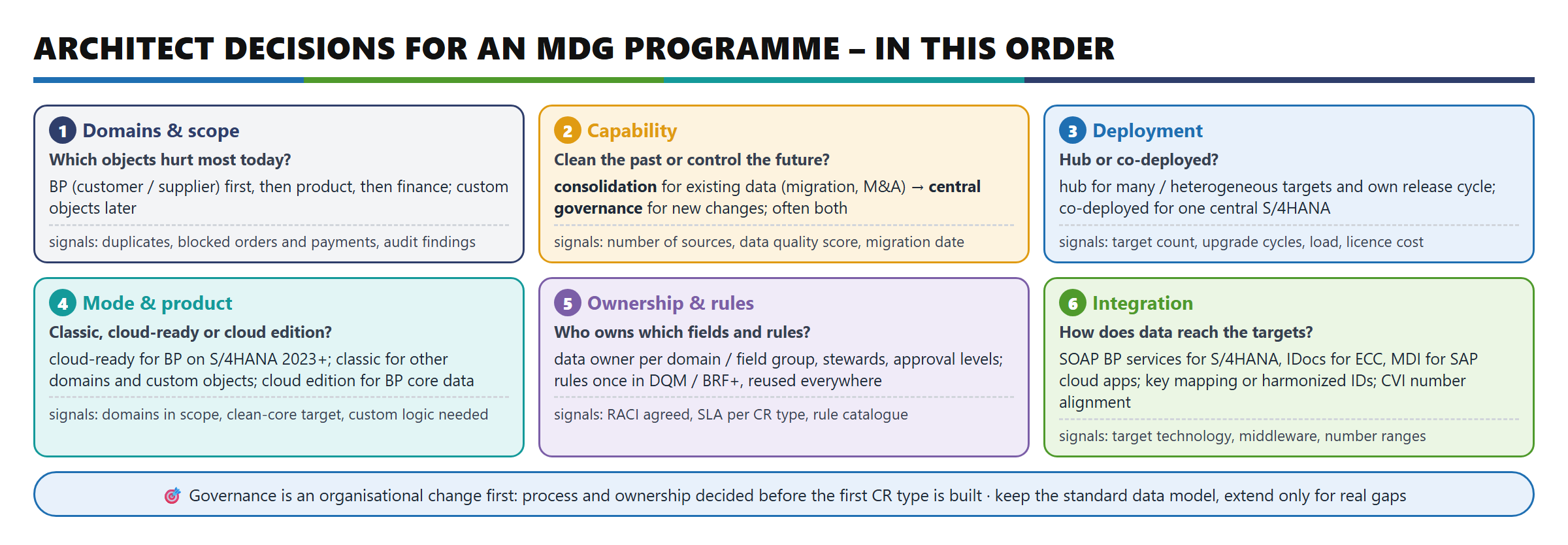
- Start with the domain that hurts most and has the clearest owner – usually business partner (duplicates, blocked payments, fraud risk on bank details), then product, then finance.
- Use the standard data model and extend only for real gaps; every extension costs effort in data model, UI, mapping and replication (page 05).
5.2 Central governance vs consolidation
Central governance | Consolidation | |
|---|---|---|
Direction | Create / change in MDG first, then distribute (top-down) | Collect from the sources, match, merge (bottom-up) |
Fits | New data, ongoing changes under control | Existing data in many systems, migrations, acquisitions, initial loads |
Data entry | Only in MDG | Stays in the source systems (optionally governed later) |
Typical path | – | Consolidate first, then switch to central governance |
5.3 Hub vs co-deployed (summary)
- Hub: many or heterogeneous targets, own upgrade cycle, no load on the ERP, MDG before or independently of the S/4HANA migration. Co-deployed: one central S/4HANA, few other targets, no replication into the own system, identical customizing. Full comparison: page 01 Part 5.
5.4 Data ownership and rules
- Define a data owner per domain or field group, data stewards who process requests, and approval levels per CR type; agree SLAs (page 03).
- Define each rule once – in DQM or BRF+ – and reuse it in central governance, mass processing and quality evaluation; BAdIs only where rules need code.
- Decide who owns customizing values (payment terms, account groups) in a hub landscape – value mapping or a single customizing master.
5.5 Replication technology and keys
- SOAP BP services to S/4HANA and BP-based systems, IDocs where ECC already uses them, MDI for SAP cloud applications, Integration Suite for non-SAP (page 04).
- Key strategy: harmonized IDs (same number everywhere, external numbering in the targets) or key mapping (targets keep their numbers). Harmonized IDs are simpler to operate; key mapping is unavoidable when existing systems keep their legacy numbers.
5.6 Customer-vendor integration (CVI)
- In S/4HANA every customer and supplier is a business partner; CVI synchronises BP with the customer / vendor tables (KNA1 …, LFA1 …). Details in SD ABAP › 01.
- Architect topics: BP grouping ↔ account group mapping, number ranges (same number for BP and customer / supplier where possible), BP roles per target, and contact persons / relationships – decided once for MDG and every receiving S/4HANA.
- In a conversion from ECC the CVI synchronisation of all customers and vendors to BP must be finished before the system conversion.
Part 6 – Clean core for MDG
Approach | Clean-core view | Use |
|---|---|---|
Cloud-ready mode with key-user fields, DQM rules and process templates | Clean core by design (ABAP Cloud) | New BP governance on S/4HANA 2023+ |
Classic configuration (MDGIMG, BRF+, FPM configuration, CBA) | Configuration, upgrade-safe | All classic domains |
Classic BAdIs and data model extensions (page 05) | Classic ABAP extensions – supported on on-premise and private cloud, but not ABAP Cloud | Where configuration and DQM are not enough |
Modifications of SAP MDG code or generated objects | Not clean – avoid | Never |
Side-by-side on BTP (apps, SAP Build Process Automation, Integration Suite) | Clean core | Portals, approvals outside S/4HANA, non-SAP integration |
- Prefer DQM / BRF+ rules to BAdI code for checks; prefer decision tables to agent BAdIs for routing; keep custom code behind the documented MDG APIs and BAdIs.
- Track the cloud-ready roadmap: domains that move to cloud-ready mode later can then be migrated with less custom code to carry over.
Part 7 – Talking points: designing an MDG landscape
Architect-style questions are usually a scenario. Answer in the order of Part 5 and name the trade-offs. Example: "A group has three ECC systems with overlapping customers and moves to one S/4HANA over three years. Design the master data governance."
Step | Answer outline |
|---|---|
1 Scope | Business partner (customer / supplier) first, product second; finance with the S/4HANA finance design |
2 Clean the past | MDG consolidation of the three ECCs: match, best record, key mapping old IDs → new BP; this also prepares the migration |
3 Deployment | Hub on S/4HANA: serves the ECCs and the new S/4HANA during the three years, own release cycle, no load on the ERPs |
4 Mode | Cloud-ready mode for BP if the release and requirements allow, classic for product |
5 Governance model | Data owners per domain, stewards, CR types with rule-based workflow, rules in DQM / BRF+, SLAs |
6 Integration | BP SOAP services to S/4HANA, BP IDoc or SOAP to the ECCs, key mapping for the ECC numbers, harmonized BP numbers in the new S/4HANA; CVI design aligned |
7 Run | DRFLOG / AIF monitoring, DQM scores, process analytics; decommission ECC targets as they migrate |
- Show you know the limits: what is roadmap (product in cloud-ready mode and cloud edition), what costs effort (reuse-mode extensions, key mapping), and that governance is an organisational change first.
- For a technical consultant interview, link each design element to a technical object: CR type, WS60800086 and its decision tables, USMD_RULE_SERVICE, replication model and outbound implementation, MDG_KM_MAINTAIN.
Part 8 – Interview questions
Q1. What changed for MDG with S/4HANA?
BP and CVI are mandatory for customers and suppliers (ECC: only MDG-C / MDG-S used the BP, XD01 / XK01 still worked), Fiori apps, HANA-based search and matching, the full consolidation and mass processing framework, built-in DQM, process analytics on CDS, cloud-ready mode and federation. MDG on ECC ends with 9.2.
Q2. What is cloud-ready mode and when would you use it?
A way to run MDG in S/4HANA (since 2023) built on ABAP Cloud – CDS, RAP, new Fiori apps, key-user extensibility, optional SAP Build Process Automation workflows. Today for business partner incl. customer and supplier. Use it for new BP projects with clean-core goals; it can coexist with classic mode for other domains.
Q3. What is SAP Master Data Governance, cloud edition?
A SaaS on BTP for business partner core attributes on the SAP One Domain Model, with central governance, consolidation and DQM, integrated through SAP Master Data Integration. It often acts as core data owner in federated governance; product is on the roadmap.
Q4. Explain federated governance.
Governance is split by ownership: a core data owner governs enterprise-wide core attributes (e.g. MDG cloud edition for BP), application data owners govern application-specific data such as customer sales or supplier purchasing data (e.g. MDG on S/4HANA).
Q5. MDG vs SAP Master Data Integration?
MDG governs: change requests, workflow, rules, quality, consolidation. MDI distributes master data between SAP applications on the One Domain Model without governance. They complement each other.
Q6. How do you migrate an MDG hub from ECC to S/4HANA?
Either a system conversion of the hub – configuration, data models, rules and DRF settings move along, after simplification and custom code checks – or a new hub on S/4HANA with selective re-implementation, often adopting cloud-ready mode for BP, loading active data and switching domains step by step. The hub can move independently of its ECC clients.
Q7. Central governance or consolidation?
Consolidation for existing data spread over systems – migrations, acquisitions, cleansing; central governance for creating and changing data under control from now on. Typical programmes consolidate first and then govern centrally.
Q8. Which domain would you start with and why?
Usually business partner: high business impact (duplicates, payment fraud risk on bank details), clear owners, standard content and cloud-ready support. Then product, then finance.
Q9. What CVI decisions matter for MDG?
BP grouping to account group mapping, number ranges (same number for BP and customer / supplier), roles per target system, contact persons and relationships – identical in MDG and every receiving S/4HANA. In a conversion, CVI must be completed first.
Q10. How do you keep an MDG implementation clean core?
Cloud-ready mode where possible, configuration before code (MDGIMG, BRF+, FPM configuration), DQM rules instead of BAdIs, only documented BAdIs and APIs, no modifications, side-by-side extensions on BTP for portals and approvals.
Q11. Harmonized IDs or key mapping?
Harmonized IDs give the same number everywhere and simpler operations but need aligned number ranges and external numbering in the targets. Key mapping is needed when targets keep their own or legacy numbers, e.g. existing ECC systems; SOA confirmations and consolidation maintain it.
Q12. How does MDG relate to SAP Business Data Cloud?
SAP positions MDG as part of SAP Business Data Cloud: the governance layer that supplies trusted, consistent master data to the business data fabric and its data products for analytics and AI.
🏠 Start Here · ◀ 05 · Development · 07 · Interview Questions ▶ · Sections: CORE ABAP | OOPS ABAP | ABAP on HANA | Clean Core | RAP | ABAP Points | SAP Fiori | SAPUI5 | Mobile Development (MDK) | BTP Foundations | BTP Development | CAP | SAP Build | ABAP on BTP | Integration Suite | SAP Business AI | SAP BASIS | Security | SAP SDLC
Functional: FICO ABAP | TRM ABAP | VIM | SAP BIS | SD ABAP | MM ABAP | PP ABAP | QM ABAP | PM ABAP | PS ABAP | EWM | TM ABAP | GTM ABAP | EHS ABAP | HR ABAP | BW | SAP Datasphere | SAP Business Data Cloud | SAP MDG | SAP Analytics Cloud | SAP Ariba | SAP CX | SAP IBP