What happens to transportation when a company moves to S/4HANA: LE-TRA is only a temporary compatibility item, TM is the successor – embedded or as a separate system, with the basic scope or the advanced licence, on-premise or in the cloud. This page covers what replaces what, what each edition offers, how to migrate from LE-TRA or SAP TM 9.x, the decisions a solution architect has to make, and how to keep TM extensions clean-core. History, deployment options and the basic / advanced feature split are introduced on page 01 Parts 2 – 3; development techniques on page 05.
Part 1 – From LE-TRA and TM 9.x to S/4HANA TM: what replaces what
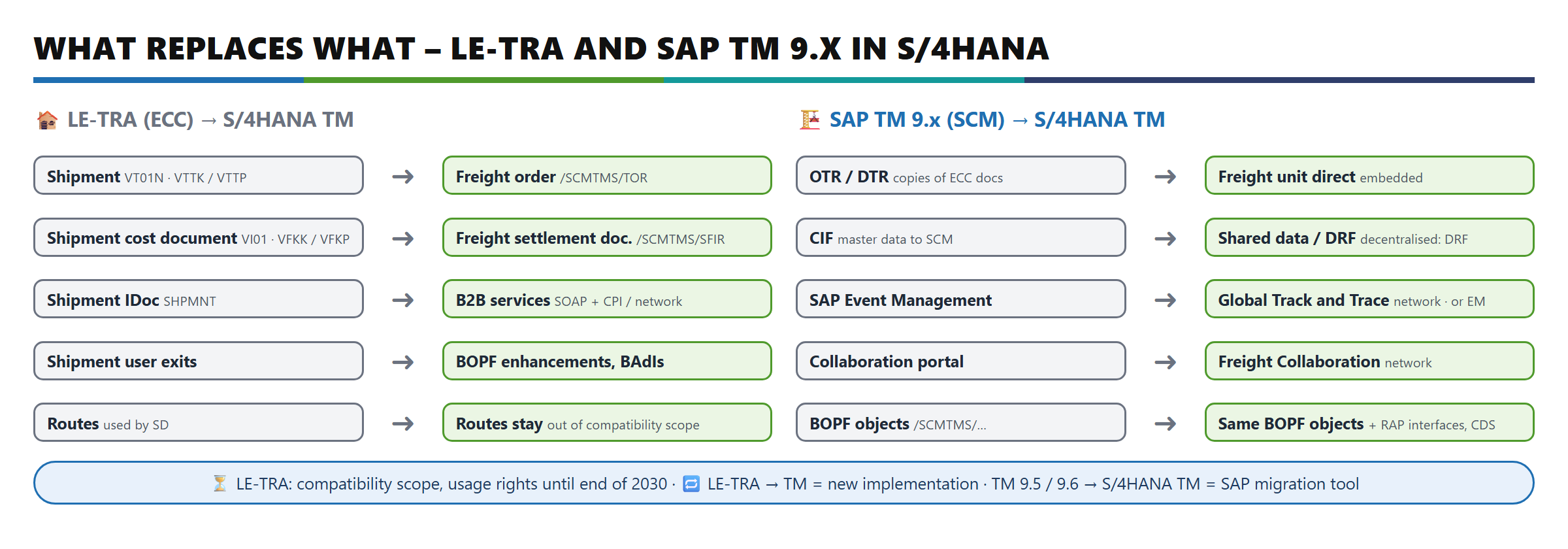
Area | ECC (LE-TRA) / SAP TM 9.x | S/4HANA TM | Impact for developers |
|---|---|---|---|
Shipment | LE-TRA shipment (VT01N, VTTK / VTTP / VTTS) | Freight order (BO /SCMTMS/TOR) | Custom code on VTTK etc. must be rebuilt on TOR (page 05) |
Freight costs | Shipment cost document (VI01, VFKK / VFKP) | Freight settlement document (/SCMTMS/SUPPFREIGHTINVREQ) → service PO + entry sheet | Same MM postings, new source object (page 04 Part 4) |
Requirements | TM 9.x: OTR / DTR documents from ECC | Embedded: freight unit directly from the S/4HANA document | Interfaces and code reading TRQ for OTR / DTR disappear |
Master data link | TM 9.x: CIF from ECC to SCM | Shared S/4HANA master data; decentralised: DRF replication | No CIF monitoring; BP instead of customer / vendor |
Tracking | SAP Event Management | SAP Business Network Global Track and Trace (or EM) | New event interfaces |
Carrier portal | TM collaboration portal | SAP Business Network Freight Collaboration | Carrier onboarding to the network instead of own portal |
Field lengths | MATNR 18 | MATNR 40, business partner | Same S/4HANA rules as SD / MM |
Part 2 – LE-TRA in S/4HANA: compatibility scope and deadlines
- LE-TRA (Logistics Execution – Transportation) still runs technically in S/4HANA, but only as a compatibility scope item (simplification item S4TWL – Transportation (LE-TRA), SAP Note 2270199; usage rights in the compatibility scope matrix, SAP Note 2269324). It gets no innovation; the successor is TM.
- On-premise usage rights for most compatibility packs ended on 31 May 2026 (under a cloud subscription: end of 2030). For three items – LE-TRA, Customer Service (CS) and PP-PI – SAP extended them to the end of 2030 for all S/4HANA systems. After that LE-TRA may no longer be used.
- Exception: LE-TRA routes (and route determination used by SD) were taken out of the compatibility scope – SD can keep using routes after 2030.
- Basic TM (Transportation Management) is included in the S/4HANA licence, so replacing LE-TRA does not automatically mean extra licence cost – only advanced features do (page 01 Part 3).
- Architect message: plan the LE-TRA → TM move as its own project wave well before 2030; it is a new implementation, not a conversion (Part 4).
Part 3 – Editions: on-premise, private cloud and public cloud
Edition | TM scope | Extensibility |
|---|---|---|
On-premise / S/4HANA Cloud Private Edition | Full TM: embedded or decentralised, basic scope or advanced licence, shipper and LSP scenarios, optimizer | Everything on page 05: BOPF enhancements, BAdIs, conditions, PPF, FPM – plus ABAP Cloud for clean-core parts |
S/4HANA Cloud Public Edition | Standardized shipper TM in scope items 6W1 External Transportation Planning, 6W2 Manual Transportation Planning, 6W3 Transportation Execution, 6W4 Freight Settlement (replacing the older scope items with 2308); 6W3 is activated together with 6W1 or 6W2, and the TM scope items must be selected explicitly | Key-user extensibility and developer extensibility (ABAP Cloud): released APIs such as API_FREIGHTORDER, I_FreightOrderTP, business events – no BOPF enhancements |
Business networks (SaaS on SAP BTP) | Freight Collaboration, Global Track and Trace – for every edition | Network APIs, EDI, side-by-side apps |
- Some APIs are edition-specific (for example the Freight Order API is API_FREIGHTORDER in the cloud, API_FREIGHTORDER_2 on-premise 2025); SAP Business Accelerator Hub lists the editions per API.
- Public cloud localisations can differ: Brazil, Poland and Russia keep the older scope items.
Part 4 – Migration paths
4.1 From LE-TRA
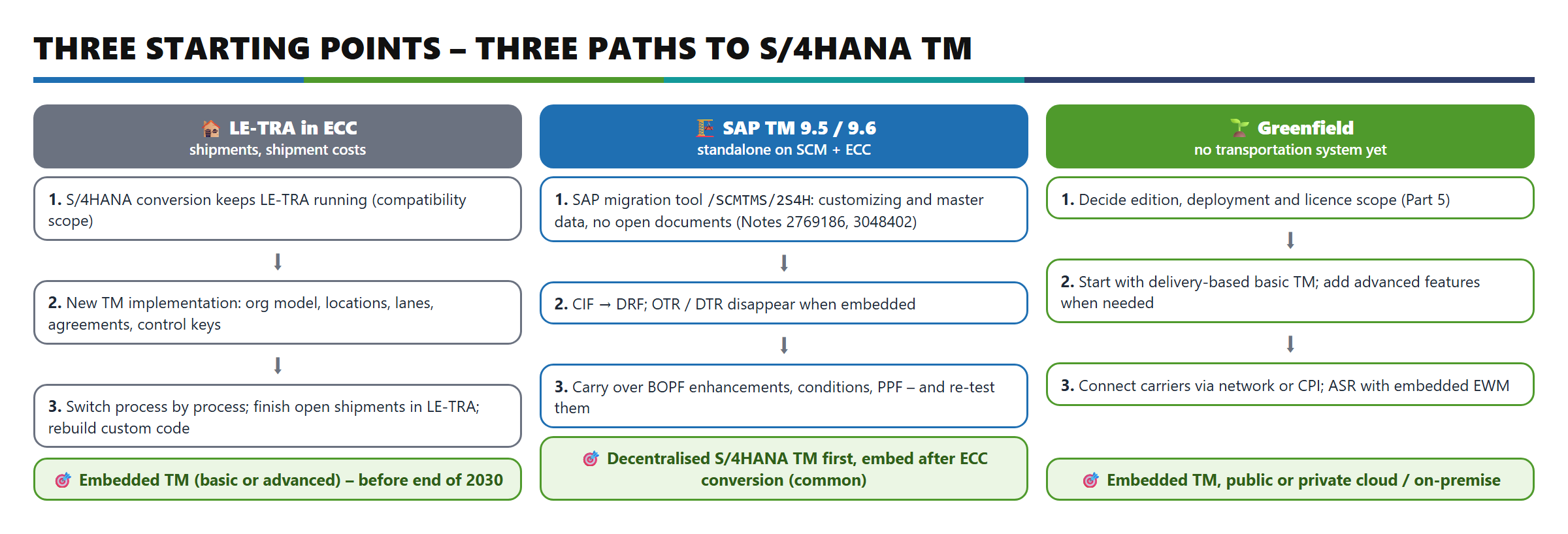
- New implementation, also in a brownfield S/4HANA conversion: there is no tool that turns shipments into freight orders. The S/4HANA conversion keeps LE-TRA running; TM is introduced afterwards (or in the same project as a separate stream).
- Steps: org model and master data (locations generated from plants, shipping points and business partners; lanes, carriers as BPs, freight agreements and rate tables) → control keys per document type → freight unit building, planning, settlement → finish open shipments and shipment cost documents in LE-TRA → switch.
- Because transportation relevance is set per document type, TM can be introduced process by process (e.g. one plant or one transport mode first) while LE-TRA serves the rest.
- Rebuild custom code: reports on VTTK / VFKK, shipment user exits and IDoc SHPMNT interfaces become TOR / SFIR logic, B2B services and CPI mappings.
4.2 From SAP TM 9.x (standalone)
- SAP offers a migration tool (transaction /SCMTMS/2S4H, SAP Note 2769186; master data transfer Note 3048402) for TM 9.5 / 9.6 to S/4HANA TM, embedded or decentralised. It copies TM customizing (master data via the master data transfer tool, Note 3048402) – no transaction data: open freight orders and bookings are finished in the old system or recreated.
- Master data replication changes from CIF (to TM 9.x) to DRF (to S/4HANA); in an embedded target OTR / DTR disappear and freight units point to the S/4HANA documents.
- BOPF enhancements, conditions and PPF settings can largely be carried over – the framework is the same – but every enhancement must be re-tested (changed nodes, removed OTR / DTR, S/4HANA field lengths).
- A common two-step path: first move TM 9.x to a decentralised S/4HANA TM connected to the existing ECC, later convert ECC to S/4HANA and decide whether to embed TM.
Generic migration tools (Migration Cockpit, conversion steps): ABAP on HANA › 02 Migration to S/4HANA.
Part 5 – Architect decisions
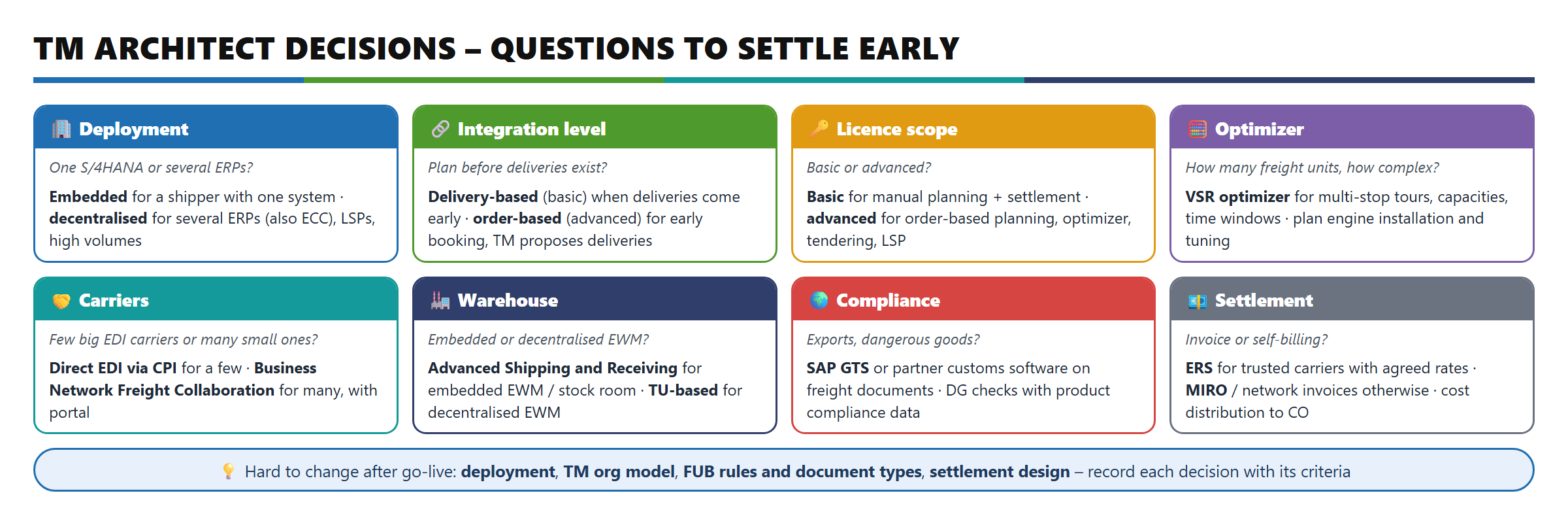
Decision | Options | Choose … when |
|---|---|---|
Deployment | Embedded vs decentralised | Embedded for a shipper with one S/4HANA system (default); decentralised for several ERPs (also ECC), central transport organisation, LSP business, own release cycle or very high volumes |
Integration level | Order-based vs delivery-based | Order-based (advanced) when carriers must be booked before deliveries exist or TM should schedule orders; delivery-based (basic) when deliveries are created early enough |
Licence scope | Basic vs advanced | Stay basic if delivery-based manual planning, manual carrier assignment and settlement suffice; advanced for order-based planning, optimizer, automatic carrier selection, tendering, LSP forwarding orders, strategic freight procurement |
Optimizer | Manual / rule-based vs VSR optimizer | Optimizer for many freight units, multi-stop routes and capacity limits; plan the separate optimizer installation and tuning |
Carrier collaboration | Direct EDI via CPI vs Business Network Freight Collaboration | Network when many carriers must be onboarded or need a portal; direct EDI for a few large carriers with existing EDI |
Warehouse integration | Advanced Shipping and Receiving vs TU-based | ASR for embedded EWM / stock room management in new projects; TU-based when EWM runs in a separate system or for existing processes |
Trade compliance | SAP GTS vs partner software | Export-heavy business, dangerous goods, sanctioned-party screening on freight documents |
Settlement | Invoice verification vs ERS self-billing | ERS for trusted carriers with agreed rates (no invoice entry); MIRO / network invoices otherwise |
- Hard to change after go-live: deployment model, TM org model (purchasing organizations), freight unit building rules and document types, settlement design. Record each decision with its criteria.
- Performance: freight unit building and planning volumes drive the sizing; asynchronous processing (bgRFC) and background reports must be monitored from day one.
Part 6 – Clean core for TM
Level | TM examples | Clean-core rating |
|---|---|---|
Configuration | Conditions, FUB rules, strategies, PPF actions, FPM configuration | Best – no code |
Key user | Custom fields and custom logic where TM offers them (mainly public cloud) | Clean |
Developer extensibility (ABAP Cloud) | Released CDS views, I_FreightOrderTP with EML, business events, released BAdIs | Clean – upgrade-stable |
Side-by-side (SAP BTP) | Carrier or customer apps on API_FREIGHTORDER, event-driven extensions, CPI mappings | Clean – decoupled |
Classic extensibility | BOPF enhancements, classic BAdIs, own service manager programs | Allowed on-premise / private cloud; keep them few and documented |
Modification | Post-exits on SAP determination classes, changes to SAP models | Avoid |
- Prefer configuration and conditions before code; for code prefer released interfaces; keep BOPF enhancements in own enhancement objects and Z classes.
- Run ATC with the cloud readiness checks on TM custom code. Clean core in general: Clean Core › 01 Clean Core.
Part 7 – Roadmap
Topic | Direction |
|---|---|
LE-TRA | Usage rights end with 2030 (routes excepted); move to TM |
SAP TM 9.x | Last release 9.6; maintenance follows the SAP Business Suite timeline (page 01) – migrate to S/4HANA TM |
Programming model | TM core objects remain BOPF on-premise; SAP adds RAP-based transactional interfaces (e.g. I_FreightOrderTP) with business events and released CDS views, first in the public cloud. No full replacement of the BOPF objects has been announced |
User interface | More SAPUI5 / Fiori apps (loading, monitoring, cost allocation) next to the FPM applications |
Collaboration | Carrier interaction, dock scheduling and tracking move to SAP Business Network for Logistics (Freight Collaboration, Global Track and Trace) |
Warehouse | Advanced Shipping and Receiving extended release by release |
Part 8 – Interview questions
Q1. Can a customer keep LE-TRA after moving to S/4HANA?
Temporarily: LE-TRA is a compatibility scope item whose usage rights were extended to the end of 2030 (routes are an exception and stay usable). It gets no innovation, so TM – basic scope included in the S/4HANA licence – should replace it.
Q2. How do you migrate LE-TRA shipments to TM?
You don't convert them – TM is a new implementation. Set up master data and customizing, introduce TM per document type or process, finish open shipments and shipment costs in LE-TRA, and rebuild custom code on TM objects.
Q3. What is the migration path from SAP TM 9.6?
SAP's migration tool (/SCMTMS/2S4H) moves TM 9.5 / 9.6 customizing and master data to S/4HANA TM, embedded or decentralised – not the business documents. Master data replication switches from CIF to DRF, OTR / DTR disappear in an embedded target, and BOPF enhancements are carried over and re-tested.
Q4. Embedded or decentralised TM – how do you decide?
Embedded for a shipper with one S/4HANA system – simpler, no replication, basic scope possible. Decentralised when several ERP systems (also ECC) feed one transport organisation, for LSPs, high volumes or an independent release cycle; it requires the advanced licence.
Q5. What does TM offer in S/4HANA Cloud Public Edition?
A standardized shipper scope in scope items 6W1 – 6W4 (external and manual planning, execution, freight settlement), activated explicitly. Extensions use key-user and developer extensibility with released APIs and RAP interfaces – no BOPF enhancements.
Q6. Order-based or delivery-based integration?
Delivery-based (basic) when deliveries exist early enough for planning; order-based (advanced) when carriers must be booked before deliveries, for long lead times or TM-based order scheduling – TM then proposes the deliveries.
Q7. When is the optimizer worth it?
For many freight units, multi-stop tours, capacity and time-window constraints where manual planning is too slow or too costly. It needs the advanced licence, the separate optimizer engine and tuning of planning profiles.
Q8. How do you connect carriers?
Either directly – TM B2B services mapped to EDI in SAP Integration Suite – or through SAP Business Network Freight Collaboration, which gives carriers a portal, APIs and EDI. Many carriers favour the network; a few large EDI carriers favour direct integration.
Q9. Which TM–EWM integration do you recommend for a new embedded project?
Advanced Shipping and Receiving: the warehouse works directly on the freight order, no transportation unit, also supports stock room management. TU-based integration remains when EWM runs in a separate system or for existing processes.
Q10. How do you keep TM extensions clean-core?
Configuration and conditions first; then released CDS views, I_FreightOrderTP, business events and released BAdIs; side-by-side apps on BTP; BOPF enhancements only on-premise, in own enhancement objects – never post-exits or modifications of SAP determinations.
Q11. Is TM moving from BOPF to RAP?
Partly: SAP adds RAP-based transactional interfaces and business events on top of TM (e.g. I_FreightOrderTP), mainly for ABAP Cloud. The core objects remain BOPF; no complete replacement has been announced, so on-premise enhancements still use BOPF.
Q12. Which decisions are hardest to change after go-live?
Deployment model, TM org model and purchasing organizations, freight unit building rules and document types, integration level (order vs delivery) and the settlement design – they shape every document and interface.
🏠 Start Here · ◀ 05 · Development · 07 · Interview Questions ▶ · Sections: CORE ABAP | OOPS ABAP | ABAP on HANA | Clean Core | RAP | ABAP Points | SAP Fiori | SAPUI5 | Mobile Development (MDK) | BTP Foundations | BTP Development | CAP | SAP Build | ABAP on BTP | Integration Suite | SAP Business AI | SAP BASIS | Security | SAP SDLC
Functional: FICO ABAP | TRM ABAP | VIM | SAP BIS | SD ABAP | MM ABAP | PP ABAP | QM ABAP | PM ABAP | PS ABAP | EWM | TM ABAP | GTM ABAP | EHS ABAP | HR ABAP | BW | SAP Datasphere | SAP Business Data Cloud | SAP MDG | SAP Analytics Cloud | SAP Ariba | SAP CX | SAP IBP