This page is the architect's view of treasury in S/4HANA: what replaced the classic ECC cash management, which simplification items a conversion must handle, what each edition offers, how data moves to S/4HANA, and the design decisions a solution architect makes – central or embedded treasury, payment factory and in-house bank, bank connectivity, hedge accounting under IFRS 9, the planning tool – plus the clean-core rules for treasury developments. Landscape and deployment basics: page 01 Parts 2 and 7; general S/4HANA finance changes: FICO ABAP › 07.
Part 1 – From ECC to S/4HANA: what replaces what
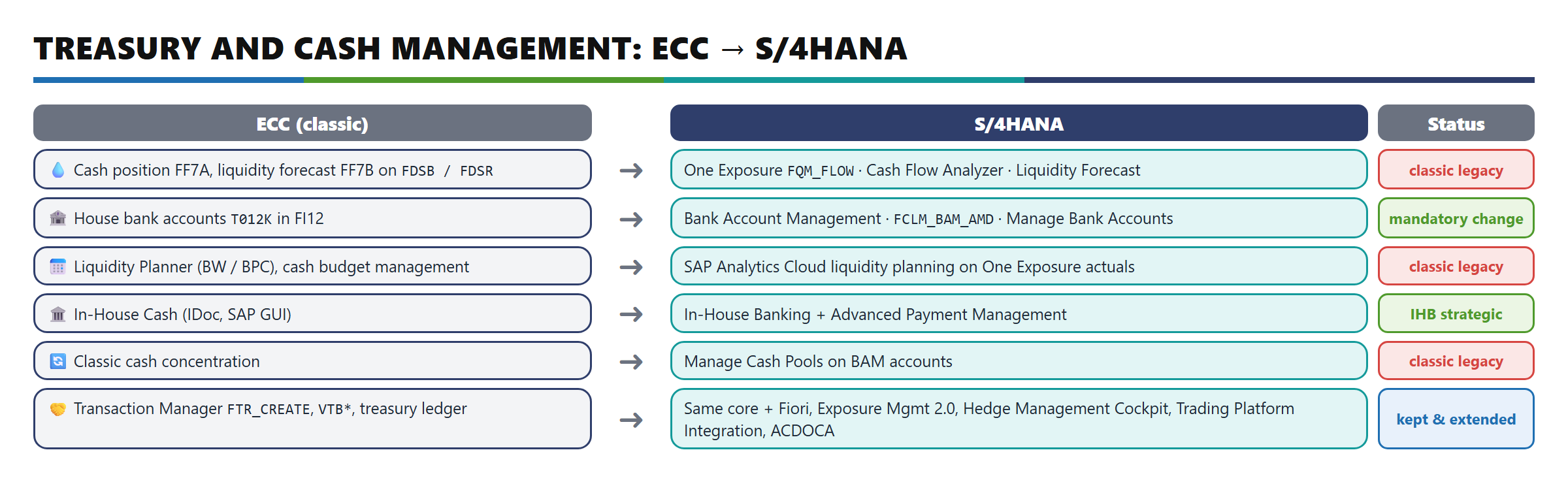
Area | ECC (classic) | S/4HANA | Status |
|---|---|---|---|
Cash position / liquidity forecast | FF7A, FF7B on totals tables FDSB / FDSR | Cash Flow Analyzer, Liquidity Forecast on One Exposure (FQM_FLOW) | Classic reports legacy |
Bank accounts | House bank accounts in T012K, maintained in FI12 | Bank Account Management (FCLM_BAM_AMD, link FCLM_BAM_ACLINK2); FI12 display only | Mandatory change |
Liquidity planning | Liquidity Planner (with BW / BPC), cash budget management | Liquidity planning in SAP Analytics Cloud on One Exposure actuals | Classic tools legacy |
Memo records | FDES, FF63 / FF65 | Stored in FQM_FLOW since 1809 (FCLM_MIGR_FDES2FQM migrates FDES), app Manage Memo Records, API Memo Record | Kept, new UI |
Cash concentration | Classic cash concentration | Manage Cash Pools on BAM accounts | Classic legacy |
In-house bank | In-House Cash (IHC) | In-House Banking with Advanced Payment Management; IHC still available on-premise | IHB strategic |
Transaction Manager | FTR_CREATE, | Same core, plus Fiori apps, Exposure Management 2.0, Hedge Management Cockpit, Trading Platform Integration | Kept |
Business partner | SAP business partner with treasury roles (TR0151); customers / suppliers separate | Business partner for everyone, CVI for customers / suppliers; treasury roles unchanged | Kept |
Postings | FI + CO + treasury documents | One journal entry in ACDOCA per ledger | Universal Journal |
- The Transaction Manager tables (VTBFHA, VTBFHAPO …) and the treasury ledger keep their structure, so most custom TRM code survives a conversion; custom cash management code on FDSB / FDSR, T012K writes or the Liquidity Planner must be rewritten.
Part 2 – New Cash Management in S/4HANA
The functions are described on page 01 Part 3 and the processes on page 03. For the architect three points matter: scope by licence, the single data source and the planning tool.
Topic | What to know |
|---|---|
Basic vs full scope | S/4HANA delivers a basic cash management scope (banks, house banks, bank accounts, cash position, liquidity forecast, memo records). The full scope (business function FIN_FSCM_CLM) – BAM workflow / dual control, payment approvers, overdraft limits, cash pools, bank fees, liquidity plans – needs the licence for SAP S/4HANA Finance for cash management (SAP Note 2270400 "S4TWL – Cash Management – General" describes the scope). In the public edition basic cash management is standard, advanced cash management is licensed separately |
One data source | All apps read One Exposure in real time; FI, MM, SD, TRM, bank statements, memo records and remote systems write into it (page 04 Part 4). No more nightly totals |
BAM | Bank accounts are master data with a life cycle, linked one-to-one to house bank accounts; the payment approval can use BAM signatories |
Planning | Liquidity planning runs in SAP Analytics Cloud (licence required); S/4HANA supplies actuals and forecasts per liquidity item |
Part 3 – Simplification items for treasury
Simplification items are checked per target release in the Simplification Item Catalog (me.sap.com/app/sic) and by the simplification item checks of the conversion (readiness check, SI-checks). For treasury and cash management the relevant ones are:
Simplification item | Impact | Action |
|---|---|---|
Cash Management – General (SAP Note 2270400) | Classic cash management (FF7A / FF7B, totals tables, Liquidity Planner) is replaced by S/4HANA Cash Management on One Exposure; licence-dependent scope | Decide basic or full scope; activate source applications, run the initial load; rewrite custom reports on FDSB / FDSR |
Bank Account Management | House bank accounts become BAM bank accounts; T012K is read via the compatibility view V_T012K_BAM | Migrate house bank accounts (FCLM_BAM_MIGRATION); no custom writes to T012K |
Business partner (CVI) | Customers and suppliers become business partners; treasury counterparties already are business partners | CVI conversion before the system conversion (FICO ABAP › 07) |
SD foreign trade → Trade Finance | Financial documents of SD foreign trade (letters of credit) move to Trade Finance in TRM | Migrate the open financial documents |
Universal Journal | Treasury postings land in ACDOCA per ledger; valuation areas must match the ledger / accounting principle design | Check valuation area ↔ accounting principle ↔ ledger group assignment |
- Older TRM functions that have newer successors – e.g. the earlier exposure management versus Exposure Management 2.0, or classic hedge processes versus the Hedge Management Cockpit – are release-dependent: the catalog gives the exact list per target release, so a list from an older project is not a valid basis.
- Developer task: run the Custom Code Migration app / ATC with the S/4HANA readiness checks on all Z code that reads T012K, FDSB / FDSR, FDES or the cash management function modules (ABAP on HANA › 02 Migration to S/4HANA).
Part 4 – Editions and deployment models
Edition | Treasury scope | Extensibility |
|---|---|---|
On-premise / private cloud | Full scope: all Transaction Manager areas (money market, FX, derivatives, securities, debt and investment), Market and Credit Risk Analyzer, hedge management and accounting, full cash management, BCM, APM with In-House Banking, In-House Cash | Classic and developer extensibility; own BAdIs, BAPIs, custom tables |
Public cloud (SAP S/4HANA Cloud for Cash Management / for Treasury and Risk Management / for Advanced Payment) | Standardised scope items; basic cash management standard, advanced cash management and TRM licensed; narrower instrument and risk scope than on-premise, growing with each release (scope items) | Key-user and developer extensibility with released objects only |
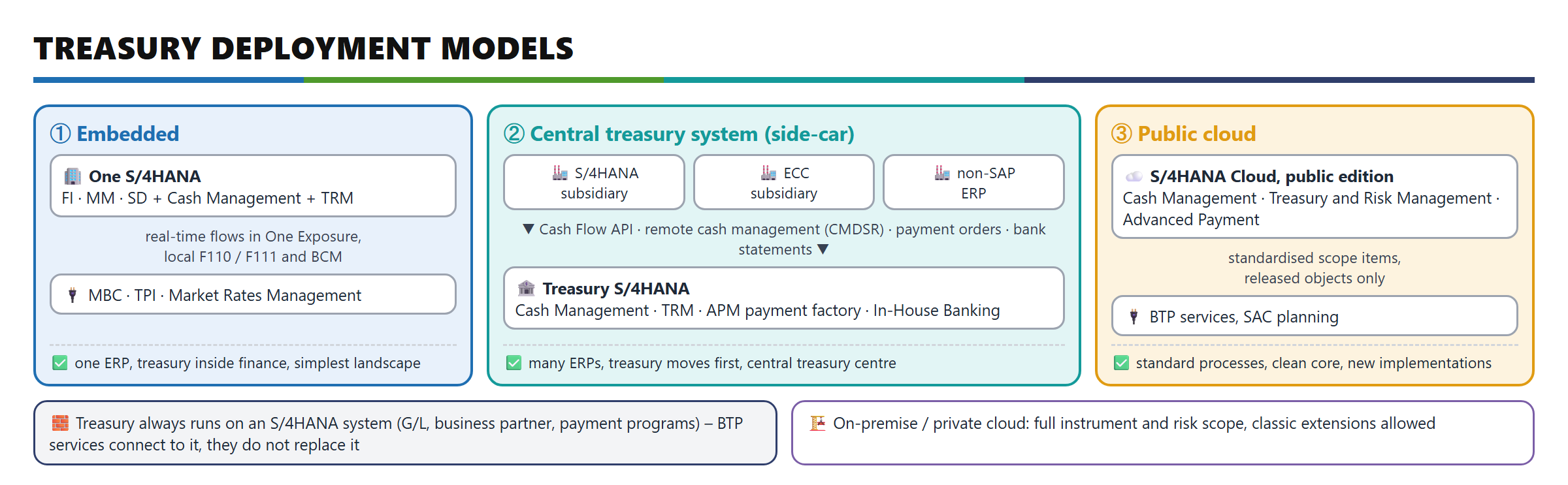
4.1 Embedded vs central treasury system
Criterion | Embedded (one S/4HANA) | Central treasury system (side-car) |
|---|---|---|
Data for the cash position | Real time from FI, MM, SD in the same system | Replicated: Cash Flow API, remote classic cash management (CMDSR), bank statements imported centrally |
Payments | Local F110 / F111 and BCM | Often combined with APM as payment factory for all ERPs |
Postings of deals | Directly in the company's ledger | In the central system's ledgers; intercompany results replicated to the subsidiaries |
Timing | Treasury goes live with the ERP | Treasury can move to S/4HANA before (or independent of) the ERP migration |
Typical company | One ERP, treasury inside finance | Many ERPs or acquisitions, central treasury centre, separate release cycle |
- Treasury always needs an S/4HANA system underneath (G/L, business partner, payment programs) – it does not run on SAP BTP alone; the BTP services (MBC, TPI, Market Rates Management) connect to that system.
Part 5 – Migration: conversion and greenfield
5.1 System conversion (brownfield)
Step | What happens | Tool / t-code |
|---|---|---|
1 Prepare | Simplification item checks, CVI for customers / suppliers, custom code analysis | Readiness check, SI-checks, ATC |
2 House bank accounts → BAM | Each T012K account becomes a BAM bank account with link to house bank and account ID | Finance data migration step "Migrate House Bank Accounts"; report FCLM_BAM_MIGRATION |
3 Configure cash management | Flow types of G/L accounts, liquidity items and queries, planning levels / groups (classic settings remain usable) | FQM_MANAGE_FLOW_TYPE, FLQC1 |
4 Load One Exposure | Activate source applications per company code, load existing documents; FI and MM preferably with the Flow Builder | FQM_INITIALIZE, Flow Builder (FCLM_FLOW_BUILDER) |
5 TRM | Deals, positions and treasury ledger stay in place; check valuation areas against the new ledger design and run test postings | TPM12 / TPM13, test TBB1 / TPM1 |
6 Liquidity planning | Classic planner data is not migrated into SAC automatically – set up the SAC model, load actuals, start with a new plan version | SAC planning content |
5.2 New implementation (greenfield)
- Bank accounts: load with the import / export function of Manage Bank Accounts, then create house banks and link the accounts.
- Open deals: the S/4HANA Migration Cockpit offers TRM migration objects (e.g. TRM – Fixed term deposit, TRM – Foreign exchange spot/forward contract; the object list grows with each release); otherwise BAPI_FTR_… load programs (page 05 Part 5). Migrate with the original start dates so that interest and accruals continue correctly; agree the cut-over of accruals with accounting.
- Balances for the cash position: opening bank balances and expected flows at go-live (memo records, open items migrated in FI).
- Market data: load current rates and the history needed for valuation and risk (curves, volatilities) before the first month-end.
Part 6 – Architect decisions
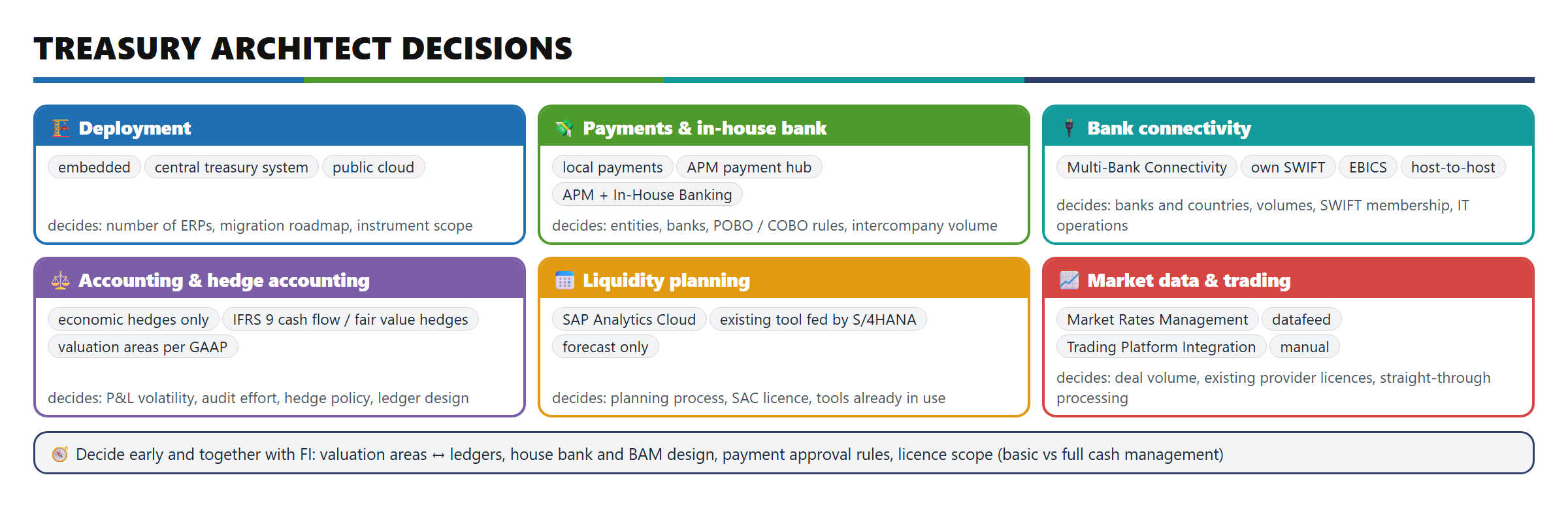
Decision | Options | Deciding factors |
|---|---|---|
Deployment | Embedded · central treasury system · public cloud treasury | Number of ERPs, migration roadmap, treasury organisation, instrument scope |
Payment factory and in-house bank | Local payments · APM payment hub · APM + In-House Banking (IHC only for existing users) | Number of entities and banks, payments on behalf of, intercompany volume, POBO / COBO regulation in the countries |
Bank connectivity | Multi-Bank Connectivity · own SWIFT · EBICS · host-to-host | Number of banks and countries, volumes, SWIFT membership, IT operating model (Part 5 of page 04) |
Accounting and hedge accounting | No hedge accounting · cash flow / fair value hedges under IFRS 9 (or US GAAP) with Hedge Management | P&L volatility tolerance, audit effort, hedge policy; valuation areas per accounting principle |
Liquidity planning | SAC planning · existing planning tool fed by S/4HANA · forecast only | Planning process with subsidiaries, SAC licence, existing BPC / other tools |
Market data and trading | Market Rates Management · datafeed · manual; Trading Platform Integration or manual deal entry | Number of deals, providers already licensed, need for straight-through processing |
Cash management scope | Basic (delivered with S/4HANA) · full (BAM workflow, cash pools, liquidity plans) | Approval requirements for bank accounts, forecasting needs |
6.1 Hedge accounting under IFRS 9 – what the architect must settle
- Which hedges are designated (cash flow hedges of forecast FX sales, fair value hedges of fixed rate debt, net investment hedges) and which stay economic hedges with P&L effect.
- Process automation: Exposure Management 2.0 → Hedge Management Cockpit → automatic designation of hedging relationships from hedge requests (page 03 Part 6) – the more automated, the less manual documentation for auditors.
- Accounting design: OCI reserve accounts, reclassification rules, valuation areas for IFRS and local GAAP, and how the hedged item (e.g. a forecast sale) is linked to the later real sale.
6.2 Payment factory and in-house bank
- APM collects payment orders from all entities and systems, applies routing, cut-off times and approvals and sends them through one bank channel; In-House Banking adds in-house accounts, so the group can pay on behalf of its subsidiaries (POBO) and collect on behalf of (COBO) with intercompany positions instead of many local bank accounts.
- Design topics: legal and tax rules for POBO / COBO per country, internal interest, statements for subsidiaries, the cash pool between in-house accounts and real bank accounts.
Part 7 – Clean core for treasury
Need | Clean-core way | Avoid |
|---|---|---|
Read deals, flows, positions, cash flows | Released CDS views (I_FinancialTransaction, I_FinTransFlow, I_TreasuryLedgerPosition, I_CashFlowDeltaData) – page 02 Part 9 | SELECTs on |
Create or change deals | Released RAP BO I_FinTransIntrstRateInstrTP, OData API; Migration Cockpit for go-live | BAPI_FTR_… in ABAP Cloud (not released) |
Cash forecasts from outside | Cash Flow SOAP API, Memo Record API / I_MemoRecord2TP | Direct inserts into FDES or FQM_FLOW |
Bank accounts and approval rules | Manage Bank Accounts import, I_PaymentApprovalRuleTP | Custom writes to |
Own logic | Released BAdIs (e.g. BADI_TCORF_FORMAT_CUST, BADI_FCLM_RCN_AUTOMATIC_MATCH), key-user custom logic | Modifications, implicit enhancements in treasury programs |
Integration | APIs from the Business Accelerator Hub via SAP Integration Suite, BTP services for banks, platforms, market data | Point-to-point file interfaces without monitoring |
- On-premise and in the private cloud the classic BAdIs of page 05 (FTR_CUSTOMER_EXTENT, BADI_FQM_FLOW_ADJUST_CORE …) are still allowed; document them as classic extensions and prefer the released route when one exists (Clean Core › 01 Clean Core).
Part 8 – Roadmap and innovation
- In-House Banking (2022) and Advanced Payment Management are SAP's strategic payment and internal-bank solutions; In-House Cash gets no new development.
- Cash management in the public cloud moves fastest: short-term cash positioning with intraday balances, bank fee analysis from camt.086, AI-supported bank relationship functions, and a Cash Register concept (API Finance – Cash Register Integration) that collects cash-relevant data from SAP and external systems in one layer – features arrive first in the public edition, later on-premise.
- AI: Joule-based assistants for cash management and AI-supported creation of financial transactions are announced or in early stages – mention them as direction, not as standard scope.
- Connectivity moves to managed services on SAP BTP (MBC, Trading Platform Integration, Market Rates Management) instead of own adapters.
Part 9 – Interview questions
Q1. What changed in cash management from ECC to S/4HANA?
Classic FF7A / FF7B on the totals tables FDSB / FDSR and the Liquidity Planner are replaced by S/4HANA Cash Management on One Exposure (FQM_FLOW) with the Cash Flow Analyzer, Bank Account Management replaces FI12 maintenance of house bank accounts, and liquidity planning moves to SAP Analytics Cloud.
Q2. What is the difference between basic and full cash management?
Basic cash management (banks, bank accounts, cash position, liquidity forecast, memo records) is delivered with S/4HANA. The full scope (FIN_FSCM_CLM) – BAM workflow and signatories, cash pools, bank fees, liquidity plans – needs the cash management licence; SAP Note 2270400 describes it. In the public edition advanced cash management is licensed separately.
Q3. Which treasury simplification items matter in a conversion?
Cash Management – General (classic cash management replaced), house bank accounts to BAM, business partner / CVI, SD foreign trade documents to TRM Trade Finance, and the Universal Journal with its impact on valuation areas and ledgers. The exact list per release comes from the Simplification Item Catalog.
Q4. How are house bank accounts migrated?
During the finance data migration each T012K account becomes a BAM bank account linked to house bank and account ID (FCLM_BAM_MIGRATION); afterwards T012K is read through the compatibility view V_T012K_BAM and accounts are maintained in Manage Bank Accounts.
Q5. What must be done for One Exposure after a conversion?
Configure flow types, liquidity items and queries, activate the source applications per company code and run the initial load (FQM_INITIALIZE; Flow Builder for FI and MM), then reconcile the cash position with the bank balances.
Q6. Embedded treasury or central treasury system?
Embedded when one S/4HANA holds the operational data – real-time cash position, simplest landscape. A central treasury system when many ERPs feed one treasury, treasury must move before the ERPs or runs on its own release cycle; flows then come via the Cash Flow API, remote cash management and central bank statements.
Q7. Why would a company introduce a payment factory and an in-house bank?
To route all payments through one hub with one bank channel and one approval process (APM), and to pay and collect on behalf of subsidiaries with in-house accounts (In-House Banking) – fewer bank accounts, lower fees, better control and visibility.
Q8. How do you choose the bank connectivity?
By number of banks and countries, volumes and the IT operating model: Multi-Bank Connectivity when SAP should run the connections, own SWIFT for large global banking groups with SWIFT membership, EBICS for German, French and Swiss banks, host-to-host only for few banks.
Q9. What does an architect decide for hedge accounting under IFRS 9?
Which hedges are designated (cash flow, fair value, net investment) versus economic hedges, how far the process is automated (Exposure Management 2.0, Hedge Management Cockpit, automatic designation), OCI and reclassification accounts, and the valuation areas per accounting principle.
Q10. What is available in the public cloud edition for treasury?
Basic cash management as standard, advanced cash management, TRM and advanced payment as licensed solutions with standardised scope items; instrument and risk scope is narrower than on-premise, and only released objects can be used for extensions.
Q11. How do you migrate open deals in a greenfield project?
With the Migration Cockpit TRM objects where they exist (e.g. TRM – Fixed term deposit, TRM – Foreign exchange spot/forward contract) or BAPI_FTR_… load programs, using the original start dates so interest and accruals continue; bank accounts through the BAM import, market data history before the first month-end.
Q12. What does clean core mean for treasury developments?
Read through released CDS views, change through released RAP BOs and APIs, feed forecasts through the Cash Flow or Memo Record APIs, use released BAdIs and BTP services – no direct table writes to FDES, FQM_FLOW, T012K or BAM tables, and classic BAdIs only on-premise where nothing released exists.
🏠 Start Here · ◀ 05 · Development · 07 · Interview Questions ▶ · Sections: CORE ABAP | OOPS ABAP | ABAP on HANA | Clean Core | RAP | ABAP Points | SAP Fiori | SAPUI5 | Mobile Development (MDK) | BTP Foundations | BTP Development | CAP | SAP Build | ABAP on BTP | Integration Suite | SAP Business AI | SAP BASIS | Security | SAP SDLC
Functional: FICO ABAP | TRM ABAP | VIM | SAP BIS | SD ABAP | MM ABAP | PP ABAP | QM ABAP | PM ABAP | PS ABAP | EWM | TM ABAP | GTM ABAP | EHS ABAP | HR ABAP | BW | SAP Datasphere | SAP Business Data Cloud | SAP MDG | SAP Analytics Cloud | SAP Ariba | SAP CX | SAP IBP