The questions an architect asks in an S/4HANA programme: do we report directly on S/4HANA with embedded analytics, keep or convert the BW system to BW/4HANA, or move to SAP Datasphere and SAP Business Data Cloud? How do we extract S/4HANA data in a clean-core way? This page gives the options, the conversion paths, the dates and the decision rules. The release history (BW 3.x to BW/4HANA) is on page 01 Part 8; the BW/4HANA modelling objects on page 02; ODP and CDS extraction in detail on page 03.
Part 1 – The SAP analytics and data warehouse landscape today
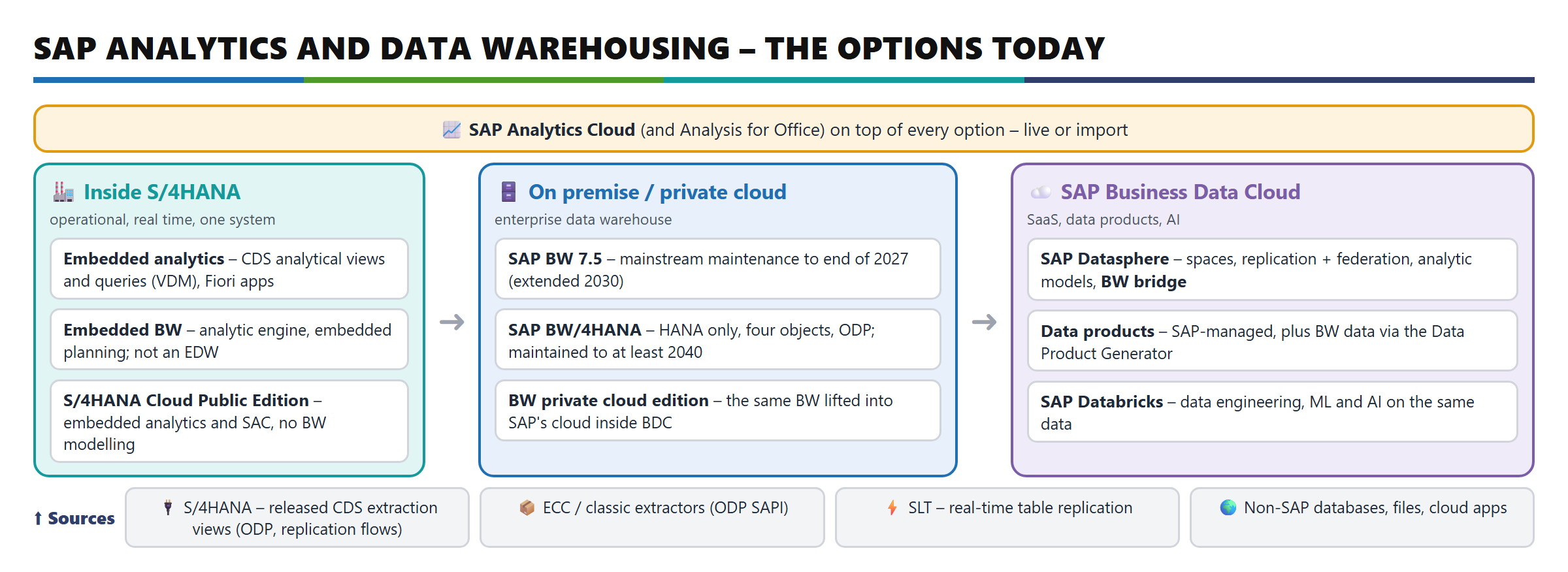
Option | What it is | Typical use |
|---|---|---|
Embedded analytics (S/4HANA) | Analytical CDS views and queries inside S/4HANA, real time, no replication | Operational reporting on one S/4HANA system |
Embedded BW (S/4HANA) | The BW component inside every S/4HANA on-premise / private cloud system | Analytic engine for embedded analytics, embedded planning; small local scenarios |
SAP BW/4HANA | SAP's on-premise data warehouse on HANA (own product, not part of S/4HANA) | Enterprise data warehouse with history, many sources, complex staging |
SAP Datasphere | Cloud data warehouse / data fabric on SAP HANA Cloud (SaaS on BTP) | Cloud modelling, SAP + non-SAP data, business-user modelling, federation |
SAP Business Data Cloud | SaaS bundle: Datasphere, SAP Analytics Cloud, BW private cloud edition, SAP Databricks, SAP-managed data products | Data products, AI / ML, modernising existing BW step by step |
SAP Analytics Cloud | Front end for dashboards, planning, predictive | Consumes all of the above (live or import) |
Part 2 – Embedded analytics and embedded BW in S/4HANA
2.1 Embedded analytics
S/4HANA reports directly on its own tables through the virtual data model (VDM): released interface views (I_…), analytical cube and dimension views, and analytical queries (C_… or custom) that the analytic engine executes. Consumed in Fiori analytical apps, the Query Browser, Analysis for Office and SAC (live). Real time, no data copy, S/4HANA authorizations apply. How to build CDS views and analytical queries: ABAP on HANA › 05 CDS Views.
- Strengths: real-time, no staging, delivered content, key-user extensibility (custom analytical queries app, custom fields).
- Limits: one system only, no history beyond what S/4HANA stores, heavy queries compete with transactions, harmonising several sources is not its job.
2.2 Embedded BW
Every S/4HANA on-premise and private cloud system contains a BW component (software component SAP_BW, not a separate BW/4HANA installation). It provides the analytic engine for embedded analytics and is used for embedded planning (BW-IP / BPC embedded) and small local scenarios, e.g. combining S/4HANA data with a few uploaded files.
- SAP's guidance: embedded BW is not a replacement for an enterprise data warehouse – it shares the S/4HANA system's resources, and multi-source staging, history and large data volumes belong in a separate data warehouse.
- S/4HANA Cloud Public Edition offers embedded analytics (CDS, SAC) but no BW modelling.
Embedded analytics | Embedded BW | Standalone BW/4HANA or Datasphere | |
|---|---|---|---|
Data | S/4HANA tables, virtually | S/4HANA + small local data | Many SAP and non-SAP sources, persisted |
Latency | Real time | Real time / near real time | Scheduled or replicated (can be near real time) |
History, harmonisation | No | Limited | Yes – core purpose |
Load on S/4HANA | Every query | Every query and load | Only the extraction |
Typical owner | S/4HANA project, key users | Planning / finance team | Central data team |
Part 3 – SAP BW/4HANA
BW/4HANA is a separate product with its own code line, running only on SAP HANA. It keeps the BW ideas (InfoObjects, transformations, DTPs, process chains, queries) but removes everything that existed only because databases were slow or because of older releases.
Area | Classic BW 7.x | BW/4HANA |
|---|---|---|
Modelling objects | 10+ InfoProvider types: InfoCube, DSO, MultiProvider, InfoSet, VirtualProvider, HybridProvider … | Four: ADSO, CompositeProvider, Open ODS view, InfoObject (page 02) |
Staging | PSA, InfoPackages, 3.x and 7.x DataSources | No PSA, no InfoPackages – the DTP reads directly from the DataSource; ODP queues buffer the data |
Source systems | SAP (Service API), DB Connect, UD Connect, file, web service, BAPI | ODP, SAP HANA (local / SDA / SDI), file, Big Data; write interface for push scenarios |
Tools | RSA1, BEx Query Designer | BW Modeling Tools (Eclipse) for all modelling, BW/4HANA Cockpit (Fiori) for administration |
Front ends | BEx Analyzer, BEx Web, AO, BI platform | AO, SAC, BI platform – no BEx (page 04) |
Transformations | ABAP runtime | HANA runtime with push-down, AMDP routines; ABAP still possible (page 05) |
Enhancements | Customer exits (CMOD) and BAdIs | BAdIs only – e.g. RSROA_VARIABLES_EXIT_BADI for variables |
Data volume | Near-line storage | Data tiering optimisation: hot (HANA memory), warm, cold (external store) |
Mixed modelling: BW/4HANA objects can generate SAP HANA views, so native HANA calculation views and SQL tools can read BW data; in the other direction CompositeProviders and Open ODS views can use native HANA tables and views. This lets one landscape combine governed BW models with agile SQL / HANA models.
Part 4 – Converting to BW/4HANA and the maintenance dates
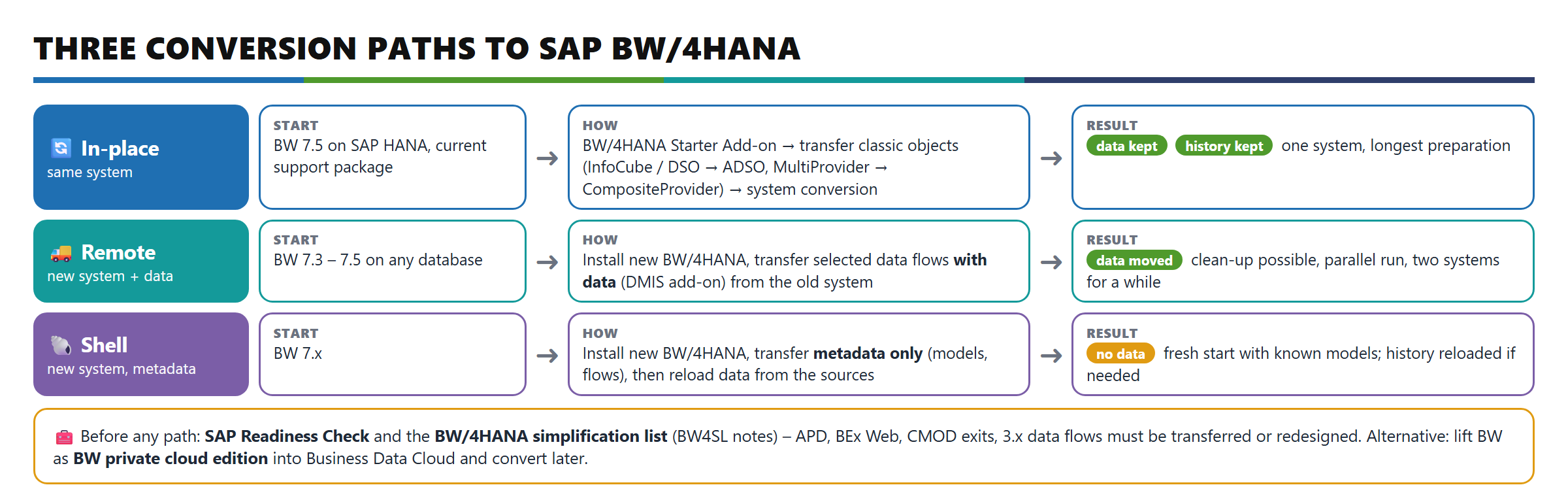
Path | Start | How | When |
|---|---|---|---|
In-place conversion | BW 7.5 on SAP HANA (current SP) | Install the BW/4HANA Starter Add-on, transfer classic objects to their BW/4HANA counterparts with the transfer tool (InfoCube / DSO → ADSO, MultiProvider → CompositeProvider …), then convert the system | System is already on 7.5 on HANA and should keep its history and system ID |
Remote conversion | BW 7.3 – 7.5 on any database | Install a new BW/4HANA system, transfer selected data flows with their data (DMIS add-on) from the old system | Old release or non-HANA database, clean-up wanted, parallel run |
Shell conversion | BW 7.x | New BW/4HANA system, transfer metadata only, reload data from the sources | Fresh start with existing models; history can be reloaded |
New implementation | – | Greenfield BW/4HANA (or Datasphere) design | Old models not worth keeping |
- Preparation: SAP Readiness Check for BW/4HANA and the BW/4HANA simplification list (notes starting with BW4SL) show which objects must be transferred, redesigned or dropped (e.g. APD, BEx Web templates, CMOD exits → BAdIs).
- Custom ABAP (routines, exits) is checked like any custom code: customer exits move to BAdIs, ABAP routines stay or are rewritten as AMDP for push-down.
4.1 Maintenance dates
Product | Maintenance |
|---|---|
SAP BW 7.5 (last NetWeaver-based BW) | Mainstream maintenance until end of 2027; optional extended maintenance (extra fee) until end of 2030 |
SAP BW/4HANA | Maintained until at least 2040 |
SAP BW 7.5 as BW private cloud edition (in Business Data Cloud) | Maintenance extended to 2030 without converting to BW/4HANA; optional SAP BW NetWeaver Cloud modernization option from 1 Jan 2031 to 31 Dec 2033 at the latest (no Java application server beyond 2030) |
So a customer on BW 7.5 has three realistic moves before 2027: convert to BW/4HANA (on premise or private cloud), lift BW into Business Data Cloud as private cloud edition and modernise step by step into Datasphere, or re-implement in Datasphere.
Part 5 – SAP Datasphere
SAP Datasphere (renamed from SAP Data Warehouse Cloud in 2023) is SAP's cloud data warehouse on SAP HANA Cloud. It combines replication and federation (remote tables read live from the source), keeps SAP business semantics, and lets IT and business users model in the same tenant.
Concept | Meaning |
|---|---|
Spaces | Isolated areas with their own storage, compute quota, connections and users – one per team or domain; objects are shared across spaces deliberately |
Data Builder | Tables, graphical and SQL views, data flows, replication flows, transformation flows, task chains, analytic models for SAC |
Connections | S/4HANA (CDS extraction views via replication flows), BW / BW/4HANA, databases, cloud stores, non-SAP SaaS |
SAP BW bridge | An ABAP-based BW environment inside Datasphere: ADSOs, transformations with ABAP routines, process chains, ODP sources – to reuse existing BW staging logic in the cloud |
Catalog / data marketplace | Discover, govern and share data sets and data products |
- From BW to Datasphere: consume BW/4HANA models directly (model transfer, remote access), convert BW staging into BW bridge, or rebuild in native Datasphere models; often all three in phases.
- ABAP skills still matter: BW bridge routines are ABAP, and S/4HANA extraction uses released CDS views.
- Datasphere and Business Data Cloud in the wider BTP data and AI portfolio: BTP Development › 04 Data & AI on BTP.
Part 6 – SAP Business Data Cloud and BW private cloud edition
SAP Business Data Cloud (BDC), announced in 2025, is SAP's SaaS offering that brings together SAP Datasphere, SAP Analytics Cloud, SAP BW (as private cloud edition), SAP Databricks and data products that SAP manages for its applications, plus ready-made insight apps.
Element | What it means for a BW customer |
|---|---|
SAP BW private cloud edition (BW PCE) | The existing BW 7.5 or BW/4HANA system is lifted into an SAP-managed private cloud inside BDC – no conversion needed first; BW 7.5 maintenance extends to end of 2030, optionally to end of 2033 with the SAP BW NetWeaver Cloud modernization option (ABAP stack only, no Java) |
Data Product Generator | Publishes BW data as data products into the Datasphere object store, so BW content can be used by Datasphere, SAC and Databricks without new extraction (only for BW running as BW private cloud edition in BDC, on BW 7.5 SPS 24+, BW/4HANA 2021 SP04+ or BW/4HANA 2023) |
SAP-managed data products | Curated, semantically rich data from SAP applications (e.g. S/4HANA) provided by SAP instead of customer-built extraction |
SAP Databricks | Data engineering, AI and machine learning on the same data products |
- Strategic direction: BW remains supported, but new investment goes into Datasphere and BDC; the path is lift (BW PCE) → shift (BW data as data products) → innovate (Datasphere, SAP Databricks, SAP-managed data products) at the customer's pace.
Part 7 – Extraction from S/4HANA: ODP, CDS, SLT and clean core
Method | How it works | Pros | Cons |
|---|---|---|---|
ODP – SAP extractors (SAPI) | Classic DataSources ( | Proven business content, delta logic delivered | Only extractors released for S/4HANA work (SAP Note 2500202 lists them); not clean core; not in S/4HANA Cloud Public Edition |
ODP – CDS extraction views | CDS views with | Released, upgrade-stable, clean core, works in S/4HANA Cloud; extensible with custom fields | Not every old extractor has a CDS successor yet |
SLT (SAP Landscape Transformation Replication Server) | Trigger-based real-time replication of tables (to BW via ODP, HANA, Datasphere) | Real time, any table | Raw tables: business logic must be rebuilt; extra system and licence |
Datasphere replication flows | Replicate CDS extraction views (or tables via SLT) into Datasphere or cloud storage | Cloud-native, initial + delta | Target is Datasphere / cloud, not BW |
BDC data products | SAP provides the data set | No extraction to build | Scope depends on SAP's delivered data products |
- Third-party tools: SAP Note 3255746 states that the ODP RFC interface may not be used by non-SAP applications to extract data from SAP systems – use SAP-supported paths (e.g. Datasphere replication flows, released APIs).
7.1 Clean core view of extraction
- Use released CDS extraction views (find them in the View Browser app, in ADT by searching for the annotation
@Analytics.dataExtraction.enabled: true, or – from S/4HANA 2020 – through the CDS viewI_DataExtractionEnabledView); if none fits, build a custom CDS extraction view on released I_ views in ABAP Cloud. - Add custom fields with key-user extensibility and enable them for the extraction views, instead of append structures plus RSAP0001 / RSU5_SAPI_BADI code (page 05 Part 3).
- Avoid new function module extractors and table-based generic DataSources on S/4HANA application tables – they bind the extraction to internal tables that can change with every release.
- Classic SAPI extractors are acceptable on-premise during a transition, but plan their replacement.
Part 8 – Architect decisions
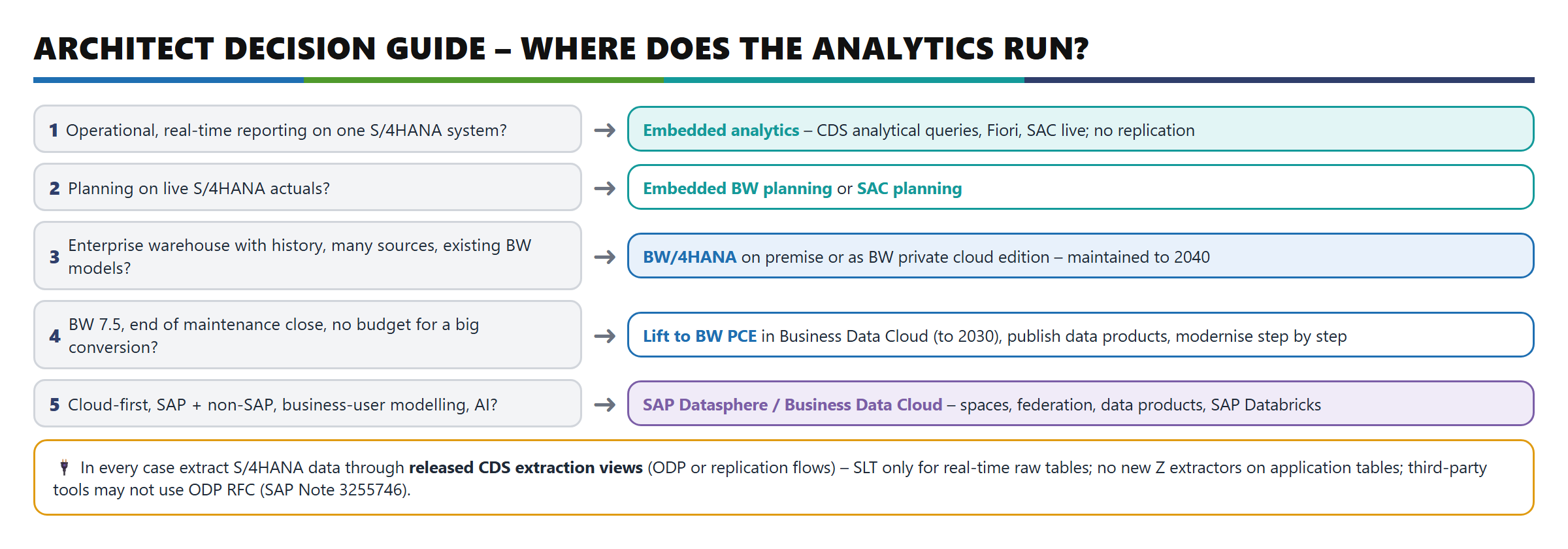
Requirement | Recommendation | Why |
|---|---|---|
Real-time operational reports on one S/4HANA system | Embedded analytics (CDS analytical queries, Fiori, SAC live) | No replication, delivered content |
Planning close to S/4HANA | Embedded BW planning or SAC planning | Plans on live actuals |
Enterprise data warehouse, many sources, history, existing BW models | BW/4HANA (on premise or as BW PCE) | Reuse skills and models; maintained to 2040 |
Cloud-first, mixed SAP / non-SAP, business-user modelling | SAP Datasphere (in BDC) | Federation, spaces, SAC integration |
BW 7.5 near end of maintenance, no budget for a big conversion | Lift to BW PCE in BDC, then modernise | Maintenance to 2030, data products from BW |
AI / ML on SAP and non-SAP data | BDC with SAP Databricks on data products | Same governed data for analytics and AI |
Extract S/4HANA data into any warehouse | Released CDS extraction views via ODP or replication flows; SLT only for real-time raw tables | Clean core, upgrade-stable |
Typical greenfield S/4HANA answer
Operational reporting with embedded analytics from day one; enterprise and cross-system reporting in Datasphere (or the existing BW/4HANA) fed by released CDS extraction views; SAP Analytics Cloud as the single front end; no new Z extractors on application tables.
Part 9 – Interview questions
Q1. What is embedded BW, and should we use it as our data warehouse?
It is the BW component inside every S/4HANA on-premise / private cloud system, used as the analytic engine for embedded analytics and for embedded planning. It shares the S/4HANA system's resources, so it is not meant as the enterprise data warehouse with many sources and long history.
Q2. Embedded analytics or BW/4HANA – how do you decide?
Embedded analytics for real-time operational reporting on one S/4HANA system; a data warehouse (BW/4HANA or Datasphere) when data from several systems must be harmonised, historised and reported together, or when query load must be kept off S/4HANA.
Q3. What changed from BW 7.5 to BW/4HANA?
HANA only; four modelling objects (ADSO, CompositeProvider, Open ODS view, InfoObject); no PSA or InfoPackages; ODP as the main extraction channel; Eclipse modelling and a Fiori cockpit; no BEx front ends; BAdIs instead of customer exits; HANA push-down of transformations.
Q4. Which conversion paths to BW/4HANA exist?
In-place (BW 7.5 on HANA with the Starter Add-on, objects transferred, system converted), remote (new BW/4HANA system, models and data transferred from BW 7.3 – 7.5 on any database), shell (new system, metadata only, data reloaded), or a new implementation.
Q5. BW 7.5 runs out of mainstream maintenance. What are the options?
Mainstream maintenance ends with 2027 (extended maintenance to 2030). Options: convert to BW/4HANA (maintained to at least 2040), lift BW into Business Data Cloud as BW private cloud edition (maintenance to end of 2030, optionally to end of 2033 with the SAP BW NetWeaver Cloud modernization option; then modernise into Datasphere), or re-implement in Datasphere.
Q6. What is SAP Datasphere, and what is the BW bridge?
Datasphere is SAP's cloud data warehouse on HANA Cloud with spaces, replication and federation, analytic models and SAC integration. The BW bridge is a BW-style ABAP environment inside it (ADSOs, transformations, process chains, ODP sources) for reusing BW staging logic in the cloud.
Q7. What is SAP Business Data Cloud?
A SaaS bundle of Datasphere, SAC, BW private cloud edition, SAP Databricks and SAP-managed data products with insight apps. BW customers can lift their BW system into it and publish BW data as data products with the Data Product Generator.
Q8. ODP extractors, CDS extraction views or SLT – which for S/4HANA?
Released CDS extraction views first (clean core, delta via timestamp or CDC). Classic SAPI extractors only where they are supported on S/4HANA and no CDS view exists. SLT when real-time replication of raw tables is required and the logic can be rebuilt in the warehouse.
Q9. What does clean core mean for extraction?
Extract only through released interfaces: released CDS extraction views or custom extraction views on released I_ views, custom fields through key-user extensibility. No new FM extractors or DataSources on internal tables, no new appends with exit code.
Q10. What is mixed modelling?
Combining BW objects and native HANA objects: BW generates HANA views for its InfoProviders and queries so SQL tools and calculation views can use them, and CompositeProviders / Open ODS views can include native HANA tables and views.
Q11. A third-party ETL tool wants to read S/4HANA through ODP RFC. What do you say?
SAP Note 3255746 does not permit non-SAP applications to use the ODP RFC interface. Use SAP-supported paths such as Datasphere replication flows or released APIs and CDS views.
Q12. Design the analytics architecture for a greenfield S/4HANA.
Embedded analytics for operational reporting; Datasphere (or an existing BW/4HANA) for enterprise reporting, fed by released CDS extraction views; SAC as the single front end; BDC data products and Databricks where AI is needed; no new custom extractors on application tables.
🏠 Start Here · ◀ 05 · BW ABAP · 07 · BEx Deep Dive ▶ · Sections: CORE ABAP | OOPS ABAP | ABAP on HANA | Clean Core | RAP | ABAP Points | SAP Fiori | SAPUI5 | Mobile Development (MDK) | BTP Foundations | BTP Development | CAP | SAP Build | ABAP on BTP | Integration Suite | SAP Business AI | SAP BASIS | Security | SAP SDLC
Functional: FICO ABAP | TRM ABAP | VIM | SAP BIS | SD ABAP | MM ABAP | PP ABAP | QM ABAP | PM ABAP | PS ABAP | EWM | TM ABAP | GTM ABAP | EHS ABAP | HR ABAP | BW | SAP Datasphere | SAP Business Data Cloud | SAP MDG | SAP Analytics Cloud | SAP Ariba | SAP CX | SAP IBP