How the Order Approval Portal protects its data (CR7): authentication strategies and the CAP user, pseudo roles, @requires and @restrict, instance-based filters with user attributes, XSUAA with generated xs-security.json and role collections, IAS + AMS as the newer option, other security duties, and testing with mock users.
Part 1 – Why: who is calling, and what may they do?
Requirements on this page
CR-ID | Requirement | Where on the page |
|---|---|---|
CR7 | Only logged-in users; reps use RepService, managers ManagerService | Part 2 (authentication), Part 3 (@requires) |
CR7 | Only managers approve or reject | Part 3 (@restrict grants on actions) |
CR7 | Reps see only requests of their own region | Part 4 (instance-based, $user attributes) |
CR7 | Runs with SAP BTP identity services | Part 5 (XSUAA), Part 6 (IAS + AMS) |
CR12 (part) | Prove it with tests | Part 8 (mock users, tests) |
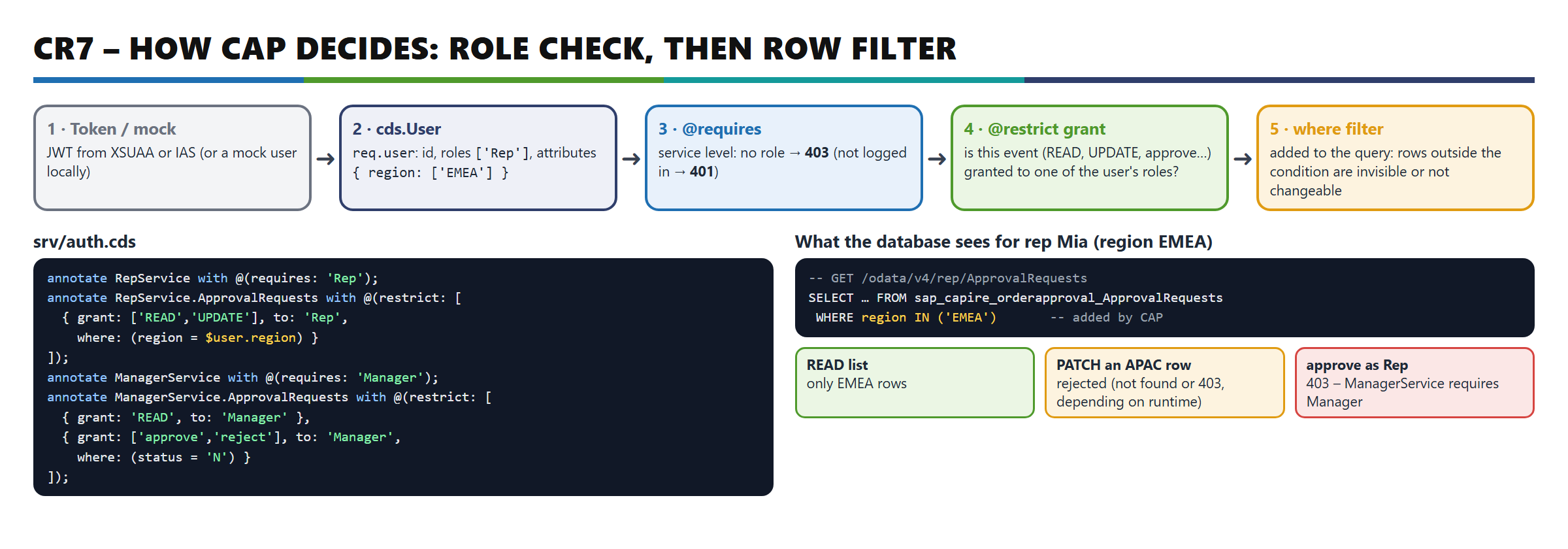
Two questions decide every request: authentication – who is calling (a valid token, a mock user locally)? – and authorization – may this user perform this event on these rows? In ABAP the answers come from SU01, PFCG roles, authorization objects and DCL. In CAP, authentication is done by a pluggable strategy (XSUAA, IAS, mocked …) that produces a cds.User with roles and attributes; authorization is declared in CDS with @requires and @restrict and enforced by the generic handlers.
OAuth 2.0, JWT, XSUAA and the app router as BTP building blocks are explained on BTP Foundations › 04 · BTP Security Deep Dive. This page is the CAP side: how CAP consumes those tokens and how you model access.
Part 2 – Authentication and the CAP user
2.1 Authentication strategies
cds.requires.auth.kind | Used for | Notes |
|---|---|---|
mocked | Development and tests (default for | Predefined and custom mock users, basic authentication with user name |
basic | Simple tests with passwords | Not for production |
xsuaa | Production with SAP Authorization and Trust Management (XSUAA) |
|
ias | Production with SAP Cloud Identity Services – Identity Authentication |
|
jwt | Node.js default in production: XSUAA token validation |
|
dummy | Temporarily switching off | Never in production |
custom | Own implementation | Rare; e.g. special gateways |
- In production CAP authenticates every service automatically; a public endpoint must be opened explicitly with
@requires: 'any'(capire, Automatic Authentication). - By default
$metadataof a protected service is protected too.
2.2 The CAP user
Property | Node.js | Java | From |
|---|---|---|---|
ID | req.user.id | userInfo.getName() | token |
Roles | req.user.is('Manager') | userInfo.hasRole("Manager") | XSUAA scopes, AMS policies, mock |
Attributes | req.user.attr.region | userInfo.getAttributeValues("region") | XSUAA attributes, AMS, mock |
Tenant | req.tenant | userInfo.getTenant() | token zone / subaccount (11 · Multitenancy) |
2.3 Pseudo roles
Pseudo role | Who has it | Use |
|---|---|---|
authenticated-user | Every successfully authenticated user | "Must be logged in" |
any | Everybody, also anonymous | Public endpoints |
system-user | Technical clients with client-credentials tokens | Machine-to-machine APIs |
internal-user | Technical clients of the same identity instance | Calls inside the same app, e.g. between microservices |
Pseudo roles are added by the runtime from the type of authentication – administrators never assign them.
Part 3 – @requires and @restrict
Write authorization in its own file (srv/auth.cds) next to the services – separation of concerns, and reviewers find all rules in one place.
|
Part of a privilege | Values | Meaning |
|---|---|---|
grant |
| Which events are allowed |
to | Role names, pseudo roles; omitted = every user that passes | Who |
where | CDS condition with element names, | On which rows (instance-based, Part 4) |
3.1 Rules worth knowing
@requires: 'Manager'is a shortcut for@restrict: [{ grant: '*', to: 'Manager' }];@readonlyequals@restrict: [{ grant: 'READ' }]– so a@readonlyentity also blocks its bound actions.- Several privileges are combined with OR: a user gets everything granted by any matching entry.
- Service-level and entity-level restrictions both apply; an entity restriction does not lift a service
@requires. - Restrictions on a domain entity are inherited by projections unless the projection defines its own; auto-exposed and composition children follow the root's rules (capire, Propagation of Restrictions).
- For draft-enabled entities the draft events are covered by the grants for the active entity (capire, Draft Mode).
- capire writes conditions in the expression form
where: (region = $user.region), which the compiler checks against the model; the older string formwhere: 'region = $user.region'still works.
Interview tip: be precise about HTTP codes: missing authentication → 401; authenticated but role or grant missing → 403; instance-based filter on READ → the row is simply not returned (or 404 for a single read).
Part 4 – Instance-based authorization: only my region
CR7: reps of region EMEA must never see APAC requests. The where clause of a privilege is turned into a filter that CAP adds to every query on the entity – reads return only matching rows, and updates or deletes of other rows fail. This is CAP's equivalent of a DCL access control on a CDS view.
|
- User attributes are lists:
region = $user.regionmatches if the row's region is any of the user's values (['EMEA', 'NA']). An empty or missing attribute means no access – unless you write theis nullvariant above for "unrestricted" users (capire, User Attributes). - Supported in
where: comparisons with$userattributes, path expressions to associated entities, andexistspredicates on association paths (combinable, nestable, no paths inside the filter);existswith a subquery is Java only. - For CREATE (no row exists yet) and for unbound actions Node.js supports only static conditions such as
$user.level > 2; check region values for new rows in a before handler instead (04 · Custom Logic).
4.1 When a rule cannot be declared
|
Declare first, code second: declarative rules are visible in the model, enforced for every protocol and show up in generated artefacts such as xs-security.json.
Part 5 – XSUAA: from CDS roles to role collections
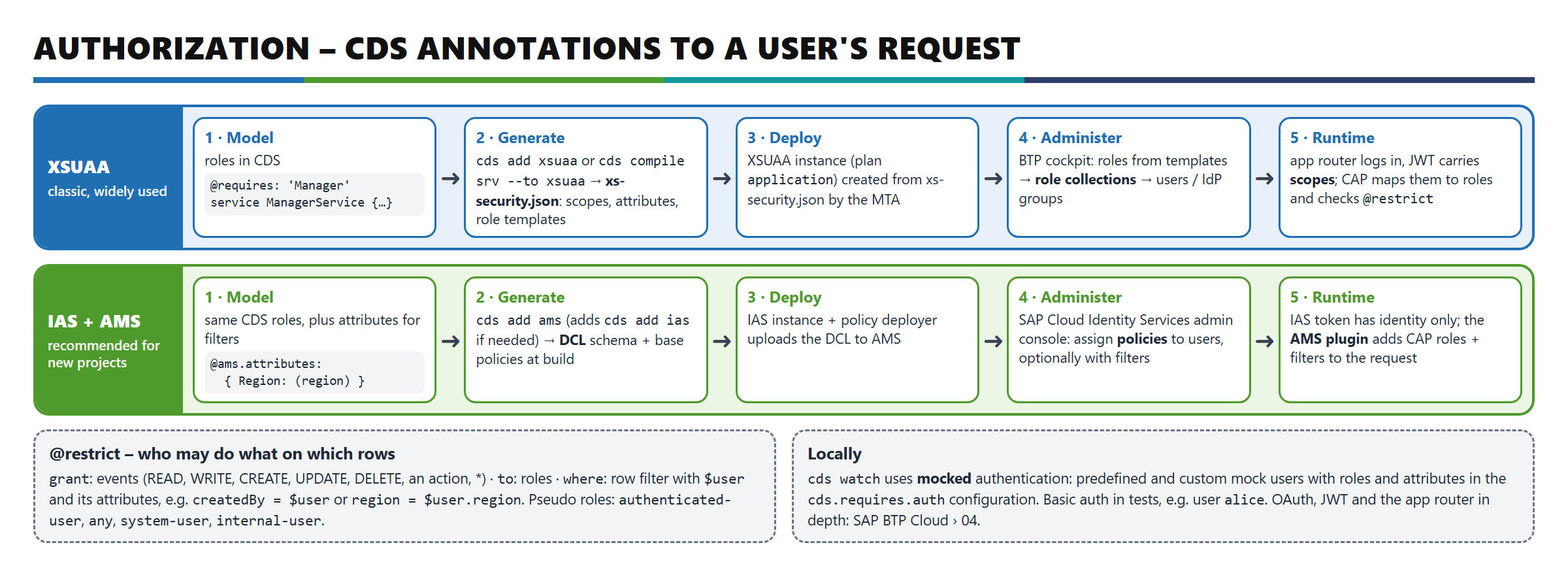
With XSUAA (SAP Authorization and Trust Management service) every CDS role becomes an OAuth scope, every $user attribute an XSUAA attribute. xs-security.json carries them, plus role templates; administrators bundle roles into role collections in the BTP cockpit and assign them to users or identity-provider groups.
|
|
- Simplified example – the generated file may differ by version. If you edit it by hand, keep scope names exactly equal to the CDS role names: CAP checks them at runtime.
- Role collections can also be predefined in
xs-security.json(role-collections) so they appear after deployment; assignment to users stays an administrator task. - Attribute values (e.g. region EMEA) are set on the role in the cockpit or mapped from IdP attributes.
5.1 The app router in front
- Browser users reach the Fiori apps through an app router (standalone
@sap/approuteror the managed one of SAP Build Work Zone). It redirects to the login, receives the JWT and forwards it to the CAP service (destination or route withforwardAuthToken). - CAP itself never shows a login page; it validates the token on every request. Technical clients call CAP directly with a client-credentials token (pseudo role
system-user). - Setting up routes,
xs-app.jsonand destinations: BTP Foundations › 04 · Security Deep Dive and 18 · Hands-On; deployment with MTA: CAP › 08 · Databases & Deployment.
Part 6 – IAS + AMS: the newer option
capire recommends starting new projects with SAP Cloud Identity Services – Identity Authentication (IAS): single sign-on and multi-factor authentication, corporate IdP federation, OpenID Connect and user propagation across landscapes. IAS tokens carry identity but no CAP roles, so roles come from the Authorization Management Service (AMS), also part of SAP Cloud Identity Services.
|
|
Step | XSUAA | IAS + AMS |
|---|---|---|
Roles in CDS |
|
|
Generated artefact |
| DCL schema and base policies (in |
Assignment | Role collections in the BTP cockpit | Policies in the SAP Cloud Identity Services administration console, optionally with filters |
Row filters |
| AMS attributes ( |
Runtime | CAP reads scopes from the JWT | CAP AMS plugin evaluates the user's policies per request |
- AMS is transparent to application code – handlers still use
req.user.is('Manager'). - capire notes two limits: authorizations for technical users can't be addressed by AMS policies yet, and IAS authentication is available only for single-tenant applications – a multitenant SaaS app stays on XSUAA.
- IAS can consume XSUAA-protected services in a cross-consumption mode, which helps when migrating.
Part 7 – Other security duties in a CAP app
Topic | What CAP offers | Where |
|---|---|---|
Input validation | Generic checks, parameterised CQL (no SQL injection through tagged templates) | 03 · Services, 04 · Custom Logic |
Personal data |
| capire, Data Privacy |
Secrets | Service bindings, never in code or | 01 · Foundations |
Tenant isolation | Tenant from the token, separate HDI containers per tenant | 11 · Multitenancy |
Principal propagation to S/4HANA | Destinations with OAuth2SAMLBearerAssertion / user exchange, Cloud Connector | 09 · Remote Services |
Security headers, CSRF | Handled by the app router and OData adapter (CSRF token for modifying requests from browsers) | BTP › 04 · Security |
Part 8 – Testing authorization with mock users
|
|
cds.testlives in@cap-js/cds-test(npm add -D @cap-js/cds-test). Its HTTP methods reject for status codes outside 200–299 (validateStatus), and itsexpectis Chai with chai-as-promised and chai-subset, sorejectedWith(/403/)andcontainSubsetwork.- Java: mock users in
application.yaml(cds.security.mock.users) and Spring tests with@WithMockUser(05 · CAP Java).
Common mistakes: testing only as an admin mock user; forgetting the region attribute on a mock user (the rep then sees nothing and the test "passes" with an empty list – assert the count); hand-edited xs-security.json whose scope names no longer match CDS roles; relying on a hidden UI button instead of a server-side grant.
Part 9 – Interview questions
Q1. What is the difference between @requires and @restrict?
@requires names the roles needed for a service, entity or action – a shortcut for @restrict: [{ grant: '*', to: … }]. @restrict lists privileges with grant (events), to (roles) and optional where (row filter) for fine-grained and instance-based authorization.
Q2. How does instance-based authorization work in CAP?
The where condition of a privilege, e.g. region = $user.region, is added as a filter to the queries on that entity, so users see and change only matching rows. User attributes come from the token (XSUAA attributes, AMS) or mock users; they are lists, and an empty attribute means no access.
Q3. What are pseudo roles?
Roles the runtime adds from the type of authentication: authenticated-user, any (also anonymous), system-user (client credentials) and internal-user (technical calls within the same identity instance). Nobody assigns them.
Q4. How do CDS roles end up with real users when you use XSUAA?
cds add xsuaa / cds compile srv --to xsuaa generate xs-security.json with a scope per role and role templates; the MTA creates the XSUAA instance from it; administrators build role collections in the BTP cockpit and assign them to users or IdP groups; at runtime the JWT carries the scopes and CAP maps them to roles.
Q5. Why does capire recommend IAS for new projects, and what is AMS for?
IAS offers SSO, MFA, IdP federation, OpenID Connect and cross-landscape user propagation. IAS tokens have no application roles, so AMS provides them: policies (DCL) generated from CDS roles and attributes are assigned in the Cloud Identity Services console, and the CAP AMS plugin injects roles and filters per request.
Q6. Which HTTP status codes do you expect for authorization failures?
401 when the caller is not authenticated, 403 when authenticated but the role or grant is missing; a row excluded by a where filter is just not returned (404 for a single-entity read).
Q7. How do you test authorization locally?
Mocked authentication with custom mock users (roles and attributes) in the development profile; requests with basic auth (curl -u mia:), .http files or cds.test with auth: { username }; assert both allowed and forbidden cases and the number of returned rows.
Q8. When do you check permissions in code instead of annotations?
When the rule needs data or logic the where language cannot express – e.g. an approval limit by amount per manager level or a check against S/4HANA. Use req.user.is() / req.user.attr in a before handler and req.reject(403, …); keep everything else declarative.
Q9. Scenario: a rep in EMEA sees no requests at all after go-live, although data exists.
The where: (region = $user.region) filter gets no attribute value: the role collection or the IdP mapping does not provide region, so the attribute list is empty and CAP grants nothing. Check the JWT (attribute missing), the role's attribute source in the cockpit, and the attribute reference in xs-security.json.
Q10. Scenario: the Approve button is hidden for reps, but a rep calls the approve URL with Postman and it works.
Authorization was only in the UI. Add @requires: 'Manager' to ManagerService and a @restrict grant for approve / reject to Manager (with where: (status = 'N')), redeploy, regenerate xs-security.json if roles changed, and add a test asserting 403 for a rep.
🏠 Start Here · ◀ 06 · Fiori & Draft · 08 · Deployment ▶ · Sections: CORE ABAP | OOPS ABAP | ABAP on HANA | Clean Core | RAP | ABAP Points | SAP Fiori | SAPUI5 | Mobile Development (MDK) | BTP Foundations | BTP Development | CAP | SAP Build | ABAP on BTP | Integration Suite | SAP Business AI | SAP BASIS | Security | SAP SDLC
Functional: FICO ABAP | TRM ABAP | VIM | SAP BIS | SD ABAP | MM ABAP | PP ABAP | QM ABAP | PM ABAP | PS ABAP | EWM | TM ABAP | GTM ABAP | EHS ABAP | HR ABAP | BW | SAP Datasphere | SAP Business Data Cloud | SAP MDG | SAP Analytics Cloud | SAP Ariba | SAP CX | SAP IBP