Controlling (CO) is internal accounting: it answers where costs arise (cost centers), what they were spent on (internal orders, production orders), what a product costs (product costing, material ledger) and which customers, products and regions make money (profitability analysis). FI reports to the outside world; CO steers the company from inside. In S/4HANA both live in the same Universal Journal ACDOCA, so CO no longer needs its own document tables or a reconciliation ledger. Controlling area and org structure: page 01; Universal Journal and document splitting: page 02; period-end closing sequence: page 05; CO BAdIs and APIs: page 06.
Part 1 – CO concepts: cost elements as G/L accounts, primary and secondary costs
All CO data belongs to a controlling area (OKKP, table TKA01) to which one or more company codes are assigned (TKA02). Every CO posting needs a cost object – cost center, order, WBS element, profitability segment – identified internally by the object number OBJNR (e.g. KS + controlling area + cost center, OR + order number).
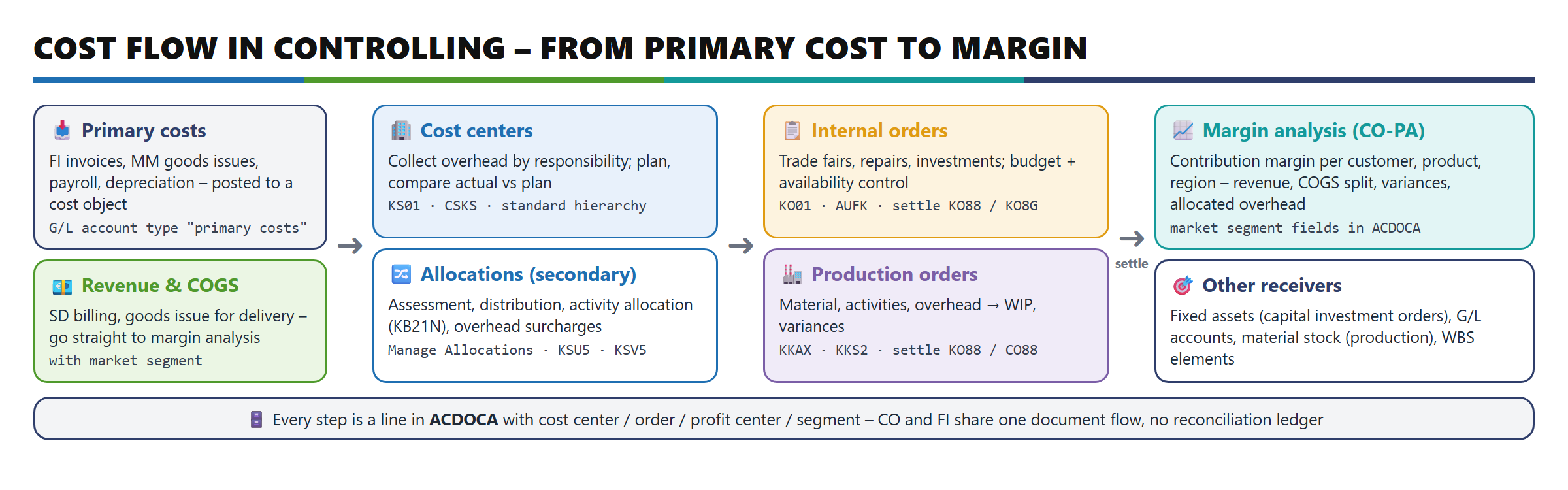
1.1 Cost elements in S/4HANA
S/4HANA: cost elements are no longer separate master data. They are G/L accounts, maintained in FS00 (or the Fiori app Manage G/L Account Master Data) with a G/L account type and, for cost-relevant accounts, a cost element category. The ECC transactions KA01 – KA06 are replaced by FS00; FS00 still writes the cost element data (e.g. the category CSKB-KATYP) to CSKA / CSKB. Secondary cost elements therefore also exist as G/L accounts (type secondary costs) and appear in ACDOCA.
G/L account type | Meaning | CO relevance |
|---|---|---|
Balance sheet account | Assets, liabilities, equity | Not in CO (except category 90 for asset accounts) |
Nonoperating expense or income | P&L account without CO posting (e.g. extraordinary income) | No cost object needed |
Primary costs or revenue | P&L account that also posts to CO | Cost object required (default account assignment OKB9 possible) |
Secondary costs | Exists only for CO allocations (assessment, activity allocation, settlement) | Used only inside CO, nets to zero over the company |
Category | Kind | Used for |
|---|---|---|
1 | Primary | Costs and cost-reducing revenues (material, salaries, depreciation) |
11 / 12 | Primary | Revenues / sales deductions |
22 | Primary | External settlement (order settled to G/L account, asset, material) |
90 | Primary | Statistical cost element for balance sheet accounts (e.g. asset acquisitions shown on investment orders) |
21 | Secondary | Internal settlement (order → cost center, order → profitability segment) |
31 | Secondary | Results analysis / WIP |
41 | Secondary | Overhead rates (costing sheet) |
42 | Secondary | Assessment |
43 | Secondary | Internal activity allocation |
- Primary costs come from outside CO (FI invoices, MM goods issues, payroll, depreciation) and always have an FI posting. Secondary costs arise inside CO when costs move between cost objects – no effect on the P&L total.
- Cost element groups (KAH1) are used in reports, allocation cycles and planning layouts.
Part 2 – Cost center accounting
A cost center is an area of responsibility that incurs costs: production line, IT, HR, sales office. Overhead is collected there, planned, compared with actuals and finally allocated to the products and markets that caused it.
Object | T-code / app | Table | Notes |
|---|---|---|---|
Cost center | KS01 / KS02 / KS03; Fiori Manage Cost Centers | CSKS, CSKT texts | Time-dependent (DATAB – DATBI); company code, profit center, category, person responsible |
Standard hierarchy | OKEON | Set tables (SETHEADER / SETNODE) | Mandatory tree – every cost center is in exactly one node |
Cost center groups | KSH1 – KSH3 | Set tables | Alternative hierarchies for reports and allocations |
Cost center category | OKA2 | TKA05 | Production, administration, sales … – defaults and allowed activity types |
2.1 Planning
- Classic CO planning: KP06 costs per cost center and cost element, KP26 activity quantities and prices, KSPI plan price calculation – still available on-premise.
- S/4HANA: plan data is stored in ACDOCP (plan counterpart of ACDOCA) and is entered with SAP Analytics Cloud planning (integrated financial planning) or uploaded with the Fiori app Import Financial Plan Data. Plan/actual reports then read ACDOCA and ACDOCP.
2.2 Actual postings and reporting
- Actual primary costs arrive with every FI / MM posting that carries the cost center (e.g. FB60 expense line, goods issue 201). Wrong postings are corrected with KB11N (repost costs) or KB41N (repost revenues).
- Reports: KSB1 cost center line items, S_ALR_87013611 actual / plan / variance per cost center; Fiori analytical apps for cost center actuals and plan / actual comparison on ACDOCA / ACDOCP.
|
Part 3 – Activity types, statistical key figures and allocations
Object | Meaning | T-code | Table |
|---|---|---|---|
Activity type | Output of a cost center measured in units: machine hours, labour hours, IT tickets. Has a price per unit per period. | KL01 – KL03; price KP26 | CSLA |
Statistical key figure | Quantity used as a tracing factor: employees, square metres, phone lines | KK01 – KK03; actual values KB31N | TKA03 |
Overhead costing sheet | Percentage or quantity surcharges for overhead on orders | KZS2 | – |
3.1 Allocation methods
Method | How | Cost elements on the receiver | T-code (classic) |
|---|---|---|---|
Direct activity allocation | Sender cost center × activity quantity × price → receiver (cost center, order) | Secondary, category 43 | KB21N |
Indirect activity allocation | Activity quantity derived from tracing factors, then valued at the price | Secondary, category 43 | KSC1 / KSC5 |
Assessment | Allocates totals by tracing factor (%, statistical key figure); original cost elements are hidden | One assessment cost element (category 42) | KSU1 cycle, KSU5 run |
Distribution | Allocates primary costs; receiver keeps the original primary cost elements | Original primary cost elements | KSV1 cycle, KSV5 run |
Periodic reposting | Like distribution but for postings collected on a clearing cost center; less data, no sender history | Original cost elements | KSW1 / KSW5 |
Overhead surcharge | Costing sheet adds overhead to orders, credits cost centers | Secondary, category 41 | KGI2, CO43 |
- S/4HANA: universal allocation (since 1909) handles assessment, distribution and other allocations in one framework with Fiori apps Manage Allocations, Run Allocations and Allocation Results; it is the newer allocation tool (scope item 2QL); classic cycles can be migrated to it.
- Actual activity price calculation KSII revalues allocated activities at the real price of the period (cost of the sender ÷ actual quantity).
- Assessment vs distribution in one sentence: distribution keeps the cost element detail (only primary costs), assessment summarises everything into one secondary cost element.
Part 4 – Internal orders
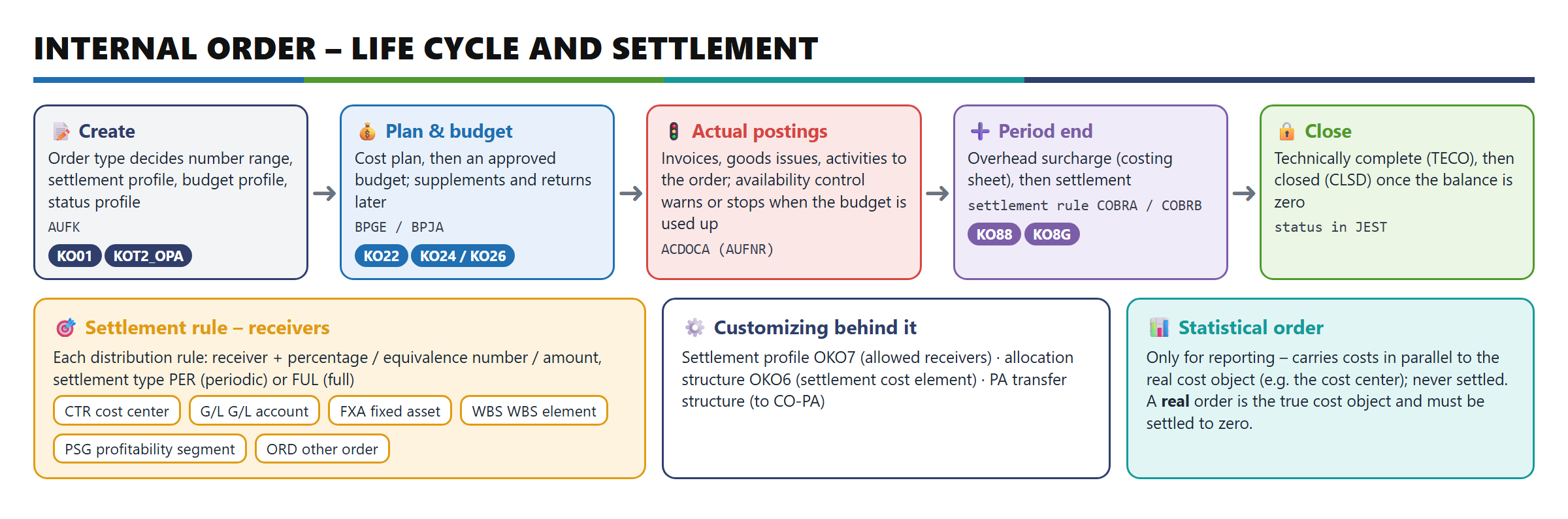
An internal order collects costs of a task or event that is limited in time: a trade fair, a marketing campaign, a repair, an investment, an IT project. Costs are planned, budgeted, collected and then settled to their final receivers.
Order kind | Example | Settled to |
|---|---|---|
Overhead order | Trade fair, training, repair | Cost center(s) |
Investment order | Building a machine (with Investment Management) | Asset under construction, then fixed asset |
Accrual order | Accrued costs calculated in CO | Cost centers |
Order with revenues | Small customer service jobs | Profitability segment |
Statistical order | Additional reporting on a real cost center posting | Never settled |
- Order type (KOT2_OPA): number range, order category 01, settlement profile, planning and budget profile, status profile, whether the order is statistical.
- Budget and availability control (AVC): the budget profile of the order type sets tolerance limits – e.g. warning at 90 %, error at 100 % of the budget. Budget KO22 (original), KO24 (supplement), KO26 (return); totals in BPGE (overall) and BPJA (annual).
- Settlement: the settlement rule (header COBRA, distribution rules COBRB) lists receivers with percentage or amount and settlement type PER (periodic) or FUL (full). KO88 settles one order, KO8G a selection of orders; the posting uses the settlement cost element from the allocation structure (OKO6).
- Status: CRTD created → REL released (postings allowed) → TECO technically complete → CLSD closed (no more postings), stored in JEST. Line items KOB1, order overview KOK5; in code read the master data through the released view I_InternalOrder.
|
Part 5 – Profit center accounting in S/4HANA
A profit center is a part of the company managed as if it were a business of its own (business unit, product line, region). Profit center accounting shows its revenues, costs and – with document splitting – its balance sheet.
- S/4HANA: profit center accounting is part of the General Ledger. Every ACDOCA line carries PRCTR (and the partner profit center PPRCTR); there is no separate EC-PCA ledger. The ECC tables GLPCA / GLPCT and the transfer of balance sheet items to EC-PCA are legacy.
- Document splitting by profit center and segment (page 02) splits payables, receivables, taxes and bank lines so that a full balance sheet per profit center or segment can be produced.
- Master data: KE51 / KE52 / KE53 or Fiori Manage Profit Centers; table CEPC (with SEGMENT – the profit center decides the segment), texts CEPCT; standard hierarchy and groups (KCH1). A dummy profit center catches postings without assignment.
- Derivation: profit center comes from the cost center (CSKS-PRCTR), the material per plant (MARC-PRCTR) for logistics postings and sales order items, the order or WBS element, or from substitution rules.
- Transfer prices between profit centers can be valued in parallel with profit center valuation in the material ledger (Part 8).
Part 6 – Product cost planning
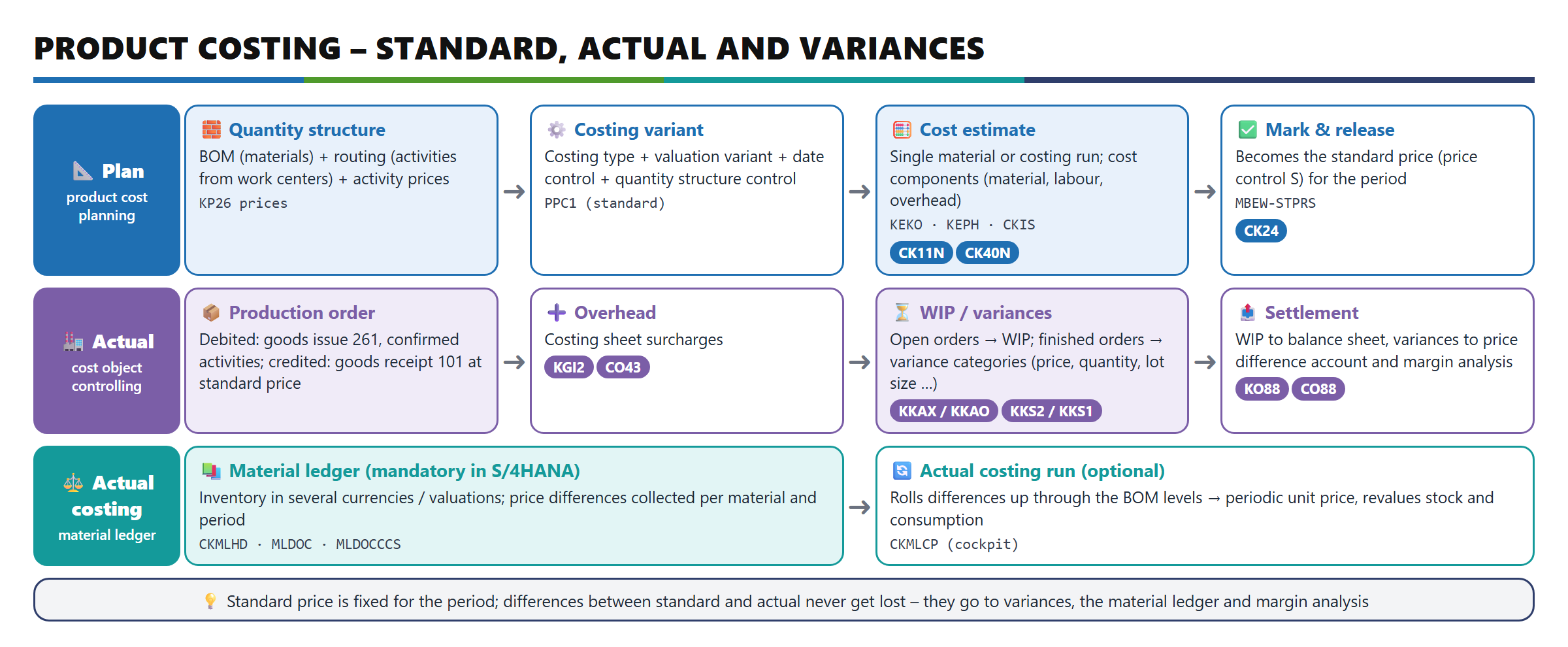
Product cost planning calculates what a product should cost – the standard cost estimate – from the bill of material (material costs), the routing (activities at their planned prices) and overhead. Released, it becomes the standard price of the material (price control S, MM ABAP › 03).
Element | What it controls | Customizing / t-code |
|---|---|---|
Costing variant (e.g. PPC1 standard) | Costing type (which price field is updated), valuation variant (which prices for materials, activities, subcontracting, overhead), date control, quantity structure control, transfer control | OKKN |
Cost component structure | Groups cost elements into components (raw material, labour, machine, overhead) for the cost component split | OKTZ |
Material cost estimate | Cost estimate with quantity structure for one material | CK11N create, CK13N display |
Costing run | Mass costing of many materials (selection, BOM explosion, costing, analysis, marking, release) | CK40N |
Mark and release | Mark proposes the future price, release updates the standard price for the period | CK24 |
- Tables: KEKO cost estimate header, KEPH cost components, CKIS itemization (each BOM item, activity and overhead line). The released price ends up in MBEW (STPRS) and in the material ledger.
- A cost estimate is valid for a period; a new standard is usually released once a year or per quarter, after checking the costing run log.
Part 7 – Cost object controlling: WIP, variances and settlement
Cost object controlling collects the actual costs of production: material issued (261), activities confirmed, overhead; the goods receipt (101) credits the order at the standard price. What remains on the order at period end is either work in process (WIP) or a variance.
Scenario | Cost object | Typical use |
|---|---|---|
Product cost by order | Production / process order | Discrete manufacturing, costs per lot |
Product cost by period | Product cost collector (KKF6N) | Repetitive manufacturing, costs per period |
Sales order controlling | Sales order item (make-to-order) | Costs and revenues per customer order |
7.1 Period-end steps for production orders
Step | Individual / collective | Result |
|---|---|---|
Overhead surcharge | KGI2 / CO43 | Overhead from the costing sheet debited to the orders |
WIP calculation (orders not delivered) | KKAX / KKAO | WIP at actual costs (results analysis key, category 31) |
Variance calculation (delivered or TECO orders) | KKS2 / KKS1 | Variance categories: input price, resource usage, input quantity, remaining input, lot size, mixed price, output price |
Settlement | KO88 / CO88 | WIP to the balance sheet; variances to the price difference account and margin analysis |
- Target costs (target cost version 0) = standard cost estimate × actual quantity delivered; variance = actual costs − target costs.
- S/4HANA: event-based production accounting posts WIP when components are issued and settles variances automatically when the order is finally delivered – no period-end runs. It is the default in S/4HANA Cloud, public edition (scope item 3F0, successor of the period-based scope item BEI); on-premise and in the private cloud period-end processing is still the common approach.
- Production order data: AUFK (order master), AFKO / AFPO (production order header / item, PP); costs in ACDOCA (order number in AUFNR, object number in OBJNR).
Part 8 – Material ledger and actual costing
S/4HANA: the material ledger (ML) is mandatory for inventory valuation (ECC: optional, activated per valuation area). It records every valuated movement per material and period, can value inventory in several currencies and valuations (legal, group, profit center valuation) and collects price differences per material. Actual costing on top of it is optional.
Topic | Detail |
|---|---|
Without actual costing | Materials keep the standard (S) or moving average (V) price; ML gives multi-currency values and price difference reporting (CKM3 material price analysis) |
With actual costing | Price differences are rolled up through all BOM levels at period end; the result is the periodic unit price (actual cost) used to revalue closing stock and consumption |
Actual costing run | CKMLCP cockpit: selection, sequence determination, single-level and multilevel price determination, revaluation of consumption, post closing |
Tables | CKMLHD ML header per material / valuation area; S/4HANA: ML documents MLDOC and cost component split MLDOCCCS replace the ECC documents (MLHD / MLIT / MLPP / MLCR) and most of the periodic ML tables |
Postings | Inventory values and revaluations are ACDOCA lines; MBEW still exists, but its value fields are served from ML / ACDOCA |
- Architect note: actual costing adds a heavy period-end job and is chosen when legal or management reporting needs actual product costs (e.g. transfer pricing, some local GAAPs); many companies run ML without it.
Part 9 – Profitability analysis: margin analysis and costing-based CO-PA
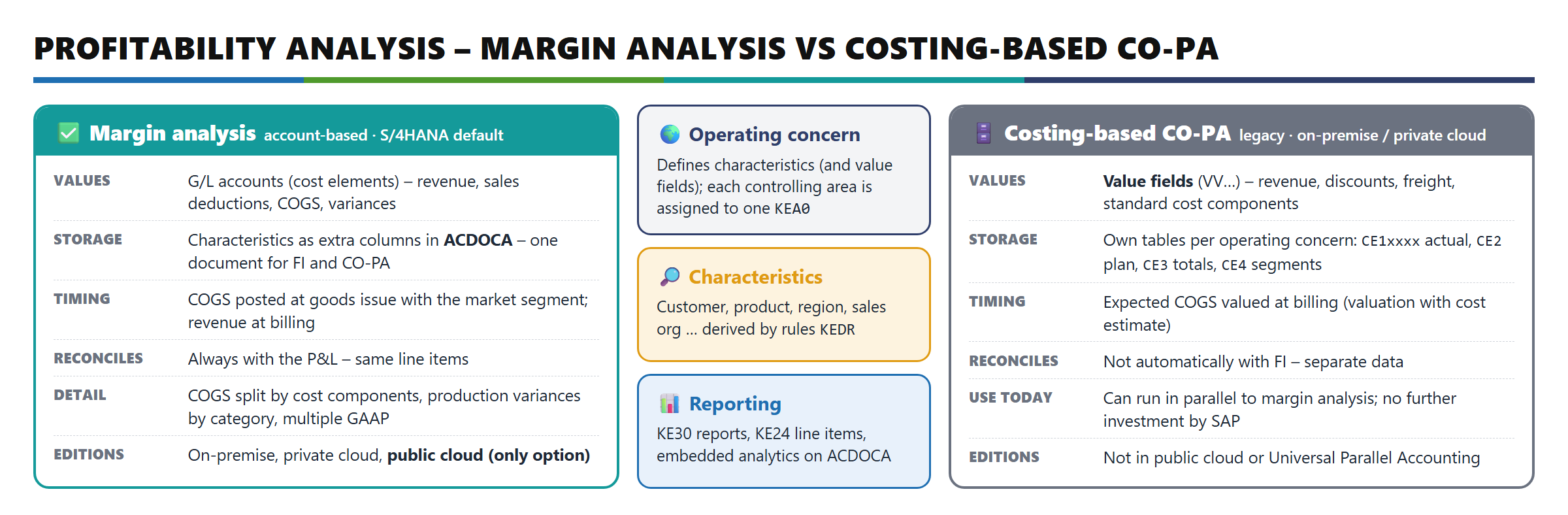
Profitability analysis (CO-PA) reports the contribution margin per market segment – any combination of characteristics such as customer, product, product group, region, sales organization, distribution channel. The operating concern (KEA0) defines these characteristics; each controlling area is assigned to one operating concern.
9.1 Margin analysis (account-based) – the S/4HANA default
- Values are G/L accounts. The characteristics of the market segment are stored as extra columns in ACDOCA (standard fields plus customer fields
WW…added when the operating concern is generated), so FI and CO-PA are one document and always reconcile. - S/4HANA additions: cost of goods sold posted at goods issue with the market segment, COGS split into cost components, production variances by variance category, assessment and settlement to the market segment – all in the Universal Journal.
- Characteristic derivation (KEDR) fills characteristics from rules and tables, e.g. region from customer, product group from material. Assessment of cost center costs to CO-PA: KEU5 (or universal allocation).
- Reports: KE30 profitability reports, KE24 line items, embedded analytics queries on ACDOCA (page 05).
9.2 Costing-based CO-PA – legacy
- Values are stored in value fields (revenue, discounts, freight, standard cost components …) in tables generated per operating concern: CE1xxxx actual line items, CE2xxxx plan line items, CE3xxxx segment level (totals), CE4xxxx segment table (characteristic combinations).
- Advantages that kept it alive: expected COGS valued at billing, value field mapping from SD conditions (KE4I), flexible top-down distribution (KE28). Disadvantage: separate data that must be reconciled with FI.
- Still available on-premise and can run in parallel to margin analysis, but SAP no longer develops it; it is not available in S/4HANA Cloud, public edition, or with Universal Parallel Accounting. Greenfield recommendation: margin analysis only.
Part 10 – Key tables, t-codes and released CDS views
Table | Content | S/4HANA |
|---|---|---|
TKA01 / TKA02 | Controlling area / company code assignment | Unchanged |
SKA1 / SKB1 | G/L account (chart of accounts / company code) | Master of cost elements |
CSKA / CSKB | Cost element (chart of accounts / controlling area) | Still filled (category KATYP), maintained only through FS00 |
CSKS / CSKT | Cost center master / texts | Unchanged |
CSLA | Activity types | Unchanged |
AUFK | Order master (internal, production, maintenance orders) | Unchanged |
COBRA / COBRB | Settlement rule header / distribution rules | Unchanged |
CEPC / CEPCT | Profit center master / texts | Unchanged |
KEKO / KEPH / CKIS | Cost estimate header / cost components / itemization | Unchanged |
CKMLHD, MLDOC | Material ledger header, ML documents | MLDOC is S/4HANA |
COEP / COSP / COSS | CO line items / totals primary / totals secondary | Compatibility views; actuals come from ACDOCA – new code reads ACDOCA |
GLPCA / GLPCT | EC-PCA line items / totals | Legacy – profit center in ACDOCA |
CE1xxxx – CE4xxxx | Costing-based CO-PA | Legacy, on-premise / Private Edition only |
ACDOCA / ACDOCP | Universal Journal actuals / plan | S/4HANA |
Released CDS view | Content |
|---|---|
I_CostCenter | Cost center master data (time-dependent) |
I_ProfitCenter | Profit center master data |
I_InternalOrder | Internal order master data and status |
I_GLAccountInChartOfAccounts | G/L account = cost element |
I_JournalEntryItem | Universal Journal line items with all CO account assignments |
I_GLAccountLineItem | G/L line items for reporting |
Area | Key t-codes |
|---|---|
Cost elements | FS00 (KA01 – KA06 replaced), KAH1 groups, OKB9 default account assignment |
Cost centers | KS01 – KS03, OKEON, KSH1, KP06, KSB1, S_ALR_87013611, KB11N |
Activities / allocations | KL01, KP26, KB21N, KK01, KB31N, KSU5, KSV5, KSW5, KSII; Manage Allocations |
Internal orders | KO01 – KO03, KOT2_OPA, KO22, KO88, KO8G, KOB1, KOK5 |
Profit centers | KE51 – KE53, KCH1; Manage Profit Centers |
Product costing | CK11N, CK13N, CK24, CK40N, OKKN, OKTZ, KKF6N |
Period end (production) | CO43, KKAO, KKS1, CO88, CKMLCP, CKM3 |
CO-PA | KEA0, KEA5, KEA6, KEDR, KE30, KE24, KEU5, KE28 |
Part 11 – Interview questions
Q1. What happened to cost elements in S/4HANA?
They became G/L accounts. Primary and secondary cost elements are created in FS00 with G/L account type 'primary costs or revenue' or 'secondary costs' and a cost element category. KA01 – KA06 are replaced; FS00 still fills CSKA / CSKB in the background. Secondary costs are therefore visible in ACDOCA.
Q2. What is the difference between primary and secondary costs?
Primary costs come from outside CO with an FI posting (invoices, goods issues, payroll, depreciation). Secondary costs arise inside CO when costs are moved – assessment, activity allocation, overhead, internal settlement – and net to zero for the company.
Q3. Assessment vs distribution – when do you use which?
Distribution moves primary costs and keeps the original cost elements on the receiver – good when the receiver must see the cost type. Assessment moves primary and secondary costs under one assessment cost element (category 42) – simpler, less data, but the detail is lost.
Q4. How does an internal order get rid of its costs?
Through settlement (KO88 / KO8G) according to its settlement rule (COBRA / COBRB): receivers such as cost centers, G/L accounts, assets, WBS elements or profitability segments, with percentages or amounts. Settlement profile and allocation structure control receivers and cost elements.
Q5. What is a statistical internal order?
An order that receives costs only for information, in parallel to the real cost object (usually a cost center). It is never settled and cannot be the only account assignment of a posting.
Q6. How is profit center accounting different in S/4HANA?
It is integrated into the G/L: PRCTR is a field of every ACDOCA line and document splitting gives a balance sheet per profit center and segment. The separate EC-PCA ledger (GLPCA / GLPCT) and its periodic transfers are gone.
Q7. Explain the standard cost estimate process.
With a costing variant (e.g. PPC1) the system explodes BOM and routing, values materials and activities, adds overhead and builds the cost component split (CK11N single, CK40N mass). The estimate is marked and released with CK24 and becomes the standard price in MBEW. Data in KEKO, KEPH, CKIS.
Q8. What happens at period end on a production order?
Overhead (CO43), WIP for orders not yet delivered (KKAO), variances for delivered or TECO orders (KKS1: actual minus target costs by variance category), then settlement (CO88) – WIP to the balance sheet, variances to price differences and margin analysis. In public cloud, event-based production accounting does this in real time.
Q9. Is the material ledger mandatory? What about actual costing?
In ECC the material ledger was optional; in S/4HANA it is mandatory for inventory valuation (multi-currency, price differences, MLDOC documents). Actual costing (CKMLCP, periodic unit price) remains optional and is activated only when actual product costs are needed.
Q10. Margin analysis or costing-based CO-PA for a greenfield project?
Margin analysis: it is account-based, stored in ACDOCA, reconciles with the P&L, offers COGS split and variance detail at the market segment, and is the only option in public cloud and Universal Parallel Accounting. Costing-based CO-PA (value fields, CE1xxxx tables) is legacy and only for on-premise / Private Edition systems that cannot yet live without it.
Q11. A developer must report cost center actuals in S/4HANA. Which source?
ACDOCA (or the released view I_JournalEntryItem / I_GLAccountLineItem in clean core) filtered by ledger, controlling area, cost center, fiscal year and period; plan data from ACDOCP. COSP / COSS still answer SELECTs as compatibility views, but they are slower and not for new code.
Q12. Architect view: which CO design decisions must be taken early in a greenfield project?
Number of controlling areas (usually one; all its company codes share the operational chart of accounts and fiscal year variant), profit center and segment design with document splitting, cost center standard hierarchy, margin analysis characteristics in the operating concern, use of actual costing, event-based vs period-end production accounting, and whether planning moves to SAP Analytics Cloud.
🏠 Start Here · ◀ 03 · AP, AR & Assets · 05 · Integration & Close ▶ · Sections: CORE ABAP | OOPS ABAP | ABAP on HANA | Clean Core | RAP | ABAP Points | SAP Fiori | SAPUI5 | Mobile Development (MDK) | BTP Foundations | BTP Development | CAP | SAP Build | ABAP on BTP | Integration Suite | SAP Business AI | SAP BASIS | Security | SAP SDLC
Functional: FICO ABAP | TRM ABAP | VIM | SAP BIS | SD ABAP | MM ABAP | PP ABAP | QM ABAP | PM ABAP | PS ABAP | EWM | TM ABAP | GTM ABAP | EHS ABAP | HR ABAP | BW | SAP Datasphere | SAP Business Data Cloud | SAP MDG | SAP Analytics Cloud | SAP Ariba | SAP CX | SAP IBP