What an ABAP developer builds in QM: logic in customer exits and BAdIs at lot creation, results recording, usage decision and notification save; programs and interfaces that read lots and record results with BAPIs; ALE / QM-IDI interfaces to labs; APIs and CDS views in S/4HANA; and the typical QM RICEFW objects (certificates, LIMS interface, mass usage decision). The general techniques are on CORE ABAP › 10 Enhancements, 07 Interfaces and 11 Forms; the business background is on pages 01 – 04 of this section.
Part 1 – Where to enhance QM: choosing the technique
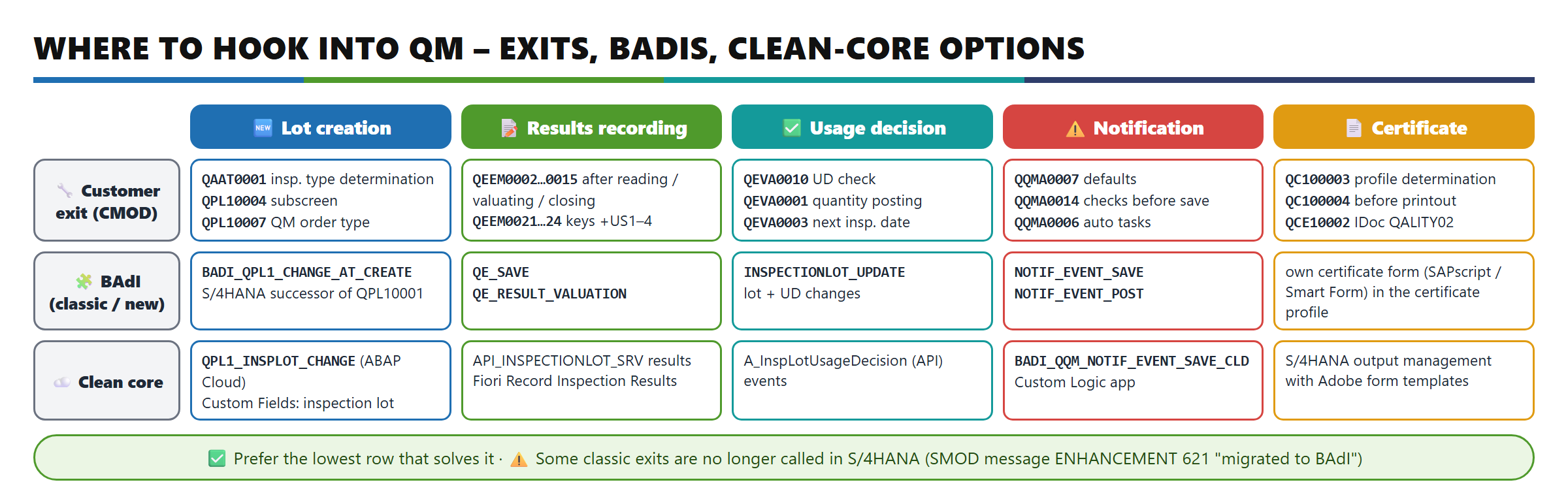
Requirement | Technique | Where |
|---|---|---|
Change fields of a new inspection lot (e.g. text, sample, QM order type) | BAdI BADI_QPL1_CHANGE_AT_CREATE (S/4HANA; was exit QPL10001), exit QPL10007 | Parts 2, 3 |
Different inspection type than the standard determination | Exit QAAT0001 | Part 2 |
Check or derive values while results are recorded | Exits QEEM0002 – QEEM0015, BAdI QE_RESULT_VALUATION, QE_SAVE | Parts 2, 3 |
Block or check a usage decision, own stock quantities | Exits QEVA0010, QEVA0001, BAdI INSPECTIONLOT_UPDATE | Parts 2, 3 |
Defaults and checks on quality notifications | Exits QQMA0007 / QQMA0014, BAdI NOTIF_EVENT_SAVE; cloud: BADI_QQM_NOTIF_EVENT_SAVE_CLD | Parts 2, 3 |
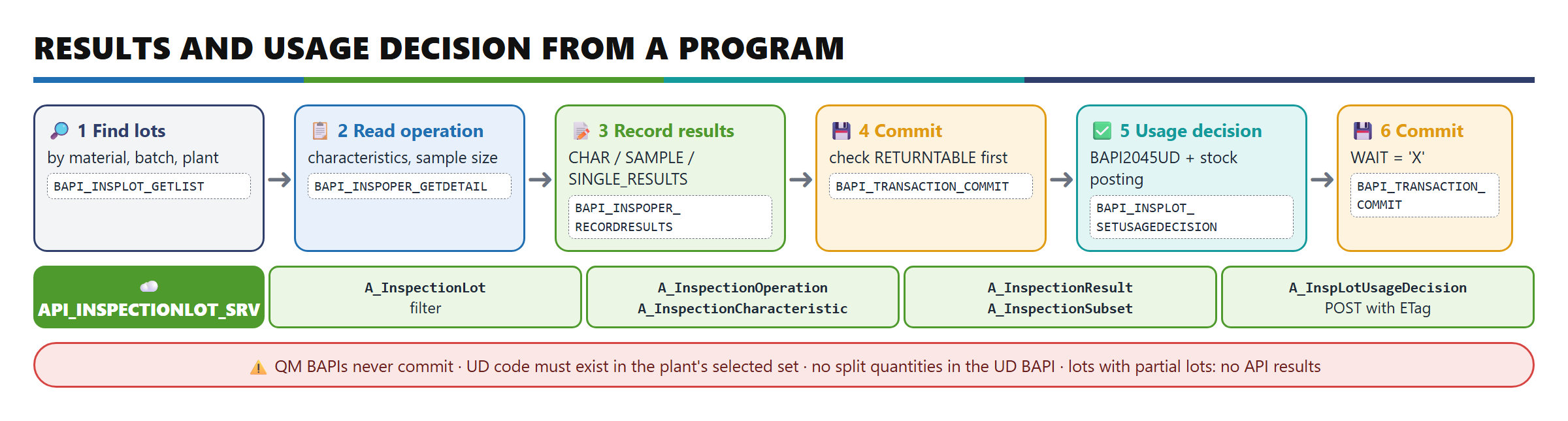
Record results / make the UD from a program or interface | BAPIs or API_INSPECTIONLOT_SRV | Parts 4, 6 |
Lab system (LIMS) interface | QM-IDI RFCs + QIRF exits, or the API via Cloud Integration | Part 5, page 04 |
Certificate of analysis layout | Certificate form + exits QC100003 / QC100004 | Part 8 |
S/4HANA clean core | Custom fields, released BAdIs, released CDS views and APIs | Part 7 |
Part 2 – Customer exits (SMOD / CMOD)
QM has a large set of customer exits (function modules EXIT_SAPLQ…). Find them in SMOD with enhancement Q* + F4, read the documentation there, and activate them in a CMOD project. Also useful: a breakpoint on the statement CALL CUSTOMER-FUNCTION while running QA11 or QE51N. How exits work: CORE ABAP › 10 Enhancements.
Area | Exit | Purpose |
|---|---|---|
Lot creation | QPL10001 | Edit the lot work area at creation – in S/4HANA migrated to BAdI BADI_QPL1_CHANGE_AT_CREATE; the exit FM is no longer called |
QPL10004 / QPL10007 | User subscreen with additional lot data / change the QM order type | |
QAAT0001 / QAAT0002 | Inspection type determination different from variant 01 / control of acceptance lots at goods receipt | |
QPAP0002 | Material–plan assignment and plan selection | |
QDSE0001 – QDSE0003 | Dynamic modification: quality level and inspection stage | |
Results recording | QEEM0002 / 0003 / 0004 / 0006 | Additional functions after reading characteristics / valuating / valuating partial samples / closing characteristics |
QEEM0011 / 0012 / 0015 | Before valuating characteristics / partial samples, after entering single results | |
QEEM0021 – 0024, QEEM0029 / 0030 | Own functions on user keys +US1 – +US4; own subscreens in the characteristic overview / single screen | |
Usage decision | QEVA0001 | Quantity posting for the usage decision |
QEVA0003 | Calculate the next inspection date of the batch | |
QEVA0005 / QEVA0007 | User subscreen with additional UD data / compulsory comment or long text | |
QEVA0008 / QEVA0010 | Customer function key (e.g. reset UD) / usage decision check | |
Notification | QQMA0007 / QQMA0013 | Default values when creating a notification / a task |
QQMA0006 / QQMA0014 | Automatic task determination / checks before saving | |
QQMA0001, QQMA0008 – 0012 | User subscreens: header, item, cause, task, activity | |
QQMA0018 / QQMA0019 / QQMA0029 | Deadlines from priority / default partner / change notification type | |
Certificates | QC100001 – QC100008, QCE10002 | Batches used, profile determination, before form printout, after reading delivery data; IDoc QALITY02 |
Master data | QPMK0001, QSMT0001, QPAA0006 | Change MIC / method data at creation; extra consistency checks for inspection characteristics in plans |
Costs, vendor | QLCO0002, QLIB0002 | Preset appraisal cost confirmation / complaint score for vendor evaluation |
QM-IDI | EXIT_SAPLQIRF_* function exits | Before / after processing for each QIRF RFC module |
- Several classic exits are not called any more in S/4HANA because they were migrated to BAdIs (SMOD shows message ENHANCEMENT 621 'already migrated to BAdI definition …'). Check this before planning a conversion – custom code in a dead exit fails silently.
Part 3 – BAdIs: classic, S/4HANA and cloud
BAdI | Area | Use |
|---|---|---|
INSPECTIONLOT_UPDATE | Lot and UD | Create and change inspection lot and usage decision – e.g. fill own fields, trigger follow-up logic after the UD |
QE_SAVE | Results recording | Logic when results are saved (checks, own tables) |
QE_RESULT_VALUATION | Results recording | Own valuation of single values (accept / reject) |
NOTIF_EVENT_SAVE | Notifications (QM / PM) | Change the notification when saving (fields not covered by BAPI_QUALNOT_CREATE) |
NOTIF_EVENT_POST | Notifications | Read the notification data at update – e.g. send it to another system |
BADI_QPL1_CHANGE_AT_CREATE | Lot creation – S/4HANA | Successor of exit QPL10001 |
BADI_QQM_NOTIF_EVENT_SAVE_CLD | Quality notification – cloud | Released BAdI for Custom Logic when a quality notification is saved; filter on notification type (e.g. Q2) |
BADI_QPL1_CHANGE_AT_CREATE4CLD | Lot creation – ABAP Cloud | Change the lot header during lot creation (used in S/4HANA Cloud developer extensibility) |
- Find BAdIs with SE18 / SE84 by package or application component QM, or a breakpoint on
CL_EXITHANDLER=>GET_INSTANCE(classic) /GET BADI(new); implement in SE19. - Released vs. not released: in ABAP Cloud you may only use BAdIs and APIs with a release contract (check the API state in ADT). Lot-creation function modules such as QPL1_INSPECTION_LOT_CREATE or the QPLEXT_… modules are not released for custom code.
Part 4 – BAPIs: reading lots, recording results, usage decision
BAPI / FM | Purpose |
|---|---|
BAPI_INSPLOT_GETLIST | Inspection lots by material, batch, plant, dates … (RETURN message Q5001 'no entries' when nothing is found) |
BAPI_INSPLOT_GETDETAIL | Lot detail data, status and usage decision |
BAPI_INSPOPER_GETDETAIL | One operation of a lot with its characteristics (optionally single results) – call it before recording to know the characteristic numbers |
BAPI_INSPOPER_RECORDRESULTS | Record results for one operation: INSPLOT, INSPOPER, INSPPOINTDATA (inspection points), CHAR_RESULTS (BAPI2045D2), SAMPLE_RESULTS (BAPI2045D3), SINGLE_RESULTS (BAPI2045D4), RETURNTABLE |
BAPI_INSPLOT_SETUSAGEDECISION | Usage decision: NUMBER, UD_DATA (BAPI2045UD); returns RETURN, STOCK_DATA; tables SYSTEM_STATUS, USER_STATUS |
BAPI_QUALNOT_CREATE → BAPI_QUALNOT_SAVE | Create a quality notification (header, items, causes, tasks); SAVE before the commit |
BAPI_QUALNOT_GETDETAIL | Read a quality notification |
BAPI_TRANSACTION_COMMIT / _ROLLBACK | End the LUW – the QM BAPIs never commit themselves |
BAPI_INSPCHAR_SETRESULT | Obsolete – replaced by BAPI_INSPOPER_RECORDRESULTS |
4.1 Example: usage decision with stock posting
- The UD code must exist in the selected set of the plant (customizing); a wrong combination returns 'Selected set code does not exist, or data entered is incomplete'.
UD_STOCK_POSTING = 'X'posts the stock as the UD code proposes (e.g. all to unrestricted). The BAPI has no field for split quantities – for 'part unrestricted, part scrap' use QA11 or the stock posting of the Fiori app.- Long-term characteristics:
UD_FORCE_COMPLETIONdoes not close a lot that still has open long-term characteristics.
|
4.2 Recording results – what to know
- Results are recorded per operation: first BAPI_INSPOPER_GETDETAIL to get the characteristics (INSPCHAR numbers, quantitative / qualitative, required sample size), then one RECORDRESULTS call per operation, then commit.
- CHAR_RESULTS holds the summarized result and valuation per characteristic (closed indicator, evaluation A / R, mean value or code); SINGLE_RESULTS holds individual values when the characteristic requires single-result recording. Mixing them up is the most common error.
- For lots with inspection points fill INSPPOINTDATA (the point identification as defined in the routing header); errors such as 'evaluation of the sample not possible' appear when only some characteristics of a sample are valuated.
- Check RETURNTABLE (BAPIRET2) for E / A messages before committing.
Part 5 – IDocs, ALE and QM-IDI
Interface | Objects | Developer task |
|---|---|---|
ALE message types MATQM, QPMK, QSMT, QPGR | Inspection setup, MICs, methods, code groups – BAPI-based, inbound FM BAPI_IDOC_INPUT1 | Distribution model BD64, filters; exits QPMK0010 / QPMK0020, QSMT0010 / QSMT0020, QPGR0020 for extension parameters |
IDoc QALITY02 | Electronic quality certificate | Fill extra segments in exit QCE10002 |
QM-IDI (function group QIRF) | Worklist, specifications, results, usage decision to / from a LIMS | RFC user and authorizations, mapping in EXIT_SAPLQIRF_* function exits (page 04 Part 8) |
QM-STI | Statistical data to CAQ software | Exits QIST0002 … QIST0011 |
- Inspection plans themselves are usually loaded (migration) or created by API rather than distributed by ALE.
- WE19 / BD87 for testing and reprocessing, partner profiles WE20: CORE ABAP › 07 Interfaces.
Part 6 – OData APIs and CDS views
6.1 Released APIs (SAP Business Accelerator Hub)
API (technical name) | Content | Communication scenario |
|---|---|---|
API_INSPECTIONLOT_SRV | A_InspectionLot, A_InspectionOperation, A_InspectionCharacteristic, A_InspectionResult, A_InspectionSubset, A_InspLotUsageDecision – read, record results, make the UD | SAP_COM_0318 Quality Inspection Process Integration |
API_INSPECTIONPLAN_SRV | A_InspectionPlan with operations, characteristics and material assignments | Inspection master data |
API_MASTERINSPCHARACTERISTIC_SRV | Master inspection characteristics (A_InspectionSpecification) | SAP_COM_0110 Inspection Master Data Integration |
Inspection Method API | Inspection methods | Inspection master data |
API_QUALITYINFORECORD_SRV | Quality info record in procurement (and first article inspection) | SAP_COM_0358 Quality Info Record Integration |
API_QUALITYNOTIFICATION (on-premise) / Quality Notification OData V4 (CE_QUALITYNOTIFICATION_0001) | Quality notifications with items, causes, tasks | – |
- Optimistic locking: the lot and the UD entity carry ChangedDateTime; sending an outdated value returns 'a newer version of inspection lot exists'; a request without If-Match / ETag is refused with HTTP 428 (precondition required).
- Lot creation through an API is limited to manual lots (origin 89) where the release offers it; all other lots are created by their business event (page 03 Part 1).
- Lots with partial lots cannot receive results through the API; inspection points need the point key in A_InspectionSubset.
- OData basics: CORE ABAP › 08 OData; integration via Cloud Integration: Integration Suite › 02.
6.2 CDS views
The VDM for QM starts with I_InspectionLot (inspection lot, used e.g. as data source for custom CDS views and the Fiori apps) and further released views for operations, characteristics, results and quality notifications. Check names and the release state (C1 / released for ABAP Cloud) in ADT or the View Browser app for your release before building on a view. Field names follow the API: InspectionLot, Material, Plant, InspectionLotOrigin, InspectionLotType, Supplier …
|
- QM tables (QALS, QAVE, QAMV, QAMR, QASE, QMEL …) and their CDS views per object: page 02.
Part 7 – Key-user and clean-core extensibility
- Custom Fields app: add fields to QM business contexts such as the inspection lot or the quality notification; they appear in the Fiori apps and APIs (note: custom fields of the inspection lot context are display-only in the QE51N worklist).
- Custom Logic app: implement released BAdIs such as BADI_QQM_NOTIF_EVENT_SAVE_CLD in the browser.
- Developer extensibility (ABAP Cloud): released BAdIs in ADT, own RAP apps on released CDS views (e.g. a lab worklist), released APIs for writes – RAP section, Clean Core › 01 Clean Core.
- Side-by-side on SAP BTP: LIMS / MES integration, mobile result capture or AI-based defect classification as BTP apps calling API_INSPECTIONLOT_SRV and reacting to events.
- Classic (on-premise / private cloud only): CMOD exits, classic BAdIs, Z reports on QALS etc. – allowed but not upgrade-stable; choose the highest level that solves the requirement.
Part 8 – Typical QM developments (RICEFW)
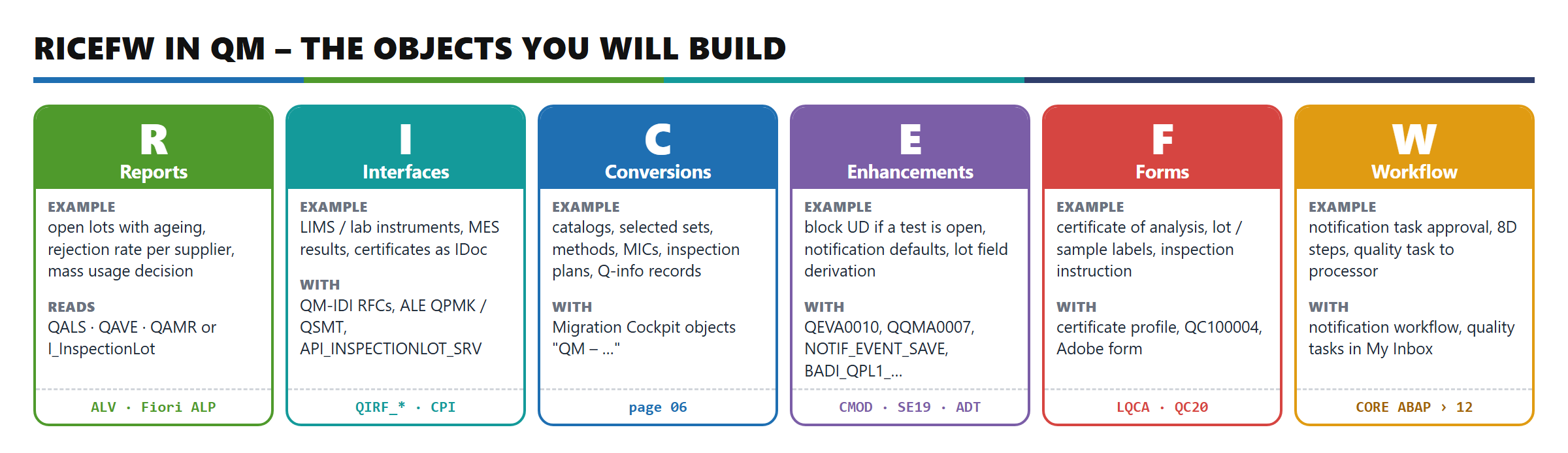
Type | Example | Objects used |
|---|---|---|
R Report | Open lots with ageing, rejection rate per supplier, results per batch | QALS, QAVE, QAMR / I_InspectionLot; ALV or Fiori analytical list page |
R Mass usage decision | Accept all lots without defects of a plant / supplier in one run | BAPI_INSPLOT_GETLIST + BAPI_INSPLOT_SETUSAGEDECISION with commit per lot; standard alternative QA10 |
I LIMS / instrument interface | Lab system receives lots, sends results | QM-IDI or API_INSPECTIONLOT_SRV via Cloud Integration |
C Data migration | MICs, methods, catalogs, inspection plans, Q-info records | Migration cockpit objects (page 06) |
E Enhancement | Block the UD if a long-term test is open; default notification fields | QEVA0010, QQMA0007 / NOTIF_EVENT_SAVE |
F Form | Certificate of analysis, inspection lot label, sample label | Certificate profile + form; QC100004; Adobe form in output management |
W Workflow | Approval of a quality notification task, 8D steps | Notification workflow, quality tasks in My Inbox (CORE ABAP › 12 Workflow) |
Mass usage decision: commit after each lot (stock postings are per lot), collect the RETURN messages into an ALV log, and run it as a background job with a variant – or first check whether the standard automatic UD (QA10, report RQEVAI30, job planning per plant) already covers it.
Part 9 – Interview questions
Q1. Which QM user exits have you used?
QEVA0010 to check the usage decision, QEVA0001 for UD quantity postings, QQMA0007 / QQMA0014 for notification defaults and checks before saving, QEEM exits for additional functions in results recording, QC100004 before the certificate is printed.
Q2. Your custom code in QPL10001 stopped working after the S/4HANA conversion. Why?
QPL10001 was migrated to the BAdI BADI_QPL1_CHANGE_AT_CREATE; the exit function module is no longer called. Move the logic into an implementation of the BAdI.
Q3. Which BAdIs exist for results recording and the usage decision?
QE_SAVE (saving results), QE_RESULT_VALUATION (valuation of single values) and INSPECTIONLOT_UPDATE (create / change lot and usage decision).
Q4. How do you record results from a program?
BAPI_INSPOPER_GETDETAIL to read the characteristics of the operation, BAPI_INSPOPER_RECORDRESULTS with CHAR_RESULTS (summary and valuation), SAMPLE_RESULTS or SINGLE_RESULTS, check RETURNTABLE, then BAPI_TRANSACTION_COMMIT.
Q5. What do you pass to BAPI_INSPLOT_SETUSAGEDECISION?
The lot number in NUMBER and BAPI2045UD in UD_DATA with selected set, plant, code group and code, optionally UD_STOCK_POSTING. Check RETURN and commit. Split quantities cannot be passed.
Q6. How do you create a quality notification from an interface?
BAPI_QUALNOT_CREATE (header, items, causes, tasks), BAPI_QUALNOT_SAVE, then commit. Fields the BAPI does not cover can be set in BAdI NOTIF_EVENT_SAVE. In S/4HANA the quality notification API is the alternative.
Q7. How is QM master data distributed between systems?
BAPI-based ALE with message types QPMK (MICs), QSMT (methods), QPGR (code groups) and MATQM (inspection setup), modelled in BD64; exits for extension parameters.
Q8. Which API would you use for a modern LIMS integration?
API_INSPECTIONLOT_SRV (communication scenario SAP_COM_0318): read lots and characteristics, POST results, POST the usage decision to A_InspLotUsageDecision – via SAP Cloud Integration, with ChangedDateTime / ETag handling.
Q9. Which QM CDS views do you know?
I_InspectionLot as the main view of the VDM, plus released views for operations, characteristics, results and notifications – always checked for release state in ADT / View Browser before use.
Q10. How would you extend QM in a clean-core way?
Custom Fields on the inspection lot / notification context, Custom Logic in released BAdIs (e.g. BADI_QQM_NOTIF_EVENT_SAVE_CLD), released CDS views and APIs, RAP for own apps, BTP for side-by-side. CMOD exits and classic BAdIs only on-premise when nothing released exists.
Q11. What is a typical QM form and how is it built?
The certificate of analysis: its content comes from the certificate profile, the layout is a form assigned there / in output management; exits QC100003 and QC100004 adjust profile determination and data before printing.
Q12. How would you build a mass usage decision program?
Select lots (BAPI_INSPLOT_GETLIST or I_InspectionLot), check that results are complete and no defects exist, call BAPI_INSPLOT_SETUSAGEDECISION and commit per lot, write a log. First check the standard automatic UD (QA10 / RQEVAI30).
🏠 Start Here · ◀ 04 · Integration & Reporting · 06 · S/4HANA & Architect ▶ · Sections: CORE ABAP | OOPS ABAP | ABAP on HANA | Clean Core | RAP | ABAP Points | SAP Fiori | SAPUI5 | Mobile Development (MDK) | BTP Foundations | BTP Development | CAP | SAP Build | ABAP on BTP | Integration Suite | SAP Business AI | SAP BASIS | Security | SAP SDLC
Functional: FICO ABAP | TRM ABAP | VIM | SAP BIS | SD ABAP | MM ABAP | PP ABAP | QM ABAP | PM ABAP | PS ABAP | EWM | TM ABAP | GTM ABAP | EHS ABAP | HR ABAP | BW | SAP Datasphere | SAP Business Data Cloud | SAP MDG | SAP Analytics Cloud | SAP Ariba | SAP CX | SAP IBP